

When Rhythm Matters: Alliteration and Assonance in Prose
From the basic definitions of alliteration and assonance to complex examples that combine these techniques to create passages where the prose itself establishes mood.

Rhythm is not just pertinent to poetry. Prose benefits from it just as much—perhaps even more.
Unfortunately, rhythm-conscious prose is often mistaken for purple prose, as though a deliberate cadence could only come at the expense of clarity or substance. In reality, rhythm is another storytelling tool. It can shape mood, reinforce atmosphere, and even reveal the narrator's state of mind in a limited point of view.
Consider this sentence from Annihilation by Jeff Vandermeer:
“Ghost bird, do you love me?” he whispered once in the dark, before he left for his expedition training, even though he was the ghost. “Ghost bird, do you need me?” I loved him, but I didn't need him, and I thought that was the way it was supposed to be.
Or this excerpt from Embassytown by China Miéville:
You’ll be able to say how the city is a pit and a hill and a standard and an animal that hunts and a vessel on the sea and the sea and how we are fish in it, not like the man who swims weekly with fish but the fish with which he swims, the water, the pool. I love you, you light me, warm me, you are suns.
Regardless of their length or style, those sentences have something in common: a quality that carries the reader forward, reinforcing the meaning of the text instead of distracting from it. That quality is rhythm—and it is not exclusive to literary fiction. Every genre can benefit from it.
Yet a flowing tempo is easier to demand than to achieve. It does not emerge from applying a single technique throughout a piece, but from combining several devices with intention.
Therefore, in this essay, we’ll look at two of the most versatile tools for shaping cadence: alliteration and assonance. We’ll begin with their traditional definitions and a few familiar examples before moving on to two unconventional examples—which combine these techniques with the perceived emotion of sounds to transform the prose’s cadence without ever drawing attention to themselves.
What is alliteration and assonance?
Both are literary devices, and both focus on the intentional repetition of sounds.
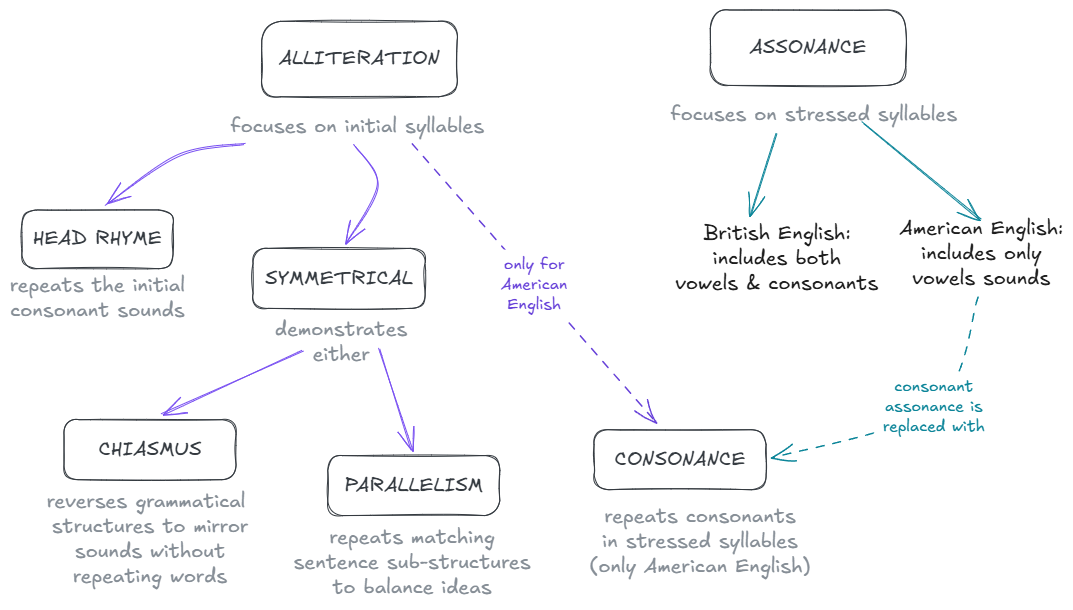
Alliteration focuses on repeated consonant sounds.
Where and how that repetition exists creates different types of alliterations. Let us review the three fundamental types:
The head rhyme (or initial rhyme) type.
This is the one we commonly encounter when searching for a definition of alliteration: “the repetition of usually initial consonant sounds in two or more neighboring words or syllables”1 . Consider this example from The Road by Cormac McCarthy:
[…] he set the bag down and sat bent over with his arms crossed at his chest and coughed till he could cough no more.
In this case, McCarthy was repeating the sound /c/—the voiceless palatal plosive according to the IPA2. It is possible to argue that the choice of consonant for this alliteration is deliberate: as a voiceless sound, the /c/ creates a sound not too dissimilar to a cough itself—especially here: “and coughed till he could cough.” That resonance between the sound and what the sentence is describing makes the alliteration even more meaningful.
While the concept of alliteration does not require combining the meaning of the text with the sound’s ‘style’, doing so can yield some incredibly effective sentences.
Another type is symmetrical alliteration…
…which appears either as a chiasmus or as a parallelism; both of these are also rhetorical devices.
A chiasmus is the reversal of grammatical structures in successive phrases or clauses without repetition of words. Think of this as a mirror—placed in the middle of a sentence—that only reflects the initial sounds of the words. A common example for this comes from a poem3:
By day the frolic, and the dance by night.
Notice the order of the sounds: b-d-th, and after the comma: th-d-b. That’s a chiasmus.
However, these are commonly confused with the other style of symmetrical alliteration—the one focused on parallelism. This is another rhetorical device that relies on “the use of matching sentence structure, phrases, or longer parts so as to balance ideas of equal importance”4. You have probably encountered it in famous speeches.
Consider the case of Winston Churchill’s famous speech regarding the Normandy landings of WW25:
We shall fight on the beaches, we shall fight on the landing grounds, we shall fight in the fields and in the streets, we shall fight in the hills.
Here, the three-word structure “we shall fight” creates a rolling cadence that becomes more unavoidable the more it is repeated. However, if you look at the sounds there is something even more interesting here:
“we” is a voiced sound, with the /w/ being a semi-vowel sound, and thus smooth and resonant by nature. And yet,
“fight”—which is the last word of the parallelism—transcribes to IPA as /faɪt/, and ends with the sound /t/: a voiceless plosive also referred to as a “stop.”
Combining those two sounds yields a very interesting cadence that remarks the word “fight”—quite appropriate in the context of this speech. Here, the combination of the mechanics of sound (what our mouths and tongues do to generate the sound) plus the meaning of the words enhance the ‘feeling’ of the text as a whole, creating a very specific mood: in this case, that fighting was unavoidable, everything ‘ended’ in the fight.
Parallelism can also be used, to great effect in fiction.
In particular, the first example I used to open the essay—from Annihilation by Jeff Vandermeer—is actually a symmetrical alliteration using parallelism:
“Ghost bird, do you love me?” he whispered once in the dark, before he left for his expedition training, even though he was the ghost. “Ghost bird, do you need me?” I loved him, but I didn’t need him, and I thought that was the way it was supposed to be.
Look at the structure: “Ghost bird, do you X me?” where the X is first ‘love’ then ‘need’. It is the same principle as in the speech, but subtler because it is only used twice, in dialogue, and the sentence that comes after has a rhythm of its own—which complements the dialogue’s.
Finally, there is poetic alliteration.
…which, in reality, includes several ‘exceptions. In particular:
The repetition of syllable-initial vowels functions as alliterations, even though it deviates from its original definition.
Alliteration includes both word-initial consonants/vowels, but also stressed sounds. For example: “…dragging the lazy languid line along” counts the -long part of ‘along’ because of the stress. In this sense, non-stressed syllables will not alliterate.
Assonance, however, is a slightly more relaxed literary device.
It is the “relatively close juxtaposition of similar sounds, especially of vowels”6 that occur close together, either in terms of their vowel or consonant phonemes7.
For example, this from Blood Meridian—by Cormac McCarthy—features two assonances back-to-back:
[…] out of a fevered dream with the skins of animals and silk finery and pieces of […]
Because ‘fevered’ and ‘dream’ both use the long /iː/ sound, while ‘skins’, ‘silk’ and ‘finery’ use the short /ɪ/ sound. This could be considered as two overlapping assonance chains.
Both techniques have one characteristic in common
Though they are visible through the spelling of the words on the page, they both focus on the sounds used in those words. Therefore, words that are spelled slightly differently but read using the same sounds (as defined by IPA) will thus count towards an alliteration or an assonance. For example:
The City’s voice itself is soft like Solitude’s
…includes the ‘c’ of ‘city’ in the alliteration because the sound is similar to the ‘s’.
This is the case of the Blood Meridian example we saw above, where ‘e’ (from ‘fevered’) and ‘ea’ (from ‘dream’) yielded the same sound and, therefore, created an assonance.
With this, let us analyse an unconventional example.
I have two examples to show you, both from renown authors. For each case, I will introduce the excerpt, then break it down segment by segment to present the different techniques applied on each. We will analyse the repeated sounds, the choice of words, and how they combine to add meaning to the rhythm of the prose.
