

Book Review: A Canticle for Leibowitz by Walter M. Miller Jr
A Canticle for Leibowitz is a devastating post-apocalyptic novel that remains current because of its central theme: humanity’s own nature. Click for the full book review.

A Canticle for Leibowitz is a devastating post-apocalyptic novel that remains current because of its central theme: humanity’s own nature. It covers our insatiable need for war and conflict, how prone we are to bury the past instead of learning from it, and how easily we turn history into myth.
It is often presented as a book about religion and—to put it in modern terms—perhaps incensepunk. I, however, wouldn’t go that far. Miller leveraged satirical elements at many points (though I’d be hesitant to call this only a satire) to critique the Catholic Church, as well as our tendency to succumb to dogma without any attempt to question the truth beneath it. If anything, it is more social science fiction than anything else—and not precisely kind in its portrayal.
But I’m getting ahead of myself.
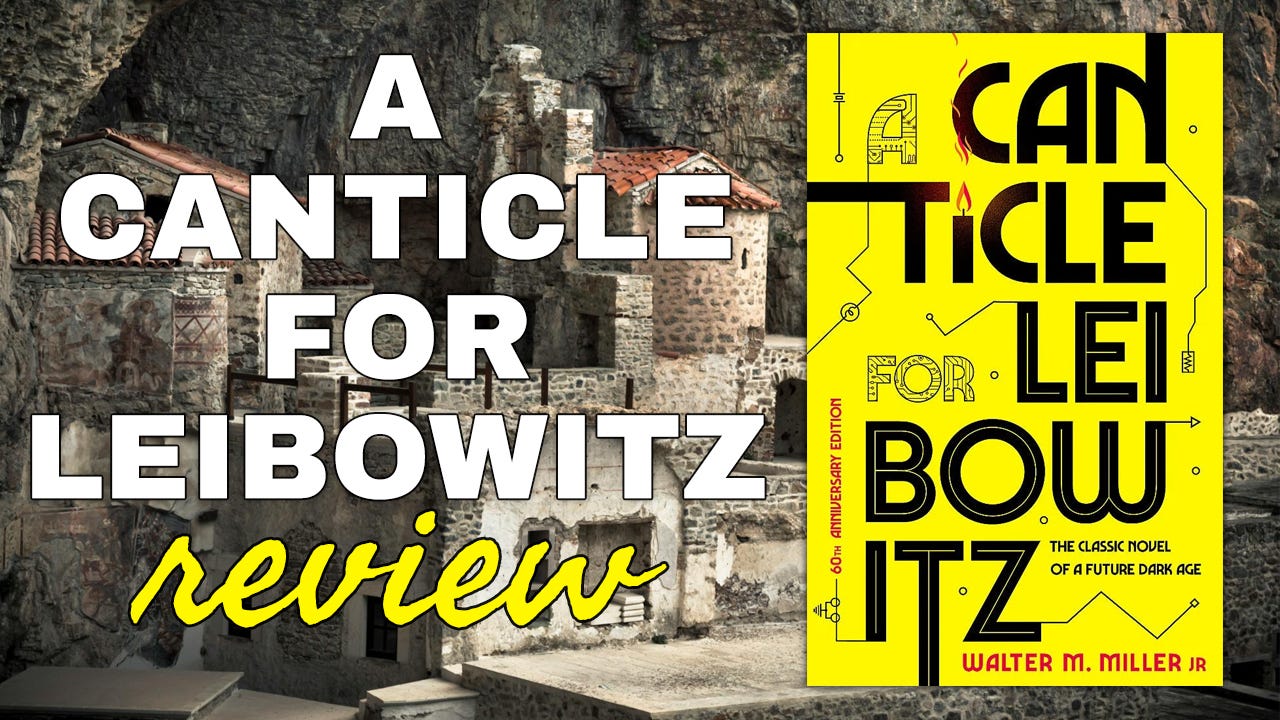
The novel is divided into three sections, each titled in Latin: Fiat Homo (namely, “let it be human” / “let there be men”), Fiat Lux (”let there be light”), and Fiat Voluntas Tua (”let it be your will”). The first section takes place approximately 600 years after a nuclear holocaust, likely to have occurred somewhere around the 1970-80s. The following two sections are set 600 years apart from each other.
The first section, Fiat Homo, begins in the post-apocalyptic dark ages.
Much of what occurred during that cataclysm has been lost to history, surviving only through myths and legends. The reason for this is that, after the nations destroyed one another, the surviving population adopted a strikingly anti-intellectual stance. Rather than confronting their own indirect responsibility—whether through electing the politicians who led them to ruin, or remaining politically disengaged—they concluded that knowledge itself (physics, chemistry, computer science, etc.) had been the root cause of humanity’s suffering.
Thus began the Age of Simplification.
During this period, politicians, researchers, educators, and eventually anyone who could read or write—including school teachers—were systematically hunted down and killed. In an effort to survive, many sought refuge within the Church and its monasteries, taking holy orders to escape persecution.
This was the case for Leibowitz, a scientist. The novel reveals little about him directly, though it is strongly implied that he was a Jewish engineer who played a role in developing the bomb responsible for the cataclysm, drawing an intentional parallel with Oppenheimer. Following the death of his wife, he sought sanctuary within the Church. Eventually, he returned to the desert—somewhere near present-day Denver—alongside several companions to recover and conceal books. “Until humanity is ready again,” was their motto.
By the time of the Fiat Homo section, the Albertian Order founded by Leibowitz possesses its own abbey and preserves a collection known as the Memorabilia: texts and records of the “ancients” recovered and hidden by Leibowitz and his followers. Leibowitz himself has since been declared a Beatus.
But here comes the tragedy of the setting: the monks protect the documents and work to preserve them... but they don’t truly understand what the documents mean. As an abbot thinks:
How much of it had been reduced to gibberish, embellished with olive leaves and cherubims, by forty generations of us monastic ignoramuses, children of dark centuries, many entrusted with a message to be memorised and delivered.
This forms one of the novel’s central ideas: that scientific knowledge—whether in the sciences, the humanities, or any other discipline—depends upon both contextual understanding and collective memory. Ultimately, knowledge cannot exist in isolation; it is shaped by the society in which it develops and by what each generation preserves and passes on to the next.
The monks living after the Age of Simplification possess the surviving books, yet they are incapable of making practical use of them because two essential pieces of the puzzle are missing: the social context in which that knowledge once existed, and the accumulated cultural memory needed to interpret it.
As the abbot explains:
Long ago, during the last age of reason, certain proud thinkers had claimed that valid knowledge was indestructible-that ideas were deathless and truth immortal. But that was true only in the subtlest sense [...] or Man was a culture-bearer as well as a soul-bearer, but his cultures were not immortal and they could die with a race or an age, and then human reflections of meaning and human portrayals of truth receded [...]
Therefore, what little remains known about the world before the Flame Deluge—the nuclear catastrophe itself—has become inseparable from myth and mysticism. Many scenes throughout the novel illustrate this cultural regression. The “Fallout”, for instance, is commonly understood as a “demon”, imagined as a salamander-like creature... while wandering hunter-gatherers roam the wastelands breaking apart ancient “rocks” (concrete) to retrieve the metal rods hidden within them—fragments of long-decayed structures whose original purpose they cannot possibly comprehend.
Likewise, in a society where literacy is rare outside the monasteries—and where being a “simpleton” is regarded almost as a virtueven human suffering is interpreted through superstition. The descendants of those exposed to radiation are viewed as “children of the fallout-demon”, not out of cruelty alone, but out of profound ignorance. The novel makes it abundantly clear that this civilisation lacks even the most elementary scientific concepts, including chemistry, electricity, and thus radiation itself. They witness the consequences of these forces without possessing the intellectual framework required to understand them.
It is here that one of the novel’s most compelling dualities emerges: although the characters interpret the world through myth, the reader is often able to infer the underlying truth through context and common sense. I will give one example below, within spoiler tags.
During Homo Lux, the monks read this ‘historical record’:
[…] that the princes of Earth had hardened their hearts against the Law of the Lord, and of their pride there was no end.
And each of them thought within himself that it was better for all to be destroyed than for the will of other princes to prevail over his. For the mighty of the Earth did contend among themselves for supreme power over all; by stealth, treachery, and deceit they did seek to rule, and of war they feared greatly and did tremble; for the Lord God had suffered the wise men of those times to learn the means by which the world itself might be destroyed, and into their hands was given the sword of the Archangel wherewith Lucifer had been cast down, that men and princes might fear God and humble themselves before the Most High. But they were not humbled.
With some common sense, modern readers can deduct that the “princes” are likely presidents or prime ministers, and their “pride” possibly extreme nationalism or economic aspirations. In that manner, the “sword of the Archangel” could refer to a weapon of mass destruction. This part: “of war they feared greatly and did tremble” could indicate the understanding of the threat of MAD (mutually assured destruction), something often discussed during the post-war era and the Cold War.
Curiously, the monks know that much of these ‘historical’ accounts are not accurate, but they cannot distill the truth out of them. Eventually, this enables a discussion on whether humanity can learn from a past that has been mangled by distorted accounts retold and ‘adjusted’ through the centuries.
Reconstructing lost knowledge becomes the central theme of the second section: Fiat Lux (”let there be light”).
On one level, an inventive monk succeeds in recreating an electrical generator—a dynamo—to power a lightbulb: the novel’s most literal expression of light. He achieves this not through genuine scientific advancement, but by painstakingly inferring forgotten principles from fragmented books, diagrams, and blueprints.
At the same time, a secular scholar arrives at the abbey to study the Memorabilia, hoping to usher in a new age of enlightenment: the metaphorical light of knowledge and reason. In doing so, however, he is eventually forced to confront an uncomfortable truth: he is not an inventor of new knowledge, but merely a rediscoverer of what humanity had already lost.
The exchanges between this scholar and the abbot introduce another discussion: humanity’s persistent tendency to distance itself from its own past. The scholar continually constructs elaborate theories intended to separate the present from the civilisation that preceded the Flame Deluge. At various points he speculates that the Memorabilia may be fraudulent, reduces figures such as Einstein to little more than magi or natural philosophers, and even entertains the notion that the “ancients”—the civilisation responsible for the Fallout—may not have been truly human at all.
The abbot answers this:
Why do you wish to discredit the past, even to dehumanising the last civilisation? So that you need not learn from their mistakes?
The idea of whether humanity can learn from its past is an underlying constant in the story.
It is also the central theme of the last section: Fiat Voluntates Tua (”let it be your will”).
It shows how society changed after 600 more years, and how different—or not—it is, 1800 years after the last nuclear holocaust. I will not spoil this part; I’ll only say this: while the first two parts are satirically funny, the last one is darkly truthful to human nature.
Yet these are not the novel’s only concerns.
Although the narrative is largely centred upon the monks of the Albertian Order of Leibowitz—and many of its rituals deliberately mirror Catholic tradition—the novel is by no means uncritical in its portrayal of religion.
Through irony and satire, Miller frequently draws attention to the institutional absurdities of organised faith, including:
The bureaucratic machinery surrounding sainthood, particularly the exhaustive effort to gather “evidence” of “miracles” in order to canonise Leibowitz;
The treatment of books as sacred relics to be venerated rather than understood;
And the preservation of ritual long after its original meaning has been forgotten. One striking example occurs when the monks activate the dynamo while reciting, in Latin, the passage from Genesis containing the words “let there be light”—the phrase from which the section itself takes its title.
The novel also presents a significant critique of universities and scientific institutions. Though such organisations often portray themselves as neutral or apolitical, Miller criticises how readily they align themselves with political power to preserve influence and funding—even when this cooperation contributes to the development of weapons of mass destruction. In this respect, the book repeatedly hints at a troubling historical pattern: humanity’s greatest discoveries are so often first employed in the service of conflict before later being redirected towards more constructive ends.
At the same time, the novel reflects upon both humanity’s resilience and its capacity for self-destruction. Miller portrays civilisation as stubbornly prone to division, endlessly categorising people into competing groups, ideologies, and identities that produce little beyond hostility and resentment. Governments, likewise, are depicted as willing to accept the devastation of war rather than devote themselves to preventing it in the first place.
To close off…
A Canticle for Leibowitz is far more intellectually and thematically complex than many reviews suggest. Beneath its post-apocalyptic setting lies a remarkably layered discussion on knowledge, memory, religion, war, and humanity’s cyclical tendency towards self-destruction. From its recurring symbolism to its literalised metaphors—including two characters I have deliberately avoided discussing in detail—the novel constantly demands careful attention from the reader.
For that reason, it is also a work that can be easily misunderstood. Miller is rarely interested in offering simple moral answers; instead, he presents a civilisation shaped by contradiction, ignorance, faith, guilt, and historical amnesia, leaving the reader to wrestle with the implications.
Copyright © 2026 Livia J. Elliot. All rights reserved. This publication is licensed for personal reading only. No article, or substantial part of an article, may be reproduced, republished, adapted, translated, compiled into another publication, incorporated into teaching materials or course packs, or used for AI training without prior written permission. Linking to the original articles is encouraged.
I read this book in my 20s, 60ish years ago. I thought it was great but I’ve never met anybody who I could talk it over with. I’m glad you’re reacting to it. I was a fallen away Catholic at the time, but I don’t I didn’t see the critique of religious belief the way you did. I thought it was brilliantly funny in showing how archaeologists draw absurd conclusions from the objects they come across from the past. I think the final part is brilliant and how well it portrays the sacredness of life.