

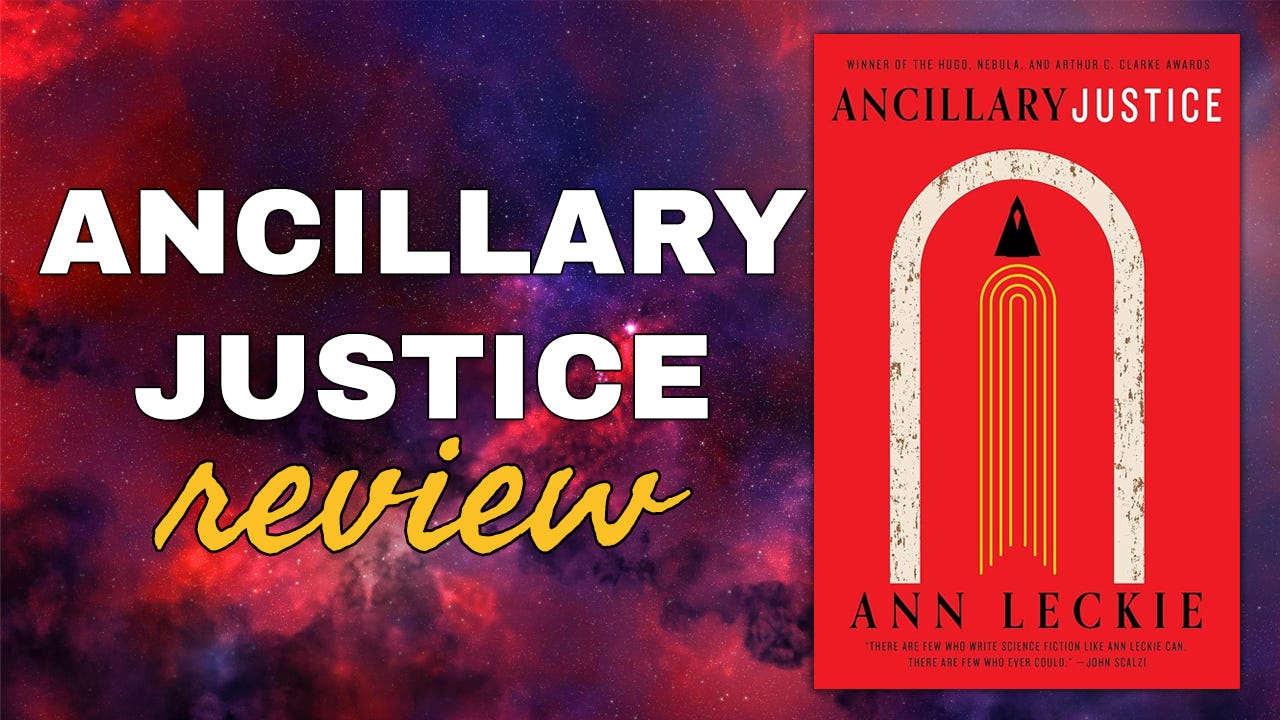
Book Review: Ancillary Justice by Ann Leckie
Ancillary Justice is an intriguing novel concerned with identity, civilisation, empire, and colonisation... but it shies away from developing the themes it introduces.

Ancillary Justice is an intriguing novel concerned with identity, civilisation, empire, and colonisation. It gestures towards several compelling themes, though it shies away from fully developing them.
The story centres on the Radch:
—a human-led empire spanning several regions of the galaxy. It is ruled by an Emperor (the Lord of the Radch, Anaader Mianaai), and built on a multi-deity pantheon of gods—similar as the Roman Empire. This society is highly classist and reminiscent of patrician structures in ancient Rome, with high-born houses extending patronage to those of lesser status, thereby expanding their networks of influence.
The military forms a fundamental pillar of Radchaai society. This is an expansionist empire, intent on conquering—or, in its own terms, “annexing”—other human, non-Radchaai planets. As such, most citizens serve in some capacity. Entry into service requires passing the ‘aptitudes’, a particular form of assessment. The novel hints at an ongoing debate as to whether these aptitudes are biased—either in favour of the “well-bred” or of “provincial upstarts”, depending on which character is voicing the opinion. Regardless, as with many other commentaries, this is mentioned in passing and never truly addressed.
The central element is the Radchaai fleet itself. Each vessel is equipped with a sentient AI, capable not only of emotion but of inhabiting multiple human bodies known as ‘ancillaries’. The procurement of these bodies is unethical (they’re captives taken during the annexations) and certainly not consensual—another concern noted in a handful of comments but never developed in depth.
That said, these ancillaries—these bodies—function as extensions of the AI’s single consciousness, creating a distributed, multi-bodied identity.
This leads to several interesting elements.
In particular, the book is narrated in first-person past-tense, following the last surviving ancillary of the Justice of Toren—a troop carrier destroyed twenty years before the book’s events. The story is split between the events leading to the destruction (past timeline, with the Ship as the narrator) and the present timeline (with ancillary Breq/One Esk as narrator).
What I need to praise is the execution of the almost omniscient presence of the Ship in the past timeline. In a handful of scenes, the conversations or events reflect the multi-spacial awareness, hopping from place to place in each paragraph—for example, Justice may be talking to its captain with one ancillary, while another is serving tea to a Lieutenant, another escorting someone else, a last one running to deliver a message. The execution is neat, novel, and never abused.
However, one of my main grievances is around the execution of the central theme:
The idea of fragmented or multi-body identities.
Early on, the book presents a curiosity: one of Justice’s units, One Esk, has developed a penchant for singing, which the other units do not share—hinting that there is some degree of individuality or fragmenting identity. Likewise, these units (such as One Esk) can have ‘preferences’ towards specific humans that are not shared by the Ship as a whole.
More interestingly even, the Lord of the Radch—allegedly a human, not an AI—has ‘cloned’ herself to exist in multiple bodies thus ensuring her continuance throughout millennia. However, after ordering the genocide of a specific society (the Garsedd), her identity split due to the weight of the decision. This division led the Lord to fight a secret “war” against herself.
Unfortunately, there is very little commentary about either: (a) the philosophical and psychological implications of Anaader’s identity split, and (b) what does it mean for Justice of Toren> that only a segment of it (the ancilliary Breq) survived.
Granted, there are some quotable and philosophical sentences:
...or is anyone’s identity a matter of fragments held together by a convenient or useful narrative, that in ordinary circumstances never reveals itself as a fiction? Or is it really a fiction?
But from the moment of the theme’s breakthrough onwards—when both ‘identity splits’ are revealed—the narrative just... forgets about the implications entirely, as if the author had shied away from the thematic complexity she wove into the plot.
For example, ancillary Breq comments on ‘grieving’ part of her self... but we are never shown the pain, just informed of it by one or two lines of thought, always centred on the awkwardness of having a single body. Likewise, Breq never wonders whether she lost something else, or if she’s truly herself (Justice of Toren) or a new self that resulted from the split.
Were the narrator omniscient, this might be forgivable. Instead, because the story is limited to Breq’s first-person perspective, the lack of exploration of her identity (along with other elements such as the emotional dissonance between Breq’s actions and interiority) reads less like subtlety and more like an unresolved pretense: the theme is suggested, but never probed in depth.
Another of my grievances…
…is the existence of extremely convenient elements that favour Breq or result in events that align with her goals. I’ll give you two examples.
As I mentioned above, there are two timelines: the past (detailing the events leading to the destruction of Justice of Toren), and the present, following Breq on her revenge quest.
The present timeline begins with Breq discovering a drugged, near-dead individual sprawled at the entrance of a tavern in a far away world. Breq recognises this person as a former Radch Captain Seivarden and—for reasons unknown to herself—decides to help Seivarden.
Eventually, it is Seivarden’s presence that allows Breq to stand face-to-face with the subject of her revenge—extremely convenient, given that Breq still had the intelligence of an AI, and had spent two decades plotting this revenge.
Through the book, it is clear that Anaader Mianaai, the Lord of the Radch, was capable of implanting ‘secret’ instructions on the AI’s minds. Thus, there is a chance that Mianaai had implanted something... but the book does not raise suspicions, and leaves this open entirely. Likewise, Seivarden seems strangely attached to Breq for no reason—and Breq merely comments on it once and lets it be.
Given that this is a trilogy, this could be a setup for something else—especially given the above breadcrumbs. Unfortunately, the opening is too fortuitous, and the text does not offer enough foreshadowing as to indicate that there was a purpose beyond something convenient to the plot.
Likewise, towards the end of the book, Breq makes some questionable choices and, for some reason or another, the consequences of her actions are cleaned up in her favour. For example, on a depressurising shuttle, a sail-pod happens to be nearby to rescue her just on time.
While Radch society’s belief in omens and fate provides a thin thematic justification, the reliance on these conveniences stretches plausibility and highlights the tension between the novel’s ambitious themes and its narrative mechanics.
That said, certain aspects of the setting are particularly well realised.
For instance, whenever the Radchaai annex a new society, they argue that local deities are merely incarnations of Radchaai gods—echoing the strategies of the Roman Empire. Similarly, the novel conveys a distinctive and consistent sense of fashion and etiquette, using jewellery to indicate affiliations and patronages. Non-verbal communication seems standardised and it often accompanies speech through gestures, adding depth to social interactions.
Perhaps the most distinctive and frequently discussed element is the treatment of gender. Radchaai society does not recognise gendered traits (such as mannerisms, fashion, accents, or interests), and therefore employs a neutral pronoun for all individuals. In the English ‘translation’ from Radchaai, this generic pronoun is rendered as she/her. The choice has provoked debate among readers, but it also functions as meta-commentary: why should the male pronoun be considered default?
This approach also produces secondary effects that enrich the world-building. Radchaai citizens often struggle with pronouns in other languages or regions, since annexed provinces may signal gender differently. Traits considered ‘female’ in one society may register as ‘male’ or ‘neutral’ in another, highlighting the subtle interplay between language, perception, and social interaction.
This linguistic sensitivity is reminiscent, to some degree, of Samuel Delany’s Babel-17. It is also a reasonable assumption that distinct societies develop different traits and languages—an element of speculative fiction that is too often overlooked in favour of simplified, monolithic cultures.
All in all…
While the first half of the book promises thematic richness and delves head-on into it, the second half does not deliver. Instead, it shifts towards a more conventional narrative structure, leaving many of these ideas insufficiently explored. This creates a sense of imbalance, as though the novel gestures towards complexity but ultimately retreats from it.
Copyright © 2026 Livia J. Elliot. All rights reserved. This publication is licensed for personal reading only. No article, or substantial part of an article, may be reproduced, republished, adapted, translated, compiled into another publication, incorporated into teaching materials or course packs, or used for AI training without prior written permission. Linking to the original articles is encouraged.