

Book Review: Tender Is The Flesh by Agustina Bazterrica
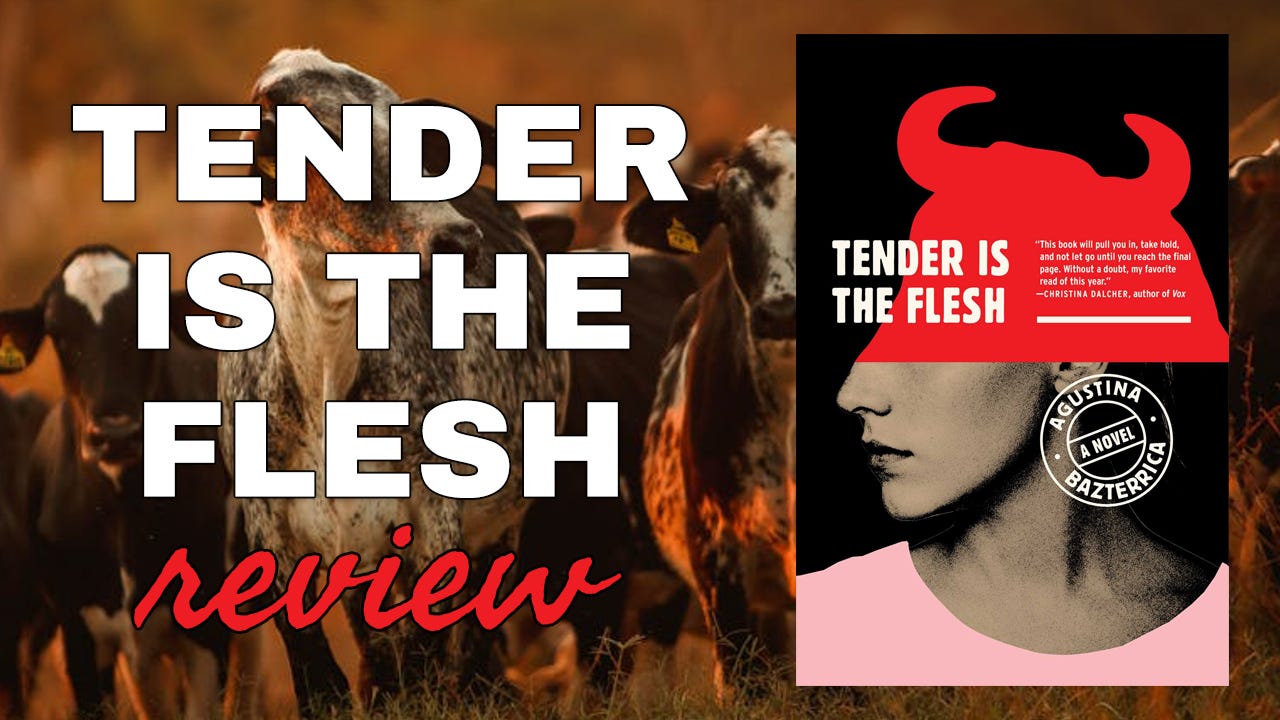
Tender Is The Flesh. A complex, layered dystopian novel that examines language as a tool for the normalisation of horror.

Tender is the Flesh is a complex, layered dystopian novel that examines language as a tool for the normalisation of horror, the biased and uneven moral standards applied to our surroundings, and the pressures that enforce social compliance. Despite this, it is frequently reduced to a narrowly framed vegan allegory.
I will first review the narrative, the characters and plot, and then move into the themes.
In terms of narrative, Tender is the Flesh is told in a limited third-person present tense—an unusual choice that generates a dissonance between the apparent proximity to Marcos Tejo’s mind (the narrating character) and the increasing blurring of events in his life.
The author also alternates between presenting dialogue conventionally (using quotation marks) and narrating it in large, dense paragraphs. This choice appears deliberate, as narrated dialogue only surfaces when Marcos ‘spaces out’, disregarding whoever is speaking in favour of his own inner monologue. This works very effectively, particularly because these moments often coincide with gruesome scenes (for instance, Marcos’s tour of a breeding centre of ‘heads’: humans bred for consumption). In these cases, his lack of attention creates a sense of detachment that, by any reasonable moral measure, should not exist—yet it does, because the normalisation of horror is, perhaps, the novel’s central concern.
Which leads us into the plotlines weaving throughout the book:
Marcos’s work as the second-hand man to the owner of the Krieg Processing Plant presents the horror of legalised cannibalism, alongside its implications for those dehumanised individuals now designated as ‘products for consumption’. It establishes the setting, but operates as the background of Marcos’s life—the day-job he performs while other, more personally transformative events unfold. This ‘relevance’ says plenty about his character.
The death of his child and the departure of his wife, Cecilia, bear down on Marcos. It acts as a catalyst for several narrative developments, including those connected to Jasmine’s storyline.
Jasmine’s is arguably the most harrowing, yet also the most relegated. As a high-quality ‘head’ (a human bred for consumption), she is gifted to Marcos... yet despite her market value, he locks her in a barn and tends to her minimally. His disregard culminates in an act of sexual violence, resulting in her pregnancy. I will return to this storyline when discussing the novel’s themes.
The central storyline is, in my opinion, the most important: the situation with Don Armando, Marcos’ senile father, now living in an aged care. It shapes much of Marcos’ behaviour, from his line of employment to his visits to an abandoned zoo solely because his father once took him there. Likewise, Armando’s death marks a decisive turning point: the moment when Marcos begins to impose boundaries, sever relationships that burden him, and initiate change.
Thematically, though, this novel is a goldmine.
It presents extreme horrors through Marcos’ detached, almost bored narrative voice, yet it tempers this detachment with selective ethical concerns—enough ‘morality’ to make him initially relatable, and enough ambiguity to allow it to surface throughout the story. This gradual unveiling of Marcos’ true character can be read as a covert moral test for the reader. What I found particularly effective, is how the author sowed ‘clues’ about Marcos’ ethics from the very beginning, yet hid them in his curated, carefully crafted inner monologue:
No one can call them humans because that would mean giving them an identity. They call them product, or meat, or food. Except for him; he would prefer not to have to call them by any name.
As the story progresses, his language ‘slips’ and becomes blunter—mirroring Marcos’ gradual acceptance of his own feelings towards the ‘heads’. This is especially evident when he bathes Jasmine before naming her:
He cleans her chest, armpits, stomach. Diligently, as though he were cleaning a valuable but inanimate object. He’s nervous, as if the object could break, or come to life.
Her story is uncomfortable and dehumanising. As a ‘head’, her vocal cords have been removed (a practice intended to prevent screaming during slaughter and, likely—though never explicitly stated—to limit communication). She has been branded in the forehead like cattle, and kept in a cage sleeping on hay. When Marcos receives her, she is even wearing a leash and does not attempt to remove it.
Yet the novel uses language effectively to convey Marcos’ discomfort around her: he keeps her out of sight in the barn, tends to her minimally, and considers selling her. It is not until he observes her body that he perceives her differently, going so far as to strip naked in front of her:
He strokes her neck. Now he’s the one who trembles. He removes his jeans and stands there, naked. His breath quickens. He continues to hug her as it rains down. What he wants to do is prohibited. But he does it anyway.
For a book that does not shy away from explicit depictions of extreme horror (which I will not detail here), the scene in which Marcos sexually assaults Jasmine concludes with the passage above. This is particularly striking given that before the novel included two explicit, on-the-page sexual encounters between Marcos and a former lover.
This omission can be read as a reflection of the value Marcos assigns to Jasmine: she is ‘beautiful’, a ‘valuable object’—yet insignificant enough that her rape is excluded not only from the narrative, but from Marcos’ conscience. The text expects the reader to infer what occurs (as well as the subsequent months Marcos spends ‘enjoying’ her), precisely because she is framed as a ‘head’, and nothing more.
The second half of the novel—beginning when Jasmine is eight months pregnant—is harrowing, yet notably restrained in how it exposes her continued dehumanisation. Marcos may sleep with her, fondle her, yet he keeps her locked in a room and monitors her through cameras akin to those commonly used to monitor pets. He still ‘feeds’ Jasmine (rather than ‘serving her food’), and worries about her primarily insofar as she is carrying his child.
His treatment of her as the bearer of his child, rather than as a woman pregnant with his child, opens the door to a broader discussion of objectification, and of the way societies often value a foetus more than the person carrying it.
This brings us back, once again, to language and its role in constructing moral contradiction. At one point, Marcos narrates:
She spends hours watching television, sleeping, drawing, staring at a fixed point. At times, it seems she’s thinking, like she really can.
And yet, only a few pages earlier, he acknowledged that ‘heads’ were, in fact, human:
Before going into the plant, he sits in the car for a few seconds and looks at the complex of buildings. They’re white, compact, and efficient. There’s nothing to indicate that inside them humans are killed.
So is Marcos’s numb detachment a defence mechanism, or an ethical failure? Is he dehumanising because the system is, or because he himself has grown numb?
The novel doesn’t answer these questions. Instead, it presents situations for the reader to craft their own answer—while simultaneously ‘training’ that same reader to accept its language until, by the end, they have learnt to expect the most gruesome crimes against humanity.
It is then when the horror surfaces: when the reader finishes the book and realises that, halfway through, Marcos no longer needed to be subtle with his choice of words.
PS: A podcast episode will be landing soon.
This review was originally shared on Goodreads, on March 2nd, 2026.
Copyright © 2026 Livia J. Elliot. All rights reserved. This publication is licensed for personal reading only. No article, or substantial part of an article, may be reproduced, republished, adapted, translated, compiled into another publication, incorporated into teaching materials or course packs, or used for AI training without prior written permission. Linking to the original articles is encouraged.