

Book Review: The Book Thief by Markus Zusak
Historical fiction with a speculative element, and a compelling exploration of meaning, the power of words, and the duality of humankind.

The Book Thief is historical fiction at its core, but literary due to its presentation; it also blends a distinct speculative element: Death—the grim reaper—as a narrator… but not as the protagonist. It was originally sold as Young Adult fiction, though it is not, in my opinion, comparable in any way to what is sold as YA fiction at the time of this review.
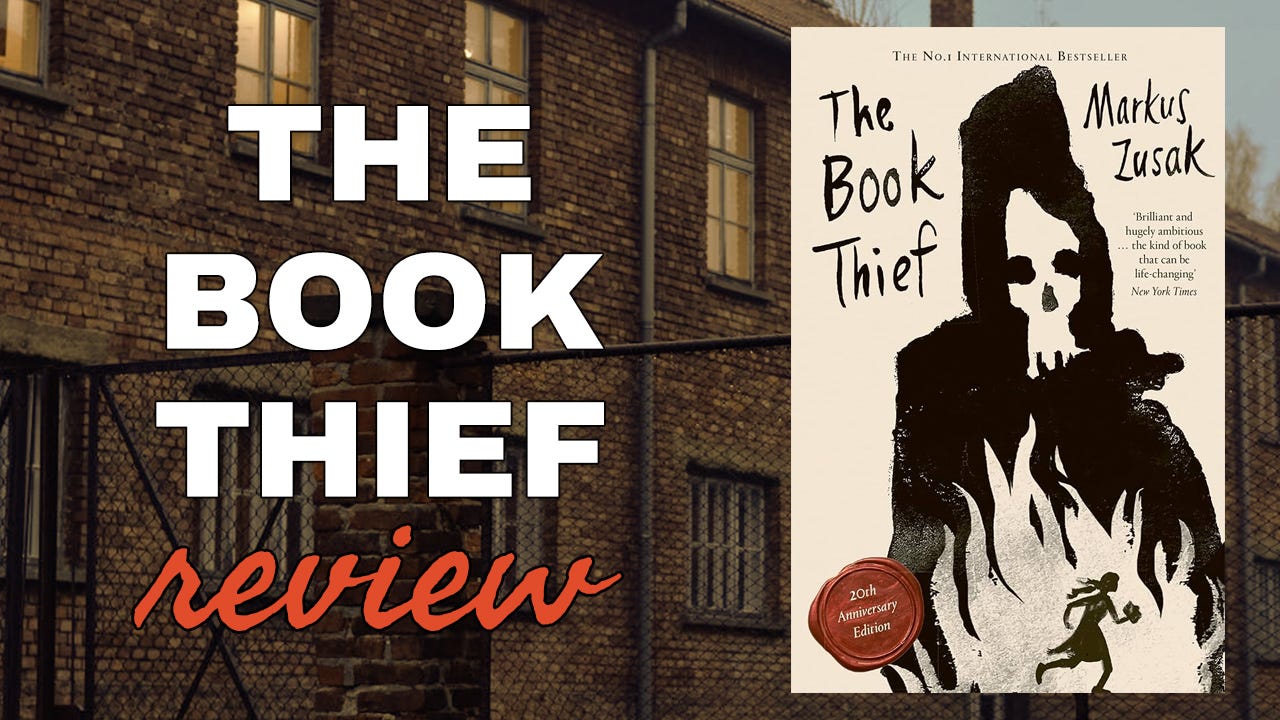
In this review, I will cover the elements of the story through the three ‘interwoven’ genres I mentioned.
First, this is a fictional story set during the Second World War, in the small town of Molching, on the outskirts of Munich. The bulk of the story takes place between 1939 and 1943, and follows Liesel Meminger: from the first time Death meets her when she is nine years old (Death is there to take her younger brother), to the moment Death collects the ‘journal’ she wrote during the war. Liesel is German, and it is implied her parents were German Communists—meaning that her biological mother was forced (though there are few details about her) to give Liesel to an adoptive family before disappearing.
Her adoptive family lives on a relatively poor street, not far from Dachau—one of the concentration camps. The book also follows some of the neighbours; for example a Nazi shopkeeper, a widow of unknown political affiliation who has lost both sons to the war, frightened people, radicalised people, and small children with little understanding of what is happening. From this group, Liesel’s adoptive father is the most important character.
Hans Hubermann is German. He survived the First World War because a Jewish friend—who also taught him to play the accordion—saved his life. As the plot develops, this
connection escalates unfavourably: while working as a painter, Hans ‘commits the crime’ of repainting slurs on a Jewish man’s door. This costs him his membership of the NSDAP, which in turn hurts his work, as he receives fewer and fewer commissions. Things take a further turn when Liesel is eleven years old and Hans arranges something else entirely: to hide Max Vandenburg—the son of his deceased Jewish friend—in their basement.
Something to note is that familiarity with WWII history enriches the reading because—more often than not—Death (the narrator) is quite vague when referencing events during the war. For example, he mentions ‘the beach in the north of France’ before recounting how many souls he collected, or shares a scene in which a returned soldier ironically asks a child, ‘Do you think this is cold?’—only for it to be revealed later that the man survived Stalingrad. Sometimes, Death describes the skies after bombing raids with an abstract focus on colour, as though the grim reaper himself does not wish to dwell on the suffering and death on the ground.
Some comments are clearer than others, but the effect is always the same: once realisation dawns, reality hits differently.
But let me move on to the speculative element: Death as the narrator.
One would think Death would make the story quite grim, but that’s not the case. Death takes no sides, and is kept relentlessly busy by what humans do to one another. Here is where one of the key themes of the book come into play: in the end, everyone meets Death, regardless of the flag they wave.
Overall, he is a fascinating narrator: mesmerising and thoroughly opinionated, to the point that he often ‘interrupts’ Liesel’s story to offer a comment or two. For example:
I do not carry a sickle or scythe. I only wear a hooded black robe when it’s cold. And I don’t have those skull-like facial features you seem to enjoy pinning on me from a distance. You want to know what I truly look like? I’ll tell you: find yourself a mirror while I continue.
Death is never graphic in his commentary. On the contrary, and as per the example above, he is constantly reminding the reader of what humans do to other humans: the terrible and unthinkable, but also the acts of kindness.
The final element to consider is the book’s literary construction. Death narrates in an unconventional style:
He uses the first person, but also the collective ‘you’ to address not the individual reader, but humanity as a whole. This can be seen in the quote above.
At times, Death uses bullet points to quickly outline people, stolen objects, beliefs, and more. This is an interesting literary device that reinforces Death’s inhuman presence (that is, Death is not human and does not adhere to conventional human narrative structures), though it may not appeal to every reader.
Likewise, Death frequently ‘interrupts’ the flow of the story with clearly presented ‘intermissions.’ These are always centred on the page, given an all-caps title, and contain Death’s translations, opinions, or recollections. In some cases, these intermissions follow his account of how a character—now only marginally relevant to the story—died.
Finally, there are also ergodic elements. For example, when Death recalls the three colours present when he first met Liesel (red, white, black), and introduces them through a list with small drawings (a flag, a circle, a symbol). When Max Vandenburg writes an illustrated story for Liesel, the thirteen drawn pages are included as the story itself, rather than being supplementary material, as it’d be done in an illustrated book.
Something that struck me is how this book consistently presents events in a quiet way that requires the reader to dwell on detail. Death, being neither human nor aligned with any particular flag, presents facts alongside subtle commentary—and it is within these moments that a spectrum of meaning emerges.
For example, when Liesel realises that her biological mother was a Communist and may have been taken by the NSDAP—even though she was German—she exclaims, “I hate the Führer” during a book burning held to celebrate his birthday. Hans, her father, slaps her across the face in public, forces her to stand, and makes her perform the salute alongside him.
Has Hans changed his beliefs? Death offers no explicit commentary beyond this:
It was quite a sight—an eleven-year-old girl, trying not to cry on the church steps, saluting the Führer as the voices over Papa’s shoulder chopped and beat at the dark shape in the background.
This moment exemplifies the book’s subtlety. By this point, readers already know that Hans is opposed to the NSDAP, yet is still waiting for his long-delayed party application to be approved because it offers a measure of safety. The reader also knows that Hans has helped Jewish people before, and Death has already hinted—this time less subtly—that Hans will hide a Jewish man in his basement within the year.
From here, it is left to the reader to infer Hans’s motivations: protecting Liesel, who at eleven years old has no understanding of the broader political context or the danger of making such statements in public, surrounded as they were by loyal party members.
Thematically, the book explores meaning, the power of words, and the duality of humankind: the extremes we reach to protect others, and the extremes we reach when radicalised by belief. It is baffling—and it baffles Death, who reflects on this more than once throughout the novel.
All in all, this is an excellent book.
About the Rating
I ultimately withheld a five-star rating for two details related to Death’s narration, both of which are a matter of personal taste. At the beginning of the novel, Death has a truly distinctive voice; however, in my view, this voice dilutes toward the middle section, before returning in the final third. Likewise, while Death’s commentary on the broader historical context is often subtle, he occasionally labels Liesel’s internal states too clearly and neatly by comparison.
This review was originally posted on Goodreads on December 29th, 2025. Yes, I was reading this over the holiday break, followed by Man’s Search for Meaning by Viktor E. Frankl. Do not judge me.
Copyright © 2026 Livia J. Elliot. All rights reserved. This publication is licensed for personal reading only. No article, or substantial part of an article, may be reproduced, republished, adapted, translated, compiled into another publication, incorporated into teaching materials or course packs, or used for AI training without prior written permission. Linking to the original articles is encouraged.
I loved this book and must be overdue a reread. “The human child - so much cannier at times than the stupefyingly ponderous adult.”