

Book Review: The Road by Cormac McCarthy
The Road by Cormac McCarthy. A bleak, philosophical discussion on survival, morality, and the human spirit in the shape of a novel.

More than a book, The Road is a philosophical discussion on meaning, purpose, and the true nature of humankind.
The story is intentionally narrow: a post-apocalyptic setting, and a nameless father and son travelling south across the United States. There is no clearly defined goal beyond escaping the cold—which seems to follow them—and one message:
You have to carry the fire.
This message is easy to overlook, particularly at the beginning, as McCarthy does not return to it often, and certainly does not explain it—at least not on the page.
But I am getting ahead of myself. Allow me to examine the novel from its setting to its characters, and finally its themes.
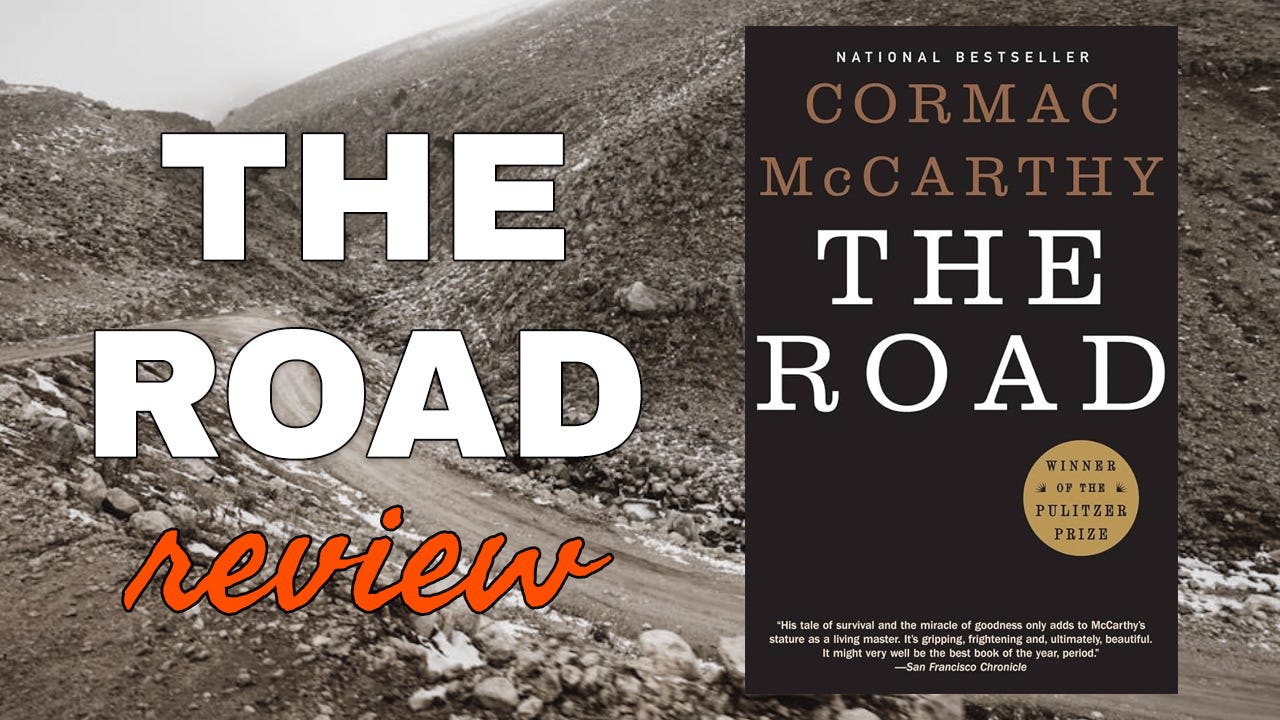
The setting is minimalist: an ashen, desolate world, post-apocalyptic (perhaps in the aftermath of a nuclear catastrophe), yet scarcely explained. The decay is pervasive, all-encompassing, and overwhelming, eroding everything—especially the remnants of humanity.
What the father and son encounter makes the bleakness unmistakable. This is an “every man for himself” world, where survivors will readily kill one another simply to strip away whatever rags and goods they possess. There are “bloodcults” roaming the roads, pillaging and enslaving others (it is implied that they assault women, keep adolescent boys as sex slaves, and even consume newborns). Some survivors have also resorted to cannibalism, a horror underscored through several encounters along the road.
This is never made explicit, yet the extreme nihilism—which renders even survival seemingly meaningless—is essential to the exploration of the novel’s central question: can moral goodness exist when every external structure that sustains it has collapsed?
The setting itself appears to suggest that, without such frameworks—no society, no laws, no governing bodies to enforce them—humanity will descend into utmost depravity and moral disintegration.
Here I must pause to analyse the father and son.
Interestingly, McCarthy chose to keep them nameless. At no point are their names revealed, and even when the narration remains closely aligned with the father’s perspective, he refers to his son simply as “the boy”. One might argue that this resists the expectations of readers more used to conventional, commercially-oriented narrative structures; however, the absence of names is consistent with the novel’s thematic axis: if the world is nihilistic, if meaning itself is eroded, what purpose does a name serve?
Ultimately, a name is typically bound to identity, but the road—and the post-apocalyptic landscape it traverses—relentlessly strips both meaning and identity away: first at the societal level, and then from the individuals who endure it.
For this reason, the father and son are not quite characters in the traditional sense, but rather characterised themes—almost akin to literalised metaphors, where abstraction is given narrative form.
Allow me to elaborate.
The father is a remnant of the “old world”: a man who remembers what it was, and who clings to the identity that way of living once allowed him to have. He was raised to be the provider, the protector, the moral centre of the family he was building—but the journey along the road steadily erodes that role.
It begins with a question:
How does the never to be differ from what never was?
From the moment this question surfaces, something in him begins to change. He is forced to confront whether he could kill the boy—if circumstances demanded it—while questioning why they continue to survive at all. And yet, he persists in a fragile, almost reflexive faith in an unnamed god, insisting that they are “the good guys”, that they are still “carrying the fire”.
Yet, as the father’s doubts deepen, an unspecified sickness begins to take hold of him—subtle at first, but progressively more debilitating.
The boy’s age is unspecified, though he cannot be older than four to six years. At first, the father attempts to shield him from the surrounding amorality—covering his eyes when they pass burnt corpses, or withholding explanations when the truth would reveal something too disturbing. He tells the boy:
Just remember that the things you put into your head are there forever.
Later, when they cross a stretch strewn with charred bodies, the father again tries to protect him—but the boy responds:
What you put in your head is there forever?
Yes.
It’s okay Papa. [...] They’re already there.
Yet somehow, this doesn’t... reach the boy. He remains unchanged—innocent, vulnerable, and in need of protection.
More importantly, the extent of the world’s bleakness seems not to matter (whether it be a man holding a knife to his throat, the discovery of humans imprisoned as livestock, or being shot at by those seeking their supplies): the boy retains his innocence. Whenever they encounter others—someone struck by lightning, a lost child, even a half-blind old man—he insists on sharing their food, or offering help in whatever way he can.
Such behaviour may appear irrational if the boy is read purely as a character. However, if he is understood instead as a characterised theme, his behaviour fits what he embodies: an irreducible moral instinct, a form of pre-cultural goodness that cannot be entirely eroded by the surrounding desolation, and which must, therefore, be protected.
You have to carry the fire.
I don’t know how to.
Yes, you do.
Is the fire real? The fire?
Yes it is.
Where is it? I don’t know where it is.
Yes you do. It’s inside you. It always was there. I can see it.
Understanding the boy in this way allows us to reinterpret the father’s faith—not as belief in an unspecified god, but as faith in the idea of goodness embodied in the child. The father’s sickness, then, is not merely a loss of the will to live, but a weakening of his ability to remain “one of the good guys” in a world where such a choice can be fatal.
This brings us back to the nihilistic setting, and to the question McCarthy may have been probing: can moral goodness exist when every external structure that sustains it has collapsed?
What the novel hints at is philosophically compelling: morality is a choice, and one that must be continually reasserted through each decision (through every encounter along the road) even when any external justification for it has already fallen away—whether social, religious, rational, or evolutionary. The boy (and the moral instinct he represents) must be protected, and cannot persist entirely on its own (as the ending may suggest), because morality is only meaningful if it can endure despite having no reason to exist.
This, perhaps, is what it means to “carry the fire”. To choose to live nobly despite hardship, and morality not as a principle that can be proven or defended, but as something enacted, again and again.
All in all, The Road resists easy categorisation and offers none of the legibility of modern fiction. For those willing to engage with it on its own terms, this is a work of remarkable philosophical depth.
Copyright © 2026 Livia J. Elliot. All rights reserved. This publication is licensed for personal reading only. No article, or substantial part of an article, may be reproduced, republished, adapted, translated, compiled into another publication, incorporated into teaching materials or course packs, or used for AI training without prior written permission. Linking to the original articles is encouraged.
Another great 'undoing' of a great book!
Since reading this book over a decade ago, it has haunted me with the depths of darkness. As I've grown up and have come to see the depth of darkness in humanity, however, I see this as a study in human resilience, innocence, love and the fight to keep light inside of us in the darkness. The struggle to do that is a heroic battle.