


Ubik is a masterpiece that challenges reality in a multi-layered, faceted take on Plato's allegory of the cave. Likely the precursor to The Matrix, and presented like a fun, fast-paced, yet deeply thematic futuristic story.
In short, a masterpiece as only PKD could craft.
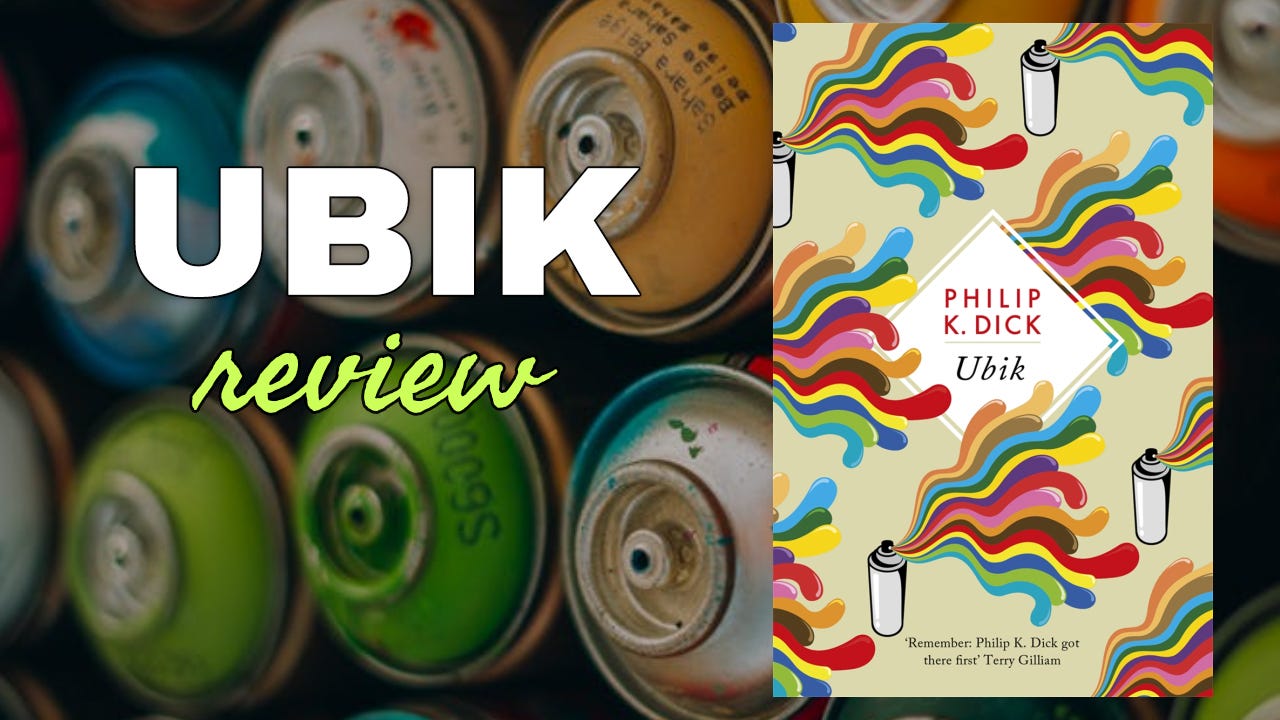
In terms of setting, this is what I affectionally call "period scifi"—sci-fi books that are actually set in the past, most likely because it was "near future" when it was written. In here, it is the year 1992, and individuals with psionic powers (e.g., precognition, telepathy) are a threat to the social, economic and political balance. To contain their manifestations, there are "prudential" companies that provide individuals called "inertials" that can neutralise the activity of telepaths and precogs. Prudence organisations also offer their clients security and privacy from the intrusions of psychic spies. Runciter Associates is owned by Glen Runciter and provides "inertial" services, but has lost track of a dangerous telepathic.
That is only part of the setting. A key element is the distinction between full-life (i.e., what we currently consider as "being alive") and half-life. Half-life occurs when someone is recently dead and placed into a cryogenic facility called "cold-pac", known as Moratoriums. While in this cryogeny, the half-lifers cannot move, and their bodies age neither, but they can be "telephoned" by their full-life relatives.
This description is just scratching the surface of what half-life is, since very early in the book it is implied that half-lifers have their own sort of "world", that they mingle with the others that are close, and that perhaps their half-life minds create a different reality.
So that begs the question: what if the world we know is just a half-life world (the product of our minds) and not "true" reality?
Here is where Plato's allegory gets twisted: how would people/characters react to being told they're dead and half-living? Would that be more painful? Can they do anything about it? But then... how many layers to reality are? What if you "awaken" from one reality into another, then "awaken" into another? Maybe there’s no safe layer of reality at all.
I won't answer these questions because the book doesn't; PKD was just exploring them… though I do find those questions core to Ubik's theme.
Now, what is Ubik? It's a product; a spray can, a salve, a balm, powder to be diluted. The most popular definition out there is that Ubik is:
…a stabilizer that can reverse the course of time and protect people and things from decay.
Though while somewhat true, that definition falls short of what Ubik truly is... yet any attempt at defining or explaining it are deeply spoilery. I think a nice attempt at defining Ubik is saying that Ubik is the product of someone's mind, will manifest, the persistence to live, a belief that gives someone resistance to reality. I don't think there is a single answer, but to me, the spray can was certainly not "god", as I've seen reported in some reviews.
TL;DR: It's a great book, but in PKD's style, it cannot be taken lightly as "just" a plot. Thematically, it is incredibly rich.
This review was originally shared on Goodreads, on July 18th, 2025.
If you are interested in hearing more about Ubik, I did a lengthy podcast episode (with transcript included) discussing the book through Plato’s Allegory of the Cave, and Kant’s noumenal/phenomenal as applied to Ubik (the spray can, the salve, the… everything Ubik is inside the book). It’s one of my favourite episodes:
No Exit from Half-Life: Demiurges and Unanswered Questions in Ubik

“He felt all at once like an ineffectual moth, fluttering at the windowpane of reality, dimly seeing it from the outside.” This is one of the key ideas behind one of the most enigmatic novels written by Philip K. Dick. I’m talking about Ubik.
Copyright © 2026 Livia J. Elliot. All rights reserved. This publication is licensed for personal reading only. No article, or substantial part of an article, may be reproduced, republished, adapted, translated, compiled into another publication, incorporated into teaching materials or course packs, or used for AI training without prior written permission. Linking to the original articles is encouraged.