

The Narrator Who Censors Herself: Strike-Through as Subtext
She didn't mean that... or did she? Let's analyse how strike-through text can tease a hidden narrative—one not even the narrator can accept.

At first glance, the answer is: yes, it does. We often use italics for character thoughts (in a third-person narrative), or even "Quotes and italics," for dialogue that is not spoken (e.g., hand-signalling). We also use CAPS for shouting, and in social networks, tHInGs LIkE ThIs have a mocking meaning.
Books, however, are different things, and literary fiction sometimes takes these details to the Nth degree. Check this example 👇🏻:
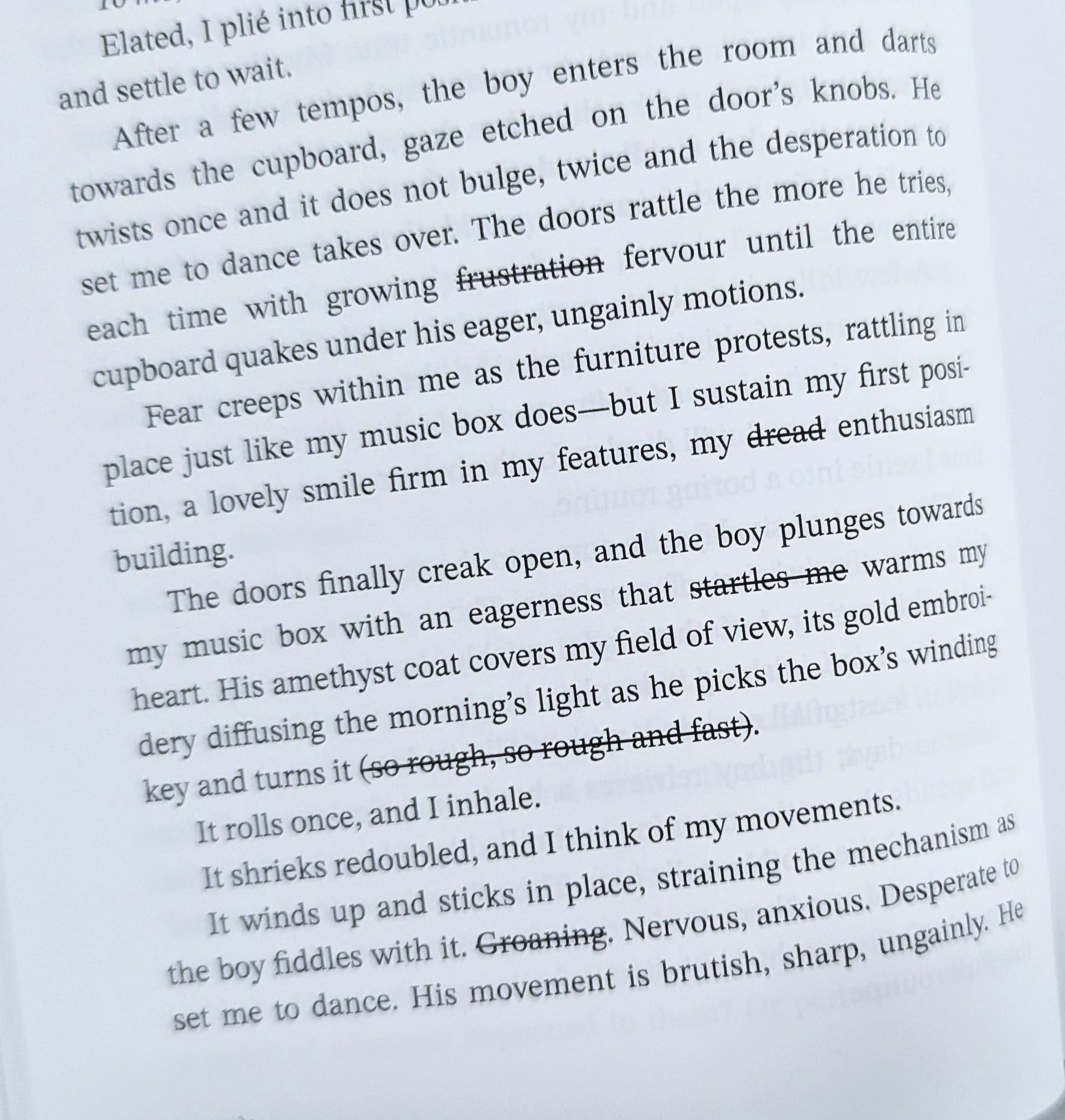
To give you some non-spoilery context, this book is highly allegorical, and the meaning of that strike-through text depends on the allegory.
In short (and without spoilers), this book follows Lyra, an enchanted ceramic ballerina doll—the type you find as decorations atop a music box—who was 'brought to life' with elven magic, and is expected to dance ballet when the music box plays.
At first glance, we should already have two red-flags disguised in fairy tale magic: (1) Lyra's innocence (she just came to life), and (2) dangerous power dynamics. After all, the 'elven boy' is 'normal sized' while Lyra is 'doll size' (can size imply power? It certainly does here!). Likewise, Lyra is locked in that cabinet, and cannot even travel to other bookcases or cabinets on her own. When the boy is not there, she spends the day planning nice ballet poses to amuse him.
This is a dark story, since soon after her arrival, the boy becomes more and more rough. He snatches her from the shelf, is brutish when opening the locked cabinet, and even shakes the box when winding up the box's crank.
But Lyra doesn't seem to want to have ill-thoughts about boy... or does she? Early in that screenshot, she describes him opening the cabinet "...with growing frustration fervour until the entire cupboard quakes [...]" What does the strike-through text means there?
Let's break the analysis in two steps.
Let us consider this is a first-person present-tense narrative; we are in Lyra's mind—the narrator can be read as her constant thoughts. We can assume that the author actually intended to write both "
frustrationfervour". Therefore, Lyra thinks both adjectives about the boy.Now, think of strike-through text in a different context. When hand-writing (if anyone besides me still does that), strike-through text is something that was added then removed and/or replaced... which is exactly what Lyra does here. She replaces 'frustration' with 'fervour', and then replaces 'dread' with 'enthusiasm' (when talking about her own emotions).
But why would a character replace their own thoughts?
To answer that, we need to bring back the allegory, and the red-flags we mentioned before. From there, the answer is straightforward: Lyra is very young, she's highly indebted to the boy (his magic brought her to life), she's trapped in his cupboard (!), and she cannot refuse when the boy snatches her (!!).
Conclusion:
Lyra is in an abusive situation, disguised as an allegory of enchanted dolls.
Lyra doesn't dare to acknowledge what is happening (the boy's violence, her own fears) because doing so would make it more real and, thus, more difficult to deal with.
Lyra slowly becomes depressed, and then the positive thoughts appear
strike-throughbecause her depression doesn't allow her to feel anything but the gloominess.
In my extremely subjective opinion, this is a very clever use of formatting to achieve a show-don't-tell that is literary in nature, but heartbreaking once you understand what it means.
Now let me tell you a secret…
That book we just analysed is my own book: Dance With Me.
I originally published it in 2023 as a interactive fiction in my app Unearthed Stories; it is still available there. However, it's been two years since the launch of the app, and I chose to celebrate with a Kickstarter project for the novelised version.
But what is there in the Kickstarter?
An illustrated hardcover and paperback, an audiobook, and another literary interactive story. The prelaunch is active now, and the campaign begins May 6th, 10am EST.
If you want to support me, backing within the first ~48h is crucial for the success of the project. Give it a look! 👇🏻
“One of the most compelling novellas I’ve read in a very long time. It breaks and mends the heart in the span of a few pages.” Books with Zara. ⭐⭐⭐⭐⭐
“Lyra’s journey is a lesson in empathy, as much for herself as for the reader. It’s so easy to judge her for her naivety or to get frustrated with her refusal to accept the reality, but anyone who has ever suffered (or been close to someone suffering) from the same mental health issues will immediately recognize just how authentic and painfully realistic her struggles are.“ Grimdark Magazine ⭐⭐⭐⭐.5
“Insightful and brilliant. This tale of life, pain and everything in between gives voice to the broken, offering a balm to the heart.” Kay’s Hidden Shelf ⭐⭐⭐⭐⭐
“There are some books that people want to read. I suspect, that for many, Dance With Me is a book they need to read. Because we all know a Lyra. Some of us have been a Lyra ourselves. And alongside the sad and sorrowful, this story has a sweetness and catharsis to it.” H.L. Tinsley (author) ⭐⭐⭐⭐⭐