

Collaboration Is Not Chaos: On Collaborative Writing Techniques
Collaborative writing is a fascinating experiment in trust, style, and storytelling. In this Guest Essay we deep-dive into a very specific scene wrote by three authors under a single pen-name.

Collaborative writing—when two or more writers collaborate and publish under a single pen-name—is a fascinating experiment in trust, style, and storytelling. When it works, it can produce stories richer and more dynamic than any one author could craft alone, and within speculative fiction we have some modern examples: S.A. Corey (Daniel Abraham and Ty Franck, who co-write The Expanse), or Erin Hunter (a collective of writers behind Warriors).
Writing collaboratively under a single pen-name allows writers to combine strengths, share workloads, and bounce ideas off each other… though it’s not without its challenges. It can lead to disagreements and challenges—such as maintaining a coherent voice and tone, developing plot-points to everyone’s satisfaction, as well as exercising creative control.
Today’s essay focuses on collaborative writing—and I have the pleasure to cede the spotlight to Amy Minton, from J.A.J. Minton: authors of Discovery. She will dive in into the specifics of one particular scene of their book, and how they combined their talents to craft it; she’ll touch on inspirations, discuss key elements, and showcase an excerpt.
Ready? Let’s get this scene undone.
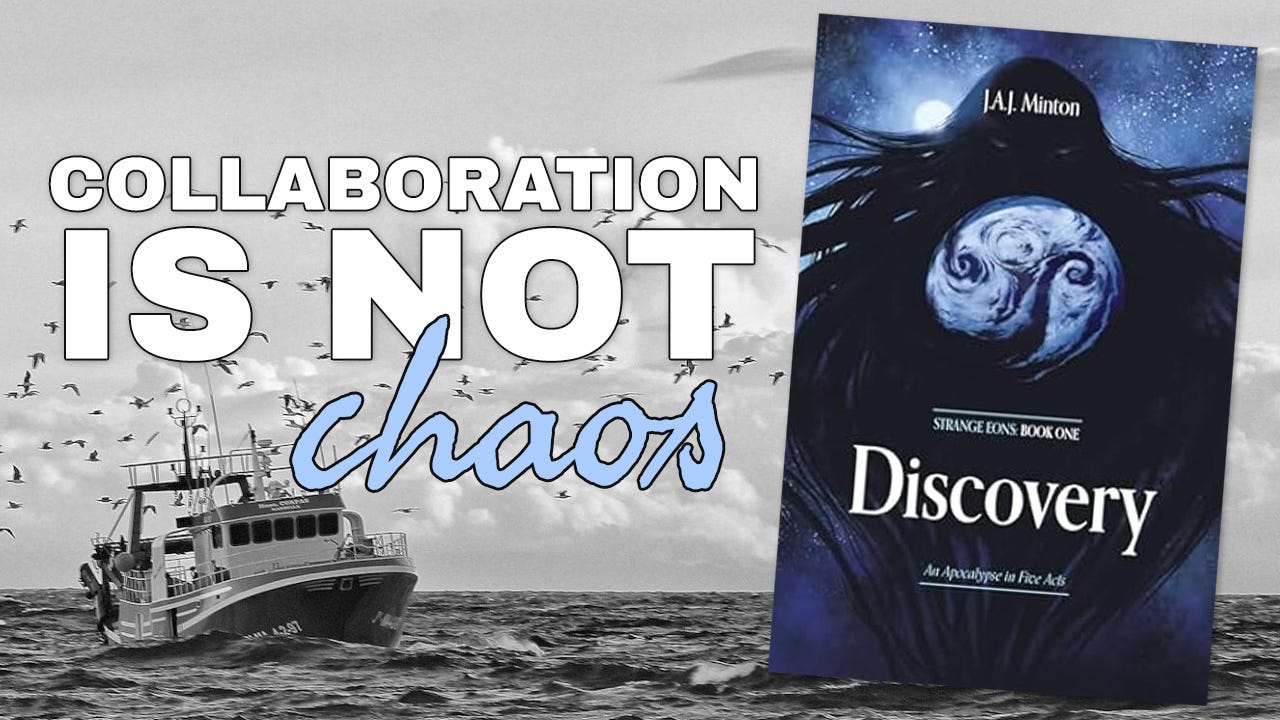
The “Rosie” Scene: The Collaborative Writing Techniques in J.A.J. Minton’s Discovery (2025)
We get the question all the time: how did three family members write a story together? One fellow writer said, “My family can’t decide what to eat for dinner without an argument. How did you manage a novel?”
Since Discovery was released earlier this year, many have wanted to know how group writing worked for the novel format. We know about group writing for a television series, for a movie, for a play. But how did it apply to what’s considered a solo art form? How did we communicate our visions? How did those visions eventually unify? How did you, as family, not kill each other in the process?
To address that last question, we were used to collaborating as a family.
“J.A.J. Minton” is the pen name for three family members: Jakob (the son), Amy (me, the mother), and John (the father) Minton. In the past, John and I have run a theatre company. We were used to communicating in an artistic setting. And now, Jakob and John co-host the YouTube channel, Talking Story. Jakob, being the youngest, had some catching up to do in the shorthand communication style I had with John. (In short, it’s this: honesty over emotion. Everyone wants a great story—same goal, all for one and one for all.)
As far as the writing itself, we all made the agreement to stick to our strengths and know when to let someone else take the lead. Sometimes that didn’t go well. One of us had to be prodded to get off the stage to allow someone else to take over. But when we did cede the workflow to the better-experienced person, we quickly saw the rewards for doing so. Eventually, like training a dog with positive reinforcement, we trained ourselves to enjoy when it was time for another of us to show off their talents.
This is how those talents broke down:
Jakob: the visual guy. Trained in film, knows how to make a scene cinematic.
Amy: the word girl. Trained in literary creative writing, knew how to squeeze words for all they were worth.
John: the genre guy. Brought extensive knowledge of horror/sci-fi/fantasy in multiple story mediums. Knew story shape well—what worked, what didn’t, what had been done before, and what was new. He especially knew the stories of H.P. Lovecraft, whose monster pantheon would inform our own story.
To give a specific example of how we worked together, I’ll go through how we wrote a fantastical segment, what we eventually called ‘Griff’s Approach to the Rosie.’
This scene occurs about halfway through Act I. In it, Griff Tran, a hardened television journalist, has chartered a boat with a television crew to investigate a mayday call from the Rosie, a ship stranded in the South Pacific. When Griff arrives, he finds the Rosie crew exposed to a toxic fungus that impels them to violence and hallucinations.
It was an intimidating scene to write, so we left it until late in the process. Moreover, we didn’t want a standard horror scene. We wanted something new, something fun to read, something tense. It was the first time in our series the reader would see our theme at work in the most literal sense: what is the human reaction to an alien presence? We needed a crown jewel of a sequence. No problem, right?
First, John weighed in with what we call his “30,000 foot view.” Like Jaws (1975, Steven Spielberg) and The Thing (1982, John Carpenter), the reader wasn’t going to get a glimpse of the headlining antagonist quite yet. He said we would want to show the alien’s effects before anyone even laid eyes on it.
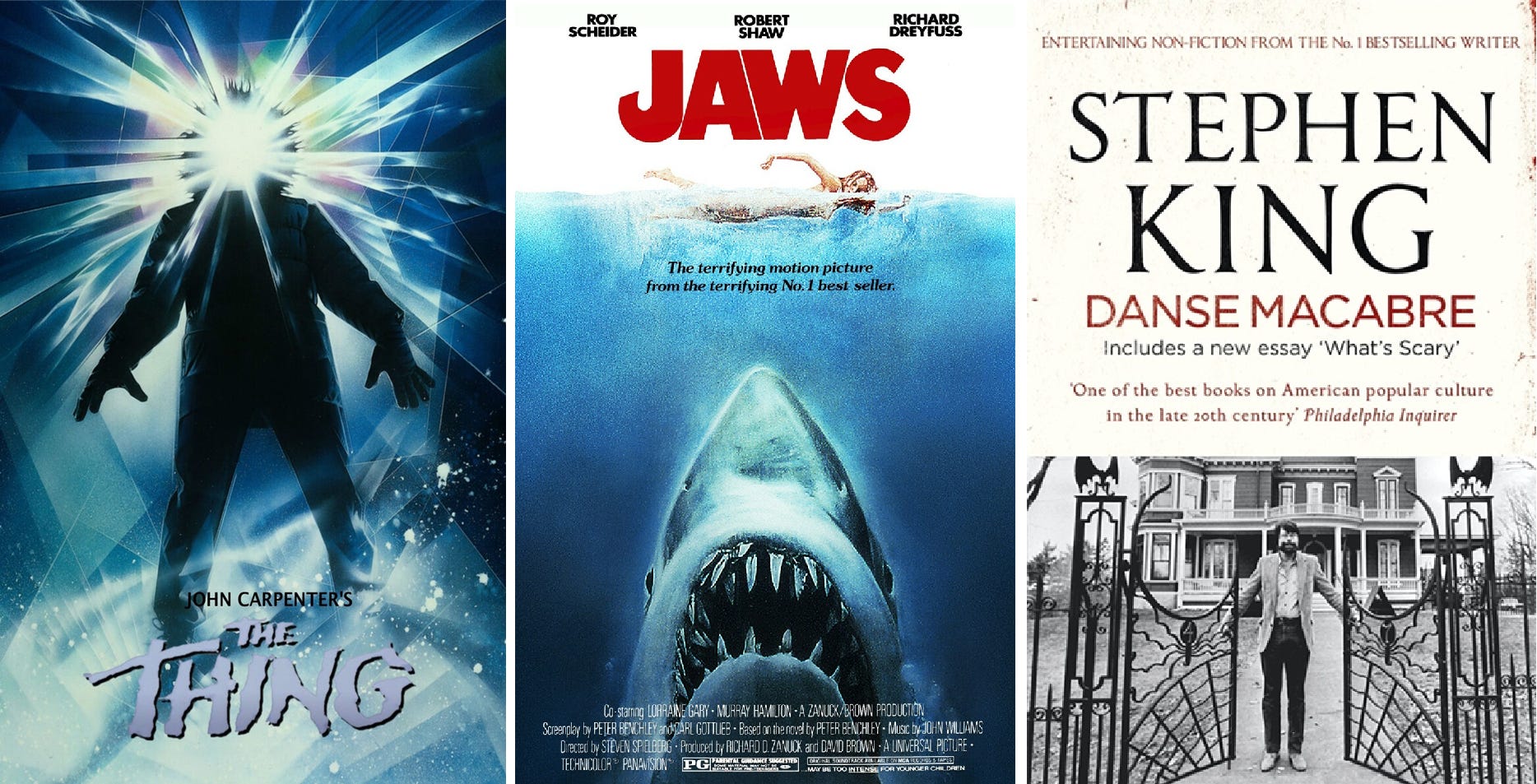
John is the most widely read in the horror genre and knows best what the scene needs to do to make the story work. How far is too far? How literary could I get without boring genre readers? The tone should be creepy, John said, and the body horror on full parade. For someone who reads literary work, this task felt insurmountable. I had to do some research.
And who better to consult than the king?
Stephen King lays the groundwork for the different levels of writing a scary scene in Danse Macabre (1980):
On the first level, one has terror. That’s where suspense and dread live. Uncanniness also lives here.
On the next level, one has horror. That’s the reader’s reaction to fright, and usually it’s revulsion.
Finally, one has body horror. (Stephen King says it’s the easiest, but that’s subjective. I found it difficult to go far enough.) Body horror is an appeal to the gag reflex. It should be used sparingly, to signify the stakes if our protagonist makes a wrong decision.
Now that I knew all the different elements that would need to go into our scene, I looked for role models. For that, I turned to the cinema.
A classic scene of another boat approaching a frightening situation occurs in Apocalypse Now (1979, Francis Ford Coppola). In it, the antagonist Colonel Kurtz, played by Marlon Brando, was being hidden in a similar fashion: everyone talked about Kurtz, but not many had seen him yet. When our heroes in the River Patrol Boat finally approach Kurtz’s compound, the viewer gets a good look at what effect Kurtz has on people. It’s terrifying, horrific, and gross.
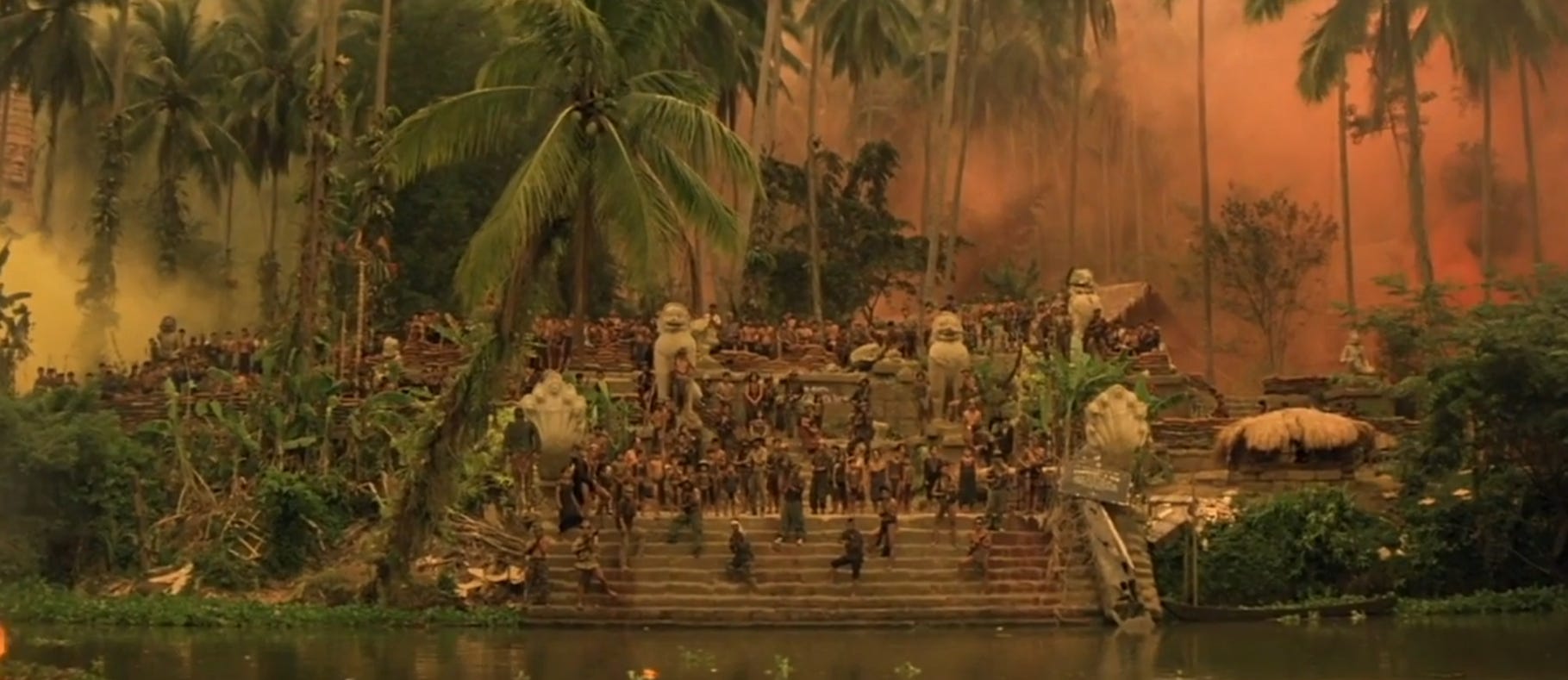
Check, check, and check.
Fascinatingly, both Apocalypse Now and its source material, the novella Heart of Darkness (1899) by Joseph Conrad, inject a bit of comedy in their final approaches to Kurtz. In the text, an animated character known only as The Harlequin becomes the model for Dennis Hopper’s cameraman in Apocalypse Now. Both characters fill the role of a court jester to the unseen king of the scene, while amplifying the control the antagonist has over their minds. Both characters also provide comic relief in otherwise tense scenes, but the comedy heightens tension instead of lessening it.
That interested me.
Both characters are unstable and unpredictable. Both offer an opportunity to laugh and might make the viewer/reader wonder at why they’re laughing at such terror. I loved what those characters did for the scenes. I especially loved how Dennis Hopper’s character gave Captain Willard a tour of the compound, saying,
“There’s mines over there, there’s mines over there…”
—like a host pointing out where the bathrooms are to his guests, all the while neglecting to mention the naked corpses hanging from the trees. This, I knew, was a perfect model for how to spotlight a human reaction to terror and madness. We humans love to whistle in the dark and shove our heads in the sand. This character trope did both. That’s how I came to invent a similar tour guide in our scene. Peni Palu, a Tongan crewman on the Rosie, would be Griff Tran’s tour guide of Hell. And like his forebears, Peni is chipper as hell about it.
[Our] cameraman shone a flickering light deep into the cabin where the bunks were. One was covered in massive blood stains. Two belts were looped around the side rails, as if to restrain someone.
“Oh, crackers! I should have cleaned up.” Peni dodged my gaze as if embarrassed.
I asked, “What happened there?”
“That’s where our captain crossed into the twilight kingdom. Pardon the mess.”
(Discovery, Chapter 4, 2025)
Ever the academic, I wanted to leave a citation for these ideas in my own story. I call them ‘footprints’ in the text that allude to other works. They’re ‘Easter eggs,’ if you will. Just as Dennis Hopper does in Apocalypse Now, Peni asks the arriving crew for cigarettes. He also trumpets his crewmen’s nationalities similarly to how Dennis Hopper blurts, “I’m an American!” I also left a footprint for Joseph Conrad. Before that scene, Griff dreams of horrible creatures calling to him:
“‘Come and see,’ they beckoned me. ‘Come and find out.’” (Chapter 4)
Marlow says something similar when he contemplates the African continent from the water. This is also a reference to the originating story that gives us our creature, “The Call of Cthulhu” by H.P. Lovecraft.
It was time to share my tone and character choices with Jakob.
He was surprised by them; he did not see the scene in the same way. He viewed the Apocalypse Now clip, and what stuck out to him was the silence. A tense, thudding bass line, like a heartbeat, escorts the crew into the compound while stoic figures look on. He liked how the water played a lively character role in the scene—reflecting the fires and ushering the crew on the current. And all of that gave him an idea.
Jakob turned to the Battle of Blackwater scene in season two of Game of Thrones (2012, Neil Marshall).
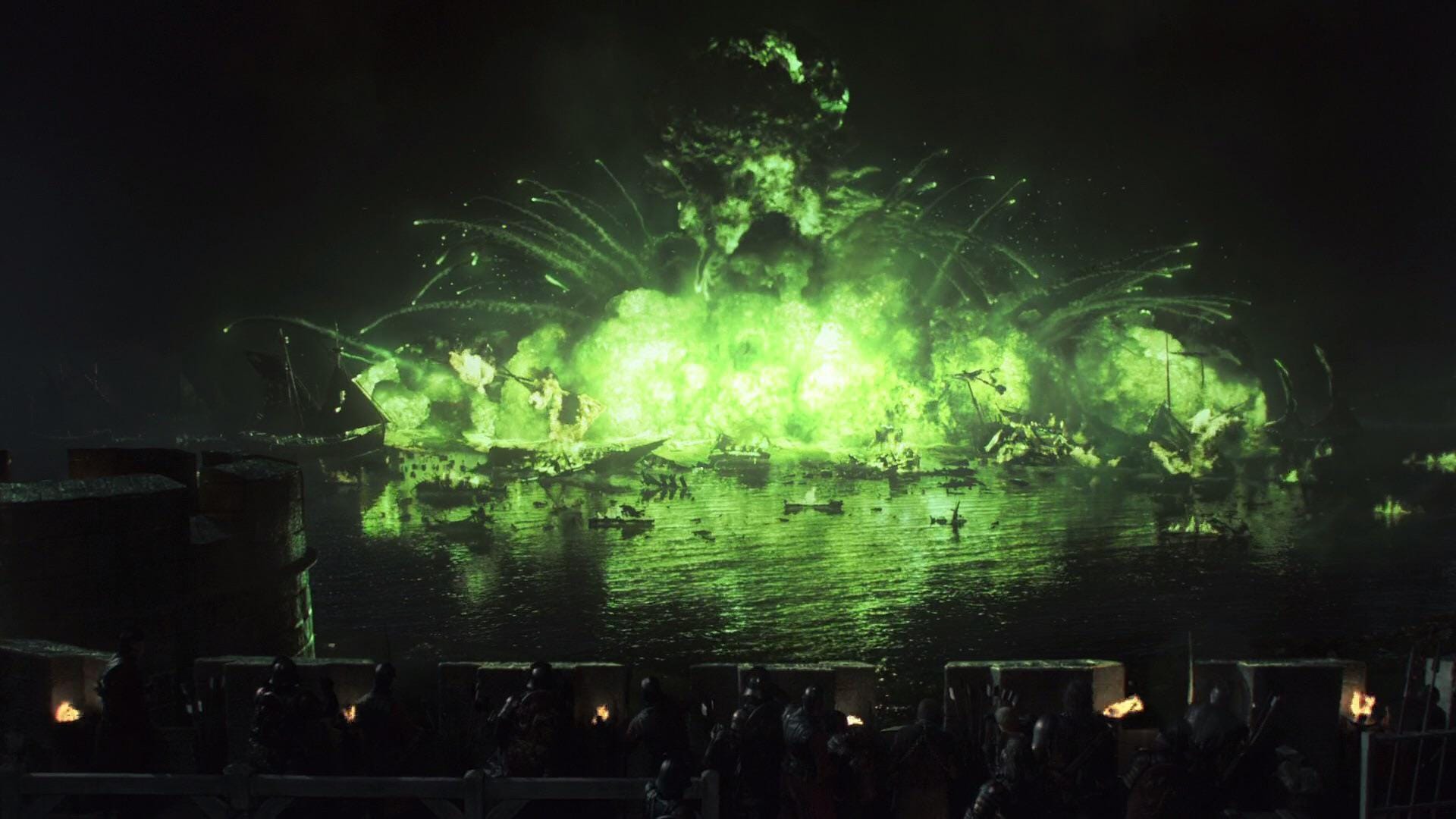
This is a sea battle based loosely on a siege of Constantinople in 717 A.D., in which enemy ships were destroyed using fire on water. In the television show, the lead-up to the battle is quiet and tense. Ser Davos is on the black water. All around him, the water itself is a living presence, dark and menacing as death. With pinpricks of light, the water taunts Ser Davos’s obscured vision just as the enemy obscures their tactics. When the water finally ignites, the green fire is reflected in Ser Davos’s eyes. That directorial decision gave Jakob the idea to place an eerie light in our scene to warp the faces of the characters onboard the Rosie.
From there, Jakob got to work creating storyboards of our scene. We had used storyboards before and knew them to be helpful when our director, Jakob, had a specific action sequence to convey. In this scene, we knew the blocking would be simple: it was a tour of Hell, from the top of the Rosie to the dark secret in her hold.
From our research, we knew what kind of boat Rosie was—her measurements, her layout. We knew she had two decks and how the cabins on each would be divided according to use. Jakob drew all her cabins, indicating how Griff Tran and his camera crew would move through the Rosie on a tour. On these drawings, he indicated which characters were in which sections of the boat, estimating how Peni Palu would escort the arriving crew through the horrors. Most importantly to Jakob, he noted how the supernatural glow from the water would play on the characters’ faces as they moved through the cabins.
Here is a passage showing how all these elements came together from the first person point of view of Griff Tran:
I made sure our camera recorded everything on the bridge before allowing Peni to lead us to a side door accessing the cabin.
The acidic smell of vomit was intense there. The unearthly shimmer from Yuna II reflected on the water, casting rolling shadows like murky waves through the cabin windows. This, and the softly strobing camera light, was the interior’s only source of illumination. The ceiling twisted and rolled with the reflected waves. My knees buckled and my stomach lurched.
Inside was a small galley kitchen and a dining area with two booths and a table. I was startled when I saw a crewman laying on the dining table. Another two lay on the bench seats. They were out cold. Peni shifted from one foot to another. “That’s Chuckie, that’s Filipe. And that’s Gavin on the table. He’s American!”
(Discovery, Chapter 4, 2025)
As John and I used to say in our acting days: “And scene.”
As internet streaming changes the way we consume story, the three of us feel that writers also need to adapt to how we generate stories. Research and writing can bring together multiple media, multiple visions, and multiple stories that echo each other throughout storytelling history. Just as Peni Palu echoes two famous works, and just as Game of Thrones echoes real-life military tactics, our stories build on each other to contribute to a fantastical tapestry. It has been our immense pleasure to become a part of that tapestry.
To Close Off…
In the end, the Rosie’s approach became a snapshot of how three imaginations can merge into one coherent voice. Collaborative writing isn’t about losing individuality, but about playing into each author’s strengths.
That said, if you want to learn more about Discovery, you are in for a ride: I interviewed the three of them—Jakob, Amy, and John—on my podcast. The first half of the episode dives a bit more into the collaborative writing element, and the second half is a thematic analysis of their book:

Also, if you want to hear more from Amy, we did a 1:1 discussion about her MFA’s thesis: the interplay between character, narrator, and author in framed narratives. If you are writing in first person, this episode is a must and full of hands-on writing advice:

That said, Discovery by J.A.J. Minton is available in paperback and e-book through Amazon (on sale now), and in audiobook from Audible (on sale Dec 9, 2025).
Thank you so much for reading, and let’s continue the discussion on the comments. Happy writing,
Livia~
Copyright © 2025 Livia J. Elliot. All rights reserved. This publication is licensed for personal reading only. No article, or substantial part of an article, may be reproduced, republished, adapted, translated, compiled into another publication, incorporated into teaching materials or course packs, or used for AI training without prior written permission. Linking to the original articles is encouraged.