

Six Words, Endless Ache: Writing Depression Into Fiction
How much can a single sentence hold? In The Slow Regard of Silent Things, Rothfuss captures depression, loneliness, and beauty—all without saying much at all. Let's analyse what he left unsaid.

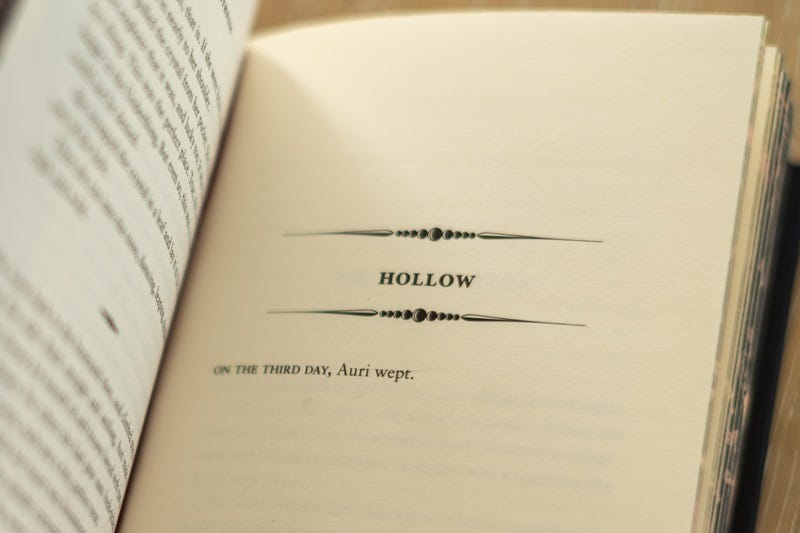
Yes. That's the entirety of the chapter. The title, "Hollow", and a single sentence: "On the third day, Auri wept."
This is an incredibly powerful chapter with more implied meaning that the one present in the page. It is difficult to appreciate for the emotional complexity presented here, and easy to get annoyed if we don’t look under the guise of the few words to find the literary tricks Rothfuss explored.
Let’s dive in.
This book follows Auri: one of the most curious characters from The Kingkiller Chronicles, and certainly one that's baffled a lot of readers. Auri appears very little in the series, and is always presented from Kvothe's perspective... but even then, we can realise she is not neurotypical, although the extent of her neurodiversity is not explicitly addressed in the main series.
However, The Slow Regard of Silent Things (henceforth, Slow Regard) is narrated exclusively from her point-of-view—meaning that a reader should not expect a reliable, straightforward narrator either.
Slow Regard opens with the following line:
"When Auri woke, she knew that she had seven days. [...] A long time. Long for waiting. But not so long for everything that needed to be done."
This bit of context indicates that Auri must complete something within the space of seven days while also adding urgency, and setting some motivations.
Yet regardless of that urgency, then we have that single-sentence chapter in which Auri just 'wasted' (quotes intended) an entire day weeping! Quaint.
If you have read anything by Patrick Rothfuss, you know that he is meticulous. His prose is a carefully curated, purposefully assembled sequence of words where you can find meaning anywhere and at any point, across books, and even if read skipping chapters. Slow Regard is just that but taken to the Nth degree—especially in this sentence.
If we consider the contextual opening line of the book, Rothfuss' tendency to weave hidden meaning, plus a bit of common sense, then "On the third day, Auri wept." can indicate many things although only one is explicit and on the page. Most of its meaning is depends—almost entirely—on the reader's empathy and understanding.
For example:
Regardless of the urgency and the limited seven-days timeframe, Auri spent the third one crying.
The lack of other actions, especially when compared to the detail in the other chapters, imply that Auri may not have done anything else but cry. No eating, no self-care, no going around, nothing.
If we've read the main novels, we know that Auri is quite thorough on her daily life. She's always clean, is picky about her clothes, and has proper manners. This makes her lack of actions here even quainter.
Now add the title "Hollow"—a meaningful chapter name of the type that summarises and/or reflects the contents. From it, we can infer that Auri was feeling empty inside, devoid of feelings, without reasons to act. A likely cause for her weeping.
If we remember that this book is narrated from Auri's PoV (a narrow third-person PoV), we can now assume she didn't even have strength to think (and thus narrate her own actions). From this, we can assume she was thoughtless for the entire day.
If we add some common sense brought from the real world... do you know what can make someone feel so hollow and empty, so devoid of strength that the only thing one can do is stare emptily and cry? Depression.
That is the point Rothfuss is trying to make.
Depression is a monster, and it can it someone alive. It sucks everything, leaving no motivation, no feelings, no thoughts, and sometimes no strength to eat or accomplish basic things such as self-care. Within a depression relapse there is nothing except a vacuum and a utter lack of emotions—not even sadness, just pure, abyssal emptiness.
"Hollow", like the chapter title.
But depression isn't a constant; sometimes the person can seem functional and suddenly have a relapse... something that seems likely given that Auri is 'fine' (in appearance) in the chapters before and after.
All of this is what Rothfuss is packing into that single sentence.
On the one hand it is genius! He is saying so much with so little—about Auri, about her mindset, her struggles, her day-to-day life. It forces the reader to evoke what they know of from their real-world life, to add those emotions into the page... especially if we consider she was so thoughtless she couldn't think enough to narrate. There is just so much we can learn about Auri in that single chapter.
However, most of it is implicit; not on the page but extremely dependent on the reader's understanding of mental health and what depression truly is.
On the other hand, that single-sentence chapter is awful.
When a writer packs so much implicit meaning they risk alienating their readers. For example, many may be lucky enough to have never experienced depression up close, or may speed read and not sit down to over-analyse a single sentence; others may prefer books that are more straightforward, while others simply want characters that are exactly like them and thus must 'relate' to the protagonist1. Furthermore, it is confusing—as we just mentioned, depression is inconsistent, and Auri being seemingly 'fine' in the chapters before and after can be baffling to many people.
Accessibility vs ‘Evokability’
What we are seeing here is a matter of (in my subjective opinion) accessibility vs evoking strong emotions:
Accessible text may require more descriptions, making everything less explicit and thus demanding less from the reader; it becomes less personal and, maybe, more telling.
Evoking strong emotions requires (often, not always) pulling from the reader's real-life feelings. Writers have to make a reader 'remember' their feelings to fill the gaps of the narrative. This is less accessible to those lacking specific experiences, thus adding complexity to the text.
Is it 'wrong' or 'right'? Well... there is no answer to that question. Reading is a subjective activity and while some of us may love this single-sentence chapter (that's me, by the way) others may just hate it. It's a case of both opinions are fine.
Copyright © 2025 Livia J. Elliot. All rights reserved. This publication is licensed for personal reading only. No article, or substantial part of an article, may be reproduced, republished, adapted, translated, compiled into another publication, incorporated into teaching materials or course packs, or used for AI training without prior written permission. Linking to the original articles is encouraged.
I have thoughts on ‘relatability’ which I shall discuss in another essay, later.