

Know the Rules, Break the Rules: What Embassytown Teaches About Meaningful Dialogue Formatting
Dialogue formatting guidelines are there for a reason, but with a good enough counter-reason, you can break the rules and craft something memorable. Let's discuss the case of Embassytown's Ambassadors.

When you started writing, one rule was probably drilled into you: every new speaker must have their own line of dialogue. I covered this—along with its interaction with body language and non-verbal communication—in Part I of my series on The Anatomy of Paragraphs.
But as we know, there are no real ‘rules’ in creative writing, only guidelines that may be broken or disregarded when doing so conveys meaning... and “meaning” is the key word here. It is that underlying purpose that makes it possible to steer away from the guidelines, to add more layers to the story without spending words in doing so.
The reason? As I have discussed multiple times here1, grammar and formatting are excellent tools to show and not tell. This is precisely what China Miéville does in Embassytown: he has a thematic reason (identity and individuality in a society that has normalised the erasure of both for a specific demographic), and he breaks two rules in order to convey it:
(a) capitalisation in names, and
(b) paragraphing in dialogue, because if one is blurring identity and attempting to create multi-body individuals, that famous rule—“every new speaker must have their own line of dialogue”—suddenly has highly undesirable implications.
In today’s essay, I’ll show you a number of excerpts concerning Miéville’s use of dialogue in Embassytown, from the presentation of the innovation to how the use becomes conventional within the novel. I’ll also do a brief thematic analysis of it. However, if you’re keen on a thorough study of the linguistics behind Embassytown, I recommend my podcast essay:

That’s said, let’s dive in.
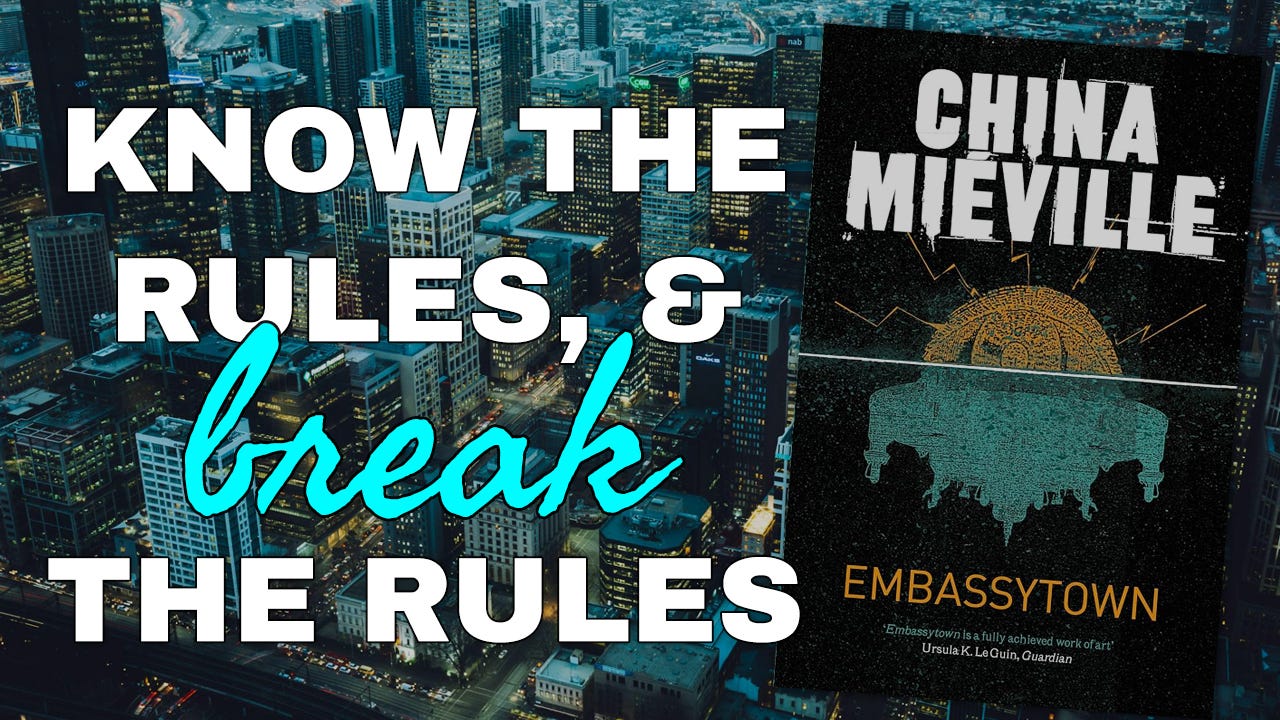
What makes Miéville’s rule-breaking work is that he is selective.
Within Embassytown, most characters follow conventional paragraph breaks in dialogue—meaning that every new speaker appears in a new paragraph, like so:
“The constables are coming,” he said. “I heard you playing. I thought it might help him to have a friend with him. You could hold his hand. […] You could tell him you’re here, tell him he’ll be alright.”
“Yohn, it’s me, Avice.” After a silence I patted Yohn on the shoulder. “I’m here. You’ll be alright, Yohn.” My concern was quite real. I looked up for more instructions, and the man shook his head and laughed.
“Just hold his hand then,” he said.
In this excerpt, the spoken words are kept in the same line as the tag—and Miéville is deliberately using the simplest of them all: I/he/she said2. In the second paragraph he’s also adding related non-verbal communication (e.g., Avice looking up and waiting expectant for an answer). But it’s all fairly ordinary, don’t you think?
However, this ordinary structure makes the later rule-breaking stand out. It shows that the formatting is not merely stylistic3, but carries meaning—one reserved for the characters whose dialogue follows an unconventional pattern.
Thus, when the unconventional pattern appears, the reader notices it immediately.
Let me show you one brief excerpt, from one of the first conversations where it appears:
“Honestly?” said EdGar. “They’re all worried.” “To various degrees.” “Some of them think we’re…” “…exaggerating. RanDolph thinks it’ll all be good for us.” “To have a newcomer, to shake us up. But no one’s sanguine.”
“Where’s JoaQuin? And where’s Wyatt?” [Avice said.]
“They’re bringing the new boy along. Together.” “Neither’s been letting the other out of their sight.”
There are a few details to consider here:
At first glance, this looks an exchange between two people: EdGar, and Avice. The paragraphing seems to confirm this thesis, because the exchange can be abstracted to the following beats: (1) EdGar explains his colleague’s mood, (2) Avice asks about two other people (and also somewhat ignores his commentary), then (3) EdGar answers her questions. Three paragraphs, three dialogue beats: EdGar, Avice, EdGar. But there is more than meets the eye.
We can also see that while some people have conventional names (i.e., Avice, Wyatt) others have strangely capitalised names (i.e., EdGar, RanDolph, JoaQuin)—names that, if we ignore the second-syllable capitalisation, read as a fairly common names (i.e., Edgar, Randolph, Joaquin).
But here’s the exception: EdGar’s speech closes the quotes and reopens them immediately after without the intervention of a body beat or dialogue tag. Like so: “They’re all worried.” “To various degrees.” In some cases, there are ellipses trailing at the end and beginning of a segmented dialogue as if to show some sort of pause: “Some of them think we’re…” “…exaggerating. RanDolph thinks it’ll all be good for us.”
To understand the rationale behind this choice, we need to step back and look at the setting of Embassytown, how its naming conventions reinforce the novel’s themes, and why this rule-breaking applies only to a very specific group of characters.