

Take It Literal: Literalised Metaphors in Speculative Fiction
What makes literature... speculative? Literalised metaphors, and their ability to enable thematic discussions, is a common answer. But what are they?

The term speculative fiction may be one of the most contentious labels in literature.
On the one hand, there are authors who refuse it despite their work fitting the description rather well—Margaret Atwood being the most prominent example. The suspicion is that the genre label may indicate something more akin to second-tier literature than anything else, and certain writers would rather not have it attached to their work1. On the other hand, there are equally vocal authors and readers who find speculative itself a rather “pretentious” label, and perhaps a failed attempt to compete with high-brow literature.
Yet regardless of the animosities, what makes a work of literature speculative?
One answer lies in a device called literalised metaphors—what Ken Liu defined as taking “some aspect of reality that we usually speak of as metaphorical” and then “making that metaphor literally true [to be] able to gain a different perspective and understanding of reality”2.
It sounds straightforward, but neither crafting nor reading (and understanding one) is simple. Therefore, in today’s essay, we’ll first dive into a more in-depth definition, cover three essential points, and for each, I’ll analyse very specific—and quite unconventional—examples: from movies, books, and graphic novels. After that, I will share a list of considerations to develop literalised metaphors.
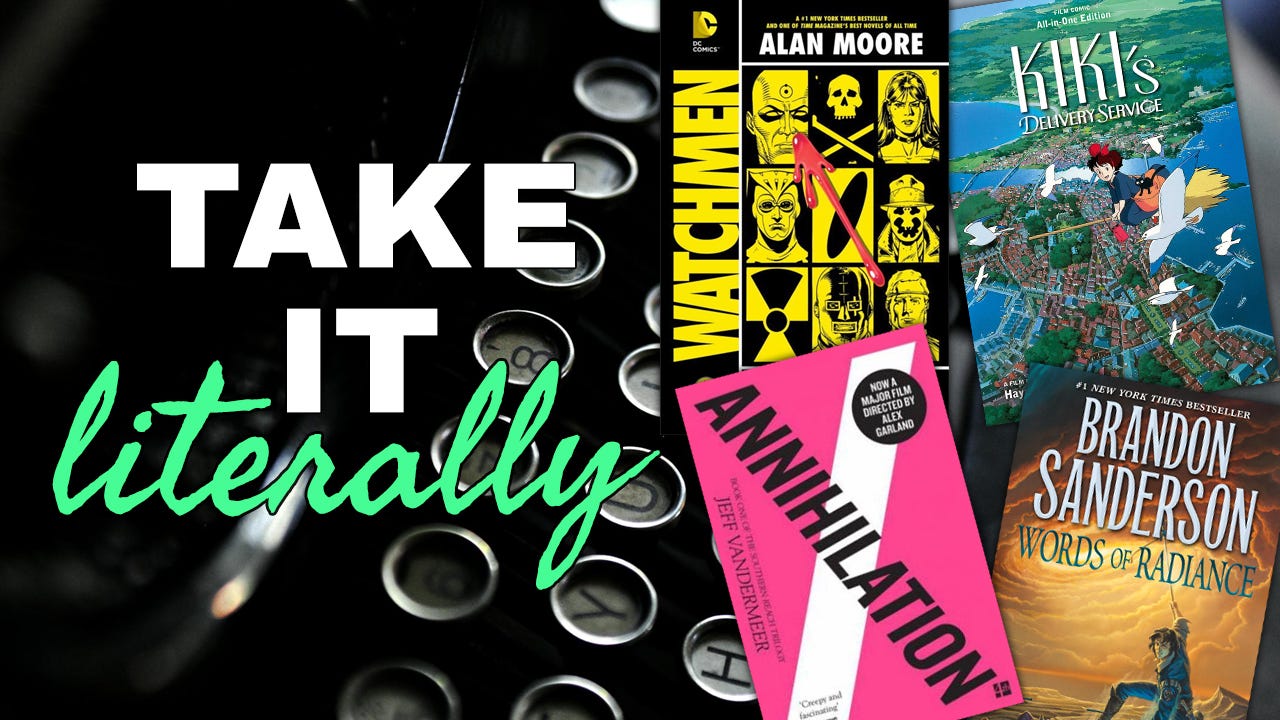
Literalised metaphors are a literary device:
One specific element (or a set of elements) within the text that add thematic depth and complexity, requiring critical reading skills—and maybe some philosophising—to be fully understood.
They are also the greatest enabler of thematic subtlety: an author’s ability to hide something—such as ideas, points of view, what-ifs, or even social or political commentary—within a book, in a way that only a critical reader would be able to discover what the author truly meant. As McKitterick observed3:
One of SF’s greatest tools is the literal metaphor, where an actual, literal thing in the story can stand in metaphorically for something in our world, as a means to critique that thing without immediately throwing up defensive walls against admitting we’ve failed in some way or otherwise need to improve.
But how is this done?
In ordinary language, regular metaphors work precisely because of the distance they create between what’s happening on the page, and what that truly means—not for the story or plot, but thematically. When we say someone was “rewritten by a difficult experience”, we understand the emotion without having to confront the thing itself: that whatever happened during that “difficult experience” deeply affected the person’s identity and self… but what if whatever happened had literally rewritten someone’s memories and personality?
By taking the metaphor well, literally—instead of as a figure of speech—we can create a whole story around it. That is precisely what speculative fiction does, though there are caveats to it.
