

Favourite Reads of 2025
My reading this year unfolded more slowly, but with more intention. Instead of rushing through lists, I let curiosity lead. Here are my favourite books of the year.

My reading this year unfolded more slowly, but with more intention. Instead of rushing through lists, I let curiosity lead. I found the odd, the undefinable, the books that don’t fit neatly into labels. New or modern releases, but also old books part of The Gutenberg Project.
As the year winds down—and before I disappear into the holiday season—I wanted to look back at what I read.
January: Walking on Glass (Iain Banks)
Rating/Review: ⭐⭐⭐⭐ Goodreads review.
Why: I found it because a friend recommended this book, and gifted me an old (and signed) second-hand edition. At a very surface level, it follows three seemingly unconnected storylines… but if you only read what’s written, then you’re reading only a 10% of what this book can offer. It is the type of reading that the more time passes, the more you’ll begin to appreciate it.
Central Themes: It is most of all, nihilistic. It wonders about the purpose of existence, and how easily we can make someone (or something) our sole purpose to live, thus forgetting that we are the main characters of our lives. It is a cautionary tale, but also a bringer of grim hope: that life continues after being broken and that we can, nonetheless, find a new purpose.
What the hell was the point of trying to rationally to analyse what was fundamentally irrational? [...] [L]ife was basically absurd, unfair and–ultimately—pointless

March: A Scanner Darkly (PKD)
Rating/Review: ⭐⭐⭐ Goodreads review.
Why: Technically, this is a masterpiece; subjectively, it’s boring.
It discusses identity in a subtle, quiet yet powerful way. Likewise, the ending note reveals that he actually based these characters on real-life people that were his friends—then lists them; most were deceased or with severe brain damage.
Why Not: Because the main characters are drug-addicts, the book relies heavily on meandering, incoherent conversations that are there to make you feel the brain fog drugs causes. It is presented in an incredibly realistic way because PKD was involved in the drug scene in his time… but it’s also meandering and difficult to read.
It is truly up to you, and whether you’ll withstand the intended meandering prose in lieu of reaching the rich thematic discussion.
Central Themes: There is a rich discussion on consciousness, following the masses, and defining oneself. This is also a cautionary tale about how little governments respect undercover officers and everything they go through, and how far a government is willing to disregard humanity and the individual effort.
Knowing what I know, I still stepped across into that freaked-out paranoid space with them, viewed it as they viewed it—muddled, he thought. Murky again, the same murk that covers them covers me.

May: Annihilation (Jeff VanderMeer)
Rating/Review: ⭐⭐⭐⭐ Goodreads review.
Why: It is a cautionary tale where VanderMeer was (perhaps!) pointing out that humanity’s need to comprehend (and thus to bend reality to our frameworks of knowledge) is a symptom of our arrogance—one that blinds us as to how insignificant we are in the grand scheme of things.
Annihilation is the ‘show-don’t-tell’ advice taken to the extreme. Instead of telling the reader about how incomprehensible Area X is, VanderMeer forced its readers to experiment this place through the eyes of the biologist.
Central Themes: It criticises humanity’s intrinsic need to understand, and how we cannot accept there are things beyond our limited comprehension of reality. It twists existential horror to drop the readers—alongside the biology—in a setting where making meaning is outright impossible.
With the tower, we [...] had no sense of its purpose. And now that we had begun to descend into it, the tower still failed to reveal any hint of these things.

July: Ubik (PKD)
Rating/Review: ⭐⭐⭐⭐⭐ Goodreads review.
Why: In my subjective opinion, this was a masterpiece. The kind only Philip K. Dick would dare writing.
It challenges reality in a multi-layered, facetted take of Plato’s allegory of the cave. The setting is unique, the world dissolves as the plot advances (or moves backwards, maybe), and nothing in this book can be taken at face value. There are layers of themes—from capitalism taken to the extreme, to the demiurge and the noumenal/phonomental words—and a fast-paced narrative that twists the plot as much of the world where it happens.
Central Themes: This is a play on Plato’s allegory of the cave… except that, for PKD, there is no ‘out of the cave’, just another cave, perhaps different. He consistently asks: how many layers of reality are? What if you “awaken” from one reality into another, then “awaken” into another? But, maybe, there’s no safe layer of reality at all.
He felt all at once like an ineffectual moth, fluttering at the windowpane of reality, dimly seeing it from the outside.

November: Embassytown (China Miéville)
Rating/Review: ⭐⭐⭐⭐⭐ Goodreads review. (Though, if I’m honest, I’d give it 10/5 because this is another masterpiece).
Why: This is an idea-driven, frame narrative about the importance of language to every culture, and what language can do for our ability to think and express those thoughts. It both a meditation on language and an act of linguistic imagination itself. A novel that demonstrates what words can build, and what they can destroy.
If there is anything I would critique of this novel is the sheer amount of themes that were hinted at but not focused on. I’d love a sequel in the same universe, but I fear it may detract from this story.
Central Themes: The focus is on linguistics and, perhaps, the strong Sapir-Whorf hypothesis; Miéville seems to also be playing with the semiotic triangle, and De Saussure’s concept of sign. There is also considerations on what deception, and the cognitive mechanisms behind it, allow us to think. Beyond that, the book also includes a subtle but clear political commentary around colonisation and cultural invasion, as well as unanswered questions around identity, and the ethics of cloning. Truly, this is a rich work.
[The Hosts] spoke rapidly, craned their eye-corals. [...] I do not know, one Host said to CalVin, about me, how I did without her, how I thought what I needed to think.
PS: The podcast episode on Embassytown will be the opener of Season 3. Can’t wait to share it with you.
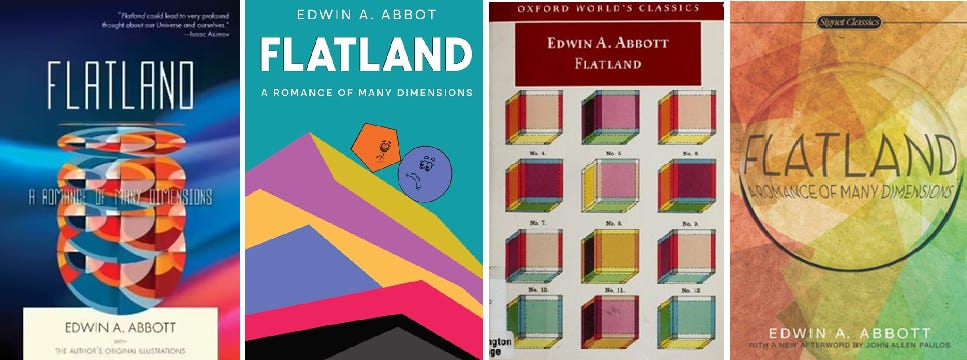
November: Flatlands (Edwin A. Abbott)
Rating/Review: ⭐⭐⭐⭐ Goodreads review.
Why: I found this book in the most unexpected of ways, searched it, and found it on the Gutenberg Project. It is a work of imagination, sheer mathematical speculation blended with an satire of Victorian society. A satire mocking elements that we—unfortunately—can still see in modern times.
Central Themes: This is an epistolary narrative told by none other than a Square—yes, the geometrical figure—living in Flatlands: a realm of two dimensions. The first half of the book is Square’s attempt to explain how Flatlands works, dimensionally and socially; this part is a social critique wrapped in a satire. The second part recounts Square’s visit to Lineland (the realm of one dimension) and his encounter with a Sphere from Spaceland (the realm of three) to speculate on the existence of other dimensions that we can neither perceive nor explain.
Overall, the mathematical speculation is equally compelling. Abott asks whether other dimensions or realms of being do exist and whether we have the capacity to perceive them. He imagines what those dimensions would be, and how would they affect the 3D forms we take for granted. Socially, he also captures the intrinsic resistance such discoveries provoke—the denial, the accusations of heresy, and the institutional mechanisms that suppress inquiry.
Warning: The satire is sharp but easy to miss, and if you don’t recognise it, the book may come across as deeply offensive. Read with that lens, though, Flatland becomes not only a mathematical curiosity, but a surprisingly incisive critique of its time.
That’s the shape of my reading this year. I’m stepping back for a little while, so this will be my last post of the season. Wishing you a peaceful start to the new year—and I’ll be back in 2026.
Until then, happy reading.
Livia~
Copyright © 2025 Livia J. Elliot. All rights reserved. This publication is licensed for personal reading only. No article, or substantial part of an article, may be reproduced, republished, adapted, translated, compiled into another publication, incorporated into teaching materials or course packs, or used for AI training without prior written permission. Linking to the original articles is encouraged.