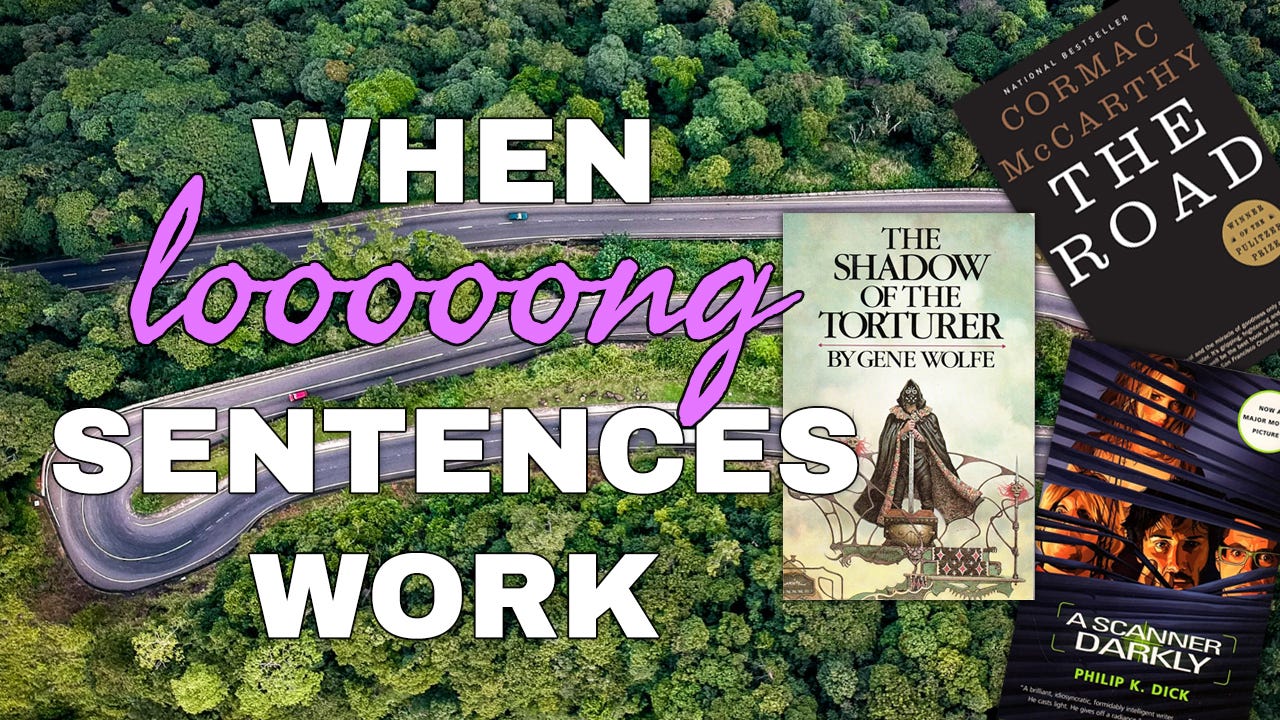
When Long Sentences Work: Why “Write Short Sentences” Is Incomplete Advice
“Write short, easy sentences” is often repeated without mentioning the caveats it relies on: audience, genre, and narrative distance. This essay focuses on how these elements justify long sentences.

“Write short, easy sentences” is common writing advice… yet many of the most celebrated writers use long, winding sentences to extraordinary effect. Consider this excerpt:
It would appear as if nothing was there, nothing at all, as if the words wrote themselves, and then the Crawler would tremble into being and then wink out again, and all that remained constant was a suggestion of an arm and the impression of the words being written.
It’s from the final quarter of Annihilation, the award-winning novel by Jeff VanderMeer.
Is it long? Certainly. Meandering? Most definitely, but deliberately so: the narrator is trying to process a shocking experience, and the prose style reflects her disoriented mental state.
So: is the advice wrong?
I don’t think so, no. However, I’d argue this specific writing advice is often repeated without mentioning the caveats it relies on: audience, genre, and narrative distance.
That audience and genre affect a reader’s preference should surprise no one.
Consider the audience. In a story aimed at middle-grade readers, the prose must strike a very particular balance between (a) matching the literacy level of its audience and (b) still encouraging them to grow as readers. Most sentences should therefore be accessible, though some may offer a mild challenge; this can be either because of the sentence structure or the words used.
However, those same short, straightforward sentences may not suit a different audience. In literary fiction aimed at adults, for example, these may be perceived as simplistic—or, worse, as poor prose. The judgement comes due to a mismatch between what the book offers and what the audience prefers.
Something similar happens with regard to the book’s genre.
Just as each genre prefers different themes and plot structures, they also prefer different writing styles. Readers of epic fantasy, for example, may find long sentences exhausting, while readers of psychological horror may appreciate the sense of mental spiralling or suffocating immersion created by the shape of the prose itself.
Yet there is another element that is often omitted when repeating this advice: narrative distance can affect sentence structure—and this is precisely why that excerpt from Annihilation works.
This is what I will explore in this essay: why long, winding sentences may be appropriate when the narrative distance is small or non-existent. To this effect, I will analyse excerpts from famous writers—including Cormac McCarthy, Gene Wolfe, Philip K. Dick, and Jorge Luis Borges. For each, we’ll aim to understand the possible reasons as to why they were used, and the effect it has.