

Look Around You: Why McCarthy Switches to Second Person in The Road
“Write in a single tense and grammatical person,” most writing advice would say—and yet some authors do it, deliberately and purposefully. Let's study the case of The Road, by Cormac McCarthy.

“Write in a single tense and grammatical person,” most writing advice would say.
And yet some authors will simply switch from third-person to second-person. Like so (bold style is mine):
He could remember everything of her save her scent. Seated in a theatre with her beside him leaning forward listening to the music. Gold scrollwork and sconces and the tall columnar folds of the drapes at either side of the stage. She held his hand in her lap and he could feel the tops of her stockings through the thin stuff of her summer dress. Freeze this frame. Now call down your dark and your cold and be damned.
Some may call this a ‘problem,’ or even daringly criticise the author for ‘committing an amateur’s mistake’—and yes, tense- and person-switching can be both of those things… if done unintentionally and because of losing the story’s tone.
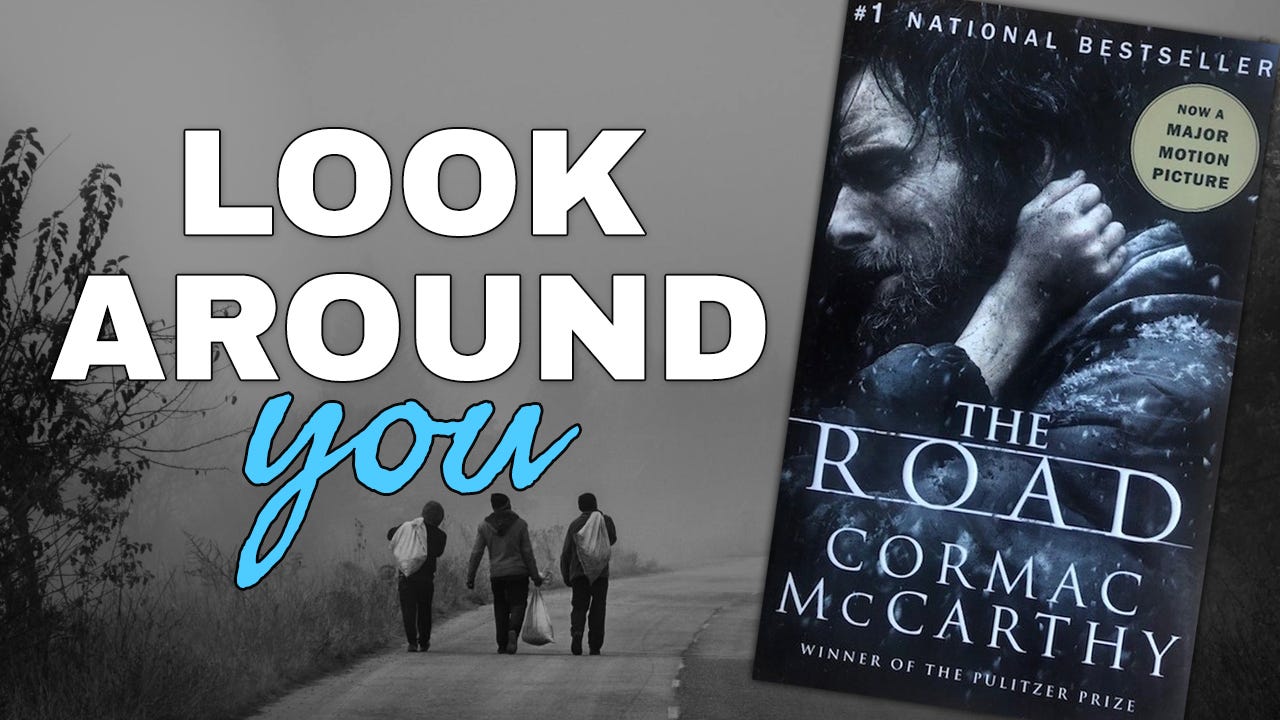
However, switching can also be deliberate, leveraged as a device in order to cause a specific effect. This is what the quote above is doing—a popular excerpt from a Pulitzer Prize winning novel: The Road, by Cormac McCarthy.
That changes things quite a bit.
Yet McCarthy was not the only one—and neither the first one—to have used it. Consider this other excerpt, which actually predates The Road; it’s the third and fourth paragraphs of Heat, a 1989 short-story by Joyce Carol Oates1:
Rhea and Rhoda Kunkel went flying on their rusted old bicycles, down the long hill toward the railroad yard, Whipple’s Ice, the scrubby pastureland where dairy cows grazed. They’d stolen six dollars from their own grandmother who loved them. They were eleven years old, they were identical twins, they basked in their power.
Rhea and Rhoda Kunkel: it was always Rhea-and-Rhoda. never Rhoda-and-Rhea, I couldn’t say why. You just wouldn’t say the names that way. Not even the teachers at school would say them that way.
Joyce Carol Oates is not an amateur author.
By now, I hope I’ve convinced you that this switch seems deliberate—and if so, you must be probably asking one very sensible question: what’s the purpose of switching like this?
That’s what we’ll explore in this essay. We’ll analyse some examples from The Road while reviewing some English grammar rules to understand both the purpose and the effect they have on the reader.
In English, the second person is not straightforward.
It has quite a few uses beyond addressing one’s audience.
Because of this, its presence may not indicate that the story is a framed narrative, though it may—quite subtly—breach the fourth wall to impact the reader in a way that the other grammatical persons may not be able to pull off. But before we reach that point, I want to review some specific grammar rules.
Everything builds from the generic you.
You (not generic, pun intended) have probably heard sentences such as this: “Brushing one’s hair is crucial for appearances.” Here, the pronoun ‘one’ is called the singular impersonal—but in everyday language, that phrase may be said like this: “Brushing your hair is crucial for appearances.” When we use ‘you’ to replace the singular impersonal pronoun ‘one’, we call that the generic you.
The “Brushing your hair is crucial for appearances” is not giving an order to—or making a claim about—a single individual (in particular, whoever is reading this). It is talking about virtually anyone. It’s generic.
Therefore, one reason to change to second-person in the middle of a narrative can be to appeal to the generic ‘you’—instead of relying on ‘one’—if the narrative’s tone must be more aligned with colloquial speech.
Consider this example (again, bold styling is mine):
