

Two Narrators, One Place, Different Takes ~ Narrators Series #6
In fiction, limited narrators bend the story according to their biases. This essay reflects on how point-of-view alters a hallway's description by analysing the description provided by two characters.

Reading a story with a limited narrator is like borrowing someone’s glasses. The lenses might sharpen certain details, blur others, and tint the whole world with their personality. Thus, everything you see, hear, and know about this world depends on the narrating character, to the point their opinions become your facts, and their blind spots become your blind spots.
That’s the power—and the trap—of a limited narrator: the narrative style itself is part of the character.
This “limitation” is an incredibly useful tool that can allow you to present the world—and the spaces/locations within it through the character themselves.
Allow me to give you one example. You have two characters both looking at a fictional plaza:
Character1 is an architect. Therefore, they may do what architect does: they’ll be utterly oblivious to the people (unless they’re damaging a building), they may focus on historical buildings, lament their poor state of preservation, remember obscure details about the infrastructure, and even criticise the choice of colours.
Character2 is a cook. Standing in the same plaza, they may be utterly oblivious to the architecture but instead notice every restaurant or food stall, may have strong opinions about the food, the cooking style, the serving size, the scents in that place…
It is the same physical space, but both of them notice different details—details that are directly linked to who they are: their profession, their education, their preferences and interests. Therefore, by leveraging the character’s perception, a mere description of a place can actually do a double-duty: it world-builds and character-builds at the same time.
I have a quaint example for you today…
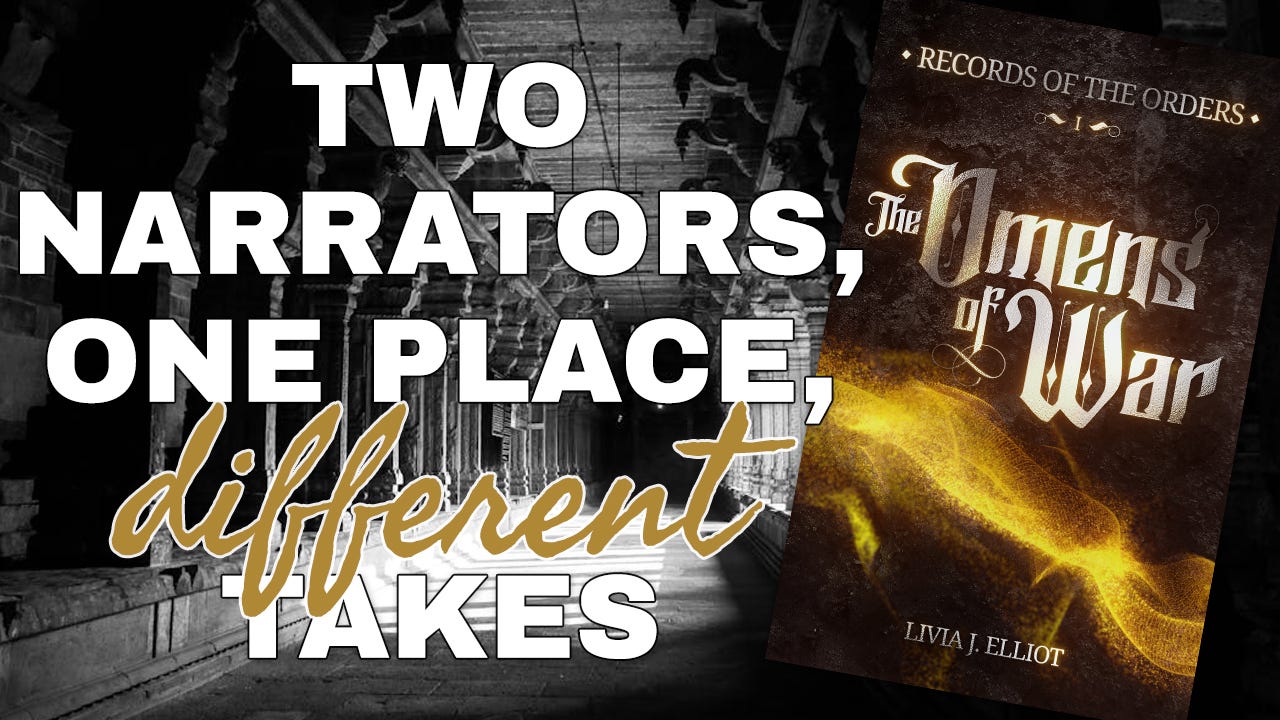
—and it is, again, taken from my upcoming book, The Omens of War.
Given the setting of my book, I put a lot of effort into trying to depict how ominous or big some of the buildings are. Thus, when I was writing it, I had one character walk through a very special corridor, and a few chapters later, his son goes through it was well.
I am a plotter, so I knew very well I wanted both characters to cross through the same place—and thus wrote it while actively asking myself: What does this character focus on? I thought the result (which is two non-spoiler passages) was quite cool to bring it here and dissect it!
Therefore, this essay will cover:
The father’s paragraph, and what (and why) I chose to make him focus on some specific elements.
The son’s paragraph, his opinions and my writerly needs.
What I focused on to clue the reader that it was, in fact, the same corridor as a way to foreshadow what would happen afterwards.
The excerpts I have here do not contain spoilers, and at the end—as usual—I’ll have some homework for you to practice as well.
Let’s get this one!
The father’s point-of-view
The father is called Centurion Juçe Praeto from the Eastern Legions of Firard. He is, by far, one of the character’s I despise the most—but let’s not allow that to interrupt the analysis.
In my world’s setting, and in the nation of Firard, people start training after their 8th birthday… and Juçe is around 60 years old. He has served, quite literally, for his whole life—and so has a very specific worldview and focus.
Let me show you the excerpt:
Juçe walked in the dark, starlight pouring through the Citadel’s broad casements. His footfalls hammered the floor with precision, his armour shifting with restrained menace. Four blind arches decorated that hallway, one statue inside each—Centurions from an era gone by, their armour simpler, their legends preserved in history. They’d be ashamed of what the Emerald Legions have become. He raised his chin as he walked past, turning the corner.
His tone is not precisely clipped, but it is leaner than usual. There are few adjectives, but Juçe pays particular attention to how things are positioned in that hallway. For example, he notices exit points (the “broad casements”), then counts how specific elements: “four blind arches” then “one statue inside each” almost as if he were surveying the hallway and accounting for enemies—something that makes sense, given he was bred for war.
After that, Juçe pays attention to the statues’ armours, by saying:
Centurions from an era gone by, their armour simpler, […]
This fragment of a sentence serves two purposes: (a) it is still describing the places while implying the building is old (or the statues would depict newer legends), and that (b) Firard has endured for so many years that the Centurions’ armours evolved. Thus, you have setting and a world-building detail.
However, the “their armour simpler” is a halved comparative; if it were correct grammatically, I’d written “their armour [was] simpler [than X]”… except I chose not to for several reasons:
The clipped/lean tone is a bit more military. They say what’s needed and that’s it.
The comparison is hinted at instead of explicitly put in the page. In the prior sentence, Juçe stated that he is walking armoured: “his armour shifting with restrained menace”. Thus, we can assume he’s comparing the statues’ to his own.
The comparison is, again, part of that “surveying” Juçe is doing: counting arches, counting statues, assessing their armour. This is almost instinctual to him.
Yet what follows afterwards is more character centric:
[…] their legends preserved in history. They’d be ashamed of what the Emerald Legions have become.
This is also pulling a double-duty! The "bit “their legends preserved in history” hints that not every Centurion gets a statue, just those that became legends for one reason or another. The thought (highlighted in italics) actually discloses Juçe’s political opinion about the current state of affairs: he is not very pleased, and is the classical case of being stuck in the “good ‘ole days”.
However, given that this is a very limited third-person narrator—as a reader—you should take the character’s opinion with a grain of salt. Juçe may think the past was better (“they’d be ashamed” isn’t it?) but another character may even think the nation has evolved, or perhaps not changed at all.
This intersection between the scene (the hallway with the arches, and the statues) and the character having an opinion about the scene (i.e., about the statues) actually pulls a double-duty: world-building (i.e., a bit of history of Firard) and character-building (i.e., Juçe’s opinions about the state of affairs).
But this hallway can look different when described through someone else’s eyes.
The son’s point-of-view
The other point-of-view is Legate Dante Praeto—Juçe’s older son. Dante was also trained since his eight birthday, but as a strategist/politician; by the time of the story, he’s 38 years old.
Now, Dante’s passage had an added “difficulty” I had to deal with: he was not well. Without spoilers, let us say the poor fella just had a terrible, terrible night. Therefore, he describes the corridor as follows:
The pre-dawn light gleamed over the polished floors, rimming the edges of the archways and casting a halo around the statues encased between them. Four towering Centurions armoured in marble—finely sculpted, and faithful to the simpler designs worn several centuries before.
Legate Dante Praeto halted between them, fists clenched as he contained the urge to hurry into the next corner. I can’t submit to this… restlessness. His hands were shaking, his heart galloping out of his body, that whistling ringing in his ears. The events of the day before absorbed his thoughts, […]
Notice the choice of words first. Dante says “gleamed”, “polished” , “a halo”; his vocabulary is a bit more elevated, his sentences are longer and more flowy. Dante doesn’t count exits, doesn’t focus on how many figures/enemies are there but on time—it’s the pre-dawn1, the day is just starting.
Dante doesn’t have the best relationship with his father, and that could—perhaps, who knows—reflect on the fact that he describes the statues as “towering.” Granted, marble statues could be, technically, quite tall—which is another correct read.
However, notice how he refers to the statues’ armours:
[…] towering Centurions armoured in marble—finely sculpted, and faithful to the simpler designs worn several centuries before.
When Juçe focused on the tradition and the legends, Dante is focusing in history—a discipline that concern him as a politician/strategist. After all, history is important because you can learn a lot by studying the causes of prior wars, why some treatises failed, why others lasted, and so on.
Now, if you compare both fragments, there is one blatant lack: Dante has no opinion about the statues. To him, they are just statues; history, that’s it. He doesn’t feel the weight of those Centurions’ legends, doesn’t lift his chin. In fact, Dante is so distressed that he stops between them to chastise himself about how he feels—which was not a minor event, but I won’t spoil it.
Now the question is… how do you do this?
I have said it before but I am a plotter—and sometimes, I can be as extreme as plotting paragraphs sentence-by-sentence, especially in the more imagery-driven scenes. Therefore, what I’ll list below is my own workflow; if you are a pantser/gardener storyteller, you may need to adapt it to your flow.
So how do you do it? Here is a handy list of considerations:
List what the character knows: this is their profession, technical knowledge (or lack of thereof), interests, topics that they may know about tangentially (e.g., their mother was a historian, therefore, they have heard of things but don’t know them).
Narrow down how much of that character’s knowledge is relevant to your reader: (a) in this specific scene, and (b) at this point in the story.
You may want to consider knowledge that you may need to: (a) hammer down and repeat because it’s important, or (b) begin to foreshadow for future scenes.
Remember: whatever you do, just give the reader the bare minimum. Info-dumping tends to break immersion, and even if a character is obsessive about something, there are other ways to portray that.
Understand the scene in question, and what elements of it will make the character react. Because:
In first-person narrations, you can blend the opinion with the text in quite a straightforward manner because everything is assumed to be the character’s thoughts. The reader will understand it immediately.
In a limited third-person, you need to cue in the reader that the narrator is, in fact, limited and no omniscient. Thus, changing tone, sentence structure, focus, and other details will aid you here. If you’re percolating thoughts amidst the narrative, make sure the thoughts come immediately after the thing the character is “having an opinion of.”
Once you have the draft and the content mapped out: polish! Let the prose flow!
Over to you!
I have a bit of a homework for you because, as I always say, practice makes perfect. If you won’t practice, you won’t improve.
Therefore, today’s task is to narrate a botanic garden from the PoV of two different characters: (a) a noble with extensive knowledge of gardening, and (b) a bookworm who rather be inside than amidst the wildlife. Two paragraphs, one for each character.
Before we leave, allow me to tease you a bit further.
Lovecraft meets George R.R. Martin meets Marcus Aurelius and Jean-Paul Sartre in this genre-blending cosmic horror fantasy. You can bookmark it in Goodreads, or you can go to Amazon and preorder it.
Happy writing and reading,
Livia~
Copyright © 2025 Livia J. Elliot. All rights reserved. This publication is licensed for personal reading only. No article, or substantial part of an article, may be reproduced, republished, adapted, translated, compiled into another publication, incorporated into teaching materials or course packs, or used for AI training without prior written permission. Linking to the original articles is encouraged.
Dawns and dusks are longer in this story, because this particular world has two suns, and the suns are silver… which messed up with the colours of the sky, but that’s a completely different discussion.