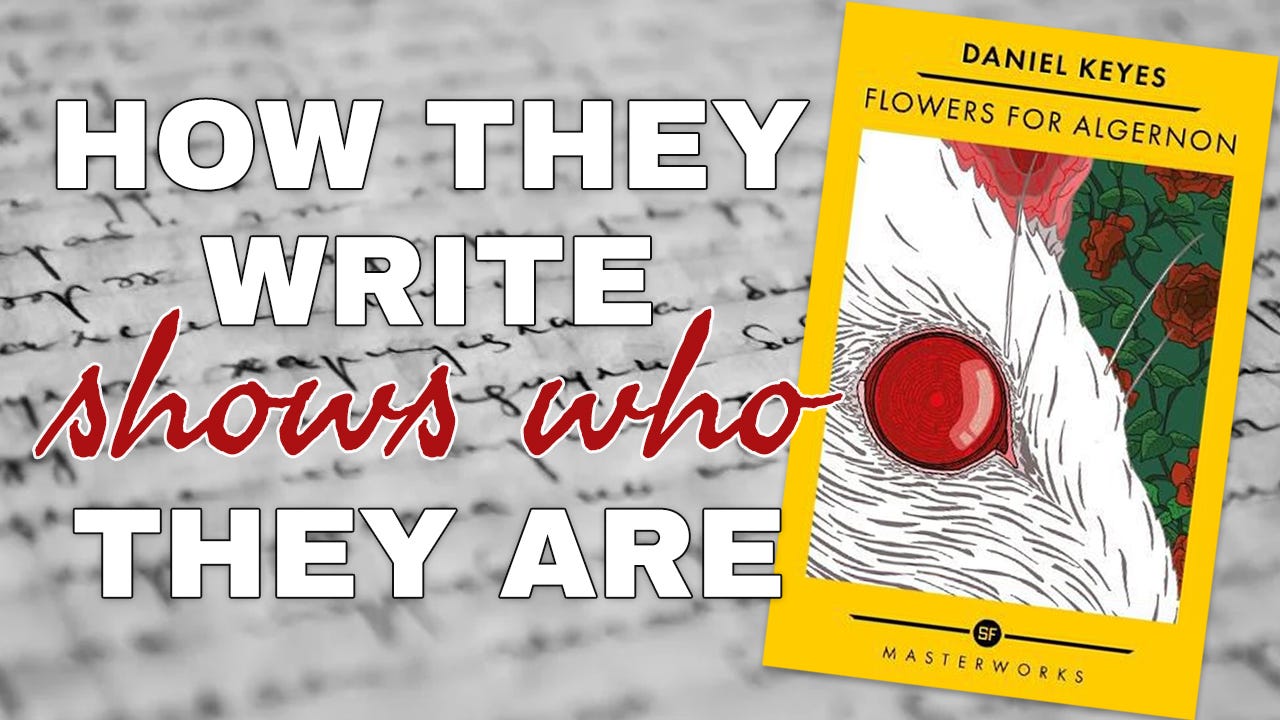
How They Write Shows Who They Are ~ Narrators Series #4
Proper grammar is overrated—or, perhaps, grammar is just one of the many tools in a writer's belt to achieve the fabled show-don't-tell advice. Let's review the case of epistolary narratives.

“Show, don’t tell.” It has to be the most overused, catch-all advice in the world of creating writers… and if you’ve been reading Books Undone, you may noticed I try my best to bring a myriad of examples on how this can be achieved under many different circumstances.
Therefore, today I want to discuss a very specific case: epistolary narratives with a close (or nil) temporal distance. This style has some quirks that allow writers to leverage grammar, sentence structure, and words choice to demonstrate crucial characteristics of the character (namely, show) without actually mentioning them in the prose (namely, tell).
To demonstrate this, we will analyse one groundbreaking novel. Flowers for Algernon by Daniel Keyes.
That said, before getting into the minutiae, we will first introduce some baseline concepts around the style, plot and setting, to ensure we’re all in the same page. After that’s done, I’ll present the analysis and—as usual—conclude with specific guidelines as to what to consider when applying this technique.
Let’s dive in!