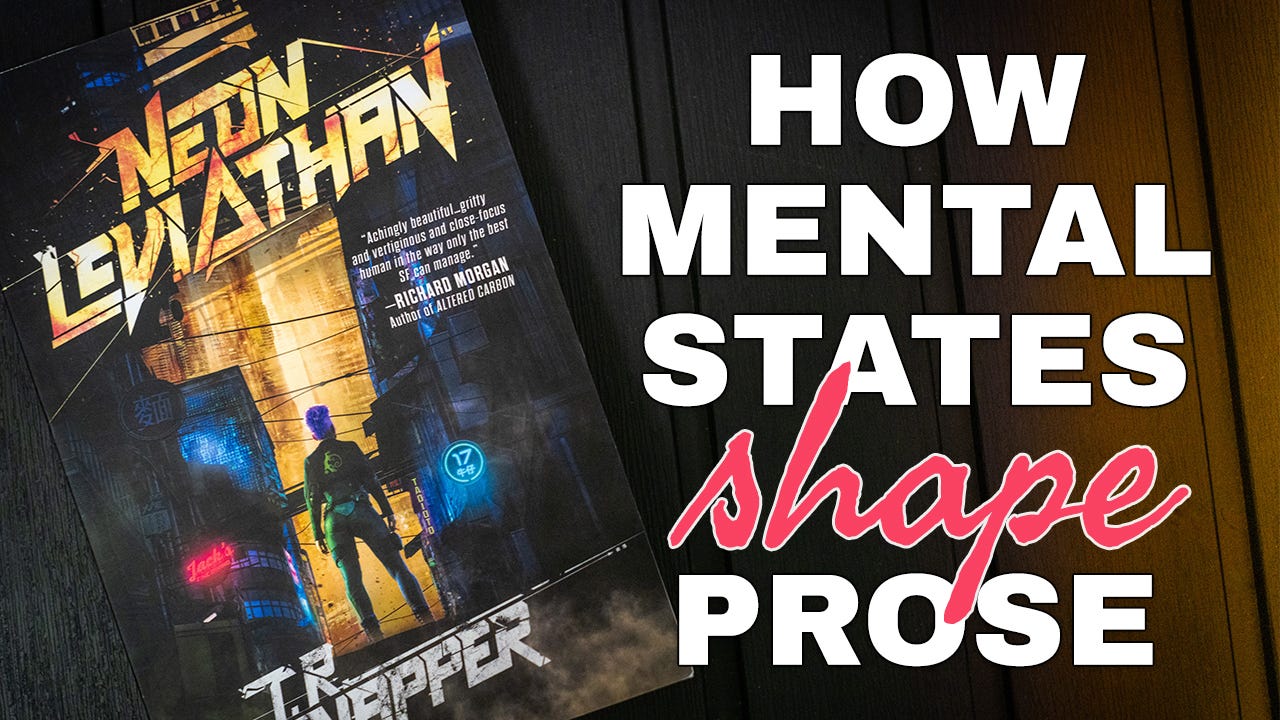
How Mental States Shape Sentences ~ Narrator's Series #5
In first-person narration, the prose itself showcases the narrator's mental state. This essay analyse one excerpt in detail, then outlines steps and considerations to apply this technique.

When narrating in first person the prose itself is often understood as the character’s own thoughts. Therefore, to steer into a more literary style, you should manipulate the prose itself (i.e., the words used, the grammar, the sentence structure) to showcase the narrator’s mental state without needing to rely on them “telling” it.
Let me give you a few examples to clarify what I mean:
Case 1: The hero just received a concerning wound, and they’re bleeding out. Realistically, the loss of blood has several symptoms, such as: fatigue, pale skin, shortness of breath, a rapid heartbeat, and dizziness. This can escalate to include confusion, lack of focus, sweating, etc. Would a character that’s loosing that much blood narrate coherently? Would they have perfect grammar and elevated C2 words? Even if they normally speak as such, the blood loss will affect their focus, their ability to articulate thoughts, and their reasoning.
Case 2: The narrator is extremely afraid. Fear triggers the sympathetic nervous system's "fight-or-flight" response (the famous 4Fs), leading to hyperarousal and hyperfocus on a perceived threat. This change will have physical effects, but because the parasympathetic nervous system is overwhelmed by the sympathetic… well, we loose the ability to reason, and we fall into instinct. Would a narrator in this state will be able to maintain a coherent narrative? Would they be able to say things such as “his blood was carmine like the sunset over the river”? Or would they just think: “Red. Everywhere. Blood. Not mine.”?
This is not just about making the narrative physically realistic, but about immersion.
A savvy reader will be able to read the text and say: “Mmm… wasn’t this guy bleeding out? Why does he sound so articulate?” The moment the reader asks themselves such a question, they become aware that they’re reading a book… when, in actuality, you want them to experience the story not to be aware they’re reading a story.
First person narratives (especially in present tense) are great to make someone feel that whatever is happening to the narrating character is happening now—but to achieve that, the narration must be coherent with their mental state.
On today’s post…
—I’ll be showing you a very concrete example of hyperarousal and how that affects the narrative. For those who don’t know, hyperarousal refers to a state of high physiological and emotional alertness often characterized by a persistent feeling of being on edge1.
We will be analysing a concrete excerpt from an award-winning novella published in 2020. I’ll show you the excerpt first, then we’ll break down the analysis into choice of word, grammar and sentence structure, and how that conveys the narrator’s mental state.
Ready? Let’s get this book undone!