The Anatomy of Paragraph Breaks (Part 2): Voice and Pace
Paragraphs are pacing devices that can accelerate, destabilise, or fracture a reader’s experience. This essay covers how to break the rules of paragraphing to mirror the narrator's mental state.

PART I (Basics) | PART II (Pacing) - HERE! | PART III (Meaning)
In storytelling, paragraphs are a fundamental structure whose impact extends beyond content organisation and structure. Well-used paragraphing can layer meaning, shape pacing, and influence voice—which is especially useful in limited narrations.
Yet, paradoxically, using paragraphing to do more than just organise content often means purposefully breaking the usual rules.
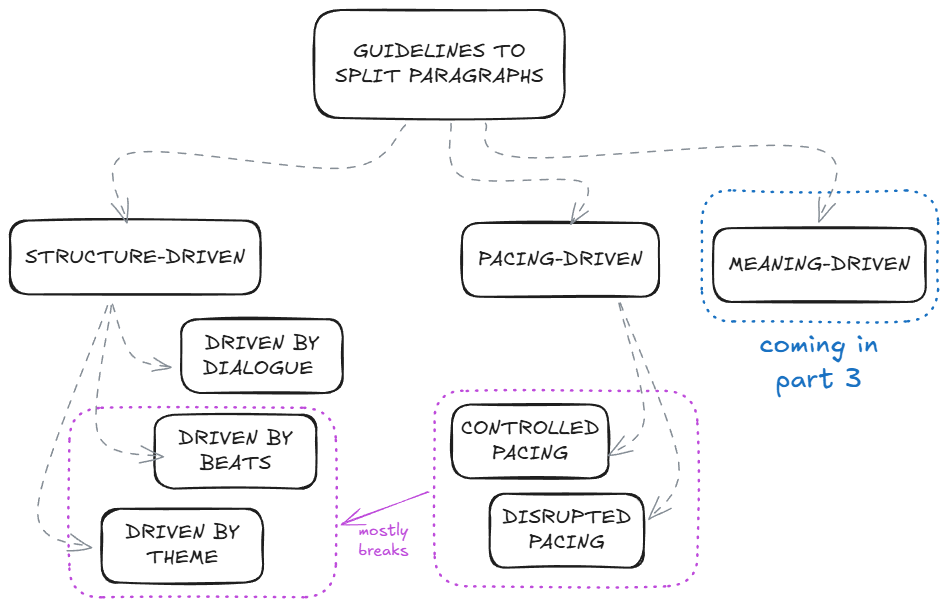
That is why last week, in Part I, we explored the basics: guidelines based on story structure, and driven by three different elements: by dialogue (extending speech to include body language and non-verbal cues), by beats (physical movement) and by theme (the story’s focus).
Today, in Part 2, we’ll look at how to break those rules deliberately, to enhance voice and pacing. Next week, Part 3, will explore examples of rule-breaking that deepen meaning and strengthen thought-patterns.
Just like we did last week, for all the cases we’ll discuss today, I will present example excerpts from different books so you can see this in action. Today’s examples include Ray Bradbury, Jeff Vandermeer, and T.R. Napper.
Although this discussion is geared toward writers, critical readers will find it just as valuable. Once you start noticing how paragraphing can steer the reading experience, you realise that much of a story’s thinking happens not just in sentences, but in everything around them.
Guidelines Set #2: Rule-Breaking To Enhance Voice & Pacing
As we saw before, the most commonly taught guidelines for breaking paragraphs were based on the structure of the story itself, and responded to changes in who is speaking, what action is taking place, and where attention (or characters) go.
Used well, these rules produce a structurally sound narrative… but everything changes when: (a) your narrator is limited (either in first- or third-person), and (b) you want to leverage paragraphs’ secret “show” power.
This is where the rule-breaking begins.
It is not haphazard, aesthetic-driven rule-breaking. What I will introduce is a purposeful, analytical approach to paragraphing based on how punctuation affects reading speed—even when reading to yourself—and how sentence plus paragraph structure can mirror the narrator’s mental state. This, in turn, has two effects on pacing:
It may control pacing (which does not imply restraint only), or
It may disrupt pacing.
Both effects deliberately override the usual guidelines for splitting paragraphs by beats and by theme.