

Plausible Lies, Unbelievable Truths: When Fiction Dresses as Non-Fiction
Some fiction doesn’t feel like fiction at all—and that’s purposeful. Let's explores how narrative can borrow the tone and authority of nonfiction to convince, confuse, and create eerie realism.

There’s a particular kind of fiction that insists it is not making anything up and that everything within it is real. It appeals to sources, facts, gossips, expert voices—sometimes real, sometimes invented but carefully presented—to make its lies more believable.
You’ve likely seen it in thrillers (e.g., the famous The Blair Witch Project) or within speculative fiction (including near-future sci-fi, urban or portal fantasy)… but it’s also used across other subgenres.
Done well, it does more than immerse. It disorients. It persuades. It convinces the reader that what they are reading is not fiction but non-fiction—factual, truthful. Done well, it can make a cautionary tale even more terrifying.
Fiction that borrows nonfiction’s tone doesn’t just aim to entertain. It wants to affect you deeply.
Let us discuss two dissimilar examples.
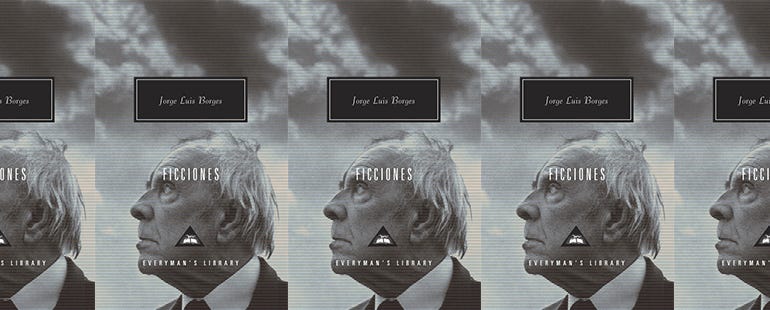
Tlön, Uqbar, Orbis Tertius
This is a short story written by Jorge Luis Borges, often classified as a “philosophical short story” with “elements of speculative fiction and fantasy.” It may be short, but it is incredibly complex. I have a podcast episode on it, in case it interests you:

One of the most curious things about Tlön, Uqbar, Orbis Tertius (henceforth, Tlön) is how deliberately it disguises itself as non-fiction.
So let’s begin where the story begins:
I owe the discovery of Uqbar to the conjunction of a mirror and an encyclopedia. [...] The whole affair happened some five years ago. Bioy Casares had dined with me that night [...] Then Bioy Casares recalled that one of the heresiarchs of Uqbar had declared that mirrors and copulation are abominable, because they increase the number of men. I asked him the origin of this memorable observation and he answered that it was reproduced in The Anglo-American Cyclopaedia, in its article on Uqbar. […] The house (which we had rented furnished) had a set of this work. On the last pages of Volume XL VI we found an article on Upsala; on the first pages of Volume XLVII, one on Ural-Altaic Languages, but not a word about Uqbar. Bioy, a bit taken aback, consulted 3 Labyrinths . the volumes of the index. In vain he exhausted all of the imaging able spellings: Ukbar, Ucbar, Ooqbar, Ookbar, Oukbahr…
It sounds personal, right? It is first person, it reads like a memoir or a personal essay, and allows itself some casual vocabulary as to make it feel less stiff and more relatable. It sets the mood right away:
The whole affair happened some five years ago […]
But who is the narrator?
Excellent question—one that many people have asked because that’s part of the trick.
The narrator may be unnamed, but the details feel suspiciously real. Borges included references to his actual friends—Bioy Casares was a writer of that era, and renown for his frequent collaborations with Borges—and layered the narrative with precise-looking citations and obscure academic references. There are even footnotes (part of the narrative) added into the “essay” to make it feel more real. Readers have long assumed the narrator is Borges (and you can see this in many of the story’s reviews), which adds to the illusion.
This is the first line blurred: because the narrator appears to be real—and more precisely, it seems to be the author himself.
For Borges’ original readers—Argentina, 1940—it would’ve been easy to read this as a straightforward essay. The “I” seems to be Borges himself, and if Borges is narrating… then surely this happened. When fiction borrows the tone and trappings of nonfiction, it does more than mimic—it manipulates.
Except it didn’t… so let’s keep digging.
What follows after is that Borges and Casares go to different places trying to find copies of The Anglo-American Cyclopaedia, only to encounter that some had references to Uqbar, while others didn’t. Even worse, they come across a work called Orbis Tertius that narrates the story of a world (a fantasy world!) called Tlön. They recruit their friends into this search—all real-life prominent figures—and end up encountering references to Uqbar and Tlön in newspapers, magazines, and even in subtle things like odd events staged in common places. Finally, Borges uncovers that a secretive group has been meticulously worldbuilding this imaginary place, publishing details in reputable sources... all as an elaborate intellectual hoax.
During that whole ordeal, narrator-Borges says the following:
Herbert Ashe died of a ruptured aneurysm. A few days before, he had received a sealed and certified package from Brazil. It was a book in large octavo. […] The book was written in English and contained 1001 pages. On the yellow leather back I read these curious words which were repeated on the title page: A First Encyclopaedia of Tlön. Vol. XI. There was no indication of date or place. On the first page and on a leaf of silk paper that covered one of the color plates there was stamped a blue oval with this inscription: Orbis Tertius.
Besides mentioning another person, we have real places, another book, and something that sounds suspicious.
Let’s stay with the names and things we recognise first. As readers, we have some elements that are actual truths: Bioy Casares was a real person, Brazil is a real place, the Anglo-American Cyclopaedia could’ve been a misspelling of the New American Cyclopaedia (which actually existed), and given that this story was published in 1940, the reader would likely assume that Herbert Ashe was a real person—simply because they had no way of corroborating it.
This is the second line blurred: real-world anchors (a familiar name, a credible date, a believable location) are tools. They’re not just there for texture, but to confuse. In turn, that confusion is a kind of narrative power.
But there is one more element at play—and that is the main worry assailing the people of the time it was published: Argentina, 1940.
This story was published one year after the onset of World War II, and in a country that—even though it did not actively participate in the war—it was still affected by it. Communication in the early ‘40s was also quite slow, sometimes reaching Argentina months after the fact, and often with blatant inaccuracies or contradictions depending on the sources you’d hear. Sometimes, only one version would actually be proved right (if at all), and so doubting was the norm.
In that setting, real-world people was constantly doubting the information they received, the sources (did they even exist?), and the faceless people behind those sources. Remember: it was published in 1940s. There were no fact-checkers, no quick communication, no way of corroborating whether the name signing a newspaper article actually belonged to a real person, or whether a citation in an article actually existed.
Add to that the mayhem of information of a war happening in another continent, yet still affecting the entire world, and people can get reasonably worried.
Knowing that, we can easily connect that “contemporaneous worry” to the theme of short-story: the purposeful fabrication and distribution of misinformation by a mysterious ‘they’—in the story’s case, the organisation Orbis Tertius.
That’s the third blurred line: when a concern of the time (something markedly non-fiction) is exploited in fiction.
Three blurred lines, one purpose
Borges was playing with three elements:
A narrator that feels personal, with a narrative style that reads like a personal essay: first-person in past-tense, clarifying footnotes, and matter-of-fact.
A real-world setting, with a plot that works around real-life elements that most readers would know are actually true.
A collective theory or fear—something that always makes people make a double-take, either to shrug it off, or worry about it.
Now think of the theme. Ultimately, Tlön is a story about the manufacture and spread of misinformation… so can you see what Borges was aiming for?
Everything in the plot and in the narrative style is consistently blending fiction with non-fiction to pull at a collective fear: what if they (whoever 'they' are) are lying to us? What if truth can be fabricated so convincingly that we don’t even notice? How can we trust what we read?
This is a story about making people believe lies… and is presented as a lie that pretends to be a truth, simply to prove how easy it is to fall for it.
That’s the power of these three elements: a narrator that feels personal, real-world elements that are known to be true, and a collective fear that makes everyone second-guess reality.
Borges’ “deception” in Tlön, Uqbar, Orbis Tertius may not seem like much today, in what so many call a post-truth world… but in 1940? This was groundbreaking!
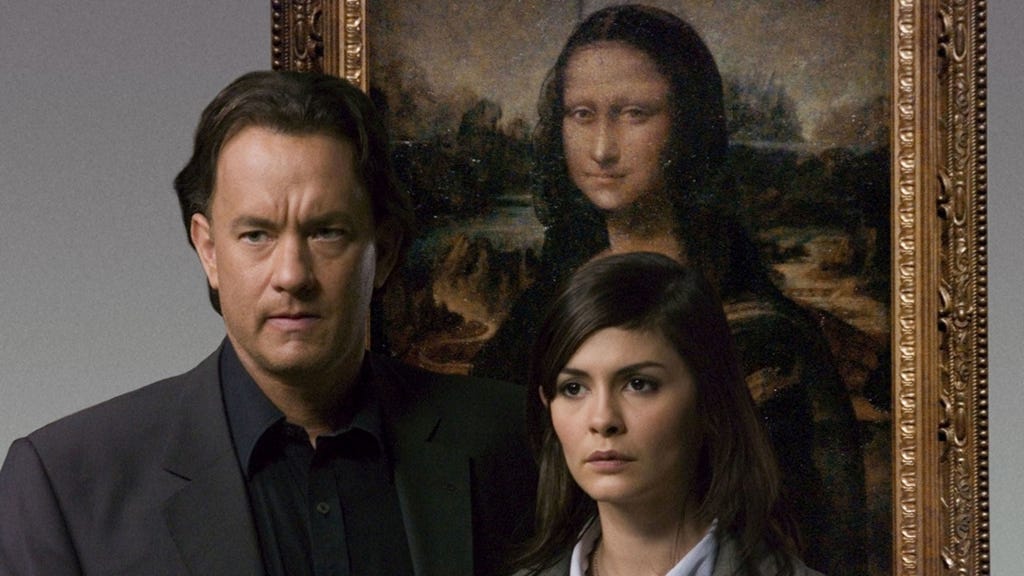
The DaVinci Code
Well, yes. You can use the same three elements that Borges used in a completely different fashion, and for a different purpose—not to enhance a theme, but a genre. In The DaVinci Code, perhaps with the purpose of enhance the reader’s immersion.
If you recall (if you’re old enough), The DaVinci Code was a phenomenon when it was published in 2003, outsold only by Harry Potter (The Order of the Phoenix)… but the reactions were pretty mixed. Half of its readership found the book amusing—an interesting thriller-mystery—while the other half actually believed that many of the mystery-adjacent elements discussed in the book (many of which were related to large, renown religious institutions) were actually true.
Two questions come to mind: why would this happen? And: was this author’s intention?
I cannot actually answer the second question, but my theory is as follows: Dan Brown, the author, was attempting to enhance the stakes of the fictional plot, by making it personal to the reader.
Summarising the entire novel here is not viable, so I will work on the assumption that you have the barebones of the novel’s plot: the main character gets called to research the clues left in a very suspicious, cult-like looking murder, finds a strange device, and is sent in a quest to solve the mystery… all while chased by dubious organisations, a trail of murders, and the what-nots of a thriller-mystery.
All and all, The DaVinci Code blurs (roughly) the same three lines than Borges’ Tlön:
While it follows a fictional character, Robert Langdon, the story is narrated in first-person, thus making it feel personal. The reader is “locked” in Robert’s point-of-view, and knows exactly as much as he does. However, just like Tlön has these “footnotes” that make it seem like a real essay, The DaVinci Code included an Annex titled “Facts” (!) that, well, many people read as real facts, not in-book facts.
The story is also set in the real world, leveraging places that everyone knows—either by having been there, or having heard about them. For example, we have: the Louvre, Paris, Disney (yes, truly), Rome and the Vatican, among others.
More importantly, all these real-world elements are associated with collective theories or fears… conspiracy theories, to be honest:
One example: the Templars who, at least in name, are pretty renown. We have heard about them in books, in fictional movies, in videogames (Assassin’s Creed, anyone?). Few of those representations are actually truthful, yet the mix of all of them lives in the collective imagination. “Templars” is a name that has been out there and twisted over and over by the collective imagination, what they actually were… well, that depends who you ask.
Another example: the Louvre. It is a magnet for conspiracy theories, often because of its historical significance, the mysteries surrounding its art, and the architecture itself. After all, it has been the setting of a thousand mysteries, it actually harbours even more mysterious relics, and… well, it’s a glass pyramid! What can be more suspicious than that? (Just joking, but hopefully you get the point beneath the sarcasm).
Last one: the Mona Lisa. The painting has quite a convoluted history, and it is has been associated with so many conspiracy theories, that there is a Wikipedia page dedicated to listing relevant speculations! There is an over-abundance of academic papers about it (see Google Scholar), and it portrays a face that almost every person has seen (at least, within the intended and adjacent audience).
With this, you can probably see why the book had the impact it did: it blended all the right elements. A plot steeped in secrets, a world built out of half-truths and speculation, and a narrator who moves through it all like a guide through a museum of hidden knowledge.
Now the author’s goal? As I said, I can only guess… but it reaches a point in the plot in which the main character, Robert Langdon, cannot trust anyone. Everyone and everything is either out to get him or holds a dangerous secret—and that is exactly what the mixture of these three elements made the reader feel.
What better way to immerse the reader in a murder-mystery-they’re-out-to-get-you than by making it personal, making it seem real, and pulling from fears and names the reader should have heard? The DaVinci Code felt personal because it tapped into something shared: a suspicion, a thrill, a collective itch: what if all of this is actually true?
It was, in its own way, a genius move. And the result was a story that convinced millions—if only for a moment—that fiction might just be fact.
To summarise…
Both Tlön, Uqbar, Orbis Tertius and The DaVinci Code blur the line between fiction and fact—but they do so to different ends.
Borges used the illusion of nonfiction to destabilise reality, to make us question the very act of knowing. In this case, the blurred line between fiction and non-fiction made a cautionary tale all the more terrifying, thus amplifying its theme.
Dan Brown used it to immerse, to thrill, to make the world feel bigger, deeper, older. Someone may say it was a commercial move… and it very well may have been—yet it worked. It captivated readers.
Regardless of the author’s intention, the technique is the same:
Use a personal narrator.
Rely on elements of the real-world known by the reader.
Appeal to the collective imagination through half-truths (aka, conspiracy theories).
This works because it relies on the reader's trust in facts, in structure, in the shape of truth. The problem is that when fiction wears that trust like a costume, it doesn’t just tell a story. It makes you believe one.
It’s a powerful tool. Use it wisely.
PS: Am I telling you to lie to your readers? Not really, I’m just showing you what others did… but perhaps if you’re writing urban/portal fantasy, you could appeal to these tricks and make the fantasy of your world feasible just enough.
Copyright © 2025 Livia J. Elliot. All rights reserved. This publication is licensed for personal reading only. No article, or substantial part of an article, may be reproduced, republished, adapted, translated, compiled into another publication, incorporated into teaching materials or course packs, or used for AI training without prior written permission. Linking to the original articles is encouraged.