

Book Review: The Hour of the Star, by Clarice Lispector
A technical masterpiece, an emotionally devastating tale of poverty, empathy, and how we aim to craft meaning though the world—more often than not—does not provide the means to do so.

A technical masterpiece, an emotionally devastating tale of poverty—outward and inward—layered with a quest for meaning and a fictional writer who, through his character, unwillingly seeks to understand a life too unlike his own.
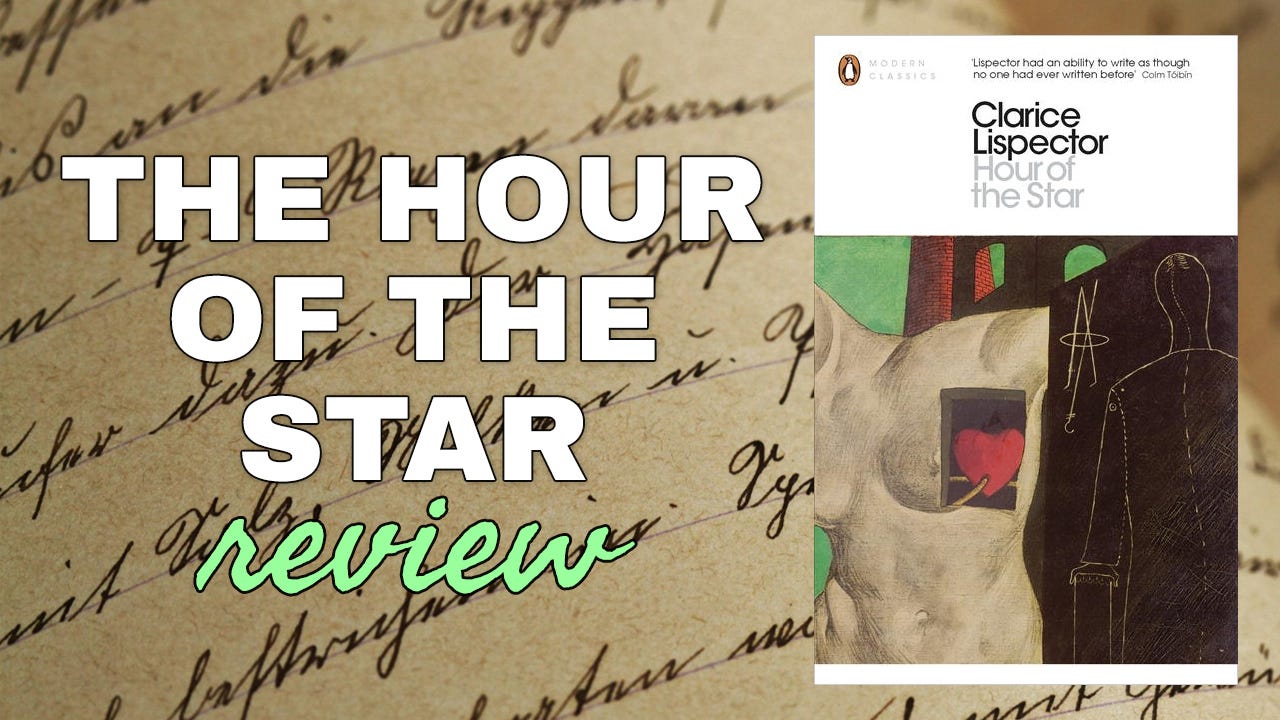
The Hour of the Star by Clarice Lispector is set in Rio de Janeiro, roughly around the fifties or sixties. Structurally, it presents an outer story (of a writer struggling with a character) and a story-within (of a fictional woman) that constantly blend into each other, with the writer interrupting his own narrative to inject self-reflections linked to the emotional register revealed by the woman’s tale. It is in this blend that the theme of ‘empathy’ shines the most.
The ‘outermost’ tale is about Rodrigo S.M.
…a fictional writer who, not long before he sat down to write, crossed gazes with a woman across the street. She was from the Brazilian northeast (a historically poor region); in his words:
Because on a street in Rio de Janeiro I glimpsed in the air the feeling of perdition on the face of a northeastern girl. Not to mention that as a boy I grew up in the northeast. I also know about things because I’m alive.
This is the seed of his empathy—seeing in her face the reflection of an emotion he used to suffer due to sharing some roots with her. What follows is his writerly struggle: he wants to craft a story inspired by that girl, but he knows nothing of the real one. Rodrigo writes:
If there is any truth to it—and of course, the story is true though invented—may everyone recognise it inside himself because all of us are one and he who is not poor in money is poor in spirit or longing because he lacks something more precious than gold—there are those who lack the delicate essential.
That ‘delicate essential’ is, as I see it, a quest for meaning and purpose constantly questioned throughout the book—with Rodrigo unknowingly establishing empathy and understanding as his purpose (or even self-discovery), and the girl of the story... being something else.
So begins (or rather, ‘interrupts’ his strife) the story-within-the-story:
The tale of Macabéa, a poor orphan girl from the northeast who, after her parents died of a disease, came to live with her aunt. The aunt taught her to type to save her from prostitution, but passed shortly after Macabéa secured a poorly paying job as a typist.
For her [...] reality too was very little. She could deal better with her unreality, living in sloooow motion [...] vagueness was her earthly world, vagueness was the inside of nature.
What matters most about Macabéa is not her outward poverty, which is clear from the beginning—with her malnourishment, her illiteracy, her lack of basic hygiene, her lack of ‘common sense’. What matters is what poverty didn’t allow her to learn: how to question her situation, how to dare hope for something different and decide how to work towards it. This inward poverty reflects in a thought she often returns to: “This is how things were.” Unchallengeable. Unchangeable. She experiences life as absolute ‘facts’(*) that cannot be understood because she has no means to do so nor to secure the help she needs.
This leads me to another theme—something that Macabéa knows very well: she’s invisible to society. At the very opening, Rodrigo writes:
[...] she sometimes smiles at other people on the street. Nobody smiles back because they don’t even look at her.
The topic of her social invisibility is brought up often enough because poverty—both outward and its inward consequence—is a by-product of society... and one that, unfortunately, we seldom attempt to fix in any meaningful way. The fact she’s invisible even to her so-called boyfriend reflects on how the basis for empathy is recognising the other as an equal—something the man, Olímpico, cannot do even though he shares his northeastern roots with her.
Yet while narrating Macabéa’s story, Rodrigo flows back to himself. As readers, we cannot detach his struggle to write from her lack of struggle to simply be.
Thus, as it emerges, the story-within produces a change on Rodrigo’s perception.
He spends the first dozen pages voicing his difficulties surrounding this endeavour as if avoiding that which is painful: understanding her in order to write her story. Yet the more he does so, the more he comes to ‘love’ Macabéa. This ‘love’ is certainly neither sexual nor platonic, but perhaps a reference to empathy: how we can truly, unbiasedly, appreciate someone after we have seen the world through their eyes. Thematically, it implies her poverty no longer distresses him because he understands it. It also offers a counterpoint to Olímpico’s lack of empathy and love for Macabéa.
The ending in itself is, without spoilers, abrupt—yet it ties back to the idea of hope as the enabler of a quest for meaning and purpose, and how, sometimes, the world doesn’t really allow us to craft meaning1.
To close, a word on Lispector’s prose
It is technically brilliant. She moves between Rodrigo’s real world and Macabéa’s fictional one with effortless grace—often within a single sentence—submerging and resurfacing the reader between levels of storytelling without warning. This constant blurring is not a mere stylistic flourish; it makes the reader acutely conscious of Macabéa’s story being constructed in real time by a narrator who does not fully understand his own subject. Furthermore, Rodrigo does not follow a temporal thread, instead moving freely between her past and present—guided by his need to discover more about her.
The result is a style that does not describe Macabéa so much as conjure her... though it demands patience and a willingness to be disoriented. Readers seeking a tidy narrative arc will find little comfort here, but those seeking an experience may have come to the right place.
(*) On the use of the word ‘facts’.
The word ‘facts’ in this story may have several meanings. In the very first page, Rodrigo writes:
Thinking is an act. Feeling is a fact.
Philosophically speaking, this is incredibly rich. Feelings are automatic reactions; they come to us due to what happens, and we have no control over them... but we do control, to some extent, what we think. How we reason, what we reason, and the conclusions we reach. Those, in turn, can affect how we feel in retrospect about what happens to us.
However, if you remove emotional literacy—the ability for someone to distinguish that, for example, contempt and frustration are two different ‘flavours’ of anger—the very act of feeling becomes estranged from thinking: one can no longer study their own emotions, one can only be those emotions.
I believe Lispector was circling this topic when using the word ‘fact’ as a replacement for ‘unknown or unlabelled emotions.’ What I find more interesting, is that Rodrigo—the fictional writer—eventually tires of ‘facts’... because, let’s be honest, true empathy is far more than ‘relating’, but an demanding an active task that requires suspending one’s beliefs to see and experiment the world as another person does.
Copyright © 2026 Livia J. Elliot. All rights reserved. This publication is licensed for personal reading only. No article, or substantial part of an article, may be reproduced, republished, adapted, translated, compiled into another publication, incorporated into teaching materials or course packs, or used for AI training without prior written permission. Linking to the original articles is encouraged.
Something that struck me is the parallelism between Macabéa’s ending and Albert Camus’ death. Intentional? I do not know; but just as I was thinking about the existential angle to this book, Rodrigo ‘chose’ to write such an ending.