

Slow Down, Cyberpunk, and Tell Us Your Story
Cyberpunk, a genre with enormous gravity, one that all but subsumed the high-minded optimism of the sci-fi that preceded it. Let's go back in history and assess this ever-relevant subgenre.


Cyberpunk is a complex subgenre of science fiction, represented by a variety of works in a number of mediums—from books to movies and videogames—which lives in people’s mind like a combination of neon and technology. Yet cyberpunk, as a genre, is so much more.
It’s not a subgenre one can pinpoint an origin, for a significant portion of what today we refer to as cyberpunk can be traced back to the new wave science fiction movement of the ‘60s and ‘70s. Those works were dystopian cautionary tales, and written to explore themes surrounding the use and abuse of technology—yet most critics consider that it wasn’t until the ‘80s that cyberpunk solidified as a subgenre.
In this constantly changing landscape we live on today, cyberpunk is making a comeback.
An Invited Author
For today’s essay, I will hand over to fellow author Henry Neilsen , Aurealis Award finalist (2024, best science fiction short story) and Vice President of Meridian Australis, a speculative fiction collective in Melbourne, Australia.
His work is a mixture of cyberpunk and horror, and so he’s well placed to discuss today’s topic.
Here you’ll find a discussion on two ‘schools’ of cyberpunk, alongside references to fundamental works in each, and Henry’s self-reflection on how he applied these concepts into his upcoming novel The Savage Aesther.
Ready? Let’s dive in.
Cyberpunk: A Conflicted Subgenre
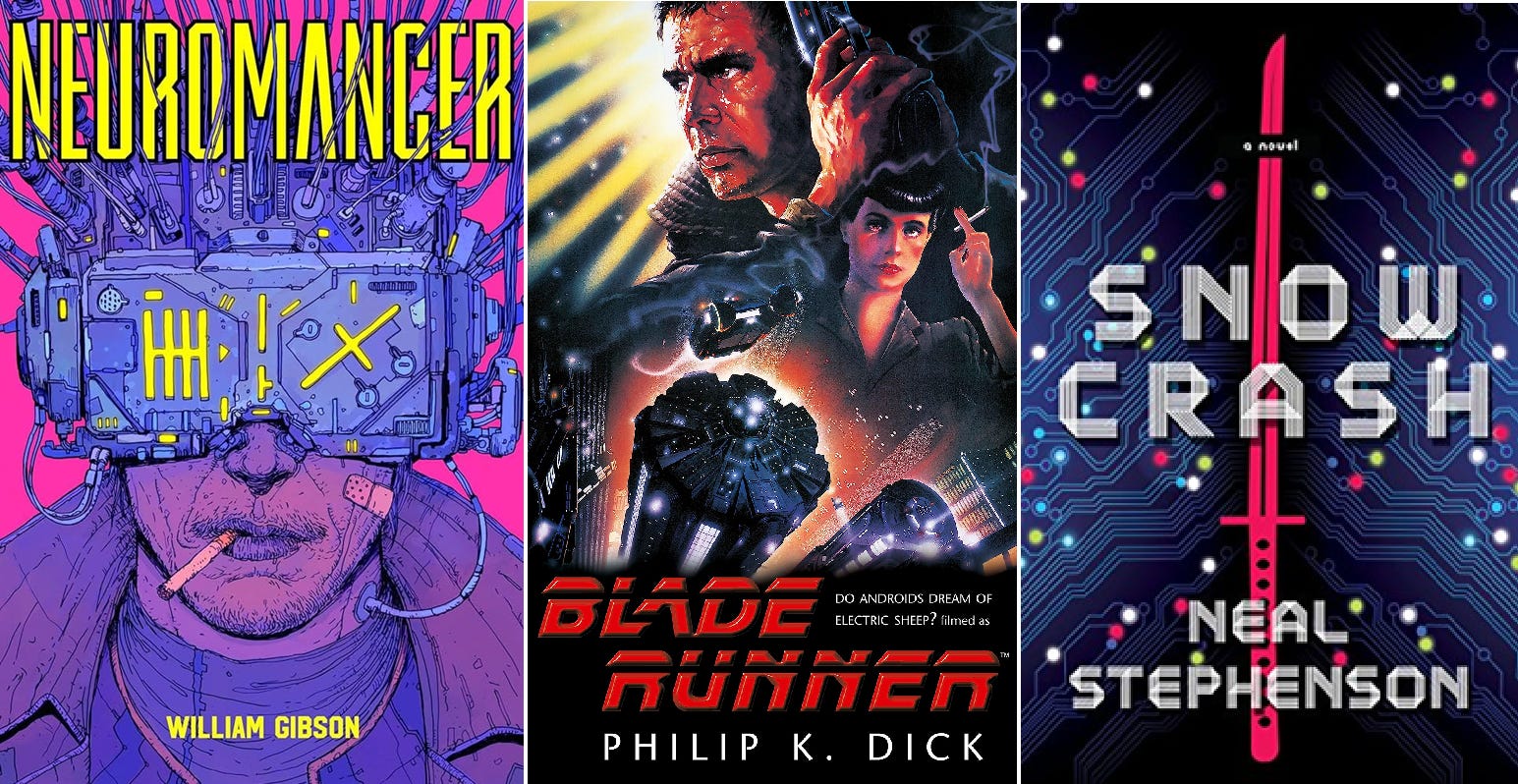
In 1982, following the runaway success of the space-born terror of Alien, Ridley Scott released Blade Runner: a moody, pensive, neo-noir take on a future full of hard-boiled detectives and ultra-realistic humanoid robots. The aesthetic was one of smoke-filled bars and rubble-strewn streets blasted with the glare of neon advertisements.
Two years later, William Gibson set the tone for the literary equivalent with Neuromancer, a heady, whirlwind rush of computer jackers, artificial intelligence and high-stakes heists. Visually, both of these stories conjure the now-monolithic idea of cyberpunk, a genre with enormous gravity, one that all but subsumed the high-minded optimism of the sci-fi that preceded it.
When it came to write my own novel The Savage Aether in the cyberpunk genre, I saw these two styles as a bifurcation, and I had a choice to make.
Despite these two works being the ur-examples of the genre, they couldn’t be more disparate in their approach to storytelling. Blade Runner, especially in its most complete form, the 2007 Final Cut1, is expansive with its breathing room. Indeed, one of the biggest complaints from people who are freshly introduced to it is that it is slow, not the run-and-gun thriller they expect from a story fronted by Harrison Ford.
On the other hand, Neuromancer barely stops to take a breath, and you tear through Chiba and beyond at the speed of the drugs that race through the blood of Case, the protagonist. You can feel the urgency, the need to flip through the decks and into cyberspace that the characters are feeling, and it’s intoxicating.
This Neuromancer take on cyberpunk is certainly the more popular of the forms the genre has taken. The Matrix took it and ran, as did many other authors up to this day. T.R. Napper’s 36 Streets and The Escher Man lay the grit on thick and pound away at the pace, and they are spectacular examples of contemporary approach to cyberpunk.


But when it came time to write my own cyberpunk tale, I found myself drawn to the other side of the bifurcated line in the genre. Moreover, I think there’s still room to plumb the brooding nature of Blade Runner’s pacing for opportunities to tell stories about technology and society.
In many ways, this is because the high-gloss neon of Neuromancer has come true. I’m certainly not the first to say it, but large corporations, local cyberspace devices, and a world replete with advertisements is simply day to day existence in modern cities. Nowadays the gaudy imagery of Neuromancer seems camouflaged with reality. Because of this, there has been a tendency for this visual language to become emblematic of the genre itself. Rather than contending with the sociopolitical commentary that it once made, cyberpunk work is often only aesthetic.
By taking a step away from the hyper-speed of Neuromancer and walking into the oppressive glow and patient slow burn of something more akin to Blade Runner, it’s my opinion that the genre can reclaim the powerful affect that lies beneath the veneer of aestheticism.
Consider Blade Runner again. In one of its most harrowing scenes, Deckard chases Zhora through the streets, eventually gunning her down, the first on-screen retirement of a replicant we see him make. Rather than move swiftly on, the camera follows Deckard as he reckons with the sin he’s just committed.
For better or worse, Zhora was a conscious being, and the audience is invited to watch as the flawed protagonist of the movie comes to terms with his actions. He’s visibly sickened.
That framing of violence, not as part of a whirlwind of high-octane thrillride, but as a brutal and singular act of sanctioned murder, is incredibly powerful. It forces the audience to ask themselves questions, and that contemplation is a strength not often found in faster cyberpunk works.
Developing The Savage Aether
In the case of my novel, The Savage Aether, I deliberately leaned into that more contemplative side of the genre. After all, this is a story that focuses on the consequences of technology for those who aren’t its benefactors. Were I to make a mile-a-minute thrill ride, I risked making the tech itself the star of the show, simply by not leaving time for its effects to be felt.
Instead, I wanted the tech to be the font of the tension in the story, and for that I needed my characters to have time to contemplate. I needed them to realise what it had done to them, and how. I needed the oppression of the tech to build and build around them, so that by the time violence does occur, it feels like an explosive release rather than a commonplace inevitability.
The Savage Aether is a horror novel, and this is, I think, more due to the particular parts of technology I focus on than anything imbued in the genre itself. Like my favourite cyberpunk works, It centres on themes that the technology and the society exposes, rather than the mere operation of the technology itself.
A particular theme that’s explored is the disconnection from society.
If you have a piece of technology that everyone relies on to survive, then what happens if you can’t connect for some reason? One character finds out the hard way that the foundation of society and decorum are built on much shakier platforms than they’d ever realised, and their slow fall from a have to a have-not is predicated on the failure of the technology to work as advertised.
The important thing here is that the technology is not the centre of the story. Indeed, the technology is impossible to achieve as written (A telepathic social network that interfaces with the brain, without any invasive process). Instead, the rhetoric of the novel is given the shape of technology, but the vehicle of the story is still centred around the characters.
So now instead of a story that concentrates on any particular technological marvel and all the deeds it can do, The Savage Aesther centres the emotional arc of the story on what happens to the characters at its behest. What happens next? Well, you’ll have to read it to see.
I do think that the decision to follow this more contemplative form of cyberpunk storytelling is what made the horror more ably felt. Had I focused on the exact themes but run through it at breakneck pace, could I have elicited the same emotions? Perhaps, but I enjoyed allowing the book to explore its dark corners.
I don’t believe that this move to a contemplative cyberpunk would necessitate a tonal shift to horror. That’s just the way my story went, and I’m sure other writers could take it in different directions. But I think that making that move will breathe life into a genre that has been perhaps overeager to reduce itself to a series of glowing bulbs.
Cyberpunk as a genre has the opportunity to be more relevant than ever,
—as the tech world begins to take up more and more space in our lives. While contemporary cyberpunk works are unlikely to attain the prescience that early examples of the genre have, I think that its ability to commentate on and inform about the state of the world is still extremely potent. But to use this power in its best way, I think the genre would do well to revisit the spectacular use of pace and atmosphere that makes Blade Runner such a classic.
After all, the world moves pretty fast these days. Why not let cyberpunk be the thing to slow you down and make you think?
To Close Of (Livia’s endnotes)…
If you liked the sound of this, check Henry Nielsen’s Kickstarter for The Savage Aether and the companion anthology The Disconnected—and my short story, The Blue Door, is included in that anthology, alongside shorts from: Lauren Taylor Bak, Laura J Campbell, Tom Gloyn, and H M Weir. The Kickstarter will have physical editions, but also all-digital packs.

Copyright © 2025 Livia J. Elliot. All rights reserved. This publication is licensed for personal reading only. No article, or substantial part of an article, may be reproduced, republished, adapted, translated, compiled into another publication, incorporated into teaching materials or course packs, or used for AI training without prior written permission. Linking to the original articles is encouraged.
Opinions differ on the specific best version, but the movie is far better in any version devoid of Harrison Ford’s lackluster voiceover.
 | A guest post by
|