

The Shape of Thought in Translation: Reading Babel-17
What if language could reshape the mind that speaks it? In Babel-17, Samuel R. Delany explores how translation isn't just about words, but about consciousness itself.

Babel-17 is a sci-fi novel from the '50s and, as most classical sci-fi, it is heavy on themes. Here, the theme is language and, more concretely, the strong Sapir-Whorf hypothesis.
What is the strong Sapir-Whorf hypothesis? You can read more here but, in short, it claimed that "a language influences its speakers' worldview or cognition, and thus individuals' languages determine or shape their perceptions of the world." It was later replaced by the weak version (aka, linguistic relativism), but we're not discussing that today.
In this novel, there is an in-book language also called Babel-17 which is (for plot reasons I shan't spoil) presented as to have a wildly different structure. The protagonist (a polyglot poetress named Rydra Wong) often presents Babel-17 as being succinct yet incredibly detailed, and thus capable of altering her perception of time due to how much she can think in a short period.
With that said, I want to show you a very specific part of this novel:
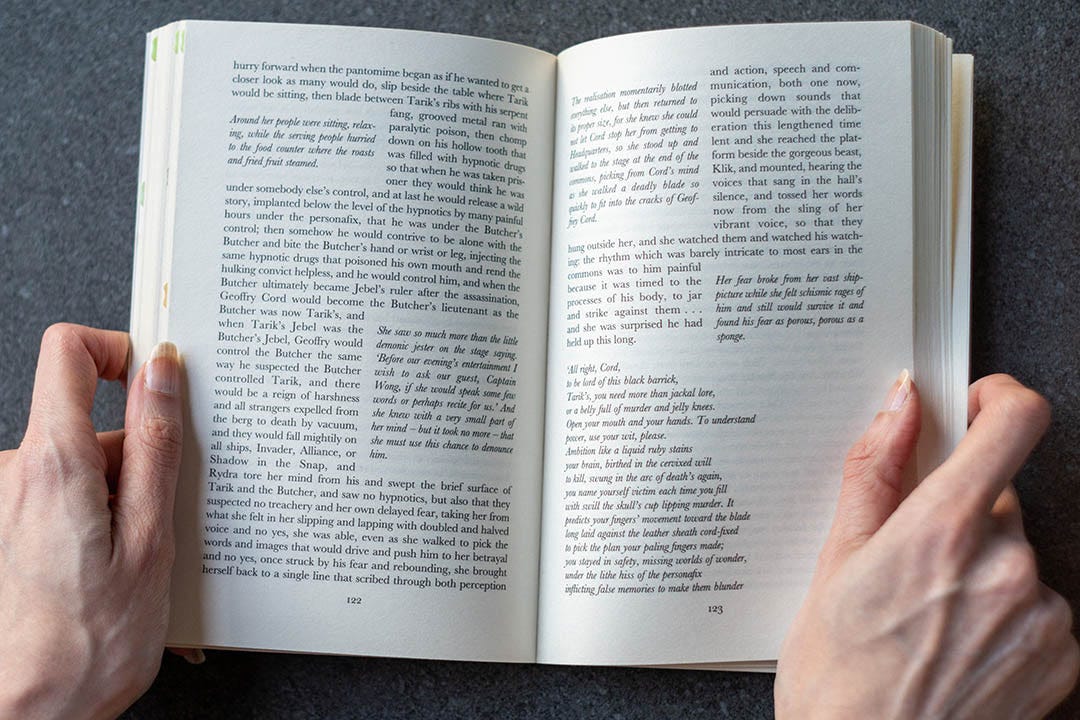
This scene is quite peculiar. Rydra is looking at what happens in the room she is in, let's her thoughts wander, and begins thinking on Babel-17. At this point, readers already know that this language is quaint and differently structured... but the writer couldn't have written 2-3 pages in a fictional language that nobody can speak!
So, how could Delany (the author) convey how Babel-17 affects thinking while writing in English?
Imho, he did something amazing. A three-pages-long, single-sentence (kid you not) stream-of-consciousness lyric about all the little inconspicuous details that Rydra notices because Babel allows her to. The text goes on and on, flowing from action to action almost without punctuation (only commas)... yet it only covers 1-2 minutes of in plot events!
At first, when I started reading, my thoughts were, "what the f—?" Then, I noticed the little squares you can see above. Can you guess what they are?
In my interpretation, those squares are the English translation of the Babel-17 thoughts! Genius!
This approach shows (and doesn't tell) the difference between both languages by managing to narrate the same events in both Babel-17 (albeit 'transliterated' to English) and in English at the same time!
Thus, while Babel-17 is capable of dwelling into incredibly detailed descriptions very quickly (hence why only 1-2 minutes of actual plot), without accounting for emotions, adjectives, or pauses... English behaves different. In comparison to Babel-17, the fictional language, English seems to lose objective meaning in favour of subjectivity and appreciation, allowing to communicate less information over the same period of time (and thus making Rydra think that it's a 'slower' language).
Remember, this is not a hot-take against English, but a discussion on the novel's theme—the strong Sapir-Whorf hypothesis on it's weaker form. This scene, in particular, is meant to show the strong version (mentioned above). Namely, that an individuals' languages determine or shape their perceptions of the world... which is exactly what happens to Rydra during this plot beat.
It is a quirky scene and, in my subjective opinion, very well executed. I loved this book and, last year, I did a podcast episode doing a deep-dive of its themes. You can listen to Babel-17's podcast episode here.
But did you read this classic? I'd love to hear your thoughts about it!
To Close Off…
If this interested you, you may want to check my podcast episode/essay on Babel-17.
Linguistic Relativity in Babel-17 ~ Books Undone

“If there is no word for it, how do you think about it?” reflects the central topic of a sci-fi masterwork known for its discussion on linguistic relativity. I’m talking about Babel-17, a Nebula Award-winning novel by Samuel R. Delaney.
Copyright © 2025 Livia J. Elliot. All rights reserved. This publication is licensed for personal reading only. No article, or substantial part of an article, may be reproduced, republished, adapted, translated, compiled into another publication, incorporated into teaching materials or course packs, or used for AI training without prior written permission. Linking to the original articles is encouraged.