

When the Narrator Slips: How Style Shapes Momentum in Writing
On how commas, sentence shape, and deliberate narration choices can carry meaning—and what two masterful novels reveal about breaking the rules with purpose.

What if commas weren’t just pauses, but told a story by being there or being omitted? What if the length of a sentence could make you feel a character’s perception, thoughts, and state of mind?
In this essay, I explore to remarkable novels that do exactly that: using sentence structure, punctuation, and rhythm to show rather than tell. First, we’ll dive into Fahrenheit 451 by Ray Bradbury, and then into Ghost of the Neon God, by T.R. Napper (Ditmar award-winning author).
We’ll look at how close-quarter narrators can leak into each other, blurring the narrative style and altering pace. We’ll touch on how pacing builds emotional tone, and why the so-called rules of writing are only worth breaking when you know exactly what you’re doing.
Let’s get these books undone.

Vertiginous, Overwhelming: Fahrenheit 451
Fahrenheit 451 is narrated in third-person past-tense, but the narrator is not omniscient—it is a very close-quarter narrative representing Guy Montag’s thoughts. This is crucial to gauge the impact of the passage we’re about to analyse.
Now, in terms of the scene, it happens a few pages into the book. Guy Montag—our already overwhelmed protagonist—has just met Clarisse, whose unusual ideas confused him. He then arrives home, and finds his wife Mildred laying in bed, overdosed with sleeping pills. He calls ER, and the two paramedics bring in a ‘snake-like’ machine that cleans her up and gives her a blood transfusion… all while they joke about how common this is.
After they leave, Montag remains alone with his thoughts, falling into a spiral of despair—one that Bradbury masterfully presents:
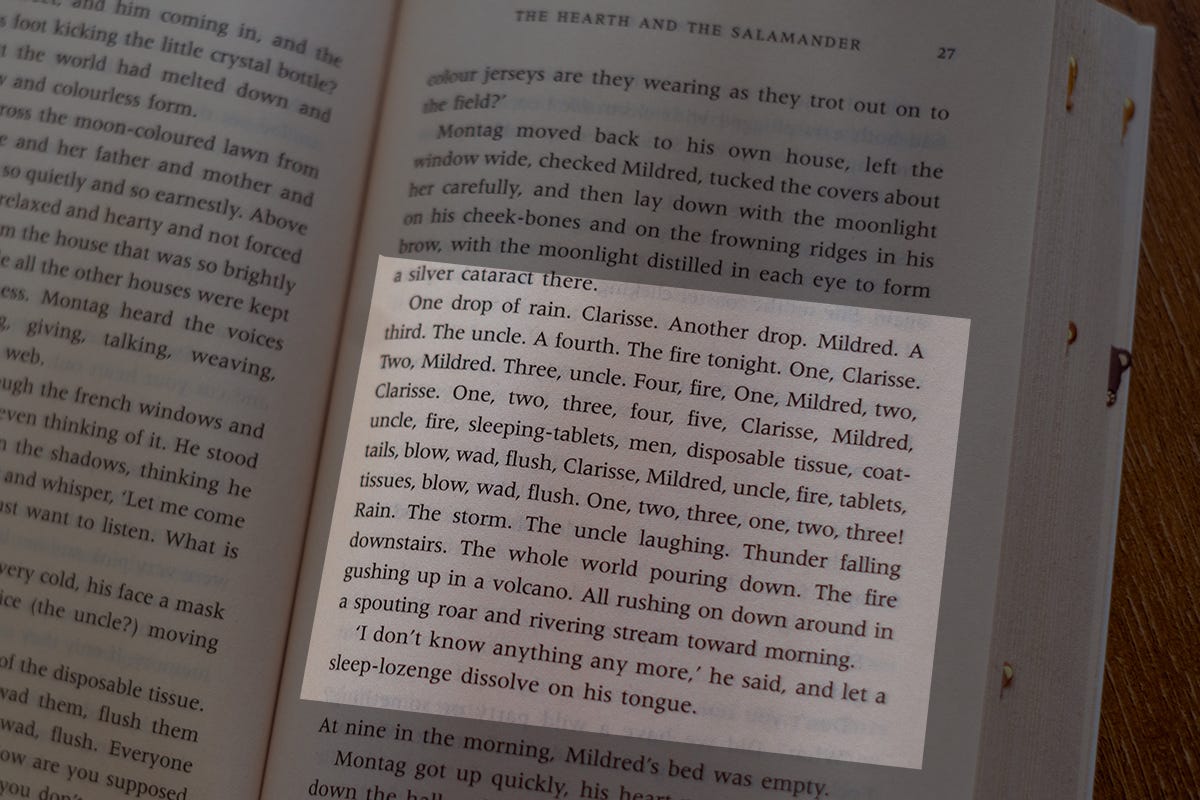
“One drop of rain. Clarisse. Another drop. Mildred. A third. The uncle. A fourth. The fire tonight. One, Clarisse. Two, Mildred. Three, uncle. Four, fire. One, Mildred, two, Clarisse. One, two, three, four, five, Clarisse, Mildred, uncle, fire, sleeping tablets, men, disposable tissue, coattails, blow, wad, flush. One, two, three, one two three! Rain. The storm. The uncle laughing. Thunder falling downstairs. The whole world pouring down. The fire gushing up in a volcano. All rushing on down around in a spouting roar and river stream towards the morning.”
Even by reading it you can feel the rhythm and, from it, understand Montag’s state of mind, even though Bradbury doesn’t explicitly tell us how he feels.
But let us focus on the actual prose. Notice:
The broken up sentences. Short, often one-word only, with no verbs (except towards the end), and written like an enumeration.
The type of words (numbers vs nouns), punctuation (periods vs commas), and the sentence structure.
