

The World-Building Power of Character Thoughts ~ World-building Series #4
The narrator’s perspective is the reader’s window into the story’s world. This essay analyses one excerpt (before and after changes) to discuss how a character's thoughts can aid the world-building.

In first or limited third-person narratives, the narrator’s perspective becomes the reader’s window into the story’s world.
In a first-world narrative (e.g., when the story happens in the real world) that perspective can clue the reader about what’s important to the narrator-character. In a secondary-world story (i.e., a story set in a fictional world) what the narrating-character perceives becomes the writer’s more fundamental tool to introduce the readers into that secondary world.
However, it is not just what the narrator sees or encounters that matters—the order in which they think about things can add layers of meaning at the expense of no words. This is because a narrator’s thought sequence can reveal culture, priorities, and even hidden tensions in the setting.
I have a quaint example for you today…
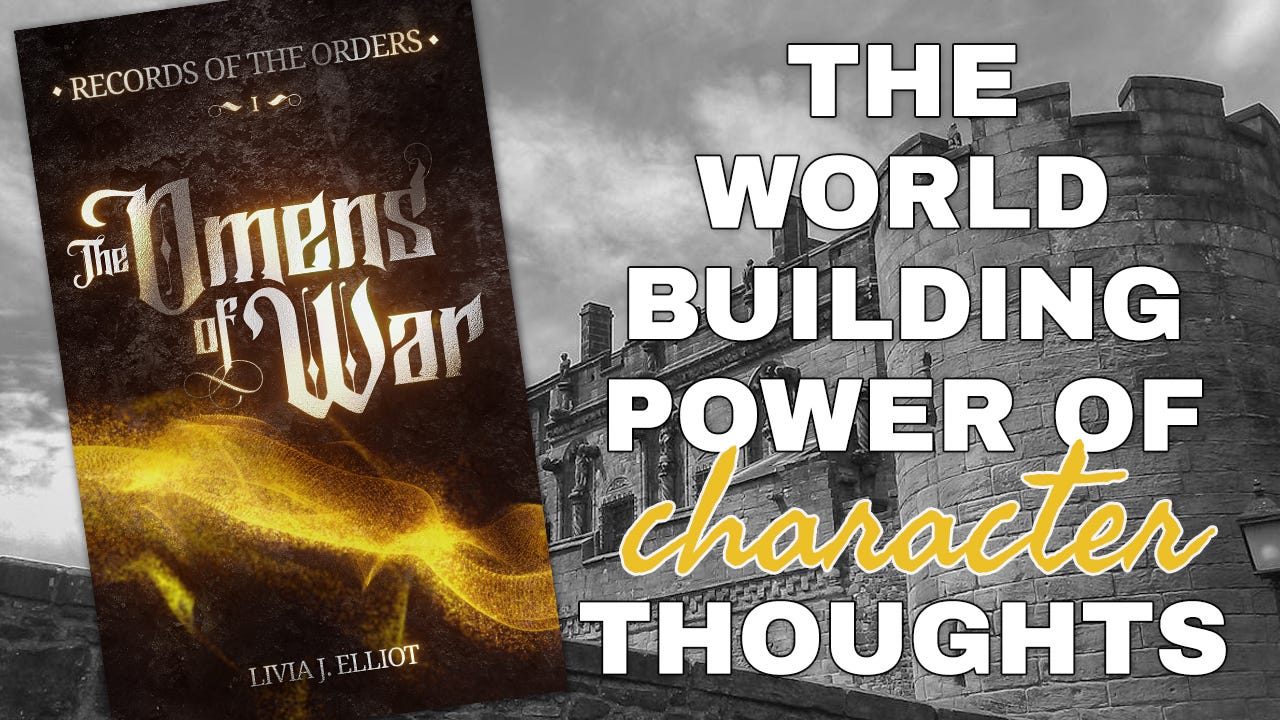
—and it is one paragraph from my upcoming book, The Omens of War.
I chose to bring this particular example because I caught my own “mistake” while self-editing a chapter before sending it to the developmental editor. I thought that the difference between the “original” and the “edited” paragraph that went to the editor (and finally made it into the book) was a cool example.
Therefore, this essay will cover:
The original (and now discarded) paragraph.
The final paragraph.
My train of thoughts and reasoning as to change the order, and
…the world-building details that led me to enact the changes.
The paragraph I bring does not contain spoilers, and at the end—as usual—I’ll have some homework for you to practice as well.
Let’s get this undone!
Introducing the Excerpt
My book, The Omens of War, is multi-pov and happens in a secondary world. The paragraph in question happens in the character’s second chapter, which is about ~6,000 words into the story. This is important because:
In secondary-world stories, the first 20% of the story tends to be more heavy in world-building.
The reader is very fresh to the new setting—this is the first book in the series—so I had to write with world-building in mind. Causing “the wrong impression” (in terms of world-building) could lead to “costly” problems later in the story—where “costly” here means that the reader failed to understand the world because of how I had misrepresented it.
Before we dive in, allow me to give you some context; I will purposefully limit myself to context the reader has gathered from the first chapter of the same character:
The narrating character is Legate Dante Praeto—a political leader and strategist from a nation called Firard. The narrator is a limited third person in past-tense, which alternates between narration and the character’s thoughts1.
Firard has five Legions: Eastern, Northern, Western, Southern, Central. Dante belongs to the Eastern Legions
The neighbouring nations are Sestel—with whom they share the ravine—and Orenos—which has attacked them over and over during the past decade or so.
Without further ado, the original paragraph…
—without the rework, was as follows:
Dante lifted a hand, demanding the spyglass. Elixane pressed it into his open palm, and he expanded the barrels to search for the distant silhouettes; the ravine’s sinuous walls hindered his sight, but he searched nonetheless. A coup, perhaps? From the Northern Legion, on Centurion Petra’s command? It would explain why Decanus Ler didn’t inform me. His tongue clicked, rejecting that last thought. No, the Legions inculcate honour and service; we have centuries of indoctrination. He noticed some shapes before a turn in the cliff’s walls, barely distinguishable under the dust raining from the mountains. They seemed to disregard the quake, continuing the War Games. The Sestelii, then? Or the Orenians?
The ground bellowed again, its cry distorted by the ravine into a deep, resonant wail. Dante’s frown secured the spyglass to his face while he observed the fissures sneaking upwards like capricious veins tracing the cliff’s iron markings. […]
What if I told you there is a blatant contradiction in that original paragraph? Look closely, and focus only on Dante’s thoughts—he rebukes himself! In order, he thinks:
A coup, perhaps? From the Northern Legion, on Centurion Petra’s command? It would explain why Decanus Ler didn’t inform me.
But immediately after, he gives a very sensible reason as to why this cannot be the case:
No, the Legions inculcate honour and service; we have centuries of indoctrination.
Thus, if the Legions have “centuries of indoctrination” about “honour and service”… why is a coup the first thought he has?
If before this paragraph I had taken time to have Dante think about a “internal tensions” or “conflicting political interests”, then this sequence of thoughts would have actually made sense… except I did not. Add to it that Dante is not a minor strategist: he owns an entire fortress, is considered the second-in-command in that region, and he knows some behind-the-scenes inner quarrels (which I took care of mentioning on his first chapter)… so why is he thinking of a coup first?
The problem we can see in that first paragraph was an order-induced plot-hole! In other words: the order in which Dante—a politician and strategist—was implying an internal instability (a world-building detail) which contradicted what I introduced before and what I had planned for the book.
But that’s not all! Let me show you the first line of the book’s blurb (which you can double-check in Goodreads, and perhaps add the book to your shelf):
The peace between Firard and Sestel teeters on the edge of collapse.
If I am literally selling the book by appealing to the feeble peace between Firard—Dante’s nation—and Sestel, the neighbouring nation, then Dante’s thoughts should align to that key worldbuilding piece, aren’t they?
Let me show you the reworked paragraph.
This is what I self edited, and I’m using the version before I sent it to the developmental editor.
Dante lifted a hand, demanding the spyglass. Elixane pressed it into his open palm, and he expanded the barrels to search for the distant silhouettes; the ravine’s sinuous walls hindered his sight, but he searched nonetheless. Could this be a Sestelii attack? Lady Seve has sacrificed troops before… His tongue clicked, rejecting that last thought. No; she’s not that reckless. He noticed some shapes before a turn in the cliffs’ walls, barely distinguishable under the dust raining from the mountains. They seemed to disregard the quake, continuing the War Games. The Orenians, then? Trying to ignite a war between Sestel and Firard?
The ground bellowed again, its cry distorted by the ravine into a deep, resonant wail. Could it be a coup? Or something to weaken Strategos Gora’s standing? Dante’s frown secured the spyglass to his face while he observed the fissures sneaking upwards like capricious veins tracing the iron markings on the cliffs. No; it seems… unworkable. […]
If you compare this to the original version, you can see that the narrator’s text (what’s written in regular, not in italics) remained mostly unchanged. What did change, though, is the order of the thoughts.
What was my rationale for the changes?
Let’s go thought-by-thought, so we can compare it to the original version, the blurb, and my goals with this single paragraph.
The first thought is now the following:
Could this be a Sestelii attack? Lady Seve has sacrificed troops before…
At first glance, you can see that Dante’s first worry matches the book’s blurb: “Could this be a Sestelii attack?” This simple change reinforces the setting as I presented it on the blurb: the political tension is between Firard and Sestel, and not internal to Firard (as the first version implied).
That first thought also relies on the book’s blurb: the other point-of-view (with alternating chapters) is Lady Calya Seve, a political leader in Sestel. She’s also mentioned explicitly in the book’s blurb. However, this thought is building a relationship between both characters, because Dante thinks: “Lady Seve has sacrificed troops before…” which means that: (a) they have faced each other before, enough that (b) Dante is aware of her tactics, and (c) he may have opinions about it.
The above—Dante’s and Calya’s political “relationship”—is now also further strengthened by the next thought:
No; she’s not that reckless.
Reader-facing, this is hinting that Calya is quite a pragmatic strategist—sacrifice troops when needed, but only when needed. It also keeps building up Dante’s opinion of her.
Writer-facing, though, I needed Dante to be able to move between possible “suspects”. If his suspicion of Calya was enough for him not to consider other options, then that was it, I could not have him think of anything else without introducing another order-induced contradiction.
After that, because Dante was not satisfied with his own suspicion, he was able to consider another possible suspect. This is the third thought:
The Orenians, then? Trying to ignite a war between Sestel and Firard?
By this point, the reader knows that Orenos is a northerner nation that has a frontier against both Sestel and Firard. Neither of them—Sestel or Firard—is, or has been, allied with Orenos. However, the reader knows that Firard is not keen on warring Sestel, and vice versa.
With that knowledge, this thought does a double-duty in terms of world-building. It tells the reader that:
After Sestel’s intentions, the second most problematic thing is Orenos’ intentions.
Orenos may not want to face neither Sestel nor Firard—the would rather just pitch them against each other, which
…speaks of Orenos’ political nature: sow discord between your enemies, let them finish each other, arrive and loot what remains.
The combination between first and third thought sets the geopolitical landscape Dante is facing: war looms close, two nations could attack him, and something very odd just happened.
These are key world-building elements reintroduced simply by tweaking the order in which Dante—the narrating character—thought about possible culprits/suspects!
However, at this point I needed more space for thoughts, so I expanded them into the next paragraph. If you compare it to the original, the reworked version features Dante still interrupting the narrative throughout the second paragraph.
Thus, after Dante ruled out the actual threats (Sestel’s and Orenos’ intentions) he finally is able to—logically and consistently—think about inner threats:
Could it be a coup? Or something to weaken Strategos Gora’s standing?
The first question: “Could it be a coup?” is reminiscent of the original, but it is far shorter. The vagueness and shortness was intended simply because two reasons: (a) if there are no blatant tensions between the Legions, (b) why would Dante pinpoint one participant (Decanus Ler) and his boss (Centurion Petra) instead of the many other people participating or watching the War Games? It was a plot-hole!
In this case, the vagueness makes more sense. He considers the possibility of a coup, but doesn’t have enough information as to pinpoint a specific rebellious person? Had I kept the names, I’d be forced to somehow explain why and how he knew one person could be the culprit. Instead, the short “Could it be a coup?” means that: (a) Dante is actually covering all angles, (b) even if this angle does not make particular sense.
The other fragment of that thought: “Or something to weaken Strategos Gora’s standing?” actually connects to a thought he had in the first chapter:
It is always politics. This time it was Marshal-Strategos Gora Rachen vying for more power within the Emerald Council, and the next time it’ll be another Marshal.
Thus, by adding that “Or something to weaken Strategos Gora’s standing?” question, I was actually creating continuity of thoughts, and building up the Strategos’ name—for Gora was mentioned in the first chapter, now in the second again, and both times around questions of power, politics, and standing. I really needed, due to things I shall not spoil, for the reader to remember Gora’s name, and this was a great opportunity to keep building him up.
Some general considerations…
There is a catch here: I was able to pull this off because of how I set up the characters. Legate Dante Praeto is in a position of power, he deals in military strategies and geopolitical movements—he knows the setting enough to allow me (the author) to leverage the character’s knowledge to “teach the world” to the reader.
This means that, in this type of limited narration, you can only introduce what your character knows about. If Dante had no clue about geopolitics, there would’ve been no reason for him to have these thoughts—on the contrary, the thoughts would’ve introduced a plot-hole/weakness. As it stands, it also allowed me to build up his character: I’m not telling you he’s clever, I’m showing you his thoughts that demonstrate he’s very aware of the political tensions.
There is also another advantage: cramming world-building information in a way relevant to the plot events. If you pay attention, Dante is not sitting idly and ruminating about the geopolitical tensions—something just happened and, using that event as an excuse, he’s thinking who could’ve done it. The world-building (the thoughts) stem from the event and are intrinsically related to it (i.e., it is Dante’s job to preoccupy himself with geopolitics). This is something you, as a writer, can pull off in any context: just think about what the character knows and what he can think of in a given moment that relates to what is happening (or about to happen).
What should you consider?
Here is a handy checklist of things to consider:
Define, exactly, what the character knows about the world.
For a given situation and/or event, narrow down the character’s knowledge to what is extremely fundamental to that moment. You can leverage things such as: the character’s profession and/or interests, their goals at that moment, their order of priorities.
One you have the above, just jot down the information you need to give to the reader. Notice that I am not saying “the character thoughts” but “the information you need to give the reader”, and that’s because there is a difference:
At this stage, you do not need to write it in “the character’s voice”.
At this stage, you may also jot down a sentence that actually spoils something you don’t want to spoil—this is excellent, especially because you can use this extra information to foreshadow things.
What matters here is that the information you selected to present is coherent in an of itself.
One the above is ensured, you can finally—finally—carefully word-smith these sentences until they are: (a) thought in the character’s voice, (b) do not contradict each other, and (c) do not spoil more than they had to.
Does it take time? For sure! Fixing that single paragraph literally took me about ~1.5 hours of work because I had to carefully think what were my goals as a writer. I wanted—and needed—to simultaneously world-build, and character-build. In my opinion, though, it paid off.
Over to you!
As I always said, practice makes perfect. If you don’t practice, you won’t improve. In this case, I have two tasks for you:
Narrate one paragraph, in which ever world, from the point-of-view of a character with overarching knowledge. For example: a king, a Noble, Tywyn Lannister, any one that—by thinking about the situation—can introduce the readers to the larger world’s stakes.
This will likely force you to be mindful about not spoiling the plot, while being careful not make the character look like they’re purposefully avoiding a topic because the writer needed that topic to be avoided.
Now narrate another paragraph, in which ever world, from the point-of-view of a character with limited knowledge. For example: a servant who only has gossip to share, a stable-hand, an urchin.
This will force you to be unreliable. The narrator doesn’t have enough information at hand, or they may even have contradictory information. How do you present that? Allow me to give you two options: (a) someone (a character) actually points out to the contradiction—thus flagging its intentionality to the reader—or (b) you hint at the narrator’s uncertainty about the information. The former would be more explicit, the later subtler and more easy to miss.
Before we leave, allow me to tease you a bit further.
Lovecraft meets George R.R. Martin meets Marcus Aurelius and Jean-Paul Sartre in this genre-blending cosmic horror fantasy. You can bookmark it in Goodreads, or you can go to Amazon and preorder it.
That said, I hope you found this useful, and happy writing!
Livia~
Copyright © 2025 Livia J. Elliot. All rights reserved. This publication is licensed for personal reading only. No article, or substantial part of an article, may be reproduced, republished, adapted, translated, compiled into another publication, incorporated into teaching materials or course packs, or used for AI training without prior written permission. Linking to the original articles is encouraged.
I think that quite often, writers tend to think that only first-person narratives can be “close to the narrating character”; I personally do not agree with this idea. To me, a third-person narrative can be as limited, as unreliable, and as immersive as a first-person present tense. Hence, why I decided to bring this example as well.