

Borges Thought His Masterpieces Were "Clumsily Executed."
On Jorge Luis Borges, self-judgment, and why writers misread their own work.

A few days ago, I was skimming through my Penguin copy of Jorge Luis Borges’ Fictions in search for a new read. As you may have noticed, I often host group discussions on my podcast, one short story at a time.
If you haven’t seen this edition, the table of content looks like this:
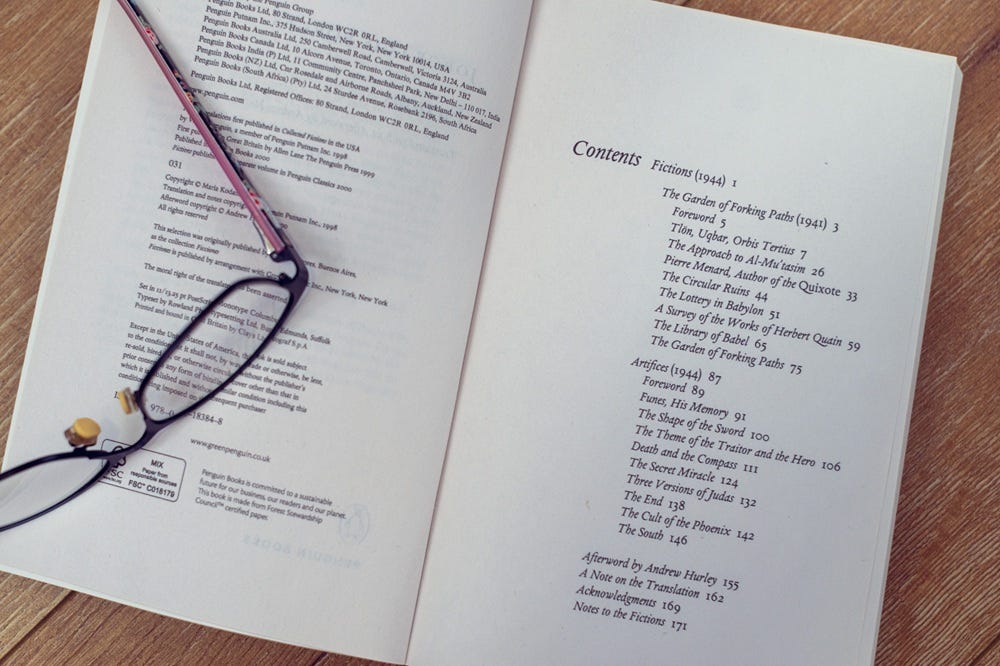
Curiously—and quite unlike me—I realised I had never read the Forewords to either collection. Thinking they might offer a hint as to which story to pick up next, I sat down and read them both.
The Foreword to the collection The Garden of Forking Paths—which contains most of the stories I’ve been discussing on the podcast—was rather unamusing: a brief summary of themes and motifs, barely a page long. But the prologue to Artifices opened with a line that left me staring at the wall:
Although less clumsily executed, the stories in this volume are no different from those in the volume that preceded them.
Tlön, Uqbar, Orbis Tertius.
The Circular Ruins.
The Library of Babel.
The Lottery of Babylon.
The Garden of Forking Paths.
“Clumsily Executed.”
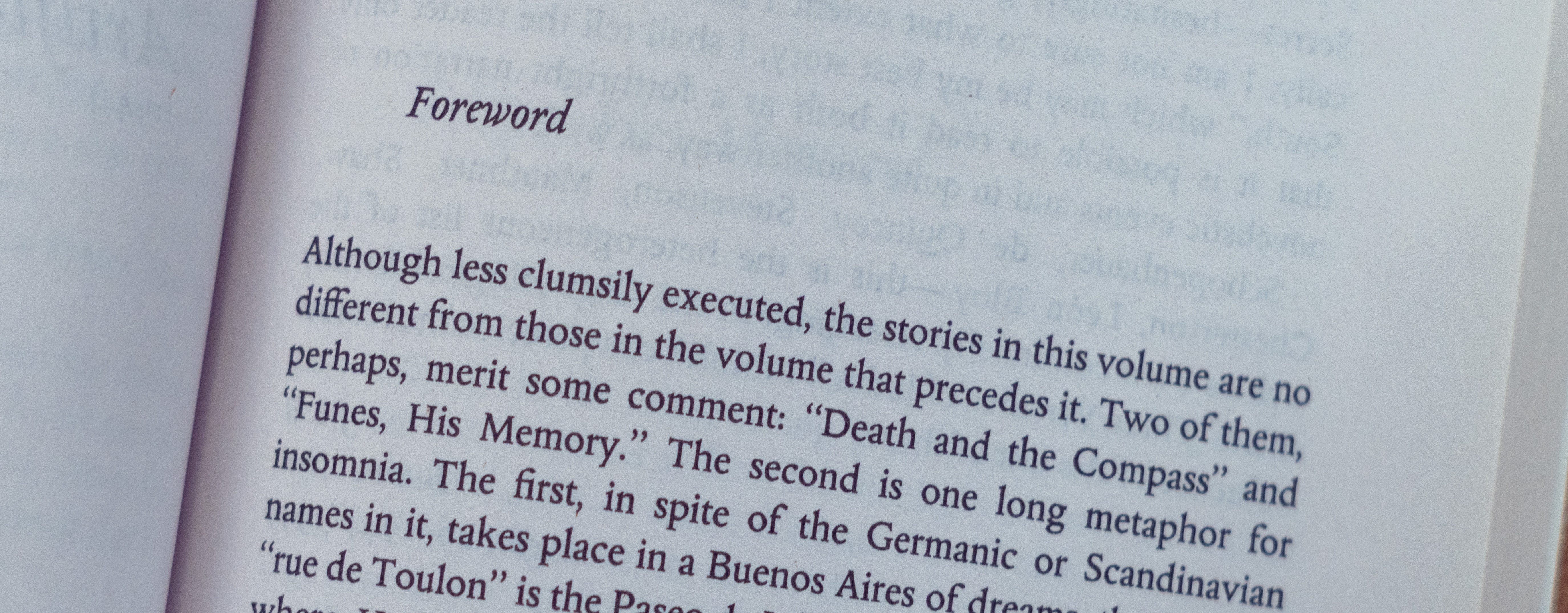
It took me a few moments to recover from the shock—not only because I admire Borges as a writer, but because of what that sentence implied. We are talking about an author whose work helped define an entire mode of fiction, and about short stories that reshaped twentieth-century literature and that, nearly eighty years after their publication, we continue to read with undiminished astonishment.
But don’t take my word for it.
Writing for the BBC1, Jane Ciabattari noted that “Jorge Luis Borges’ mysterious stories broke new ground and transformed literature forever,” adding that “Borges’ influence […] [is] so deep it that has become difficult to name a major contemporary writer who hasn’t been touched by it.”
His reach extended far beyond literary circles. In 1965, John Updike wrote that the belated North American recognition of Borges marked the arrival of an intelligence in fiction more commonly associated with philosophy or physics—a judgment later echoed by critics such as Michel Foucault, George Steiner, and Harold Bloom2.
Even William Gibson, author of Neuromancer and pioneer of the cyberpunk genre, described reading Borges3 as if he were “installing something that exponentially increased what one day would be called bandwidth.” In an interview with Publishers Weekly4, Gibson noted that:
Gibson: I think of [Borges] as one of the first writers I read as a young science fiction reader who suggested to me that there were ways into a much broader field of thoroughly imaginative literature. […]
Interviewer: Do you try to do the same thing in your own work?
Gibson: In some modest way I’ve definitely aspired to it.
And yet this same writer, whose work altered the trajectory of modern fiction, looked back on these stories and described them as “clumsily executed.”
And it wasn’t the first time he did it either.
Borges was actually quite self-deprecating about his work, going as far as to go on record stating that his earlier short stories were “written by someone else.”5
Again, that wasn’t all of it. In On Writing, Borges confessed:
I know very little of my own work by heart, because I don’t like what I write. In fact, […] I know all the chinks and all the padding, I know that a particular line is weak, and so on.
And in an interview with Ronal Christ, in July 19666, Borges took great care on critiquing his own early work, and calling it “the work of a young writer” and even sneering Death & The Compass:
As to the vocabulary, the first thing a young writer, at least in this country, sets out to do is to show his readers that he possesses a dictionary, that he knows all the synonyms; so we get, for example, in one line, red, then we get scarlet, then we get other different words, more or less, for the same color: purple.
Those comments on his own stories… are clinical. No hesitation, no remorse, not even hatred. Borges did not come across as unsure, but as unimpressed about his “younger writer persona.”
And truth be told, that calm is familiar to anyone who has spent time writing. The longer one works on a piece, the more clearly one sees its problems: the compromises, the shortcuts, the places where intention outran execution—and the public seldom sees this; they only note the finished object, without awareness of the intention behind it.
Yet at this point, we must ask ourselves one question:
What can we learn from this?
One truth we may prefer to avoid: that self-judgment and historical value do not share the same scale.
As readers—and especially as writers—we tend to assume that an author is the best judge of their own work… but this anecdote from Borges suggests otherwise. He was a genre-defining writer, admired by critics and by other genre-defining authors alike, referring to his most enduring stories as “clumsily executed.”
If Borges could look at stories that would reshape 20th-century literature and think “clumsily executed” with that clinical, analytic style… then we know that confidence is not a reliable metric, that self-doubt is not a diagnostic, and that internal judgment does not scale with external value.
What we can learn, instead, is this:
We must be harsh anyways, because that’s the only way we can grow. If you read the “newer” Borges’ short stories—including The South, which he considered his best work—you may notice a leaner style, a more refined way to present themes. Borges grew as a writer because he learned something from his mistakes: each was a necessary, and unavoidable, “stepping stone.”
But harshness can become distorted because perspective erodes over time. How many times we chastise ourselves saying, “I should’ve known better!” … but could we, truly? More often than not we assess our past work with the lens of experience that writing has granted us—and we hold our past selves to standards we had no way of meeting.
Self-doubt is not evidence of mediocrity, it often accompanies seriousness. If we are serious about our writing, then “maturing” as writers becomes an implicit goal—and there is no better way of learning that looking at our mistakes. Self-awareness has always been essential to growth. The key is not letting it become deadly.
Keep writing, then. Keep critiquing your own work.
And remember it’s not a measure of quality or impact. Self-critique is just a tool—and one we must keep in check.
So keep trying. Keep writing. No matter what your inner critic says.
Remember: self-judgement and impact do not share the same scale.
Copyright © 2026 Livia J. Elliot. All rights reserved. This publication is licensed for personal reading only. No article, or substantial part of an article, may be reproduced, republished, adapted, translated, compiled into another publication, incorporated into teaching materials or course packs, or used for AI training without prior written permission. Linking to the original articles is encouraged.
“Is Borges the 20th Century’s most important writer?” by Jane Ciabattari for the BBC. Published on: 2014-09-02. Read here.
Commentary from “Rebirth of the true Georgie” by James Woodall, published in The Guardian in 1999-01-16. Read here. For reference, Jame Wodall wrote a biography of Borges, titled “Borges: A Life” (US title) or “The Man in the Mirror of The Book” (UK title).
This is actually from an edition of Borges’ Labyrinths, edited by Donald A. Yates; William Gibson wrote an itnroduction for it. The edition was published in 2007; it’s ISBN-13 is: 978-0811216999. Here it is on Amazon.
This interview was published as part of the publicity surrounding the aforementioned edition of Labyrinths, for which Gibson wrote the prologue. Here’s the full interview.
This one is in Spanish, because I couldn’t find a translation. “La Anti Autobiografía de Jorge Luis Borges” by María Ester Martínez Sanz. Available here.
Strange, I find his earlier works much more interesting. I think that when we try to tame our original, raw genius with “experience” we castrate something feral and necessary.