Your Narrator Is A Camera: Narrative Distance in Fiction ~ Narrators Series #7
Exploring narrative distance through a camera metaphor: from the “wide shot” of omniscient narration to fully “handing off” the camera to the character. It includes three detailed examples.

This has probably happened to you. During an event, both you and your friend take your phone’s cameras out at the same time. You aim to capture the same point of interest, and are even standing shoulder-to-shoulder—but the resulting photos are nothing like each other. One of you may have zoomed in, angled the camera, perhaps even lowered the contrast… and the other may have taken a plain, forward-facing photo.
It’s the same point of interest, but your compositions evoke different moods and reactions. They capture different perspectives of the same moment.
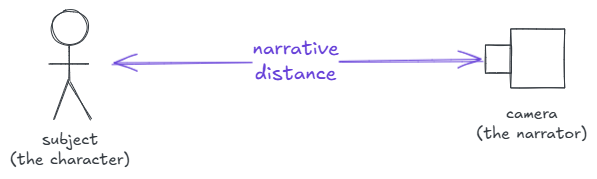
This is exactly how narrators interact with characters in a story. Here, if your character is the subject, the narrator is the camera following them:
Pull the camera back far enough, and you’ll capture everyone’s movement—but their facial expressions will be less detailed because distance smooths out details. This is what an omniscient narrative does: it trades depth for breadth.
Instead, if you push it close—and place it in the character’s shoulder—your camera will see only what the character sees. If they’re running, the shot judders, but if they’re still, the shot may seem frozen. If there’s a microphone, you may even hear their jagged breathing, and the noise may blur everything else. This is what a limited narrator does: it trades breadth for depth.
In other cases, though, a writer may hand off the camera to the character and let them handle the storytelling. This is what first-person and framed narratives do: offer only depth… and a biased one at that.
This interaction between the camera (the narrator) and the subject (the character) represents something known as narrative distance. Narrative distance, in turn, affects what is presented to the reader and how.
This is the first part of a three-part series.
Therefore, today we’ll focus on the effects of that distance: how much the character influences the narrative, what trade-offs there are, and where unreliability and bias come into play in limited or framed narratives. The following parts will focus on the effects of unreliability (namely, unreliability as a “lens”), and some interesting rule-breaking… because let’s be honest, if you have a good enough reason, every writing ‘rule’ can be broken.
Narrative Distance | Unreliability | Breaking The Rules
That said, and as usual, I will offer detailed examples from different books, with a focus on speculative fiction.