

Book Review: Flatlands by Edwin A. Abott
"A romance of many dimensions, written by a Square" which is, simultaneously a satire critiquing the Victorian society and a speculative fiction piece of mathematical proportions. A hidden gem.

Flatlands. Sheer speculation on unknown dimensions, mixed with a satire of the Victorian society, and written by none other than a Square.
This is an old book, published in 1884, and it does not fit neatly into modern-day publishing categories. Broadly speaking, it is an epistolary narrative—what we read is the main character’s own essay—set in the fictional world of Flatland: a place that is, as the name implies, flat and two-dimensional. The ‘humans’ of this world are 2D geometrical figures, and their shape determines every aspect of their social rules and structures.
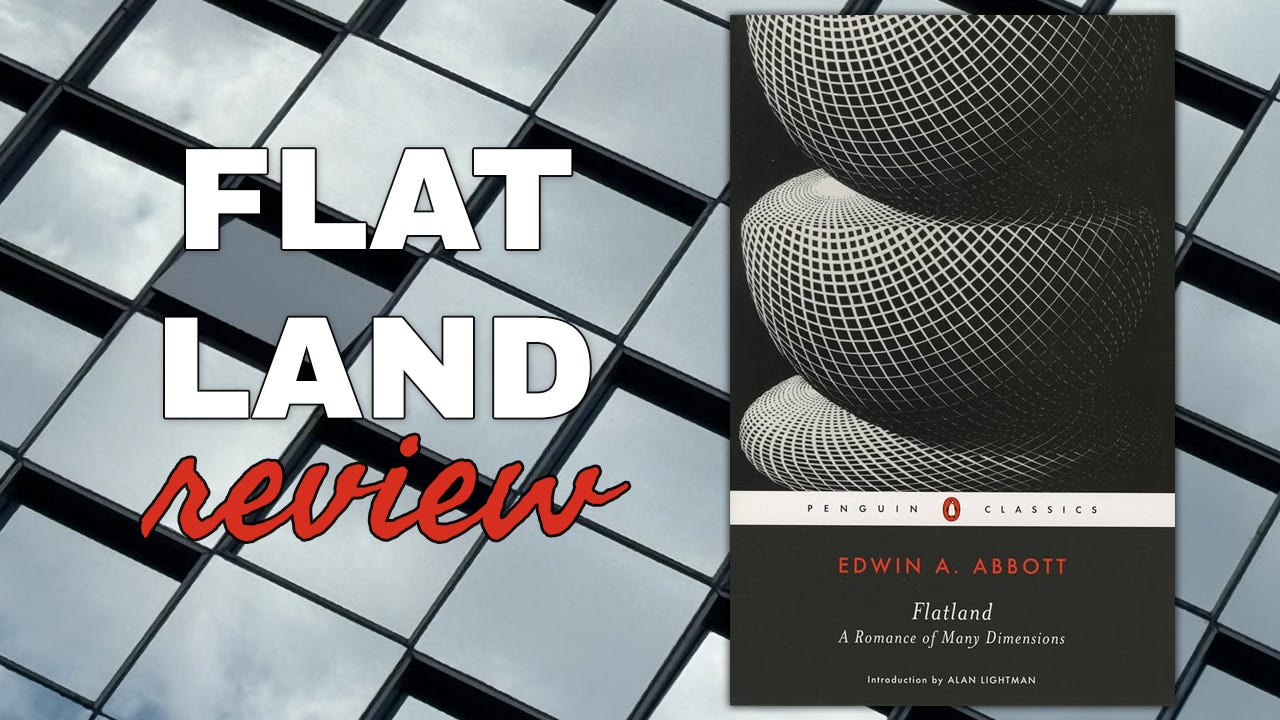
Structurally, the book opens with a ‘foreword’ that is, in fact, part of the story: it is written by a fictional character, allegedly a friend of Square. After that, the first half of the book is Square’s attempt to explain how Flatlands works, dimensionally and socially. The second part recounts Square’s visit to Lineland (the realm of one dimension) and his encounter with a Sphere from Spaceland (the realm of three).
I want to focus on the element that interested me most: the satire of Victorian society and its accompanying social critique.
This satirical tone is already hinted at in the in-book prologue, where Square’s ‘friend’ tries—somewhat desperately—to dismiss accusations that Square is ‘derogatory towards women.’ (Spoiler: he absolutely. He’s also classist and ableist.) From then on, nearly every detail of Flatland’s social hierarchy can be read as a parallel to the real world.
A few examples:
Figures range from Triangles (Isoceles as the lowest, Equilateral above them), to Squares, Pentagons, and so forth. Isoceles Triangles form the lowest class and are often policemen or enforcers. Equilateral Triangles are low-income workers, Squares are lawyers, Pentagons are physicians... and the closer a figure gets to a Circle (i.e., the more sides it has), the higher its social rank. Near-Circles are revered as High Priests. The society is rigidly stratified, as Victorian society was.
Square looks significantly down upon the Isoceles, despite not being near the top of the hierarchy himself. To me, he reads as a caricature of the Victorian middle class: contemptuous of those ‘beneath’ him and irrelevant to those above.
From Squares onwards, children have more sides than their parents; e.g., the son of a Square is a Pentagon, and his child is an Hexagon. For those Near-Circles, every child gets exponentially more sides. However, every generation of Triangle merely widens their angle a few degrees until, several generations down the road, one Square is born. To me, this critiqued social advancement: the better-off your parents are, the easier it is to ‘progress in life’ and the more you can achieve. Likewise, children of low-income workers are (due to the society itself) almost forbidden all progression; it requires far more more effort to move on from poverty, than among the ‘tiers’ of middle-class society.
Women, regardless of class, are Straight Lines—the lowest of the low. (No pun intended... though there is, because this is a satire.) Their sole purpose is marriage and domestic labour, very much in keeping with the author’s contemporary society. Abbott devotes an entire chapter to legislation restricting women’s behaviour, while also explaining how women, in Flatlands, are nearly ‘invisible.’ The book is almost shockingly self-aware.
Square also explains that, by some divine mandate, all figures are meant to be Regular—having sides of equal length—and that Irregulars are criminals, degenerates, or addicts. The real-world parallel is obvious: Victorian society was not kind to people with disabilities.
There is so many more social critiques than I can cover here. Square is classist, sexist, and ableist—but his arguments are circular (pun intended). Even though he is ‘illuminated’ (and he is fond of saying) with Perspective after visiting Spaceland… he hasn’t quite acquired social perspective, and remains oblivious to the fact.
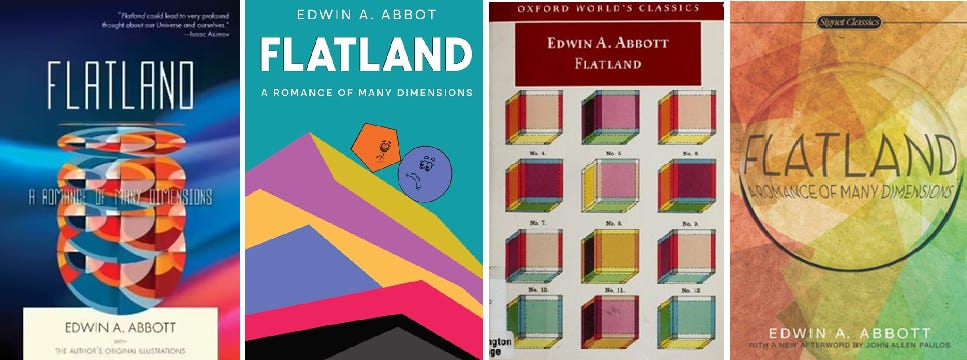
The mathematical speculation is equally compelling.
Abott asks whether other dimensions or realms of being do exist and whether we have the capacity to perceive them. He imagines what those dimensions would be, and how would they affect the 3D forms we take for granted. Socially, he also captures the intrinsic resistance such discoveries provoke—the denial, the accusations of heresy, and the institutional mechanisms that suppress inquiry.
Overall…
This is a quaint book, though for modern readers its archaic prose may feel dense. The satire is sharp but easy to miss, and if you don’t recognise it as satire, the book may come across as deeply offensive. Read with that lens, though, Flatland becomes not only a mathematical curiosity, but a surprisingly incisive critique of its time.
This review was originally published in GoodReads, on November 26th, 2025. It prompted a few posts of mine, which you may find interesting:


It also made it to my top reads of 2025:

If you are interested on reading it, Flatlands is part of the Guthenberg Project.
Copyright © 2026 Livia J. Elliot. All rights reserved. This publication is licensed for personal reading only. No article, or substantial part of an article, may be reproduced, republished, adapted, translated, compiled into another publication, incorporated into teaching materials or course packs, or used for AI training without prior written permission. Linking to the original articles is encouraged.