

Book Review: The Man in The High Castle, by Philip K. Dick
More than alternate history, this novel discusses how we construct fictions in order to withstand the context in which we live, and how conflict and suspicion are, ultimately, part of human nature.

The Man in the High Castle is a philosophical, social sci-fi take on WW2 alternate history, written during the Cold War and permeated with Philip K. Dick’s abiding preoccupation with what is real and what is fiction—or, in this case, how we construct fictions in order to withstand the non-fiction, the context, in which we live.
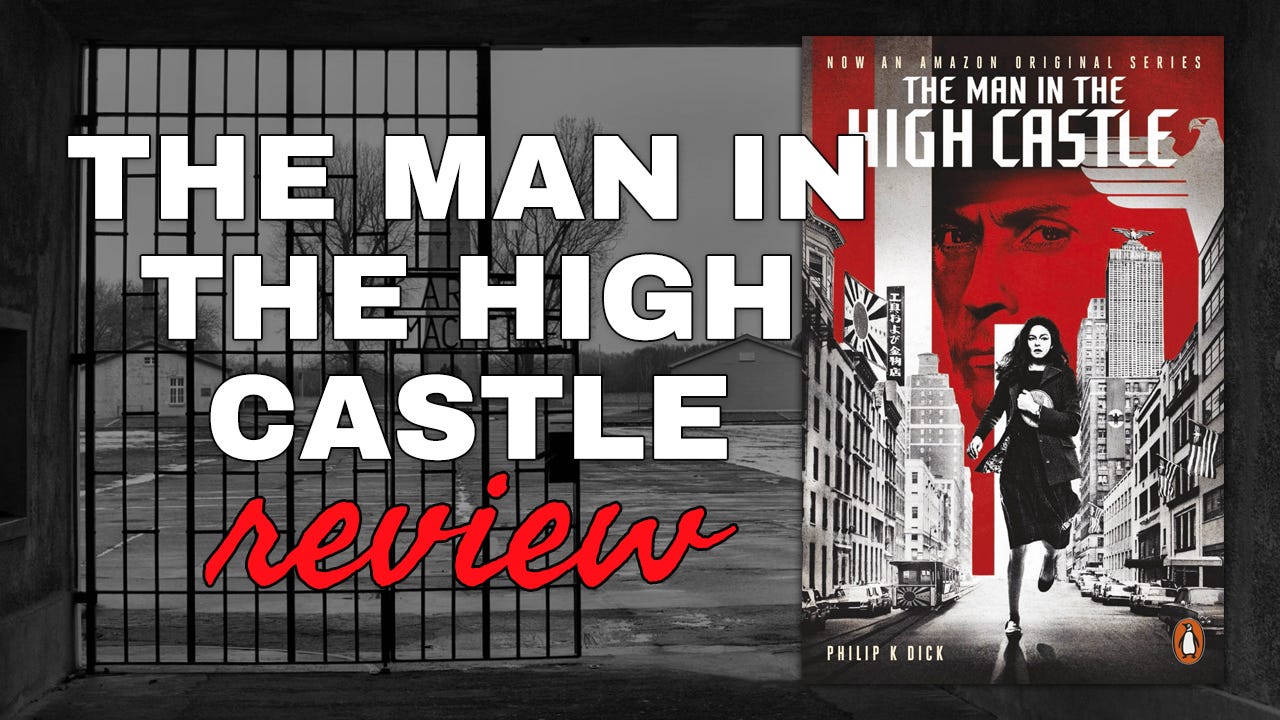
The short answer to what makes it alternate history is almost too simplistic:
Germany and Japan win the Second World War.
But the longer answer is where PKD’s political realism begins to shine. He speculates that Roosevelt was assassinated in 1934, making room for a successor who steered America towards isolationism—a decision that left the European allies without support and allowed Germany to cut through the continent unopposed. Likewise, such isolationism gave Japan the conditions to destroy Pearl Harbour and the American fleet.
What is remarkable, at a sociopolitical level, is that the novel never presents these alternate events in isolation. Events are discussed as sequences that unravel because of what came before, creating consequences that have steered this fictional world into a different New World: where Germany rules Europe and the east coast of USA, and Japan controls Australia, SEA, China, and USA’s west coast.
Of course, where frontiers have shifted, ideology has followed. The Nazis wield sufficient political power that anti-Jewish legislation is woven into the new world order—any Jew found in the open is detained and deported to the concentration camps. The ovens are mentioned several times, as is what occurs within them, though there are no explicit scenes. Nazi Germany has also “solved the African problem” (the novel’s own phrasing) which, as one might expect, refers to the mass genocide of the local population.
The Japanese, by contrast, occupy themselves with cultural appropriation—a theme that, without any attempt at subtlety, mirrors actual history: specifically, the fetishisation of Japanese and Oriental culture during the American occupation of Japan. Here, that dynamic is inverted. The Japanese collect Americana—such as art, dinnerware, weapons—from pre-occupation America, undertake the reconstruction of destroyed neighbourhoods, and hold particular views towards the stereotypical blonde woman. This last detail is, for the most part, conveyed obliquely, filtered through the thoughts of the novel’s male characters.
Against this backdrop, the novel follows multiple characters
Their stories begin in apparent isolation, connected only by the concerns and traditions of this new world.
Robert Childan, a merchant dealing in Americana, is attending to Japanese customers; Mr Tagomi, a senior functionary of the Trade Mission, is one of them—and one of the novel’s point-of-view voices. Frank Frink, a Jew, has just left his job as crafter of imitations—and while consulting the I Ching about his uncertain future finds he cannot stop thinking of his ex-wife, Juliana. She, in turn, lives in the neutral buffer territory between Nazi-occupied and Japanese-occupied America.
What draws these perspectives together is:
their detachment and/or resignation towards the current geopolitical situation (accompanied by a deep desire for a different world),
their involvement (whether voluntary or otherwise) with art, and
the ever-present role of the I Ching in their lives.
I cannot tackle all of these points in this essay-review without it becoming a book of its own. I will focus, therefore, mostly on the first.
The characters’ resignation and detachment is, in my view, the richest point of discussion.
Given the setting—and the level of sociopolitical realism and research on display—the author could have focused on the large scale... but he chose otherwise. I called this novel “social science fiction” at the outset because PKD took a far more personal approach, examining how these seemingly disparate characters internalise and navigate this alternate history.
Childan, the art dealer, is caught in what I would call ideological contradiction: he despises the Japanese occupation and resents their authority, yet actively courts the favour of high-ranking Japanese figures, seeking social proximity to advance his store’s reputation. In his own words:
Now, the Japanese on the other hand. I know them pretty well; I do business with them, after all, day in and day out. They are—let’s face it—Orientals. Yellow people. We whites have to bow to them because they hold the power. But we watch Germany; we see what can be done where whites have conquered, and it’s quite different.
But also:
If all business days were like this... but it was more than business, the success of his store. It was a chance to meet a young Japanese couple socially, on a basis of acceptance of him as a man rather than him as a yank or, at best, a tradesman who sold art objects.
Since this is among PKD’s more literary novels, Childan’s sections carry a distinctive prose style—one that subtly mimics the cadence and register of the Japanese characters he speaks with. Consider this excerpt:
“That recalls fine speech I heard by Doctor Goebbels,” Robert Childan said. “On radio, year or so ago. Much witty invective. Had audience in palm of hand, as usual. Ranged throughout gamut of emotionality. No doubt; with original Adolf Hitler out of things, Doctor Goebbels A-one Nazi speaker.”
“True,” both Paul and Betty Kasoura agreed, nodding.
“Doctor Goebbels also has fine children and wife,” Childan went on. “Very high-type individuals.”
Frink, perhaps the one whose mere existence is most at risk given fictional-Germany’s deportation legislation, seldom thinks about the danger he may face. Instead, he longs for his ex-wife, and later focuses on setting a handwrought jewellery business.
Towards the end of the book, the police apprehend Frink and he attempts to escape, but his weak resistance reads as cursory rather than desperate. To me, this was not a flaw, but an illustration of how totalising the anti-Jewish legislation had become, and how little individual resistance could matter within it. Frink seemed philosophically Stoic: accepting what would happen due to knowing his own future was out of his control.
There are other perspectives to consider—such as Mr Tagomi from the Trade Missions, and a recurrent character he meets with, Mr Baynes—but I want to move to someone else.
Juliana Frink is perhaps the most interesting character of all.
A modern reader may find her passive, easily deceived—a stereotype, even—since much of her plotline revolvers on the consequences of her poor choice of lover. And yet, thematically, her storyline is the richest in the novel.
She begins by performing stability: attempting to exist within the buffer territory while unconsciously disregarding all news of the world beyond. Then, without suspecting it, she becomes entangled with a Gestapo-style kommando sent to assassinate the actual man in the high castle—the largely absent figure who gives the novel its title, and is the author of an in-world banned bestseller that imagines yet another alternate history. One in which Britain and the United States win the war, but the world that emerges is markedly different from our own.
As she travels alongside this operative and reads the forbidden book, Juliana’s perception of the world she inhabits begins to shift. She stops mourning the present—or what America might have been—and moves, at last, into the future. To explain this, I need to discuss the book she is reading.
The Grasshopper Lies Heavy is the in-world bestseller:
The fiction within the fiction, thematically echoing the nested, unstable realities that recur throughout PKD’s work. It is not as vertiginous as Ubik1 (where reality physically disintegrates and merges into another) but it achieves something similar through more theoretical means.
One can understand why the characters are drawn to it.
Abendsen is described as a compelling writer, and his premise is genuinely so: Britain and the United States win the war and turn towards humanitarian investment—imperfect, economically motivated, but utopian by comparison to the reality The Man in the High Castle presents. And yet, even within this more hopeful alternate history, a new war eventually emerges, because Britain chooses to go to war with the United States. As one character puts it:
“Human nature,” Joe added. “Nature of the states. Suspicion, fear, greed.”
What makes this devastating is that, through Tagomi’s storyline we learn that Nazi Germany was, all along, planning to move against Japan—driven by suspicion, fear, greed. The fictional reality of Grasshopper... mirrors the fictional reality of PKDs’s novel, and both, in turn, gesture towards the conditions that gave rise to the Cold War.
Juliana’s ending, through the use of I-Ching, attempts to bridge this to the reader. Given it pertains to the controversial ending of the book, I’ll warn the below section contains major spoilers.
Juliana manages to shake off the Gestapo-style kommando and travels—with mandatory stops to finish Grasshopper...—to visit Abendsen, its author. After a brief conversation, he reveals that he wrote the book while consulting the I-Ching, whereupon Juliana insists on putting the question directly to the Book of Changes:
Juliana said, :Oracle, why did you write The Grasshopper Lies Heavy? What are we supposed to learn?”
The answer is, at face value, disconcerting:
”It’s Chung Fu,” Juliana said. “Inner Truth. I know without using the chart, too. And I know what it means.”
Raising his head, [Abendsen] scrutinised her. He had now an almost savage expression. “It means, does it, that my book is true?”
“Yes,” she said.
With anger he said, “Germany and Japan lost the war?”
“Yes.”
It left me thinking, I will not deny it.
Was PKD looping back to our reality?
After much deliberation, I arrived at this conclusion: Grasshopper... is true, because the reasoning underlying its geopolitics is true. Every nation is a looser in a war, even when they settled the terms at the end, they lost—people, funding, time. Likewise, nations do not engage in humanitarian aid unless there is an economic benefit to them, and no matter how utopian the world they construct, or however harrowing the war that preceded it, they edge back towards conflict—because conflict is inseparable from humanity’s identity.
To close off…
A particularly strong point of this book is the idea that Philip K. Dick presented alternate history as a chain rather than a single divergence point. Within that context, the characters are thoroughly flawed and thoroughly human, their storylines apparently tangential yet woven together to illuminate the alternate world they inhabit—one that, unfortunately, remains timelessly relevant.
By far, Ubik is my favourite book by Philip K. Dick so far. If you are interested, I did publish a review about it:

And analysed the book in my podcast, explaining how PKD upturned Plato’s Allegory of the Cave, while bringing Kant’s noumenal and phenomenal into play:
