



“He felt all at once like an ineffectual moth, fluttering at the windowpane of reality, dimly seeing it from the outside.” This is one of the key ideas behind one of the most enigmatic novels written by Philip K. Dick. I’m talking about Ubik.
Let’s get this book undone.
Hello everyone, and welcome to Books Undone. I’m your host, Livia J. Elliot, and today we are discussing Ubik, one of the most psychological and reality-bending novels from the prolific Philip K. Dick. Today’s theme is a bit complex: we’ll try to understand the layered realities of the book, the interplay of overpowered forces in the narrative, while hoping to answer one famous question: what is Ubik?
To do that, I will first give you a short bio of the author, then we’ll proceed with a summary of the book, and from there we will dive into the discussion. There are three main philosophical concepts I need to introduce—namely: Plato’s Cave, the Demiurge, and Kant’s noumenal/phenomenal worlds—but I’ll tackle them as we go through the analyses.
With that said, allow me to add some disclaimers.
As usual, there are spoilers in this podcast episode. Ubik is less than 200 pages long, and to discuss some of its elements, I’ll need to mention specific plot events. However, I’ll try my best to explain as we go in hopes you can enjoy this without having read the book.
Then, please know this is my personal take. I could be woefully wrong or offer a perspective you disagree with. That’s fine; we all have different ideas and this is just one more out there.
That said, let us get started with the author himself.
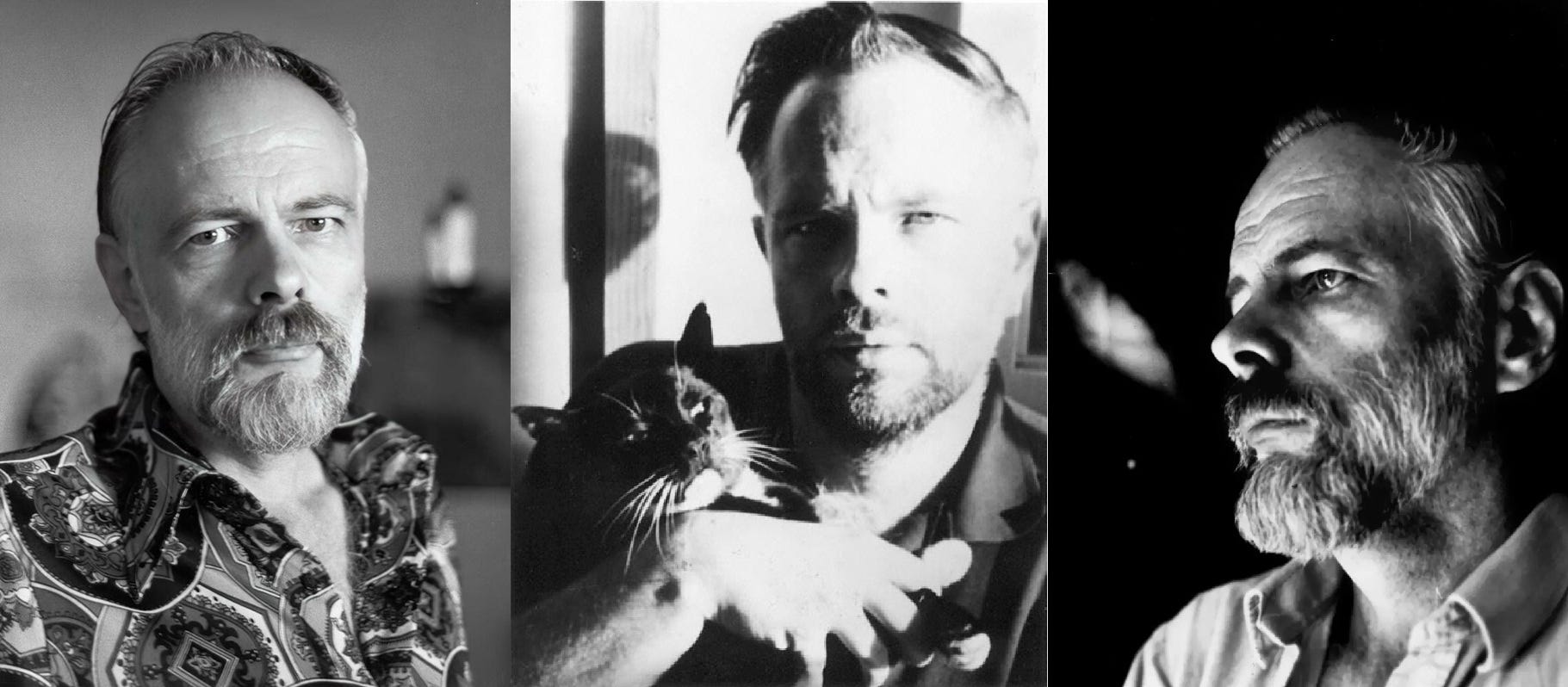
Philip Kindred Dick, also known as PKD
—was an incredibly prolific American science-fiction writer. Many of his works were later turned into movies, and I bet there are two you have heard of: the famous movie Blade Runner (based on the novel titled Do Androids Dream of Electric Sheep?), and the movie Minority Report (based on a novelette of the same title). There is also A Scanner Darkly (which featured an all-stars cast), and Total Recall, among others.
PKD was born in 1928, and he actually took an interest to science fiction when he was about ten years old; there is an interview in which he said he read his first sci-fi magazine—Stirring Science Stories in 1940. He attended the University of California, Berkeley, but did not declare a major and instead took classes in history, psychology, philosophy, and zoology, eventually dropping in 1949.
One thing to note is that PKD was an amphetamine addict and a sociopath—to the point that one of his books, A Scanner Darkly is actually dedicated to the addicts that were his friends. Because of this, his level of output was inconsistent, and he would experience periods of intense creativity, and dark times with no writing at all. By the 1950s he had begun to make a name for himself, but he was known mostly within literary circles only.
Perhaps because of his personal struggles, a common theme in his work is an attempt to demonstrate the ever-expanding potential of the universe and personal journeys into his own realities. PKD’s fiction seldom has an understandable, straightforward reality—instead, there are layers, dozens of unexpected events, and mind-bending twists that leave readers wondering what is real and what isn’t while seldom being able to find an answer. His fiction has been described as “paranoid”, and he was “notable for focusing not on the trappings of futuristic technology, as many writers in the genre do, but on the discomfiting effects that these radically different—and often dystopian—surroundings have on the characters.”1.
PKD died of a stroke in 1982 when he was only 52 years old, leaving a legacy of over sixty published works, including short story collections.
Summary of Ubik
Ubik was published in 1969, and it is one of PKD’s most acclaimed novels. In 2009, the Time Magazine chose it as one of the All-Time 100 Greatest Novels since 1923; in that review, critic Lev Grossman described it as “a deeply unsettling existential horror story, a nightmare you’ll never be sure you’ve woken up from”2. The book is now part of Gollancz Sci-Fi Masterworks collection.
In terms of the setting and world-building…
—in this book, PKD expanded a concept he’d already worked on before: some people are born with talents, others with anti-talents, but most with neither.
Those with talents manifest a power and cause change. This includes abilities such as precognition, telepathy, parakinetics, and so on.
Those with anti-talents do not manifest a power nor cause change—but nullify a talent. People with anti-talents are called inertials, and can be of the same type of the talents; namely, anti-telepaths, anti-kinetic, and so on.
When two people—one a talent and the other a corresponding anti-talent—are close, and if their power-rank is equivalent, they nullify each other.
The problem is that talents have changed the world—imagine the number of telepaths doing espionage, parakinetics attacking people from afar, precogs changing the future events without anyone knowing. To somewhat “control” talented people, there are prudential organisations which employ anti-talents and sell their services to others. Our protagonist, Glen Runciter, is the owner of a prudential organisation: Runciter Associates. The Head of Inertials is Joe Chip, a person without talents nor anti-talents who tests the inertials and assigns them to jobs.
Now, here comes the twist: Glen Runciter’s wife, Ella Runciter, is a half-lifer. Within this book, and after a person dies, they can be moved rapidly into cold-pac to preserve their consciousness. Cold-pacs are cryogenic pods linked to electronic devices that pick up the half-lifer’s brainwaves and transfer them into speakers locked into the pod—which, in turn, allows their relatives to communicate with them.
Joe Chip explains it as follows:
But this old theory—didn’t Plato think that something survived the decline, something inner not able to decay? The ancient dualism: body separated from soul. The body ending […], and the soul—out of its nest the bird, flown elsewhere. Maybe so, he thought. To be reborn again, as the Tibetan Book of the Dead says.
The mention to Plato is pretty interesting (and perhaps a foreshadow of the book’s central theme), but let’s not get there yet. For now, you also need to know that cold-pacs are maintained by moratoriums, and only last for so long—the older the half-lifer is, the later in life they passed away, or the more brain damage they had, the fewer years of half-life they have. In some cases, they may be completely “irretrievable”, in which case they skip half-life and are just dead.
The plot begins when Joe Chip discovers the first anti-precog inertial: Pat Conley.
She’s taken to Runciter Associates, where Glen has just received an offer for a new job: to take the most powerful inertials to the moon, where—according to the report—several powerful talents are attacking a company’s installation. Joe selects eleven inertials, including the anti-precog Pat, and they all travel to the moon in the company’s ship. Joe and Glen also go in this trip.
As soon as they arrive, it is revealed the request was a trap set by one of the largest talent organisations—basically, Runciter Associates biggest counterpoint. A bomb goes off in the room where all the inertials are, and Runciter is heavily wounded in the blast. Joe and the inertials survive to escape the damaged facilities while dragging Glen; once they reach the parked ship, they preserve Glen in cold-pac and go back to earth and into the moratorium where his wife, Ella, is.
The moratorium’s owner takes Glen in, but cannot contact him straight away, suspecting he was put into cold-pac way too late. Regardless, given Glen’s importance, the owner decides to try a few more things.
As Joe waits something strange begins to unfold: he can’t talk to Ella (Glen’s wife) because another half-lifer is quote-on-quote “blocking her”, and all around him…. the world begins to decay. Modern machines become rusty old ones, newly printed newspapers are actually years old, and current coins suddenly become older versions—including some that have Glen’s profile, but are accepted as valid currency!
Overnight, one of the surviving inertials, Wendy, dies. When they find her body—mere hours after she passed away—her corpse is determined to be centuries old. Upon seeing whatever is left of Wendy, Joe comments:
“This can’t be normal death… [this] is unnatural.”
To make matters worse, buildings begin to go back in time, elevators suddenly turn into old cage-locked contraptions, society forgets planes, and Joe is left to drive a 1930 car… in a world were going from USA to Paris took one hour and self-driven cars where the norm! Amidst this regression, Joe struggles to grasp stable truth.
What is happening? Why is reality… decaying?
Even amidst the mayhem, Joe Chip has a theory. Allow me to read:
It must be a manifestation of dying, he said to himself. The uncertainty which I feel, the slowing down into entropy—that’s the process, and the ice which I see is the result of the success of the process. When I blink out, he thought, the whole universe will disappear. […]
Let us say, this decaying reality is no precisely straightforward.
The world of Ubik reflects Plato’s ideas… to some extent.
Very early, the book presents us two clear realities:
The world where “living” people exist, and
The half-lifer’s world, which is the world of the mind. It somewhat reflects reality (in the sense that there are cities, streets, parks, cars)… but it is just a quote-on-quote ‘approximation’. Its inaccuracies are often attributed to the half-lifer’s having been dead for too long and thus unable to see the current world, or remember the world of their time.
This world of the half-lifers exists because they all create it together—at least, those that are close by. Let me explain.
A half-lifer’s body is kept in cold-pac, right? Cold-pac is an individual cryogenic pod. However, moratoriums place them together because the half-lifers’ minds wander around to create this approximated reality they live on. They meet in it, have ‘half-lives’ there… and the moment their bodies are isolated (on steel pods), their minds drift off into death due to feeling lonely.
Up to here, PKD teases its readers with a somewhat comprehensible setup: the world of the living is the real world, and whatever the half-lifers have is a pseudo-world; those that are actually-dead have nothing. However, it looks like there is an overlap of realities, isn’t it? Why would the half-lifers be able to create their pseudo-world only when their bodies are physically close to each other in the real world? It sounds like there is an implied dependency between both realities, but this is just the beginning of how perception twists in this book.
Now, if you recall, I stopped the plot’s summary when I told you that—after surviving the bomb explosion on the moon and coming back to the moratorium—Joe began to see the real world decay: modern appliances became old ones, coins had older dates (and even Glen’s face), and even cars had to be manually driven.
The first question that Joe asks himself is: what the hell? After the shock wears down, only confusion remains and so he asks the same questions the reader is likely pondering: Why is the real world decaying? Joe and the inertials survived the bomb, right? Or did they die in the blast and are all in cold-pac now? Except they believe to be fully alive?
Those are very sensible questions to ask, but in order to discuss what is happening—along with the interplay between the real world and the half-lifers’ pseudo-world—I need to introduce one philosophical concept.
Enter Plato’s Allegory of The Cave
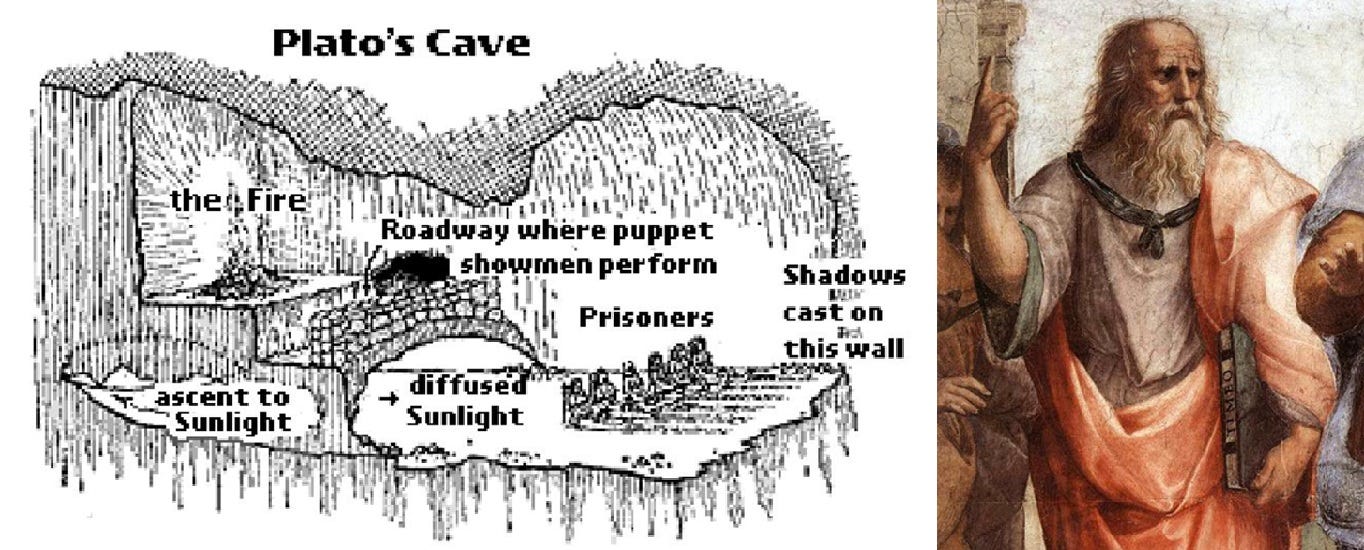
In the allegory, Plato describes people—henceforth, the prisoners—who are chained by their necks and ankles within a cave; from their angle, they only see another inner wall. There is, however, another group of people who walk over the wall the prisoners are chained to; a fire is set behind them, so that the walkers project shadows into the only wall the prisoners see. As they move, the walkers pronounce the names of the objects—but their voices are distorted by the cave, and the prisoners believe the sounds to be coming from the shadows themselves.
To the prisoners, those shadows are real. It is the only thing they have seen during all their lives; they have no evidence to doubt their truthfulness, and so they accept the shadows as real.
One day, a prisoner is freed and forced to turn his head toward the fire. At first, he is dazzled because the flames are too harsh compared to the penumbra he’s used to; when he’ dragged out of the cave entirely, the sunlight blinds him. Slowly, however, he adjusts: he comes to see real trees, real animals, real people. He understands that the shadows were mere copies of true things, and that the outside world contains the genuine forms. When he returns to the cave to tell the others, they will mock him, even grow hostile, insisting that the shadows are the only reality.
If you want to see a handy diagram of the allegory, check my blog at liviajelliot.substack.com. You can also find the transcript for the episode there.
But this ‘allegory of the cave’ is a story you’ve seen before.
Welcome to The Matrix—especially the first movie. The Matrix itself—the ’90s world Mr Anderson lives—is the actual cave. When Morpheus offers the pills, he’s offering a pathway out of the cave and into reality (aka, to stop being a literal prisoner and go out). Neo is what results of Mr Anderson seeing the real world. This is also why they cannot unplug people randomly: they die because their minds are unable to accept the real world.
However, both The Matrix and Plato’s cave are straightforward: you’re in the cave (or the Matrix), or you’re out of it. Ubik, though… we will soon see that PKD took this allegory to the nth degree and beyond.
Before we do that, allow me to remark something interesting about Plato’s allegory: it dramatises the human condition as one of entrapment. Plato assumes that most of us live content with shadows and echoes (aka, by default we’re inside The Matrix), never realizing they are mere imitations of something more real. To step beyond appearances requires struggle, pain, and transformation… and even then, the return to ignorance is tempting, because the false world is safer and more familiar than the true one.
And with that said…
Let us return to Ubik, and Joe’s dilemma!
Not long ago, I told you that after surviving the explosion, Joe’s world began to decay. At that point I asked: could it be that Joe and the inertials died in the explosion and are all in cold-pac now, living in the feeble pseudo-world of the half-lifers?
We cannot answer that question yet, so let’s evaluate Joe’s situation through Plato’s Allegory of the Cave.
We could argue that Joe is trapped in the cave: he thinks the shadows (aka, the decaying world) is the real world because he has no evidence of the contrary; thus, if he’s in the real world, he assumes to be fully alive, right? This perception—or misperception, perhaps—is challenged the moment two things happen:
The moratorium owner calls Joe to advise they still cannot contact Glen; this would imply he’s likely drifted way too close to death. And,
Joe and the surviving inertials find—amidst all the objects and things that seem to be deteriorating—a matchfolder with an advertisement that reads as follows:
Mr Runciter, although helplessly frozen in cold-pac, earned four hundred…
First, it doesn’t sound like it on my summary, but Glen Runciter has been a half-lifer for a few hours only (meaning that he couldn’t have done much)… so how comes a printed advertisement in a matchbox (delivered or purchased by the inertials) is speaking as if Runciter had been half-lifer for months maybe? Also, we just established he’s “unreachable” and that the moratorium cannot contact him—Glen may actually be dead.
So, once more: what is happening?
Reality seems to keep being twisted, for after finding that matchfolder—and some plot detours I’ll omit—Joe goes to the men’s bathroom and finds the mirror has been scribbled in purple crayon with Runciter’s handwriting. It says:
Jump in the urinal and stand on your head. I’m the one that’s alive, you’re all dead.
This is the moment when the shadows flicker, and the prisoners—Joe and the inertials—catch sight of the fire behind them.
Joe, like Plato’s escaped prisoner, is forced to confront a possibility that his world is not the ‘real’ one at all. Yet, unlike Plato’s allegory, no clear ascent follows; Joe does not emerge into the real-world because PKD’s setting is not straightforward—there is no clear-cut inside and outside the cave.
Instead of light and certainty, Joe finds only more layers of confusion: messages scratched in surfaces, coins stamped with strange faces, and objects regressing into obsolescence. The inertials continue to die just like Wendy—aging extremely rapidly, their bodies shrivelling as if devoid of water, and their remains consumed into centuries-old corpses. But why? This is not something reportedly happening on the half-lifer’s pseudo-world, at least not to the character’s knowledge.
Thus, each new revelation and death promises clarity, but only delivers another puzzle.
Yet we can find some more clues by reviewing Ella’s storyline.
Ella is Glen’s half-lifer wife, who died when she was twenty years old. Early on, I told you that another half-lifer had slowly begun to slip into her consciousness. In one early conversation with Glen—in the first chapter, way before the mission on the moon—she confessed:
“I think that other [half-lifers] who are around me… we seem to be progressively growing together. A lot of my dreams aren’t about me at all. Sometimes I’m a man and sometimes a little boy, […] and I’m in places I’ve never seen, doing things that make no sense.”
Notice this: “I’m in places I’ve never seen, doing things that make no sense.” Namely, her pseudo-world is also being twisted!
Could we read the “places I’ve never seen” comment as old places? Locations or things that have decayed, but she didn’t notice? It is plausible, because Ella was quite vague and it is implied she’d been a half-lifer for almost two-or-three decades already.
However, if we make assume that Ella has indeed witnessed the decay, and circle back to Glen’s bathroom message—saying that Joe is in cold-pac—we could posit one hypothesis: whatever is corroding Ella’s half-life pseudo-world is corroding Joe’s world; the cause of the decay is the same because Joe is also a half-lifer and his world is the pseudo-world of the mind. Furthermore, if we assume that Joe was placed in the same moratorium (and likely close by) to Ella, then her world can also be Joe’s world—even when he remains “chained inside the cave”, refusing to accept his reality.
Yet early in the book, after Ella spoke to Glenn (and told him she saw herself as “a little boy”), someone hijacked their conversation:
“Hey, hello there, Ella; can you hear me? Is something wrong?” Oh God, [Glen] thought. She’s gone.
A pause, and then thoughts materialised in his right ear. “My name is Jory.” Not Ella’s thoughts; a different élan, more vital and yet clumsier. Without her deft subtlety.
Jory died when he was 15 years old (a little boy, maybe?), and his cold-pac pod is stationed near Ella’s. Because Jory died young and not long ago, it is explained he has a strong vitality and is able to push Ella (and other older half-lifers) aside—and perhaps even manipulate their pseudo-world. Hold onto this, I’ll link it back in a moment.
Let us return to Joe’s storyline. Everything is chaos, the world is decaying and, worse off, the surviving inertials are dying just like the first one: rapidly aged, sucked out of life-force, and ending as centuries-old corpses. At that moment, one of the last inertials (Don Denny) begins to age before Joe—then transforms! Let me read:
The person standing there, […] was not Don Denny. An adolescent boy, mawkishly slender, with irregular black-button eyes beneath tangled brows. He wore an anachronistic costume: white drip-dry shirt, jeans and laceless leather slippers. Clothes from the middle of the century.
“Who are you?” Joe said.
[…] “Sometimes I call myself Matt, and sometimes Bill,” [the boy] said. “But mostly I’m Jory. That’s my real name—Jory.”
There we have it! Proof that Joe is in cold-pac and in the half-lifers’ pseudo-world… or at least that’s what PKD was intending for the readers’ to think at this stage.
As the conversation between Joe and Jory unfolds, we get some mysteries explained. Let me read:
“I did what I do,” Jory said. “It’s hard to explain, but I’ve been doing it a long time to lots of half-life people. I eat their life, what remains of it. […] Then it’s all for me, just for me. This entire world.” Jory said, “It’s not very large. One hotel in Des Moines. And a street outside the window with a few people and cars. And maybe a couple of other buildings thrown in: stores across the street for you to look at when you happen to see out. […] I constructed a tangible reality corresponding to their minimal expectations. When you flew here from New York I created hundreds of miles of countryside, town after town—I found that very exhausting. I had to eat a great deal to make up for that. In fact, that’s the reason I had to finish off the others so soon after you got here. I needed to replenish myself.”
So, Jory basically confirms his actions:
The inertials that died out aged and shrivelled were actually quote-on-quote ‘consumed’ by Jory, to feed his half-life.
The world in which Joe is, is in fact the half-lifer’s pseudo-world, except it was altered by Jory. Why does it decay? After this conversation Jory explains he cannot sustain that reality for too long—the more he crafts, the more everything decays. Even when Jory eats others, the world keeps decaying.
So Jory has limits, but he still creates the pseudo-world.
We could even argue he resembles a demiurge3. This is another concept developed by Plato: an artisan-like figure responsible for fashioning and maintaining the physical universe. Given that, to the half-lifers, the pseudo-world is all they have, then we could think of Jory as a demiurge, right?
Here is a problem, though: Plato’s demiurge is meant to craft a sensible world, and Jory’s decaying scenery is anything but sensible, lacking rationality, morality, and purpose. Jory does not build a cosmos; he toys with shadows for no other reason than to distress his fellow half-lifers. Perhaps it is better to call him a parasite-demiurge, or simply a chaotic entity whose only craft is dissolution.
If the prisoners in Plato’s cave lived by shadows, Jory is the one who keeps dimming the fire, leaving everyone stumbling in deeper confusion. Whether that makes him a creator or only a child with matches is another question entirely.
But I haven’t told you the entire story…
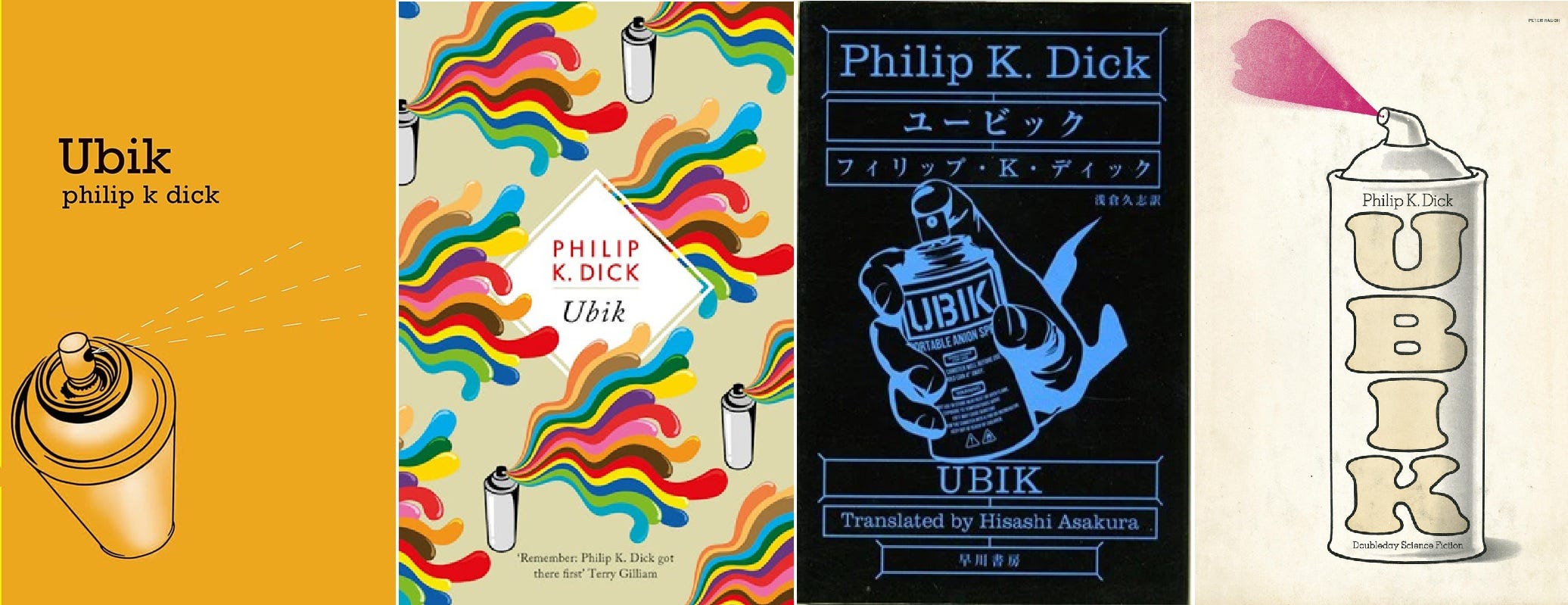
—because I omitted a key detail up until here. Allow me, thus, to introduce you to Ubik, the in-book… stuff that gives the book it’s name. The word Ubik comes from the Latin word ubique (namely, ubiquitous, which means everywhere).
We start by meeting Ubik in the epitaphs under every chapter title—except those epitaphs are worded like an advertisement promoting a product, because Ubik is a product. For example:
Instant Ubik has all the fresh flavor of just-brewed drip coffee. Your husband will say, Christ, Sally, I used to think your coffee was only so-so. But now, wow! Safe when taken as directed.
And also this one:
The best way to ask for beer is to sing out Ubik. Made from select hops, choice water, slow-aged for perfect flavor Ubik is the nation’s number-one choice in beer. Made only in Cleveland.
It almost looks like a joke, isn’t it? The epitaphs also describe Ubik as a “silent, electric” undisclosed product (in Chapter 1), beer (Chapter 2), salad dressing (Chapter 4), a shaving blade (Chapter 6), a Saving Loans store (Chapter 8)… I trust you get the idea.
But what is Ubik? What is it, actually? If I’m honest, that’s the question everyone who’s finished the book is asking.
So let’s rewind a bit…
—and if this seems chaotic, it is PKD’s reality we’re talking about, so please have a cup of Ubik and bear me with me.
Let’s rewind (without decay) to the moment in which Joe finds Glen’s crayon message on the bathroom: the first clue that he was, in fact, a half-lifer, remember? This is still a few chapters before Joe meets Jory, and so has no confirmation about being a half-lifer.
At this point, Joe leaves the bathroom, goes to a meeting room where the remaining inertials are, and discovers that the television is airing a pre-recorded advertisement… featuring Glen Runciter himself! In this advertisement, Runciter is promoting Ubik: a spray can a lady uses on a decayed fridge and restores it to its modern version. The recording ends up with the following bit:
One invisible puff-puff whisk of economically priced Ubik banishes compulsive obsessive fears that the entire world is turning into clotted milk, worn-out tape recorders and obsolete iron-cage elevators, plus other, further, as-yet-unglimpsed manifestations of decay.
The references are actually what Joe saw in exact order: first he was poured fresh milk that turned out to be clotted, then he purchased a brand-new tape-recorder that turned to be three decades old, then he saw the caged elevators, and so on. So there is some sort of… accuracy, right?
Do you remember the talented people I mentioned at the start? Could this be the work of a precog who saw the future—and everything that would happen to Joe—and pre-recorded that advertisement? Could the precog even see what happens in the half-lifer’s pseudo world?
We will find out soon enough, because the advertisement features Runciter again, to unfold as follows:
[Runciter said,] “So look for it, Joe. Don’t just sit there; go out and buy a can of Ubik and spray it all around you night and day.”
Standing up, Joe said loudly, “You know I’m here. Does that mean you can hear and see me?”
“Of course, I can’t hear you and see you. This commercial message is on videotape; I recorded it two weeks ago, specifically, twelve days before my death. I knew the bomb blast was coming; I made use of precog talents.”
“Then you are really dead.”
“Of course, I’m dead. Didn’t you watch the telecast from Des Moines just now? I know you did, because my precog saw that too.”
Wait! We have a few contradictions here, isn’t it? Let me number them:
Runciter knew he would die, yet he still went to the moon? Why?
The most obvious one: Runciter had just left a message in the bathroom saying everyone but him was dead. So which one is the truth? Who’s alive and who’s a half-lifer?
If we take the recording at face value: does that mean that Joe is actually alive? That the real world and not the pseudo world is decaying? Who wrote that message then?
But I already spoiled you a key detail: Jory—a known half-lifer—confessed to Joe to have been killing his inertials and twisting the world, because they are all in cold-pac!
Thus, if they are all dead… did Joe imagine the advertisement?
Here is where Plato’s allegory begins to warp.
As I mentioned before, for Plato there is one cave and one outside: shadows within, truth beyond. However, PKD is now twisting the plot into a very confusing situation where the so-called cave is no longer singular. Each layer of reality becomes its own cave, each with its own fire, its own shadows, its own walkers. Joe cannot climb upward toward truth, for every exit leads only to another chamber—which in this case, only means more confusion about the truth.
Yet all the questions we pondered before, are precisely the same questions that a confused dead/alive Joe Chip wonders. He does try to go to his apartment to fetch the can of Ubik he was promised… but the world is decaying, remember? Once he finally manages to open up the mailbox, the spray can reversed into a bottle with a liquid that had to be drank—and the drink had no effect.
Thus begins Joe’s quest to find an actual, non-decayed can of Ubik—amidst the reversing and decaying world… or pseudo-world, which ever—in hopes that by spraying it onto himself (and the other inertials) they’ll save their lives instead of becoming shrivelled corpses. Remember that, at this point, they don’t know about Jory. Thus, a dozen shenanigans ensure, including a store that slips in-and-out of phase going back and forth in time, and a dozen-or-so forms of Ubik, from unguents to patches.
But before Jory is introduced, Joe himself begins to die!
It all starts when Joe feels tired, his skin wanes and he begins to age. Joe has trouble climbing the stairs of the hotel he’s in, and ends up dragging himself across the hallway to finally—finally!—open the door and stumble inside. He’s extremely tired, but guess who he sees inside the hotel room in the half-lifer’s pseudo world? Glen Runciter. Let me read:
Runciter strode in three big steps to the door, slammed it and bolted it, came at once back to Joe. Opening a drawer of the vanity table, he hastily brought out a spray can with bright stripes, balloons and lettering glorifying its shiny surfaces.
“Ubik,” Runciter said, he shook the can mightily, then stood before Joe, aiming it at him. “Don’t thank me for this,” he said, and sprayed prolongedly left and right; the air flickered and shimmered, as if bright particles of light had been released, as if the sun’s energy sparkled here in this worn-out elderly hotel room. “Feel better? It should work on you right away; you should already be getting a reaction.” He eyed Joe with anxiety.
Joe is, quote-on-quote, ‘saved’ from his decay—and from this scene we can assume that Runciter’s original advertisement was correct: Ubik is a spray can that, when properly used, becomes a stabilizer that can reverse the course of time and protect people and things from decay. But saying that is an oversimplification.
Let me stop here to tell you something. After this scene, Runciter and Joe talk in that room. Runciter confirms that Joe and all the inertials were severely wounded in the explosion, and that he brought them all into cold-pac, and placed them in the exact moratorium where his wife, Ella is. So is the theory of Joe being in cold-pac confirmed? For now at least.
However, Runciter leaves after that conversation, and we get the scene in which Jory reveals himself. The conversation between Jory and Joe gets a bit intense, until Joe finally threatens the boy:
Joe said, “I’m going to kill you.” He stepped toward Jory in an uncoordinated half-falling motion. Raising his open hands he plunged against the boy, trying to capture the neck, […]
Snarling, Jory bit him. […] Jory stared at him with unwinking eyes, snoring wetly as he tried to close his jaws. The teeth sank deeper and Joe felt the pain of it throughout him. He’s eating me, he realized.
“You can’t,” he said aloud; he hit Jory on the snout, punching again and again. “The Ubik keeps you away,” he said as he cuffed Jory’s jeering eyes. “You can’t do it to me.”
So Ubik (the substance) is negating Jory’s abilities. Going back to Plato’s Allegory, we could say that spray can Ubik is almost like the light outside the cave: a mysterious, salvific force that may point to a ’truer’ state of being: one that Jory cannot corrupt. This is true to the extent that Joe is then left in that world—whichever world he’s in—to be continuously finding more cans of Ubik to spray himself and thus keep Jory at bay… because it seems that the moratorium people are aware of Jory’s doings, and keep his cold-pac close to others because his family pays well.
But let’s stop with the plot for a moment to ask one question.
Could we say that spray can Ubik… is also a truer demiurge? One that restores the balance, the sense, the logic in the world? One that tames the chaos? We could, indeed; if you search the internet there are several reviews that read Ubik (the product) as a metaphor of an omnipresent god. Especially because the last chapter opens up with this epitaph:
I am Ubik. Before the universe was, I am. I made the suns. I made the worlds. I created the lives and the places they inhabit; I move them here, I put them there. They go as I say, they do as I tell them. I am the word and my name is never spoken, the name which no one knows. I am called Ubik, but that is not my name. I am. I shall always be.
However, allow me to bring Kant into the equation
…because if you’d listened to Books Undone before, you know I cannot shy away from philosophy.
To Kant, our experience of the world is not the product of sense impressions alone, but rather the synthesis of two kinds of knowledge: a priori (knowledge independent of experience, such as intuition and understanding), and a posteriori (knowledge derived from the senses). Our world, then, is not simply ‘out there’ but partly constructed by the structures of our own cognition—basically, limited by our thoughts and knowledge.
The consequence is unsettling, for what we take for the ‘real world’ is only the phenomenal world: reality as it appears to us. In turn, the noumenal world (known as the thing-in-itself, the actual truth) lies forever beyond our reach.
Joe Chip’s struggle is nothing else but this: trapped in a phenomenal reality that is constantly regressing, forever asking if something more solid, more noumenal, exists beyond it. Whatever world he’s in—whether the one belong to live people or half-lifers—it is phenomenal; namely, something warped to fit his knowledge, his intuition, and his perception.
Within Joe’s phenomenal world, Ubik-spray makes no sense for it is the noumenal reality breaking through as a stabilizing force beyond decay, and beyond subjective filters.
This theory doesn’t put Ubik as a demiurge, but simply as something Joe cannot comprehend, reinforcing the book constant duality: it is always pitching regression/entropy (what Jory causes) vs fixes/balance (what Ubik brings). This also accounts for Ubik’s ambiguity, explaining why it takes phenomenal forms (like a spray can, shaves, salves): because it is the noumenal truth filtered through subjective experience; namely, the noumenon manifesting in ways minds can accept.
Now, towards the end of the story, two things happen:
Joe finds Ella inside the half-lifer’s pseudo world, and she gives him a certificate that guarantees a life-time supply of Ubik.
Then Joe manages to summon… someone, another girl, who brings in a parcel that has a spray-can of Ubik!
Given that this lady is from the outside world—the world were those alive live—Joe asks: “What is Ubik?”. Here is what she answers:
“A spray can of Ubik,” the girl answered, “is a portable negative ionizer, with a self-contained, high-voltage, low-amp unit powered by a peak-gain helium battery of 25kv. The negative ions are given a counter-clockwise spin […] So you can see why regressed forms of Ubik failed to—”
Yes, I cropped part of her explanation, but hopefully you can reach the same conclusion I did: this girl is implying that Ubik is a substance that is being ‘administered’ (somehow!) from the real world, into the half-lifer’s pseudo-world… which would imply that Ubik is actually explainable—thus not noumenal—and part of the outside world.
However… what if there’s no outside the cave? What if the real world—the one Joe thought belonged to those alive—is actually part of the pseudo-world?
Well, there is one minimal hint. The book ends with Glen Runciter hanging the phone of a cold-pac pod. He brings out his wallet to put a coin on the regular phone and call the office… but the coin has reversed and now features the face of Joe Chip himself. Does that mean Glen was half-life? All of them? None?
What we know is that, in Ubik, truth is slippery and recursive.
PKD seems to ask: What if every time you escape, you find a bigger cave? What if the cave is within a cave, and you never know when you’re out? In this way, the story constantly questions: what is real? Who decides what ‘real’ means? Can we ever know? I think we cannot find the answers, for PKD drags us into a cave where the shadows argue with one another and dare us to pick a side.
To close off…
—there a few more themes in the book that I did not have the space to fit in. For example:
The effects of the talented and anti-talented people in society is pretty interesting. Several impacts are mentioned in the book, and that could open an entire discussion on societal change and adaptation.
Every appliance and even doors, in the world of Ubik have coin slots: in order to use them you have to put a coin into it… even if you purchased the appliance, and it sits in your house. Apparently, the governments are not making enough money, so they taxed appliance use. Joe even has quite a funny verbal battle with his apartment door, which refuses to open unless paid. There is much to consider here.
Ignoring the layered realities, the concept of half-life is pretty interesting. In particular, it reminded me of the incorporeal people in Delaney’s Babel-17, although Ubik has a different take on the matter. Definitely worth discussing.
Finally, if you like to be challenged with more questions like this, please check my Substack at liviajelliot.substack.com. I post weekly, and you will find: thematic analyses of speculative fiction, detailed literary assessments (like an excerpt with sentence-by-sentence discussion), and practical writing advice for speculative fiction writers.
As a bonus for subscribing, you’ll get the free ebook of my novella titled The Genesis of Change. It is a blend of eldritch dark fantasy and philosophy… and it happens in a setting where reality is not what you expect; not as chaotic as PKD’s, but certainly not standard either.
Thanks for listening, and happy reading~
Copyright © 2025 Livia J. Elliot. All rights reserved. This publication is licensed for personal reading only. No article, or substantial part of an article, may be reproduced, republished, adapted, translated, compiled into another publication, incorporated into teaching materials or course packs, or used for AI training without prior written permission. Linking to the original articles is encouraged.
You can read his biography on the fansite maintained by some fans: https://philipdick.com/biography/, but there are also some good biographies on the Encyclopaedia Britannica.
The review is actually pretty short, but there is an archived version—thanks to The Wayback Machine—which you can read here.
There are plenty of theories about the Demiurge. For something short, I’d recommend you check The Encyclopaedia Britannia. If you’re up for reading, Gnosticism Explained has an longer and interesting article; this is, however, bordering religion.


