



“Language was never possible. We never spoke in one voice.” This line captures just a fraction of the novel’s daring ideas about how we speak and how we think. I’m talking about the book that Ursula K. Le Guin once called “a fully achieved work of art”: Embassytown by China Miéville.
Let’s get this book undone.
Hello everyone, and welcome to Season 3 of Books Undone. I’m your host, Livia J. Elliot, and today I’ll be discussing Embassytown by China Miéville. To me, this was an exceptional read, focused on language and communication, and with an underlying socio-political commentary. It is both a meditation on language and an act of linguistic imagination itself; a novel that demonstrates what words can build, and what they can destroy.
This episode focuses on two central threads in Embassytown: language, and the ways it shapes (and is shaped by) society. Before we dive in, allow me a few quick notes:
Spoilers ahead. I’ll be discussing major elements of Embassytown, though I won’t spoil other Miéville novels.
This is one interpretation. What follows is my reading of the book’s themes. Miéville may have meant something entirely different, and you may see it differently too—which is, of course, part of the fun.
Now, let us cover some trivia about the author and the book.
After that, I’ll introduce the setting, present my hypothesis, and follow through with the analysis.
China Miéville is a British speculative fiction writer…
—and also a literary critic. He holds the record for the most Arthur C. Clarke Award wins (three), and has—additionally—won the British Fantasy Award, Hugo Award, Locus Award, and World Fantasy Awards. He was also nominated to the Nebula Awards, Bram Stokers, a Philip K. Dick Award special citation, the Kitschies Award, among others. In 2015, he became a Fellow of the Royal Society of Literature.
Curiously, he didn’t start as a writer. In 1994, he graduated as a BA in social anthropology from Clare College (Cambridge), and went to pursue postgraduate education. In 2001, he gained both a master’s degree and PhD in international law from the London School of Economics, continuing with a Frank Knox fellowship at Harvard University.
He first published a non-fiction work based on his own PhD thesis, and then moved to writing fiction—yet his fiction has never deviated too far away from political commentary. In an interview with Long Sunday (2009)1 Miéville stated that:
I grew up reading genre, and though I’ve become really interested in it at a theoretical level, at a gut basis I’m interested in genre because that’s what was formative for me, as a reader. I think that what tends to interest me is the unexamined political assumptions of genre—or to be fair I should say ‘usually’ unexamined, because there’s plenty of self-conscious revisionist genre out there.
During interviews, Miéville has listed M. John Harrison, Michael Moorcook, Gene Wolfe, and Ursula K. Le Guin as his influences. He’s also made references to Russian writers Arkady and Boris Strugatsky, and Andrei Platonov. He is an incredibly prolific writer, publishing novels, novellas, short story collections, comic books, and even one co-written children’s picture book.
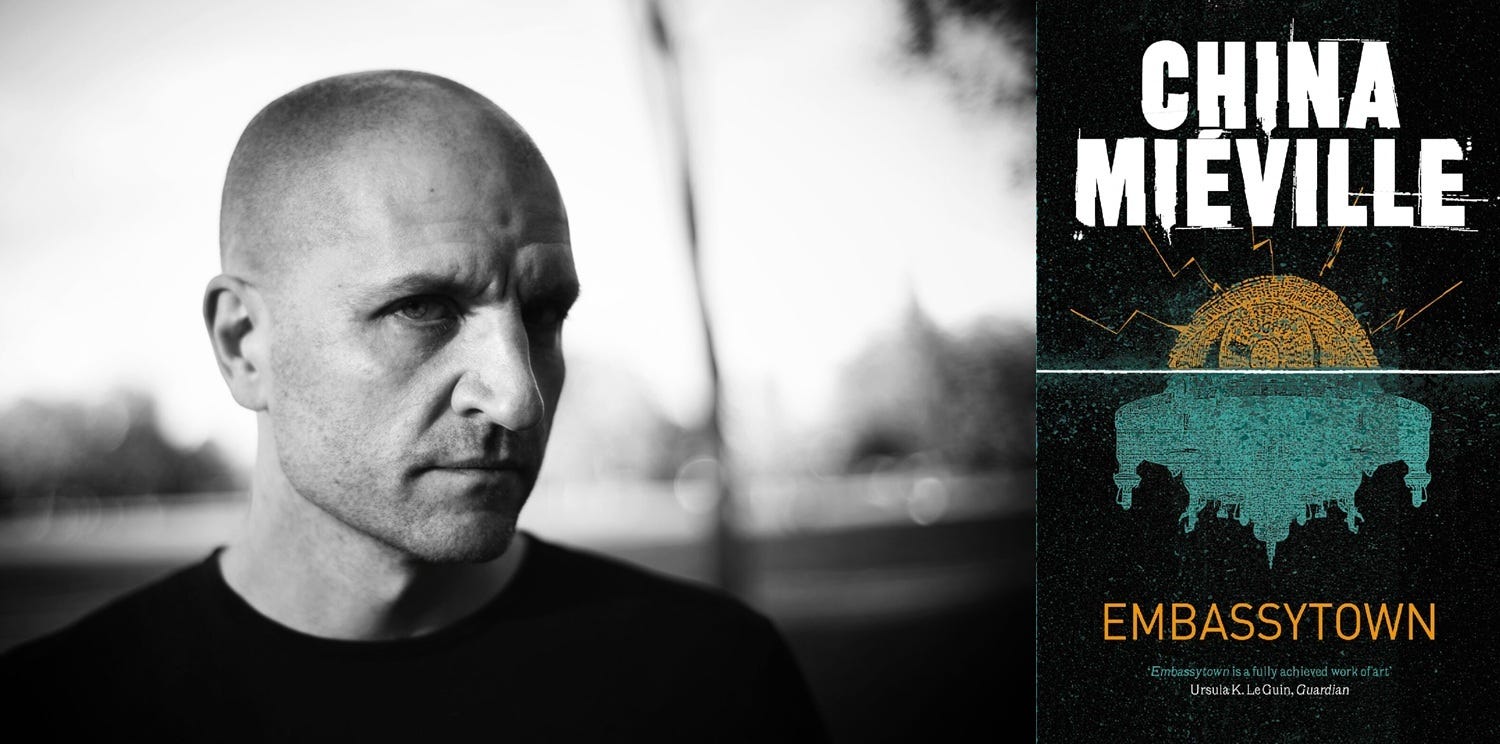
Today we are discussing Embassytown, published in 2011
It is a standalone novel oriented towards sci-fi, and including Miéville on-brand new-weirdness. It won both the Locus Award and the Premio Ignotus, and was also nominated to the following awards: Arthur C. Clarke, BSFA, Hugo, John W. Campbell Memorial, The Kitschies (Red Tentacle), the Seuin, and the Nebula.
This book is about language, and so the author relies on fictional language as a way of building the world. These neologisms often hide references to books or authors that may have influenced him. Quite interesting, Ursula K. Le Guin—one of the author’s own inspirations—reviewed Embassytown for The Guardian2, and wrote the following:
When everything in a story is imaginary and much is unfamiliar, there’s far too much to explain and describe, so one of the virtuosities of SF is the invention of box-words that the reader must open to discover a trove of meaning and implication. […] Miéville sets the bar rather high […] but most of his neologisms come clear with a nice shock of revelation.
Let us begin by presenting the setting
The story is a framed narrative, told by a human woman named Avice Benner Cho. She was born in the city of Embassytown—the main human settlement on the planet Arieka, which sits at the far edge of known and travelled space. Although Avice is important to the plot, the setting itself demands just as much attention.
Embassytown, the city, is—and at the same time is not—an independent settlement. It sits on the periphery of the indigenes’ main city and is enclosed within a vast engineered atmosphere bubble known as aeoli breath; within it, humans can breathe normally and without aid.
Throughout the book, the indigenes—the planet’s native species—are referred to in two ways. ‘Hosts’ is the respectful name Embassytowners use; everywhere else, they’re simply called Ariekei or Ariekene. The Hosts are not humanoid, and several aspects of their physiology shaped the development of their native tongue. In particular:
They have a limb called a fanwing, which serves as their hearing organ. Their other limb, the giftwing, is used for grasping objects.
They also have two mouths. Each mouth has its own shape and produces a distinct class of sounds.
As a result, when Hosts speak their native tongue—called Language, capitalised—they produce two simultaneous vocal lines: Cut (from the upper mouth) and Turn (from the lower). Language has no written form, but humans represent it using a fractional notation, with Cut as the numerator and Turn as the denominator:
Yet this perfectly synchronised duet of voices is more than sound: it is thought made words.
But what does this mean? ‘Thought made words’?
Early on the book, Avice recounts one anecdote of humanity’s first landing in Arieka; that story-within-the-story will lead us to understanding why I described Language as “thought made words.” As Avice tells us, that first mission into Arieka sent a crew called ACL—which stands for Accelerated Contact Linguistics. These people are defined as:
[…] a specialty crossbred from pedagogics, receptivity, programming, and cryptography. It was used by the scholar-explorers of Bremen’s pioneer ships to effect very fast communication with indigenes they encountered, or which encountered them.
Thus, when the ACL arrived to Arieka and encountered the Hosts, they put their machines to use. Quickly, they translated Language—that mix of Cut and Turn sounds—into Anglo-Ubiq: the universal human tongue of the setting, evolved from English. I’ll read the excerpt about what happened:
[…] within a few thousand hours, Terre linguists could understand much of what the Hosts said, and synthetised responses and questions in the one Ariekene Language. The phonetic structure of the sentences they had their machines speak—the tonal shifts, the vowels, and the rhythm of consonants—were precise, accurate to the very limits of testing. The Hosts listened, and did not understand a single sound.
Strange, isn’t it? If you hear me say, “dog,” you’ll immediately think of a canine—regardless of its breed, age, looks, or character. So why, assuming the sounds were correct, did the Host not understand?
That answer is a fundamental premise of the book, so allow me to pause here and share some relevant linguistic concepts:
At the basics, every word in a language is a combination of sounds (speech), translated into a notation (written word or hand-signals). The famous linguist, Ferdinand de Saussure3, defined these elements as the signifiers. For example, imagine a post-it note with the letters
T-E-Awritten on it; those three letters are the signifier.Each signifier is attached to a signified: a concept or mental idea evoked by it. For example, if after I described the post-it you imagined the idea of tea (the drink, its flavour, or even the act of drinking it) that mental image is the signified.
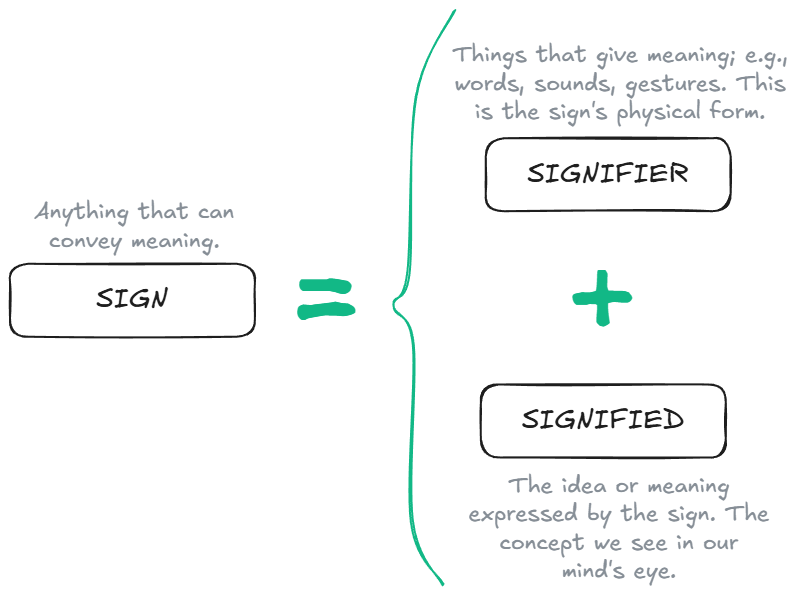
That sum of signifier and signified yields a sign: something that conveys meaning. This is related to what linguists call semantics. As Gudivada et al.4 explain, there are two types of semantics:
lexical semantics, which deals with the concepts attached to individual words and expressions, and
compositional semantics, which studies how the lexical ones combine to form phrases and sentences.
Together, they allow us to communicate meaning to others… and they’re also a source of miscommunication. For example, if when I say “tea” you instead hear T-E-E you may have thought of a t-shirt—which reflects something de Saussure argued: that the link between signifier and signified also depends on the differences between signifiers.
However, this type of miscommunication does not seem to have happened to the ACLers. Avice’s anecdote said the machine’s pronunciation was exact, and the words correct. So if we take that at face value, what else could’ve failed?
The answer is a problem we, humans, don’t have: for the Hosts, how they hear the words matters as much as what they hear (namely, the so-called ‘correctness’ of the signifier).
Truth be told, we humans seldom worry about how we hear the words. Whether you hear me say “tea” in person, through this recording, or whether you read it in the script… it doesn’t matter—you can still connect the signifier to the signified and grasp the lexical semantics.
This, however, was not true for the Hosts. The ACLers failed in their communication attempts because the machines producing sounds were the wrong quote-on-quote ‘how’. They didn’t realise this until two researchers, and perhaps due to coincidence, shouted almost in unison: suhaill/jarr, a key Language greeting. Do you know what happened? Avice plays a recording from one of the researchers, who explains:
[One] Ariekes turned to us. It spoke. We didn’t need our ‘ware to make sense of what it said. It asked us who we were. It asked what we were, and what we had said. […] This time, even though our shouts were much less accurate than any ‘ware renditions, it knew that we had tried to speak.
What was happening here is a reflection of how Language works for the Hosts—of the impact of that ‘how’ in the relationship between signifier and signified. To them, hearing a correct signifier is not enough: the sounds must be spoken thoughtfully and with intention, and the speaker must genuinely believe in each word and avoid any internal contradictions. Without that, the correct sound (the signifiers) is not a signified but merely noise for the Hosts.
Avice reasons this as follows:
Where to us each word means something, to the Hosts, each [word] is an opening. A door, through which the thought of that referent, the thought itself that reached for that word, can be seen.
Her explanation is intuitive, philosophical even. In turn, let us hear Scile’s explanation; he’s Avice’s off-worlder husband, and a linguist by profession. When talking to her, he uses the same theory I introduced to explain Language:
“Does it ever occur to you that Language is impossible, Avice?” he said. “[…] It makes no sense. They don’t have polysemy. Words don’t signify, they are their referents.”
Scile adds two new concepts to our linguistic foundations:
Polysemy is the linguistic phenomenon where a single word has multiple related meanings; for example, ‘bank’ can be the side of a river, the financial institution, or even a bench. When communicating, we infer its correct meaning due to the sentence’s context.
Referents are the third pillar proposed by Ferdinand de Saussure3—not part of the sign itself, but the actual object or thing in the real world the sign points to. If we return to my example with the “tea,” this would be the precise cup I left on my desk that’s now gone cold.
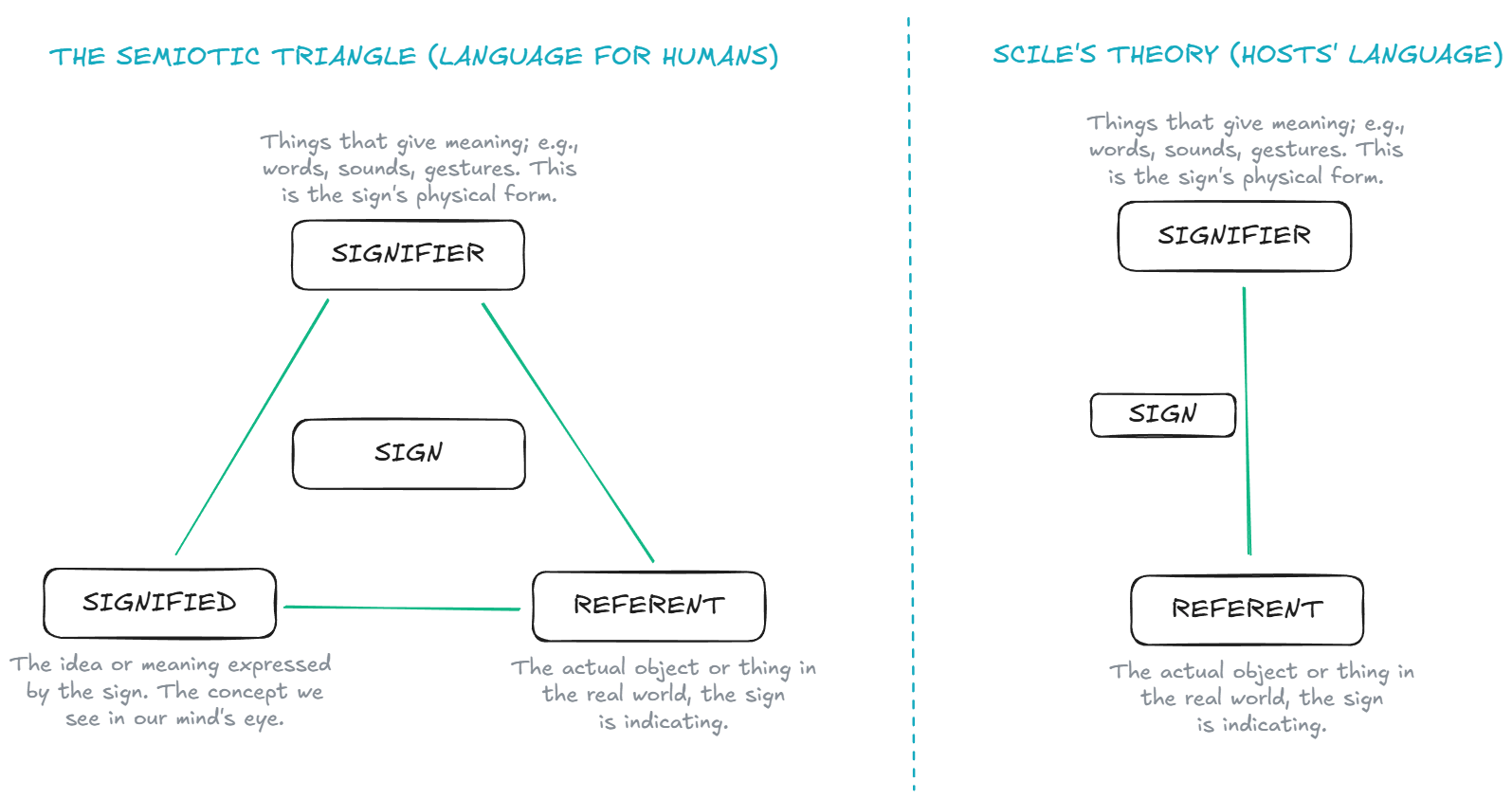
Scile is basically arguing that every word in Language (every signifier) has a unique and very-well defined signified that corresponds absolutely to the same referent. Let me put it this way:
For us humans, every word is a triangle where one side is the signifier, another the signified, and the last one the referent; the total of these three elements composes a sign.
For Hosts, every word in Language is a line: one end is the signifier (the sound-symbol) and the other the referent… and that’s it.
There is a scene in the book in which Avice is trying to understand this:
“So how would I distinguish that glass and that one and that one?” I tallied them with my finger.
“You’d say ’the glass in front of the apple and the glass with a flaw in its base and the glass with a residue of wine left in it.’”
In other words, Language forces Hosts to skip the mental image, and just refer to the actual thing in the world. This is what Scile meant when he said that, to Hosts, “words […] are their referents.” Language does not allow for abstract thought.
This tight correspondence between words (signs), truth (its referent), and thought (the intention behind it) is what I teased you before, when saying that Language is thought made words. Looking at it critically, this ‘fact’ of Language that Miéville created could also be pointing to yet another linguistic theory… but hold on to this point; I’ll come back to it later.
For now, let us stay with this: the Hosts’ literalisation (where each word in Language connects to the thought that originated it, and that to a truthful referent) forces readers to confront how we experience and leverage language. From here on, the psychological consequences of this fused language-thought model will become a lens through which the book explores truth, deception, and the reshaping of the self.
To begin unravelling these themes, let me finish the story of the researchers.
Urich and Becker. Because the Hosts understood them after they shouted together—and since these linguists had no way to infer the link between words and thoughts—they guessed the problem lay with the machines. That, perhaps, if two people spoke at the same time, one as Cut the other as Turn, then the Hosts would recognise who was speaking, making communication possible.
Spoiler alert, it did not work.
Let me to return to Avice’s narration of the events:
Of course [Urich and Becker] tried again, they and their colleagues practising duets, words that meant hello or we would like to speak. We watched their recorded ghosts. We listened to them learn their lines. “Sounds flawless to me,” said Scile [my husband], and even I recognised phrases, but the Ariekei did not. “U and B had no shared mind,” Scile said. “No coherent thoughts behind each word.”
What a conundrum, isn’t it? A machine didn’t work because although the sounds were correct, they had no thoughts behind them. Likewise, duets—two people speaking in tandem—didn’t work either because their thoughts were not perfectly aligned.
Do you know what happened?
Humanity being humanity, it promptly forgot its own ethics and started experimenting on humans to find the perfect candidates to speak Language in duets. First, they tried twins—but that didn’t quite work; their sounds may have been flawless, but the Hosts didn’t hear them. Next came identical twins, trained from babyhood to behave as one person… which, unsurprisingly, turned out to be prohibitively expensive given its low success rate. So, naturally, they moved on to cloning, creating what the book calls Ambassadors.
Here is where Miéville sneaks in a discussion on identity, individuality, and communication.
Ambassadors were two so-called ‘cloned siblings’, created just for the purpose of communicating with Hosts in Language. Each pair was crafted by Embassytown’s staff, and reared since childhood for their future position as Ambassadors. Since their earliest moments, each pair was forced to wear a cochlear link that allowed their thoughts to filter from one to another. Everyday, they had to sit on a machine that ’equalised’ them—erasing any unique marks each individual may have developed so they remained exact copies; if something couldn’t be erased, it was replicated in the other.
Furthermore, Ambassadors had composed names—namely, each quote-on-quote ‘half’ was tagged with a single syllable, and the full name only formed from both together… as if alone they were nothing, and only together they could be a person. Thus, in Anglo-Ubiq their names were read with a pause in the middle: HenRy, MagDa, or CalVin. In Language, each was presented as a fractional notation:
But things get even more complicated. The Embassytowners don’t really see Ambassadors as two separate people. Consider this exchange between Avice and her husband Scile—the off-worlder linguist:
“They’re not twins, love,” I said.
“Whatever. You’re right. Clones. Doppels. The Ariekei think they’re hearing one mind but they’re not.” I raised one eyebrow, and he said, “[…] You have to wonder. Don’t you? What it is they do—Staff, I mean—to make two people think they’re one.”
“Yeah, but they’re not two,” I said. “That’s the point about Ambassadors. […]”
“But they could have been. Should have been. So what did [Staff] do?”
Let’s pause for a moment, because there are a few threads here. This conversation reveals a crucial tension we’ll need for this analysis.
From Avice’s perspective—which, we must assume, reflects most Embassytowners’—the two clones (or doppels) forming an Ambassador are a single person.
But Scile, the off-worlder, insists they are distinct individuals. “Twins” in a sense that carries weight: two separate beings who merely look alike.
This subtle but profound misunderstanding is key to everything that follows, because within Embassytown’s society there is one taboo question. Something called the Tallying Mystery. Avice reflects on it as follows:
This was the question that we called the Tallying Mystery: did the Hosts consider each Ambassador one mind, double-bodied people? And if so, did they think the rest of us half-things, irrelevances, machines? A city full of the Ambassadors’ marionettes?
It’s an uncomfortable question, isn’t it? On one level, Avice is suggesting that a human’s inability to speak Language might make us non-sentient in the eyes of the Hosts. At another level, the Tallying Mystery argued that Embassytown’s Staff had successfully erased the doppels’ individual identity to create a double-bodied mind.
There is so much to unpack here, and not enough time (or space) to cover it all—so let us return to the linguistics by asking two more questions: could Ambassadors really speak Language? Were their minds so perfectly tuned? Scile, ever the sceptic (and insisting on the Ambassadors’ individuality) doubles down:
”[…] And Ambassadors are twins, not single people. There’s not one mind behind Language when they speak it… […] It’s like we can only talk to [Hosts] because of a mutual misunderstanding.”
Scile seems determined to scandalise his wife—so why don’t you let me scandalise you a bit?
What if I told you that Avice was part of Language?
That she was enLanguaged?
It is a tricky question, so let me begin with a real-world example. If I tell you: “The Staff were Machiavellian” you’ll probably assume the Staff members of Embassytown were cunning, scheming, or unscrupulous. Why? Because Niccolò Machiavelli’s work The Prince popularised a very specific attitude and usage of power, and now his name has become a shorthand for everything his book implied. Namely, his lastname, Machiavelli is now a signifier attached to the thesis of his book (the signified).
What happened to Avice is somewhat similar: she became part of the Hosts Language, and was quote-on-quote ‘spoken’ just as in the example above… except she’s not one word (as in Machiavelli’s case), but a whole sentence. This sentence describes something she did.
But before I tell you her Language meaning, we need to answer one nagging question: why would Avice be enLanguaged? She thought of it in this way:
For Hosts, speech was thought. It was as nonsensical to them that a speaker could say, could claim, something it knew to be untrue as, to me, that I could believe something I knew to be untrue. Without Language for things that didn’t exist, [Hosts] could hardly think them […].
As Scile said, if in Language words are their referents, then Hosts need very specific words, or they cannot say—or, even worse, think—of that referent. Remember when I mentioned that Miéville might have been speculating about linguistic theories? This is why!
The limitation of Language could be based on a now-debunked idea: the strong Sapir–Whorf hypothesis, also known as linguistic determinism. It posits that “the semantic structure of a particular language determines the structure of mental categories among its speakers.”5 In its strongest form, it implies that if a language lacks a conceptual category—such as one corresponding to ’love’—its speakers may find it difficult or even impossible to think about the concept.
In addition, every natural language—namely, every tongue that evolves organically within a community—is ever expanding. If you think of it, modern words like ‘internet’, or ‘googling’, or ’laptop’ did not exist a century ago: society developed them because speaking without them was becoming cumbersome. Before them, we needed sentences to approximate meaning. To us humans, newly-added words simplify communication; to Hosts, based on the strong Sapir-Whorf hypothesis, those new words made communication and thought possible.
Though in real-life languages evolve in unexpected ways, with words being proposed on the go and becoming widely adopted by the public before they’re accepted by dictionaries, Hosts did so differently. They were aware of Language’s limitation, identified a gap, and did something to create a word—or sentence—so they could speak of its referent.
When Avice was enLanguaged as a child, she was then turned into a simile: a figure of speech comparing two unlike things by using ’like’ or ‘as’6.
It all began when some school teachers and Ambassadors approached her with a request: to help the Hosts create a new word; the book implies that this practice is known to Embassytowners, and regarded as an honour. The teachers argued that first the hosts had decided on the actions they needed performed, and requested Ambassadors for a human girl; then, a former one had recommended Avice.
She agreed to be enLanguaged, and days later, performed the actions that would create the simile. About the experience itself, she reflects:
What occurred in that crumbling once-dining room wasn’t by any means the worst thing I’ve ever suffered, or the most painful, or the most disgusting. It was quite bearable. It was, however, the least comprehensible event that had or has ever happened to me.
What that means is that Avice had to go somewhere and perform a specific act, in order to create a truthful referent that could be spoken. After that, she was brought before the Ambassadors and her school teachers:
The Ambassadors spoke to me in the Language of our Hosts. They spoke me: they said me: “There was a human girl who in pain ate what was given her in an old room built for eating in which eating had not happened for a while.”
They warned me that the literal translation of the simile would be inadequate and misleading.
“It’ll be shortened with use,” Bren told me. “Soon, they’ll be saying you’re a girl ate what was given her.”
Having Avice enLanguaged allowed the Hosts to speak her—namely, to use her simile in normal speech to make a comparison, and eventually resolve the book’s main plot… but we cannot discuss that now. We need to understand a few more loose points before we tied them up.
In particular, how the usage of Avice’s simile evolved. Years after her enLanguagement, she returned to Embassytown and Ambassador CalVin introduced her to a Host like so:
[The Hosts] spoke rapidly, craned their eye-corals. […] I do not know, one Host said to CalVin, about me, how I did without her, how I thought what I needed to think.
That’s the key problem of linguistic determinism: your language limits your thoughts. Yet someone could still argue: well, we use similes all the time, and we don’t know for sure they exist. For example, I could write: “The dawn was red like blood pouring from a wound” without having an actual open wound… why couldn’t the Hosts do this? Remember Scile’s theory, and that one fact we introduced before: Hosts cannot speak in hypothetics because they can’t abstract themselves; Hosts can’t lie.
And humanity being humanity, deemed this clearly unacceptable.
We know ourselves: when faced with another culture, our instinctive reaction is somewhere between confusion and immediate violence—just check our first-contact films, where the steps are usually: attack, destroy, and interview the corpses for details. Embassytown didn’t go quite that far, but the Staff and Ambassadors still couldn’t accept a society incapable of lying. Their solution? Why, to generously bestow upon the Hosts the gift of deception.
Psychologically speaking, lying is not that simple. As Mares and Turvey (2018)7 explain,
“Lies generally manifest as [..]: Complete Deception, Half-Truths, Exaggerations, and Pertinent Omissions. Lies are told for one of two reasons: either the deceptive person believes they have more to gain[…], or […] is incapable of discerning what the truth is, either temporarily or owing to some permanent mental defect.”
That means we can lie unwillingly, but also knowingly and to avoid embarrassment, manage expectations, or even omit uncomfortable information. In some cases, lying may not be malicious: for example, prosocial lies are intended to benefit others, because they’re “told in situations in which honesty would cause heightened emotional harm”8.
Now, linguistically speaking, lying is also complex. For example, researcher Erin Bryan determined three main types of lies: real, white, and gray. Unsurprisingly, she discovered that “the use of white lies is so widespread they are often viewed as a form of communication competency that is necessary to successfully negotiate social interactions”9. Curiously, philosophers and linguists seem to consider irony and metaphor also as a type of deception because their “linguistic violations result in covert untruthfulness”10.
All of this is to point that so-called ‘gift’ Ambassadors tried to bestow on Hosts would undoubtedly have long-lasting, unpredictable consequences. We could argue this is the most central plot point in the book.
It all begins with the Festival of Lies.
It happened on the Hosts’ city, and Ambassadors and Staff travelled there wearing breathing masks. The Hosts would present an object—say, a blue box—and one by one the Ambassadors would step in to lie about that object before them. This is what happened on Avice’s first Festival:
The Host spoke. “It says: ‘describe it’,” Scile whispered. MayBel answered, May in the Cut, Bel in the Turn voice.
The Ariekei stepped up and down, a sudden unanimity. A tense excitement. They tottered and chattered.
“What did they say?” I said. “MayBel? What did they—?”
Scile looked as if in disbelief at me. “They’re saying ‘It’s red.’”
Then, during Ambassador LeRoy’s turn, this happened:
LeRoy spoke again and several Ariekei shouted, out of control. “LeRoy says [the box is a bird and it’s] flying away,” Scile said into my helmet. I swear I saw Hosts crane their eye-corals up as if the lifeless [box] might have taken off.
I know: from our perspective, the Hosts’ reactions—shocked, stunned, looking up to actually corroborate if the box was a bird and flying away—they all seem… foolish. Implausible or exaggerated. However, you must remember that Hosts were literally witnessing the impossible.
They could not lie: if the word’s referent did not exist they could not speak it, and they had to do so with absolute certainty backed by ultimate precision. Instead, these Ambassadors—these double-bodied people—said an untruth while actually believing on it. They had the referent before them, and still lied. Without hesitation, without second-guessing.
Imagine the cultural shock. Imagine the mental strain after being limited your whole life.
Yet the Festival of Lies didn’t end there, for some courageous Hosts took to the stage to try to lie. This was physically straining, and Avice relates that some “double-whinned” and “Some made noises that were only noises, clicks and wheezes of failure, not words at all.” Yet there were some successes:
When the object was yellow, the Host trying to lie, […] shuddered and retracted several of its eyes, gathered itself, and in its two voices said […], “yellow-beige.” It was hardly a dramatic untruth, but the crowd were rapturous at it.
After these events, lying (or trying to lie) became something like a sport. There were groups that would try to do so in different ways, finding strategies to bend their minds—and thus, Language—until they could utter a lie. Two virtuoso liers appeared: sultesh echertesh echersul and another one Avice referred to as spanishdancerdancerspanish due to the markings on its fanwing.
What was happening here is just a consequence of the complexity of lying.
You see? Lying is so fundamental to us humans, that researcher Daniel Dor11 argued that: “Without the lie, language would not be as complex as it is, linguistic communication would be much simpler, and the cognitive requirement of language would not be so heavy.” He argues that our natural languages evolved the ability to lie—namely, to communicate beyond the here-and-now, to express non-facts, abstractions, counterfactuals, and imagined states. Not long ago, I also mentioned that irony and metaphor could be lies—and some researchers10 have determined that, in certain pragmatic contexts, metaphor can function like a lie because it involves saying this is that rather than this is what it is.
Think of it this way: when you imagine a future promotion or write a story like Lord of the Rings (set in a secondary, fictional world) you are not lying in a malicious or deceitful way, but producing non-actual representations, using the same cognitive machinery that also makes deception possible. For the Hosts in Embassytown, this is revolutionary because Language forces them to only speak factual truths, and has thus denied them this ability.
Yet even then… did Hosts really needed to learn how to lie?
Excellent question. Miéville insisted on not answering it, so I won’t either. Instead, I would do what he did in the book and tell you a bit more of what happened after.
A new Ambassador was appointed…
—and they were not a doppel-pair. In fact, these two men—known as EzRaRaEz where two random off-worlders selected by Arieka’s parent nation, Bremen. I won’t discuss the politics of why the Bremenian did this here, since I could write an entire episode just on that. Suffice to say EzRa were quaint: not identical twins and neither clones, just two people who wore the cochlear implant and had passed an empathy test—the only known measure to somewhat estimate whether Hosts would hear them.
Thus, Embassytown’s Staff organised a welcome party for EzRa and invited a handful of Hosts. At a given moment, they set EzRa to introduce themselves. Avice was there to tell us what happened:
[EzRa] spoke well, beautifully. I had heard enough of it to tell that. Their accent was good, their timing good. Their voices were well suited. They said to the Hosts that it was an honour to meet them. suhailshurasuhailshurasuhailsuhail, they said. Good greetings.
[…] The Hosts [swayed] as if they were at sea. One spasmed its giftwing and its fanwing, another kept them unnaturally still. One opened and closed its membranes several times in neurotic repetition. […] In very slow and unnerving unison, the Ariekei emerged from their trance. Their eye-corals drooped toward us, and at last focused. They straightened and unstiffened their legs, as if coming out of sleep.
Clearly, something happened to the Hosts—yet to understand that, we have to link three of the many concepts we have so far discussed:
what Ambassadors are,
how Language words are thoughts (“the words […] are their referents”), and
the cognitive mechanisms enabling lying.
As we mentioned before, Ambassadors are manufactured twin minds kept in absolute synchrony through equalisation—that neurological conditioning that erased divergences or reproduced them in the other. This perfect unity was essential because, as we discussed, the Ariekei didn’t perceive sounds (signifiers) but intent (the thoughts) associated to an actual truth (the referent). It ensured that, when speaking Language to the Hosts, each doppel (one Cut the other Turn) thought and felt precisely the same about the referent they spoke of.
Yet EzRa introduced a subtle nuance—one likely linked to the cognition required to lie. You see? That empathy test was limited; both Ez and Ra said ‘good greetings’.
But to what extent can two independent people, two individuals think of ‘good greetings’ with the exact same enthusiasm and respect?
To what extent can they think of the exact same signified (the abstract concept) when saying those words?
Or even worse: what if these two individuals’ thoughts were in opposition? What if Ez was bored (and putting a nice face) while Ra was simply neutral? Or what if Ez was repulsed by the Hosts, and Ra intrigued by them?
All my questions can be summarised into another: what if EzRa had a tiny cognitive dissonance while they spoke?
We, humans, wouldn’t notice it—but for the Hosts, this encounter was catastrophic and intoxicating because it exposed a new semantic dimension. Their world had been built on perfect correspondence between word and truth, and EzRa’s speech broke that correspondence by demonstrating that one can say something that isn’t entirely true and yet still be meaningful—or even more meaningful.
EzRa’s fractured unity introduced contradiction into a species that equated language with truth. The Hosts, who required perfect alignment between sound and intention, encountered for the first time a misaligment: a truth that was not quite so, because Ez and Ra felt somewhat differently.
What happens after is a sociopolitical debacle
—and I will have to focus only on the linguistics of it to keep this episode at a sensible length.
In short, the Hosts stopped answering to ‘regular’ Ambassadors and left the meeting in their shocked state. During the following days, Embassytown’s Staff and Ambassadors tried to reach the Hosts’ leaders, but nobody replied—until a cohort of Ariekei marched into Embassytown to demand, in front of a stunned population, to hear EzRa speak. The Staff scrambled to comply, and brought EzRa. Avice was on the street along the people:
Ez came forward, then, grudgingly, Ra. They looked at each other with very different emotions, those two unalike men. They whispered. They spoke Language together, and brought the Hosts to rapture.
That scene is the moment in which Miéville literalises the metaphor “living a lie”—and to the Hosts, it reshapes consciousness itself. It is another layer of the impossible made possible, and it turns them into addicts. What they are addicted to is the key question of the second half of the book, since Staff, Ambassadors, and even Avice and other similes assume Hosts are just hung up to EzRa’s voice—the sound, and the fact their voices are not precisely the same either.
And it upended the Ariekene society
Hosts arrived en masse to Embassytown just to hear EzRa’s speach—like junkies seeking their daily fix. Even their technology faltered because it was bio-engineered and their biological pieces also became addicted to EzRa’s voice. As the days went by the Ariekene needed a higher dosage: longer sentences, more frequent speeches because the trance lasted less and less.
Relationships between both cities rapidly deteriorated, and Embassytown’s Staff were forced to put up speakers in the Hosts’ city so they could have their repeated fixes during the day. The Ariekene began to camp near these devices, waiting for their fix of cognitive dissonance. Desperate, some Ambassadors ventured to the city to find some reasonable Hosts and speak to them… but these efforts were futile.
Then something happened: some Ariekei began to self-mutilate, tearing their fanwings apart. Remember when I told you about their physical characteristics? The fanwing was a limb that served as a hearing organ. Therefore, in human terms, these Ariekene were literally bursting their tympanic membranes.
Yet again, humans being humans and self-absorbed in their own political conundrums, didn’t seek to understand the reasons behind this self-mutilation. They only saw one thing: violence, and themselves as victims. The mutilated Arieke would attack the addicts and rip their fanwings before dragging them off; to make matters worse, they also attacked unsuspecting humans—patrols, farmers, civilians living in the periphery of Embassytown.
The city began to shrink. Refugees filtered in until Staff had to turn the embassy’s central building into a communal living space. Meanwhile in the Hosts’ city, the addicts demanded longer, more frequent speeches, while the mutilated ravaged the farms to endeafen more Ariekene and build an army.
An army that soon began marching towards Embassytown.
But up to here, I did something intentionally mean: I only gave you the human perspective.
The violence, the deaths, the destruction of Embassytown by a mob that seemed out of their minds—capable of self-mutilation, and of inflicting violence on their own kind when, until that moment, they had been absolutely peaceful.
But there was more to it: EzRa’s voice was a drug, and humans were its providers. If we assume that the Arieke failed to create noise-cancelling devices, then the only quote-on-quote ‘cure’ to their addiction was to be completely unable to hear EzRa’s voice. Therefore:
By ripping their fanwings, they were willingly becoming deaf in a desperate attempt to escape the junkie trap.
By mutilating others, these deaf-Ariekene were trying to cure their own in the only way that had worked so far.
By attacking humans, they were trying to destroy the drug-dealers upending Ariekene society and culture.
It was a cry of resistance and self-determination.
If that shocked you: good. That’s the intention of the book, though Miéville is far more subtle than I was—he left it to the reader to make the connection. I couldn’t do that, though. We need this understanding to finally round up our linguistic analysis. The point where semiotics, Avice’s enLanguaged simile, the Ambassadors’ identity, EzRa’s cognitive dissonance, and the ability to lie and think abstractly finally link.
It is the final arc in the book.
The moment when some Ariekes learn to lie…
—although it’s a bit more complex than that.
While all the mayhem happened, some ex-Ambassadors found the group of liars from before, now led by the Host Avice had referred to as Spanish Dancer. These group, five in total, were trying to fight against their addiction, suffering through deprivation to remain conscious. Avice, helped by others, drew the following hypothesis:
Hosts were not addicted to EzRa’s sound, but to the ambiguity it introduced as a consequence of their tiny cognitive dissonances; to them, EzRa’s speech was the drug of contradiction. It wasn’t about the voice itself, but the link between the signifiers, the referents, and how each ‘half’ of that Ambassador was able to think of minimally different mental concepts.
Based on this, Avice and the others assumed that the only way to quote-on-quote ‘cure’ the Ariekei from Ezra’s effect was to teach them abstract thought—which, in turn, required Hosts to rapidly alter their language until it allowed the linguistic nuance that makes lying possible. The reason? As I told you before, lying isn’t just deception: it’s a broad spectrum, and it relies on the same cognitive mechanisms.
But how did Avice pulled this off? Basically, she used herself: her own simile. Like this:
“You’re trying to change things,” I said. YlSib repeated in Language. “You want change like the girl who ate what was given her. So you’re like me. Those who aren’t trying to change anything are like the girl who didn’t eat what she wanted but what was given to her: they are like me. You are like the girl who ate. You are the girl who ate. You’re like the girl. You are the girl. And so are the others, who aren’t like you.”
Did you catch what Avice was doing? She’s bending Anglo-Ubiq—or English—to its maximum extent to sneak in a lie. Let us walk that text line by line.
If you recall, Avice’s simile is: “the girl who, in the dark and in pain, ate what was given to her.”
The first sentence is: “You want change like the girl who ate what was given her”. There are a few nuances here to discuss:
First, Avice is using her simile to replace the noun ‘me’. The reason? Because of the Tallying Mystery, she’s not sure whether Hosts perceived single-bodied humans as sentient.
At the same time, she’s using the simile as it is intended: to imply that Spanish Dancer “ate what was given to it”. This is not to be read literally, but as the simile. The mental concept behind it is: “listened what was spoken to it.” Namely: EzRa’s drug-voice.
The next sentence is: “So you’re like me”—she introduces the noun to refer to herself.
Now, read both sentences together: “You want change like the girl who ate what was given her. So you’re like me.” We could translate it as: “You want change like me. So you’re like me” by replacing the full simile for the noun.
Now is where it gets linguistically spicy. The next sentence uses the simile as intended: “Those who aren’t trying to change anything are like the girl who didn’t eat what she wanted but what was given to her: they are like me.” Let’s break it down:
The first half: “Those who aren’t trying to change anything” refers to the addicts who are not trying to free themselves; therefore, it excludes the mutilated ones.
At the same time, “Those who aren’t trying to change anything” means “those who are not Spanish Dancer”; if you recall, the opening sentence is: “You[, Spanish Dancer,] are trying to change things. You want change.”
Next, “Those who aren’t trying to change anything are like the girl who didn’t eat what she wanted but what was given to her”. The abstraction, “eat what she wanted” cannot be taken literally; Avice is introducing a metaphor where ’eating what she wanted’ refers to ’listened what she understoood’ or ‘spoke as she wanted and understood’.
Likewise, “but [ate] what was given to her” continues the ’eating’ metaphor: the Hosts were forced to hear EzRa’s voice and thus become addicts.
The linguistic spice: “they are like me”. She’s turning the tables here, and using the noun “me” to refer to the simile.
At this point, you have one level of contradiction. For different, nuanced reasons, both Spanish Dancer—who is trying to cure itself from the addiction—and the addicts (content to remain as they are) are both like Avice The Simile. It’s not a wordplay itself, but perhaps a meaning-play. This is the power of metaphor. What researcher Marta Dynel10 referred to as “[linguistic] violations [that] result in covert untruthfulness.” She even added these violations can be explicit or implicit “what is said/made as if to say, or what is implicated.” Basically, to use a metaphor is a way of deception.
The next two sentences are linked: “You are like the girl who ate. You are the girl who ate.” The first one is using ‘herself’ as the simile, the second as a metaphor… but at the same time, that second sentence is an untruth. If we take this literally, we know that Spanish Dancer is not Avice; he is Avice’s simile, but she’s squeezing English to move past the literal and into the abstract.
The first works within the Hosts’ existing system—it’s the simile, the literal comparison they can understand because a simile (like Avice) has enacted that event.
The second sentence, though, is complex. If we read it at face value, we know the individual known as Spanish Dancer is not the human known as Avice. It is an untruth… but also a truth: Spanish Dancer is like the simile Avice represents: it is a new version of her simile. However, by using English in this way, Avice is pushing the Ariekes past the confines of simile, and into the abstract space of metaphor. Something Language wasn’t built to handle until this moment.
The last three sentences reinforce the two key contradictions: “You’re like the girl. You are the girl. And so are the others, who aren’t like you.”
Yet after hours and hours of training, Spanish Dancer still shuddered and stuttered, unable to utter the lies.
Until Avice remembered the Tallying Mystery.
If you recall, the Tallying Mystery was that uncomfortable question relating Ambassadors and single-bodied humans: did Hosts perceive Ambassadors—the cloned doppels artificially equalised—as one or two individuals? Furthermore, did that mean they perceived normal, single-bodied humans as non-sentient?
Ambassador YlSib tries to explains this to Spanish Dancer; I will not re-narrate the scene here but, when the Host finally grasps what humans had done with Ambassadors, the meaning of the metaphor finally sinks in. The reason? It’s not explained in the book, but I have a theory: solving the Tallying Mystery allowed Spanish Dancer to understand ‘me’ as a noun to refer to Avice, therefore enabling the distinction between Avice as a simile and Avice as an individual. “You are like the girl who ate. You are the girl who ate.” That linguistic difference revealed that meaning-play Avice was trying to teach them.
And the moment that happens is the moment Spanish Dancer and its crew are free from EzRa’s drug-voice. Avice plays a recording, and the freed-Hosts simply hear it, no longer shuddering like addicts. The reason? Understanding the nuance behind the metaphor and the abstraction needed to use it in contradictory ways, allowed Ariekei to perceive EzRa’s cognitive dissonance and accept it as possible. By teaching them how to leverage metaphor, Avice changed Ariekene society.
Let me read you the scene:
The Ariekei sifted the datchips, listening with disbelief at how they heard what they heard. […] Spanish Dancer remained bent, but its eyes looked up to me.[…]
“Yes,” I said, “yes,” and Spanish Dancer cooed and, harmonising with itself, said: “yes/yes.”
Spanish Dancer spoke English because it now had the cognitive mechanisms allowing it to express non-facts, abstractions, counterfactuals, and imagined states, therefore producing non-actual representations by using the same cognitive machinery that also makes deception possible.
I’ll summarise what happens after.
Avice, YlSib and a few more rush Spanish Dancer and its crew of liers towards the army of self-mutilated Ariekene. She plays recordings of the drug-voice, and two non-mutilated Arieke begin to shudder as they always did—while the liars, Spanish Dancer and others, remained healthy. This showed the deaf that a non-violent cure to the drug was possible, effectively removing their need to attack humans.
However, let me confess something: there is so much more to this. From here, the book goes on to explore some of the sociopolitical consequences of this change in society, how Hosts handled the addicts that couldn’t learn to lie, how their relationships with humans changed, how Embassytown itself changed, among many other things. I could write a whole episode about it, so let me know if you want to hear me talk about it; reach out to me through my Substack at liviajelliot.substack.com; if there is interest, I’ll gladly make a second episode.
However, let me close off with one more scene of the book.
As time went by, Spanish Dancer learnt that it could speak two different human tongues at the same time—one with each mouth. It could also say different words, not necessarily that yes/yes it had first said. It is after Spanish Dancer has learnt this, that the following unfolds:
When I asked Spanish if it regretted learning to lie, it paused and said, “I regret nothing/I regret”. A performance, perhaps, but I envy that precision. I wonder if Spanish Dancer ever mourns itself.
“If it ever mourns itself.” Because learning to use metaphor meant breaking through linguistic determinism to effectively change how Spanish thought—and because we are our thoughts, for Spanish Dancer, that also meant changing who it was. What walked away wasn’t the same mind that began that lesson, but whatever remained after metaphor rewrote it. But remember that this wasn’t a willing transformation—far from it. Spanish wanted a cure, and the only choices were self-mutilation or reshaping its own mind so profoundly it could no longer be the being it had been.
And it leaves us wondering: when language reshapes a mind so completely, is the one who remains a continuation, or a replacement? Had EzRa not appeared: did humans really needed to teach Hosts how to lie? Was that change in the Ariekene society evolution or corruption?
Food for thought, most certainly.
If you enjoy conversations like this, my own novel also explores alien intelligences and the redefinition of the self, though it does so from a different lens. You can find it linked below.
Thanks for listening, and happy reading.
Copyright © 2026 Livia J. Elliot. All rights reserved. This publication is licensed for personal reading only. No article, or substantial part of an article, may be reproduced, republished, adapted, translated, compiled into another publication, incorporated into teaching materials or course packs, or used for AI training without prior written permission. Linking to the original articles is encouraged.
‘A truly monstrous thing to do’: The China Miéville interview, part one. Accessible through the Wayback Machine: https://web.archive.org/web/20091012023448/http://www.long-sunday.net/long_sunday/2005/07/a_truly_monstro.html
Embassytown by China Miéville. A review by Ursula K. LeGuin. https://www.theguardian.com/books/2011/may/08/embassytown-china-mieville-review
“Art and Idea in the Novels of China Mieville”, by Carl Freedman and published by Gylphi (2015).
‘Chapter 1 - Linguistics: Core Concepts and Principles’ published by the Handbook of Statistics, by Akhil Gudivada, Dhana L. Rao, and Venkat N. Gudivada (2018). Link: https://doi.org/10.1016/bs.host.2018.07.005
‘Linguistic Determinism’ as defined by the APA Dictionary of Psychology: https://dictionary.apa.org/linguistic-determinism
‘Simile’ as defined by the Merriam-Webster dictionary: https://www.merriam-webster.com/dictionary/simile It includes a comparison to Metaphors, also relevant to the book.
“Chapter 2 - The Psychology of Lying” in False Allegations: Investigative and Forensic Issues in Fraudulent Reports, by Aurelio Coronoado Mares and Brent E. Turvey. https://doi.org/10.1016/B978-0-12-801250-5.00002-1
“Prosocial lies: Causes and consequences” in Current Opinion in Psychology, by Emma E. Levine and Matthew J. Lupoli (2022). https://doi.org/10.1016/j.copsyc.2021.08.006
“Real lies, white lies and gray lies: Towards a typology of deception.” in Kaleidoscope: A Graduate Journal of Qualitative Communication Research, by Erin M. Bryant (2008).
“Comparing and combining covert and overt untruthfulness. On lying, deception, irony and metaphor” in Pragmatics & Cognition, by Marta Dynel. https://doi.org/10.1075/pc.23.1.08dyn
This paper is honestly excellent, and the author makes a point to go against the common understanding that deception constrains a language’s evolution. The paper is: “The role of the lie in the evolution of human language” published in Language Sciences, by Daniel Dor (2017): https://doi.org/10.1016/j.langsci.2017.01.001


