



“No more terrible disaster could befall your people than for them to fall into the hands of a Hero.” This line cuts against everything modern storytelling has trained us to crave: saviours, chosen ones, and destiny confused with deliverance. It is a warning issued from a tale commonly misunderstood, endlessly adapted, and often reduced to spectacle. One that, in truth, is a cautionary tale about power, faith, and the danger of messianic heroes. I’m talking about Dune, by Frank Herbert.
Let’s get this book undone.
Hello everyone, and welcome to Books Undone. I’m your host, Livia J. Elliot, and today we are discussing the first installment of a classic space-fantasy series: Dune, by Frank Herbert. Long ago—in another century—this was my first formal encounter with speculative fiction; I read it when I was about 12-13 years old, in a translation… and, honestly, I was well-due for a reread in its original language.
Dune is, by no means, a simple book. It examines how an environment shapes a society and its politics, how political and economic power intertwine, and how resources can both provoke or deter war. It speaks about the consequences of scarcity, and how differently we treat abundance when it overflows.
Yet beyond all these themes—or perhaps because of their convergence—one emerges as dominant: Dune is a critique of messianic power as a political system. It is often read as a hero’s journey or a power fantasy, when it is, in fact, a cautionary tale.
With that in mind, this episode will focus on two key threads—details often smoothed in adaptations: the geopolitics of Dune’s universe, and how religion and myth are leveraged to manufacture authority. To explore them, I’ll draw on theory related to the causes of war, economics as deterrence, and the sources of political legitimacy.
Before we dive in, allow me a few quick notes:
There are more themes that what I can cover here. Therefore, I’ll cover only what interested me the most.
Spoilers ahead. I’ll be discussing major elements of Dune, though I will not discuss the sequels. I do plan to re-read them again, and may (or may not) cover them in future episodes.
This is one interpretation. What follows is my reading of Dune. Herbert may have had other intentions, and every reader certainly brings their own—which is why the book keeps generating arguments sixty years on.
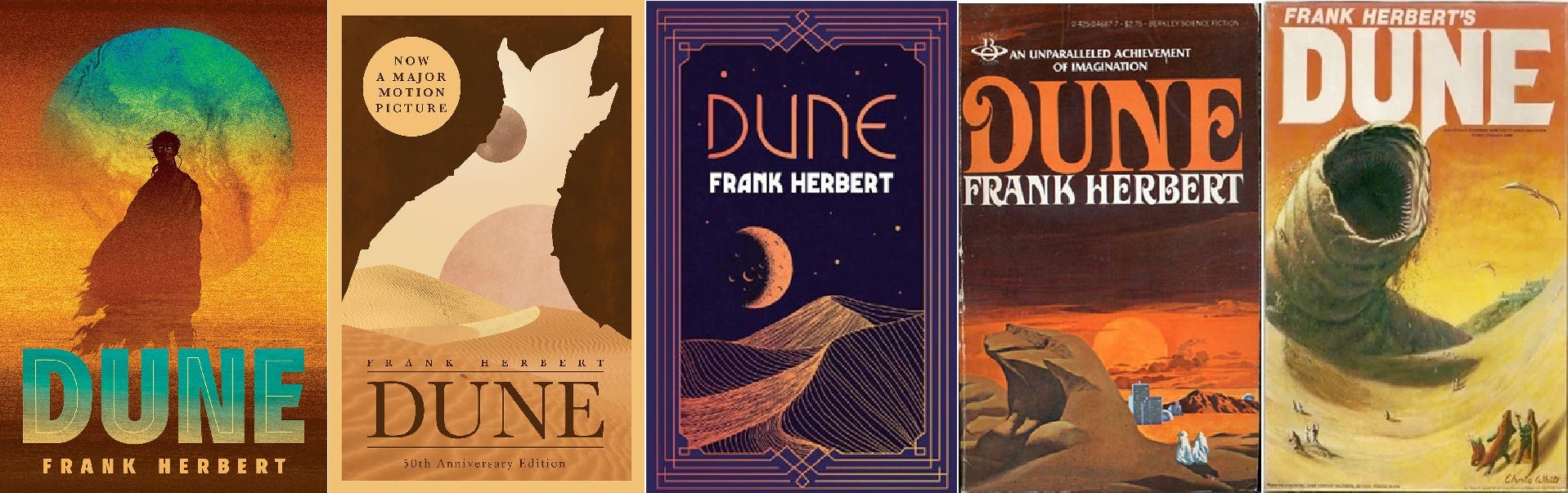
At first glance, Dune appears to offer a familiar political landscape:
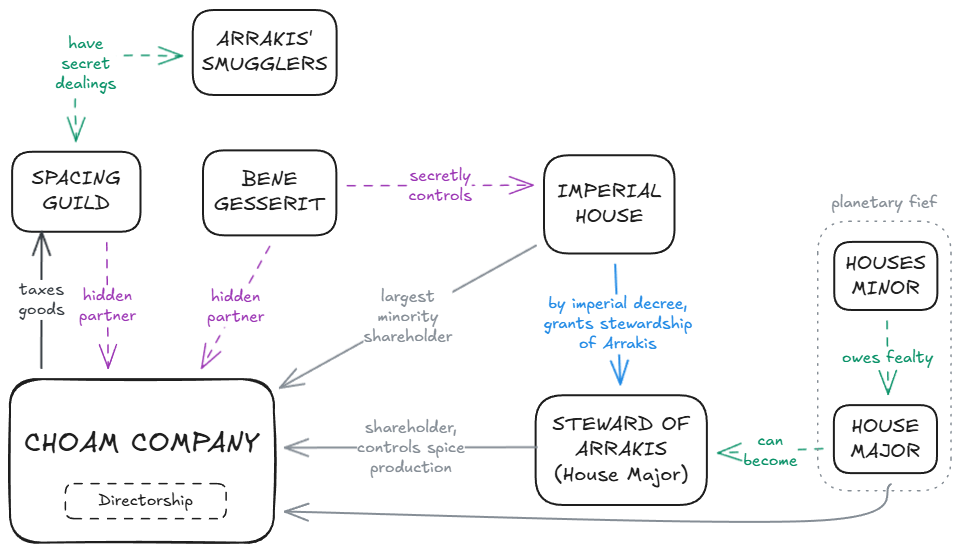
A distant future ruled by an Emperor who grants fiefdoms to Noble Houses, with power passed down through inheritance. But beneath this seemingly simple surface lies a far more intricate system—one that blends market-driven economics with feudal traditions. To unpack this unique political web, let us start by further developing the two groups I just mentioned:
Beginning with the Padishah Emperor: ruler of the known human-populated universe. His authority is inherited, though there are other pressures at play—details we will explore later. The Emperor and his Royal House possess immense wealth, but it ultimately depends on the same resource everyone covets: the spice melange harvested only on the desert planet Arrakis.
After the Emperor come the Noble Houses, divided into Major and Minor. Each is a dynastic seat of power, with Houses Major holding a planetary fief with one homeworld, and multiple others entrusted to loyal Houses Minor. The two most relevant Houses are Atreides (based on the sea-world of Caladan) and Harkonnen (based on Giedi Prime).
This structure seems straightforward, but everything changes when we introduce three other fundamental organisations:
The Landsraad is a governing council representing all the Houses. It serves as a forum where they negotiate trade agreements, forge alliances, and conduct kanly—a formalised process of feud and revenge. Think of it as a parliament within a constitutional monarchy: it balances the Emperor’s power, with member Houses voting on various matters. Naturally, the Houses Major hold more votes than the Minors.
The CHOAM Company, though, brings a new level of complexity. This colossal monopoly controls every trade out there, profiting from the taxes it imposes. It has a board of directors (and directorship isn’t easy to acquire), while every House, including the Emperor, owns shares of the company1. The Imperial House is, of course, the largest minority shareholder. Early on the book, Duke Leto Atreides makes a compelling warning about CHOAM:
“Few products escape the CHOAM touch,” the Duke said. “Logs, donkeys, horses, cows, lumber, dung, sharks, whale fur—the most prosaic and the most exotic… even our poor pundi rice from Caladan. Anything the [Spacing] Guild will transport […] But all fades before melange. […] It cannot be manufactured, it must be mined on Arrakis. It is unique and it has true geriatric properties. […] But the important thing is to consider all the Houses that depend on CHOAM profits. And think of the enormous proportion of those profits dependent upon a single product—the spice. Imagine what would happen if something should reduce spice production.”
Imagine what would happen, indeed…
But before we dive deeper into the spice, we have to consider the other company the Duke just mentioned: the Spacing Guild. In Dune, space travel is not common or privately owned, and neither the Emperor nor the Noble Houses possess their own ships. Instead, the Guild holds a strict monopoly on all space transport, charging exorbitant fees—particularly high when it comes to moving troops, and placing satellites in orbit around planets.
As you can see, we’re quickly moving away from a traditional feudal structure toward a market-driven economy.
Therefore, it’s time we finally explore the melange spice.
Duke Leto Atreides said spice has “true geriatric properties”—namely, it is a highly effective anti-aging product. It grants extended lifespan, vitality, and heightened awareness… and you can imagine that everyone would want to put their hands on something like this. After all, eternal youth (and the wealth one can accumulate in a longer lifespan) is not a new desire; humanity has craved it long enough.
The other use of spice is space travel. No one knows precisely how the Spacing Guild employs it, but without spice their ships cannot function. Because the Guild is itself a monopoly, its limitations on space travel affect everyone.
However, the most precious resources are always scarce and dangerous to procure. This is the case for the spice.
Arrakis, its sole source planet, is a dangerous desert. There, water scarcity is so extreme that inhabitants seek to recover moisture from almost anywhere—sweat, tears, dead bodies, even the wind. Worse, only some regions of the world are deemed habitable during the nights. In this world, someone is considered rich when they have water to spare.
Second, harvesting spice can be deadly. Placing a machine in the ground attracts Shai-huluds: gigantic worms that can swallow the harvesting machines and are always, inevitably, attracted to them. The harvesters cannot be shielded either, for shields are an even more compelling to the worms—thus, they need specialised aerial vehicles to lift them on the spot once a worm is detected.
Third and last, the desert is the home to the Fremen: a dangerous native population that specialises in desert combat and very much does not like CHOAM harvesting spice. We’ll talk about them later.
As a result, mining spice is costly—the wear and tear on equipment quickly adds up, and repeated clashes with the Fremen can decimate entire troops… but as the saying goes: with great risk comes great reward.
Let’s return to CHOAM, because everything happens around it.
Every few decades, by imperial decree, the Padishah Emperor grants stewardship of Arrakis to one fortunate Great House. This stewardship includes control over spice production, and may include a directorship seat on CHOAM. You can think of stewardship as a fiefdom: one rich with economic benefits, some of which may skirt the edges of legality. After all, where valuable resources exist, so do smugglers… and if managed discreetly, whoever controls the spice can take a cut from smuggling operations to build their own reserves.
If you want to see a handy diagram of CHOAM and all the other factions I’ve named so far (plus a few additional ones), head into my blog at liviajelliot.substack.com; you’ll also find the episodes’ transcript there, alongside additional references.
At the start of the book, the Baron Harkonnen has ruled Arrakis for over 20 years…
…and in that time, he became obscenely rich. Worse still, his control of the planet was enforced through his nephew Rabban, whose brutal governance kept the population firmly in line.
Everything changes when the Emperor, by Imperial Decree, grants Stewardship of Arrakis to House Atreides. At first glance, this may look like a routine political manoeuvre: a simple rotation, or an attempt to redistribute wealth among the Houses Major… but the reality is far less noble. As Duke Leto Atreides himself explains:
“[…] By giving me Arrakis, His Majesty is forced to give us a CHOAM directorship… a subtle gain.”
“CHOAM controls the spice,” Paul said. […] “Whoever had stockpiled melange could make a killing. Others would be out in the cold.”
The Duke permitted himself a moment of grim satisfaction, looking at his son and thinking how penetrating, how truly educated that observation had been. He nodded. “The Harkonnens have been stockpiling for more than twenty years.”
“They mean spice production to fail and you to be blamed.”
“They wish the Atreides name to become unpopular,” the Duke said. “Think of the Landsraad Houses that look to me for a certain amount of leadership—their unofficial spokesman. Think how they’d react if I were responsible for a serious reduction in their income. After all, one’s own profits come first.”
What we are seeing here is the Emperor deliberately sowing unrest through the careful manipulation of the three classical causes of war:
Fear, Honour, and Interest
Long before Dune, the Athenian historian Thucydides argued that wars are rarely fought for a single reason, instead emerging from the interaction of three forces: fear, honour, and interest—which he illustrated through what is often considered the first in-depth study of the Peloponnesian War2. Currently, modern historians continue to apply these three elements when analysing modern warfare.
Herbert’s genius lies in how cleanly these abstractions map onto the politics of Dune:
Interest is the obvious one: spice.
It is the pure material base of power:
economic (it generates profit),
military (to pay the Guild for transporting goods and forces), and
even epistemic (youth and other benefits).
Almost every faction’s strategy circles around who controls spice and for how long. Remember what Duke Leto said: “[…] the important thing is to consider all the Houses that depend on CHOAM profits,” and CHOAM’s main income comes from the spice.
A dangerous dependence, because…
Everyone is afraid of something—and fear drives escalation or paralysis.
So far, based on the quote I read before, we know that the Padishah Emperor fears the Atreides’ rising popularity and thus “[wishes] the Atreides name to become unpopular.” The reason is simple: public support may allow Duke Leto to scheme through the Landsraad and place an Atreides on the throne. Likewise, the Emperor fears the Landsraad as a balancing force, because it could unite the Houses against him. Fear explains why he never acts openly, instead preferring indirection, proxies, and plausible deniability.
Meanwhile, House Atreides dreads what the Harkonnens could do to them; after all, for the right amount of spice (likely taken from the Baron’s secret reserves) the Houses of the Landsraad could conveniently look aside and ignore anything that may happen to the Atreides. Duke Leto explains this:
A harsh smile twisted the Duke’s mouth. “[The Landsraad would] look the other way no matter what was done to me.”
“Even if we were attacked with atomics?”
“Nothing that flagrant. No open defiance of the Convention. But almost anything else short of that… perhaps even dusting and a bit of soil poisoning. […] [But] knowing that the Harkonnens stockpile melange, we ask another question: Who else is stockpiling? That’s the list of our enemies.”
But this cycle of fear doesn’t end there: the Atreides are wary of the Emperor as well, because they know he could release upon their House another faction we have not discussed yet: the Sardaukar. An elite military force renown for its fanatic zeal, superior fighting abilities, and sheer ruthlessness. Every House is terrified of the Sardaukar… and the Emperor promised the Harkonnen to use them against the Atreides.
Again, Duke Leto had surmised how this would happen:
“The Emperor,” Paul said. “That means the Sardaukar.”
“Disguised in Harkonnen livery, no doubt,” the Duke said. “But the soldier fanatics nonetheless.”
Why disguised? I hinted at it before: plausible deniability. The Emperor needed the Atreides extinguished, but couldn’t afford the reputational damage of doing so overtly—so he helped the Harkonnen, aware that their actions could be excused under the Landsraad’s kanly: the legalised feud-revenge system I mentioned before.
At this point, Paul asks the very same thing every reader may be wondering—and the answer, as Duke Leto knows, it is not that simple:
Paul tried to swallow in a throat suddenly dry. “Couldn’t you convene the Landsraad? Expose—”
“And make our enemy aware we know which hand holds the knife? Ah, now, Paul—we see the knife, now. Who knows where it might be shifted next? If we put this before the Landsraad it’d only create a great cloud of confusion. The Emperor would deny it. Who could gainsay him? All we’d gain is a little time while risking chaos. And where would the next attack come from?”
From that answer, we learn that the Houses are also afraid. They fear the Emperor because they can see how he’s deliberately attacking the Atreides by removing the Harkonnen’s Stewardship—all while simultaneously dreading the Baron who (after decades controlling Arrakis) has stockpiled spice and limited its sale, thus increasing its price. Because of these constraints, the Houses often tolerate injustice, simply not to bring it upon themselves.
Finally, the entire move of replacing the Harkonnens, placing and removing the Atreides, and restoring the Harkonnens generates political instability—exactly what the Spacing Guild fears: the uncertainty of who will control the spice, and what will happen to their own shady businesses. Regardless, the Guild cannot act lest CHOAM reduces their ’transportation fees’ (paid in spice).
Therefore, what emerges from here is a political system paralysed by mutual fear. No faction can act openly without risking retaliation from another; no injustice can be corrected without threatening the balance of power. Violence, when it comes, must therefore be indirect, deniable, and outsourced. In Dune, fear does not prevent war—it merely ensures that war is fought through proxies… at least for the time being.
Why proxis? Because…
Honour—the third cause of war—can manifest as legalities, not only as personal virtue.
Historian Donald Kagan explained that: “If, however, we understand [honour’s] significance as deference, esteem, just due, regard, respect we’ll find it […] also has practical importance in the competition for power”3. Understood this way, honour acquires real political weight: it governs how power is recognised, constrained, and exercised. Treaties, accords, and conventions bind faceless organisations just as effectively as they bind individuals—and they need don’t need to be ethical or just to matter. What matters is whether violating them carries consequences.
Remember what Duke Leto said:
“No open defiance of the Convention. But almost anything else short of that… perhaps even dusting and a bit of soil poisoning.”
So even the Harkonnens are forced to honour legalities. The reason is simple: in Dune, this conception of honour materialises as a dense web of institutional counterweights:
The Landsraad as a formal check on imperial authority,
kanly as a codified system of vendetta,
the Convention to limit which weapons can be used,
the Houses Minor who ‘must obey’ the House Major controlling their fiefdom,
the share-based structure of the CHOAM Company and its taxes,
the Imperial Decrees that must be obeyed even when unjust, and
the Spacing Guild’s tacit agreements with smugglers.
None of these mechanisms are moral in themselves, but all of them are honoured, and that is what grants them power.
Yet by this point, you’re probably asking yourself one question: if the three key causes of war are present in this fictional ecosystem, why don’t we have an open war? In the book all these actors we just reviewed were quite clearly avoiding war at all costs, so what is happening?
The answer is something known as a deterrent:
Something that dissuades factions from conflict or war, often through credible threats of severe retaliation, or the ability to deny them success. Deterrence is about shaping an opponent’s perception and cost-benefit analysis to demonstrate that any attack would be irrational. The problem is that, once the deterrent is nullified, war will likely happen. We will later see how this comes to be.
For now, how does deterrence come to play in Dune?
To answer that question, let me be upfront: the politics of Dune are not merely tactical; Herbert was working at a strategic and systemic levels. His world-building acknowledges that political power is inseparable from economic power—and economic power, in turn, depends on monopoly.
Knowing that, let us reinterpret three key organisations:
CHOAM is not just a company: it is the economy.
Likewise, the Spacing Guild isn’t just transport: it is both market access and the enabler of war. After all, if they refuse to transport a House’s goods or troops, then that’s it; that House doesn’t trade, and does not warre. Someone’s military strength is meaningless without their logistical permission.
Finally, the Imperial House is not just a sovereign, but a regulator with a private army.
Therefore, on the one hand we have a galactic political ecosystem on the verge of war—with fear, interest, and honour tense enough that conflict could arise at any moment… while on the other hand we have the most precious and scarce resource: the spice. And spice’s scarcity is a type of deterrence; one akin to mutually assured destruction.
So let’s elaborate on this concept.
Mutually Assured Destruction (known as MAD) is a military strategy…
…where a full-scale use of nuclear weapons by two opposing sides would result in the complete annihilation of both the attacker and defender, creating a stalemate where neither side dares to strike first due to guaranteed, devastating retaliation. Its application first started during the Cold War, and the state that results from it is considered a form of the Nash Equilibrium in which—once armed—neither side has any incentive to initiate a conflict or to disarm.
The reason? Simple: escalation risks systemic collapse. A nuclear apocalypse.
Going back to Dune, we know that the Houses cannot attack each other with spice… but they depend so heavily on it that destroying or damaging its sole source—the planet Arrakis—or the means to reach it—the Spacing Guild—would lead to MAD. Remember: the spice is their sole interest. Beside its so-called ‘geriatric properties’, this resource enables space-faring; without it, every world would become isolated, needing resources (such as food or medicine) that, without space travel, are impossible to acquire.
The Spacing Guild is, therefore, the ultimate veto player because it controls movement:
They are the only ones who can transport goods and prevent isolation, while
nobody can affront the cost of moving a large number of troops. The Baron has quite an enlightening conversation with his nephew about this topic:
“Have you any idea, Rabban, […] of how much the Guild charges for military transport?” […] The Baron shot a fat arm toward Rabban. “If you squeeze Arrakis for every cent it can give us for sixty years, you’ll just barely repay us!”
Rabban opened his mouth, closed it without speaking.
“Expensive,” the Baron sneered. “The damnable Guild monopoly on space would’ve ruined us if I hadn’t planned for this expense long ago.”
And in a market economy, the loss of income invites collapse. A House cut off from trade would stagnate, unable to maintain its power or fulfill its obligations. This is the fate the Great Houses of the Landsraad are determined to avoid.
Therefore, when the Baron Harkonnen attacks Duke Leto Atreides using undercover Sardaukar—the Emperor’s elite army—the other Houses just look to the other side. They are forced to accept this because spice is their sole interest, and its scarcity the main deterrent. Thus, we reach an apparent stalemate: nobody can move against Arrakis because everyone needs Arrakis, though the tensions for war (fear, interest, and honour) keep building up.
This setting is so much closer to modern geopolitics (with energy markets, shipping lanes, and sanctions) than medieval court drama.
Dune is so close to Thucydides, early game theory, and political theory because Herbert was asking some unforgiving questions: what happens when institutions become more powerful than their rulers? And what does power look like when violence is too costly to use?
The book doesn’t answer these questions, and so I won’t attempt it either. Instead, I’ll move alongside the story to touch on the next point: what happens after Duke Leto Atreides is dead, and how his son, Paul Atreides doesn’t seize power so much as triggers a phase transition.
To unravel this situation, we need to discuss two other factions.
The Bene Gesserit are an all-women order…
…operating behind an almost impenetrable screen of ritual mysticism. In practice, however, they are not ‘witches’ (as some call them) but highly trained political actors. Young girls are taken to specialised schools where they learn extreme bodily control, psychological manipulation, and combat techniques—all skills that allow them to operate undetected within the highest levels of power.
This unique organisation acts as a subtle but persistent partner to CHOAM, and has given the Padishah Emperor a permanent advisor in the form of the Reverend Mother—also known as the Truthsayer due to her abilities to recognise whether someone is lying. The Bene Gesserit are also embedded within nearly every House of the Landsraad, most often as concubines or wives—which grants them influence over two of the most sensitive mechanisms in the Imperium:
First, they exert control over inheritance. The Houses are patriarchal: only male heirs can rule. Since a Bene Gesserit can choose to bear a son or daughter, they plan for future marriages, alliances, and—when necessary—create succession crises. For example, the Padishah Emperor’s lack of a male heir for House Corrino is not an accident.
Second—and more troubling—is the Bene Gesserit’s long-term eugenics programme, aimed at producing a single individual capable of transcending their own limitations: the Kwisatz Haderach. In paper, this would a man, son of a Bene Gesserit, that would be capable of using their skills. The son of the Duke Leto Atreides, Paul Atreides, is the Kwisatz Haderach.
And here is where matters become complicated—both narratively, and morally.
At this point, we must introduce one of the Bene Gesserit’s covert branches: the Missionaria Protectiva. Its purpose is to sow adaptable systems of superstition across many cultures. This is best understood as a form of ‘religious engineering’: seeding beliefs that can later be harnessed to allow a Bene Gesserit to present herself as a mystical figure and guide a population toward the fulfilment of a manufactured prophecy.
My goal bringing this up is not to cast moral judgement, but to understand why the Missionaria Protectiva works as effectively as it does. The answer lies in political theory. Authority is legitimised through public perception, and faith is a particularly durable source of legitimacy. As Francis Fukuyama explains, “Political power ultimately rests upon recognition—the degree to which a leader […] is regarded as legitimate”4. To him, religion is one of the most stable sources of legitimacy because “it is extremely difficult to prove or falsify any given religious belief.”
Ultimately, legitimacy does not imply truth; it is belief that compels obedience.
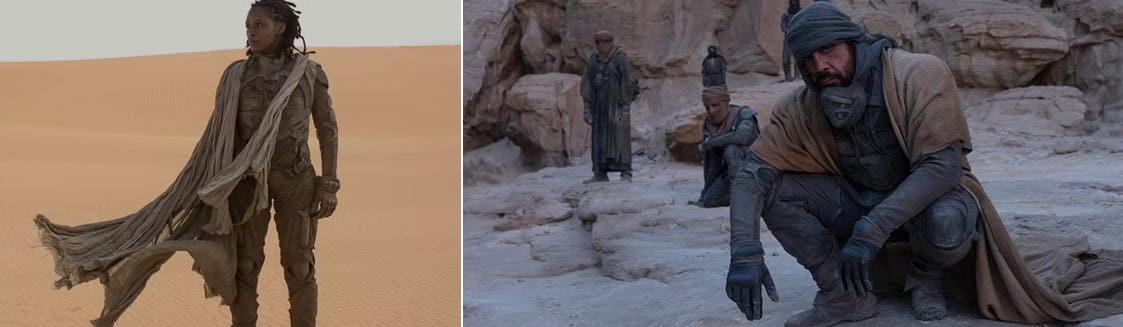
The Fremen, then, are only one of many societies the Bene Gesserit had carefully primed through the Missionaria Protectiva.
Fremen are the native population of Arrakis, found mostly in the deep desert. They live in natural underground cave systems known as sietches, and have harnessed what the book calls “desert power”: highly specialised technology and combat skills that are brutally effective in Arrakis. One of these achievements is the famous stillsuit—a full-body outfit that recovers a person’s moisture—from sweat, tears, and exhalations—to keep them hydrated for days. Another achievement is riding the Shai-hulud—the worms that attack spice harvesters.
Fremen are fierce warriors, capable of subduing even the Saudarkar—but thanks to the Missionaria Protectiva, they are also highly superstitious. Princess Irulan, daughter of the Padishah Emperor, wrote the following about them:
With the Lady Jessica and Arrakis, the Bene Gesserit system of sowing implant-legends through the Missionaria Protectiva came to its full fruition. The wisdom of seeding the known universe with a prophecy pattern for the protection of B.G. personnel has long been appreciated, but […] [the] prophetic legends had taken on Arrakis even to the extent of adopted labels […].
Lady Jessica, Duke Leto’s concubine and Paul’s mother, is—crucially—a Bene Gesserit. Therefore, from the moment House Atreides arrives on Arrakis, and well before the Harkonnen attack, Jessica recognises the familiar markers left behind by the Missionaria Protectiva. For example: how to answer to Shadout Mapes when she showed the crysknife, why the word ‘Maker’ was sacred to Fremen, and what strange phrases (like ‘weirding woman’) may truly mean. Thus, drawing on this latent belief system, she begins to subtly reinforce the idea that Paul may be the Lisan al-Gaib: the local expression of the Kwisatz Haderach, a messianic figure long anticipated by the Fremen.
When Duke Leto is killed and Jessica and Paul are driven into the desert, this careful calibration gives way to necessity. Stranded, hunted, and fully aware of the political realities at play, they understand that only one path remains:
“We’ll find a home among the Fremen,” Paul said, “where your Missionaria Protectiva has bought us a bolt hole.”
They’ve prepared a way for us in the desert, Jessica told herself. […] She looked at Paul’s face, his eyes—the inward stare. [..] It’s the look of terrible awareness, she thought, of someone forced to the knowledge of his own mortality.
He was, indeed, no longer a child.
At this point, Paul and Jessica understand something crucial: if they are to retake Arrakis from the Harkonnen and outmanoeuvre the Emperor, they need an army capable of controlling this desert world. The Atreides forces were destroyed by the Harkonnen, and they never possessed true “desert power”… but the Fremen offer another possibility.
The next realisation follows naturally: the Missionaria Protectiva can become their primary weapon in securing the Fremen’s loyalty. After all, as historian Francis Fukuyama observed, “Ideas are extremely important to political order; it is the perceived legitimacy of the government that binds populations together and makes them willing to accept its authority.”
And what better way to win the Fremen over, than by demonstrating that Paul is the Lisan al-Gaib—the messiah sent to liberate them? Such a claim would grant him immediate legitimacy, allowing him to supersede existing political authority within Fremen society.
History, of course, suggests that such legitimacy is rarely without consequenced. But since that reckoning happens on the sequels…
Let’s study how Paul and Jessica harness the Lisan al-Gaib myth.
After the Harkonnen’s attack, and the subsequent assassination of Duke Leto, Paul and Jessica are stranded on the desert. They decide to find the Fremen and begin marching south—until Stilgar, a Fremen leader, encounters them.
Jessica acts decisively. First, she presents herself as a ‘weirding woman’—the local term for a Sayyadina, women with some Bene Gesserit skills—by rapidly subduing Stilgar in combat; then, she draws upon the legends planted by the Missionaria Protectiva to anticipate his expectations and language. Through this careful performance of legitimacy, she secures the Fremen’s acceptance of both herself and Paul into Stilgar’s sietch.
Let me show you some examples of what they do. The first excerpt is when, after defeating Stilgar, she demands they’re taking to his sietch:
Jessica sighed, thinking: So our Missionaria Protectiva even planted religious safety valves all through this hell hole. Ah, well… it’ll help, and that’s what it was meant to do. She said: “The seeress who brought you the legend, she gave it under the binding of karama and ijaz, the miracle and the inimitability of the prophecy—this I know. Do you wish a sign?”
[Stilgar’s] nostrils flared in the moonlight. “We cannot tarry for the rites,” he whispered.
Jessica recalled a chart Kynes had shown her while arranging emergency escape routes. How long ago it seemed. There had been a place called ‘Sietch Tabr’ on the chart and beside the notation: ‘Stilgar.’
“Perhaps when we get to Sietch Tabr,” she said.
The revelation shook him, and Jessica thought: If only he knew the tricks we use! She must’ve been good, that Bene Gesserit of the Missionaria Protectiva. These Fremen are beautifully prepared to believe in us.
As you can see, there is no mysticism to a Bene Gesserit so-called ‘power’—just highly trained recall and observation skills. In addition, she only had to remember what she knew of the Missionaria Protectiva, say the right thing… and Stilgar believed she was a ‘weirding woman’, a priestess.
Here we have another case, in which Stilgar explicitly asks her for evidence that she is a priestess and the mother of the Lisan al-Gaib—and Jessica recognises it, thinking that: “He’s an honorable man. He wants a sign from me, but he’ll not tip fate by telling me the sign.” Thus, she pulls again from the Missionaria Protectiva:
She knew the cant of the Missionaria Protectiva, knew how to adapt the techniques of legend and fear and hope to her emergency needs. […] Stilgar cleared his throat.
“Ibn qirtaiba,” she said, “as far as the spot where the dust ends.” She stretched out an arm from her robe, seeing Stilgar’s eyes go wide. She heard a rustling of many robes in the background. “I see a…Fremen with the book of examples,” she intoned. “He reads to al-Lat, the sun whom he defied and subjugated. He reads to the Sadus of the Trial […]”
Back to her from the inner cave’s shadows came a whispered response of many voices: “Their works have been overturned.”
“The fire of God mount over thy heart,” she said. And she thought: Now, it goes in the proper channel.
“Bi-la kaifa,” they answered.
In the sudden hush, Stilgar bowed to her. “Sayyadina,” he said. “If the Shai-hulud grant, then you may yet pass within to become a Reverend Mother.”
Not only did Jessica leverage the myths engineered by the Bene Gesserit, but she managed to convince a political leader to make her the next Reverend Mother—namely, the leader of the Fremen religious order. There are many more examples of this, including moments in which Paul harnesses myth in the same way… but I gather these two examples were enough for the so-called ‘usefulness’ of the Missionaria Protectiva to become evident.
Now we must return to the spice itself.
We have so far established that spice functions both as a highly effective anti-ageing substance and as a necessity for space travel. The Fremen, however, are well aware of a third property: spice is hallucinogenic and, when consumed in sufficient quantities, grants prescience. Paul—the ‘result’ of the Bene Gesserit’s long-running eugenics programme—appears uniquely predisposed to these prescient effects, an aptitude that neatly reinforces the engineered myth of the Lisan al-Gaib.
This has two central consequences:
There are moments in which Paul sees the future consequences of his actions—many of which come to pass, not because of mythology, but because of how he and Jessica leveraged the Missionaria Protectiva. Consider the scene when Stilgar asks Paul to select a name:
“Now, what name of manhood do you choose for us to call you openly?” Stilgar asked.
“How do you call among you the little mouse, the mouse that jumps?” Paul asked, remembering the pop-hop of motion at Tuono Basin. He illustrated with one hand.
“We call that one muad’dib,” Stilgar said.
Paul swallowed. He […] remembered the vision of fanatic legions following the green and black banner of the Atreides, pillaging and burning across the universe in the name of their prophet Muad’Dib.
Using that prescience, Paul selects what to do—and, most importantly—he knows what the Fremen need him to do next to demonstrate that he is, in fact, the Lisan al-Gaib.
With these so-called ’tools’ at hand, Paul spends nearly four years following a carefully chosen path, steadily reinforcing the way the Fremen perceive him. Alongside Jessica, he teaches the Weirding Way—the Bene Gesserit’s hand-to-hand combat discipline—turning select Fremen into a so-called ‘death squad’. Then, he then uses his knowledge of Atreides military strategy to lead sustained raids against Harkonnen and smuggler supplies, until, two years on, even Rabban Harkonnen comes to dread the name of Muad’Dib.
The culmination comes a year later, when Paul rides a Shai-hulud—one of the giant sandworms. Among the Fremen, this act marks adulthood and complete inclusion within the tribe; it is a feat no outsider can achieve… and one that Paul-Muad’Dib’s followers were demanding as the ’next step’ for the Lisan al-Gaib. Consider what another Sayyadina tells Jessica—now Reverend Mother of the Fremen:
“What is it?” Jessica demanded.
“There is word from the sand,” Tharthar said. “[Muad’Dib] meets the maker for his test… it is today. The young men say he cannot fail, he will be a sandrider by nightfall. The young men […] say they will raise the cry then. They say they will force him to call out Stilgar and assume command of the tribes.”
Paul, of course, knew this and was prepared to leverage the consequences. When the Fremen soldiers pushed him to challenge Stilgar to death and become the sietch’s leader, Paul refused—and did so while owning the prophecy:
One of Paul’s companions, boulder than the others, glanced across at Stilgar, said: “Are you going to call him out, Maud’Dib? Now’s the time for sure. They’ll think you a coward if you—”
“Who dares call me coward?” Paul demanded. His hand flashed to his crysknife hilt. […] “You think it’s time I called out Stilgar and changed the leadership of the troops!” Before they could respond, Paul hurled his voice at them in anger: “Do you think the Lisan al-Gaib that stupid?”
There was stunned silence.
He’s accepting the religious mantle, Jessica thought.
Paul didn’t want to replace Stilgar because his goals were far more ambitious than simply ruling one sietch: he wanted Arrakis as the rightful fief of the Atreides, and his House to become the Imperial House—effectively displacing the current Padishah Emperor from House Corrino.
Remember what we established before, using Fukuyama’s theory: becoming the Lisan al-Gaib granted Paul immediate legitimacy, allowing him to supersede existing political authority within Fremen society. He was a prophet, not a mere ruler—and fanatics follow prophets almost blindly and without question.
So Paul speech continues, and through it, he uses the Voice—a Bene Gesserit technique that allows the wielder to speak in a way that cannot be disobeyed. By then, the crowd was so overwhelmed that this happened:
“This was my father’s ducal signet,” he said. “I swore never to wear it again until I was ready to lead my troops over all of Arrakis and claim it as my rightful fief.” He put the ring on his finger, clenched his fist.
Utter stillness gripped the cavern.
“Who rules here?” Paul asked. He raised his fist. “I rule here! I rule on every square inch of Arrakis! This is my ducal fief whether the Emperor says yea or nay! He gave it to my father and it comes to me through my father!” Paul lifted himself onto his toes, settled back to his heels. He studied the crowd, feeling their temper. […]
Beside Paul, Stilgar stirred, looked at him questioningly.
“Will I subtract from our strength when we need it most?” Paul asked. “I am your ruler, and I say to you that it is time we stopped killing off our best men and started killing our real enemies—the Harkonnens!”
In one blurred motion, Stilgar had his crysknife out and pointed over the heads of the throng. “Long live Duke Paul-Muad’Dib!” he shouted.
A deafening roar filled the cavern, echoed and re-echoed. They were cheering and chanting: “Ya hya chouhada! Muad’Dib! Muad’Dib! Muad’Dib! Ya hya chouhada!”
Jessica translated it to herself: “Long live the fighters of MuadDib!” The scene she and Paul and Stilgar had cooked up between them had worked as they’d planned.
As you can see, charisma is not improvised but deliberately staged. The speech, like the prophecy itself, was an artefact assembled with care.
Paul was not just receiving fanaticism; alongside Jessica, he manufactured the conditions for it, knowingly and skilfully. Therefore, when he declared his intentions—to reclaim his birthright as Duke of Arrakis and to lead them as the Lisan al-Gaib—the Fremen did not resist or question him. They applauded because, by their own standards, Paul had already become exactly what he claimed to be.
Yet to fulfill all ‘prophecies’ of the Missionaria Protectiva, Paul had one final task:
…he had to survive drinking the Water of Life. This poisonous liquid was produced by drowning a Shai-hulud. Reverend Mothers—and Bene Gesserits like Jessica—possessed the ability to metabolise and neutralise its toxins through mental control of their own chemistry. No man had ever attempted this before, but the Bene Gesserit’s eugenics programme was designed to produce a candidate who’d survive this test.
Consider what Princess Irulan wrote about this:
Paul-Muad’Dib lay alone in the Cave of Birds beneath the kiswa hangings of an inner cell. And he lay as one dead, caught up in the revelation of the Water of Life, his being translated beyond the boundaries of time by the poison that gives life. Thus was the prophecy made true that the Lisan al-Gaib might be both dead and alive.
Yet after neutralising the Water of Life, Paul was overwhelmed by the prescient vision granted by the spice. For three weeks he lay in a deathlike state, while Jessica struggled to revive him. Let us see what happens after Paul wakes up near Jessica and Chani, his concubine:
Chani felt a draft [of air] against her cheek, turned to see the hangings close.
“It was Otheym,” Paul said. “He was listening.”
Accepting the words, Chani was touched by some of the prescience that haunted Paul, and she knew a thing-yet-to-be as though it already had occurred. Otheym would speak of what he had seen and heard. Others would spread the story until it was a fire over the land. Paul-Muad’Dib is not as other men, they would say. There can be no more doubt. He is a man, yet he sees through to the Water of Life in the way of a Reverend Mother. He is indeed the Lisan al-Gaib.
From this point onward, doubt ceases to matter. Paul has done what no man was meant to do, and the distinction between prophecy and proof collapses. To the Fremen, he is no longer merely fulfilling the signs of the Lisan al-Gaib—he is the Lisan al-Gaib, the Kwisatz Haderach. Thus, the book drops all pretense as the characters begin to refer to Paul-Muad’Dib as capitalised ‘Him.’
Yet soon enough, the prescience granted to him through the spice allows him to realise something: a large-scale attack was coming to Arrakis. The reason?
The political tensions in the galaxy have escalated, and the two key deterrents are about to crumble.
After the Harkonnens assasinated Duke Leto Atreides, they believed Paul dead and left Rabban Harkonnen—the Baron’s nephew—in charge. However, due to Paul-Muad’Dib’s constant attacks, Rabban was consistently unable to meet the quota of spice he had to export. To understand the impact of this, we must remember what Duke Leto said:
”[…] think of the enormous proportion of those profits dependent upon a single product—the spice. Imagine what would happen if something should reduce spice production.”
As a result, the name of Muad’Dib—shouted by the Fremen during their raids—reached the CHOAM Company, introducing a new and very specific fear: the possibility that the flow of spice might be disrupted. Since all the Great Houses of the Landsraad—including the Imperial House of the Padishah Emperor—were shareholders in CHOAM, they had a direct interest both in the acquisition of spice and in the consequences its scarcity would have for their income.
At this point, we must also consider the Spacing Guild. Due to Rabban’s inability to meet his quota, and the Fremen’s raids on the smugglers, their spice reserves were considerably reduced—and no spice meant no space travel. No space travel, in turn, meant isolated worlds and generalised scarcity.
This threat on spice—a key galactic interest—forced all these actors to forego the threat of MAD.
As established earlier, the prospect of spice scarcity functioned as the primary deterrent, since its absence assured destruction through:
(a) a catastrophic loss of income, and
(b) the inability to trade for off-world necessities.
Once Muad’Dib’s raids made that scarcity a credible threat, the available strategic choices narrowed dramatically. The Great Houses could either accept the gradual disappearance of spice, or attack—despite the risks—in hopes of securing at least some region of Arrakis from which to extract it themselves.
Remember this: deterrence (and particularly mutually assured destruction) depends on a cost–benefit analysis that demonstrate that any act of aggression is clearly irrational. In this case, however, both action and inaction carried catastrophic costs… except the former offered a chance to survive. From that standpoint, war was the rational choice.
However, if you recall, the Spacing Guild provided not just transport, but both market access and troops transportation. It was the enabler of off-world wars, excepts their fares were outrageously expensive—their cost also acted as a deterrent in itself, for few Houses could afford it.
Thus, when details of the spice scarcity spread across the Landsraad, and war became the only rational choice, the Spacing Guild—interested more than anyone else on the spice—simply reduced their troop transport fares to remove that last deterrent. Then, the expected happened: all the Houses rushed to acquire troop transports, and sail towards Arrakis. War, at this point, was inevitable.
Consider this dialogue between Jessica and Paul:
Jessica tried to swallow in a dry throat, said: “For what are they waiting?”
Paul looked at her. “For the Guild’s permission to land. The Guild will strand on Arrakis any force that lands without permission.”
“The Guild’s protecting us?” Jessica asked.
“Protecting us! The Guild itself caused this by spreading tales about what we do here and by reducing troop transport fares to a point where even the poorest Houses are up there now waiting to loot us.”
As you see, the Spacing Guild had control over landing—and allowing only the Harkonnens and the Imperial House to set foot in Arrakis fulfilled two different purposes:
First, the Spacing Guild held direct power over everyone else. To those stuck in space, preventing them from landing was a reminder of who was in charge: not the Landsraad, and not the Emperor, but the Guild’s Navigators. Meanwhile, to those on Arrakis’ surface, the orbiting force was a threat of destruction.
Second, it sought to minimise the damage—not to the people of Arrakis, but to the planet’s desert, since those were the sole source of spice in the known universe.
At this point, a war for spice seemed unstoppable…
—except that Paul-Muad’Dib knew exactly how to manipulate the Padishah Emperor: by letting him know (through returned Sardaukar prisoners) that Duke Paul Atreides, rightful steward of Arrakis, was actually alive. The book doesn’t show how the Padishah Emperor takes the news, but Paul explains the two possible path of actions he had:
Paul spoke to the [Fremen] at the telescope. “Watch the flagpole atop the Emperor’s ship. If my flag is raised there—”
“It will not be,” Gurney said.
Paul saw the puzzled frown on Stilgar’s face, said: “If the Emperor recognized my claim, he’ll signal by restoring the Atreides flag to Arrakis. We’ll use the second plan then, move only against the Harkonnens. The Sardaukar will stand aside and let us settle the issue between ourselves.”
Remember the third reason for war: honour as legalities. If the Padishah Emperor responded to Paul’s claim by raising the Atreides flag—and thus supporting him—then the laws of kanly (the legalised feud system of the Landsraad) came into play.
The Emperor, however, feared the Atreides even more than before, and so chose something different. I will read the excerpt.
“They’re sending a new flag up on the tall ship,” the watcher said. “The flag is yellow…with a black and red circle in the center.”
“There’s a subtle piece of business,” Paul said. “[It’s] the CHOAM Company flag.”[…]
“A subtle piece of business indeed,” Gurney said. “Had he sent up the Atreides banner, he’d have had to live by what that meant. Too many observers about. He could’ve signaled with the Harkonnen flag on his staff—a flat declaration [of war] that’d have been. But, no—he sends up the CHOAM rag. He’s telling the people up there…” Gurney pointed toward space. “…where the profit is. [The Emperor is] saying he doesn’t care if it’s an Atreides here or not.”
After all, in a market economy, profit is all that matters.
However, there is something the Emperor doesn’t know: Paul knows how to destroy the spice:
“The Water of Death,” he said. “It’d be a chain reaction.” He pointed to the floor. “Spreading death among the little makers, killing a vector of the life cycle that includes the spice and the makers. Arrakis will become a true desolation—without spice or maker. […] He who can destroy a thing has the real control of it,” Paul said. “We can destroy the spice.”
“He who can destroy a thing has the real control of it.” It is a crude reality check, because…
In this universe, destroying the spice would be mutually assured destruction. Quite literally, MADness.
Therefore a battle ensues. The Lisan al-Gaib leads worm-riding Fremen against the Padishah Emperor and crashes his Sardaukar forces.
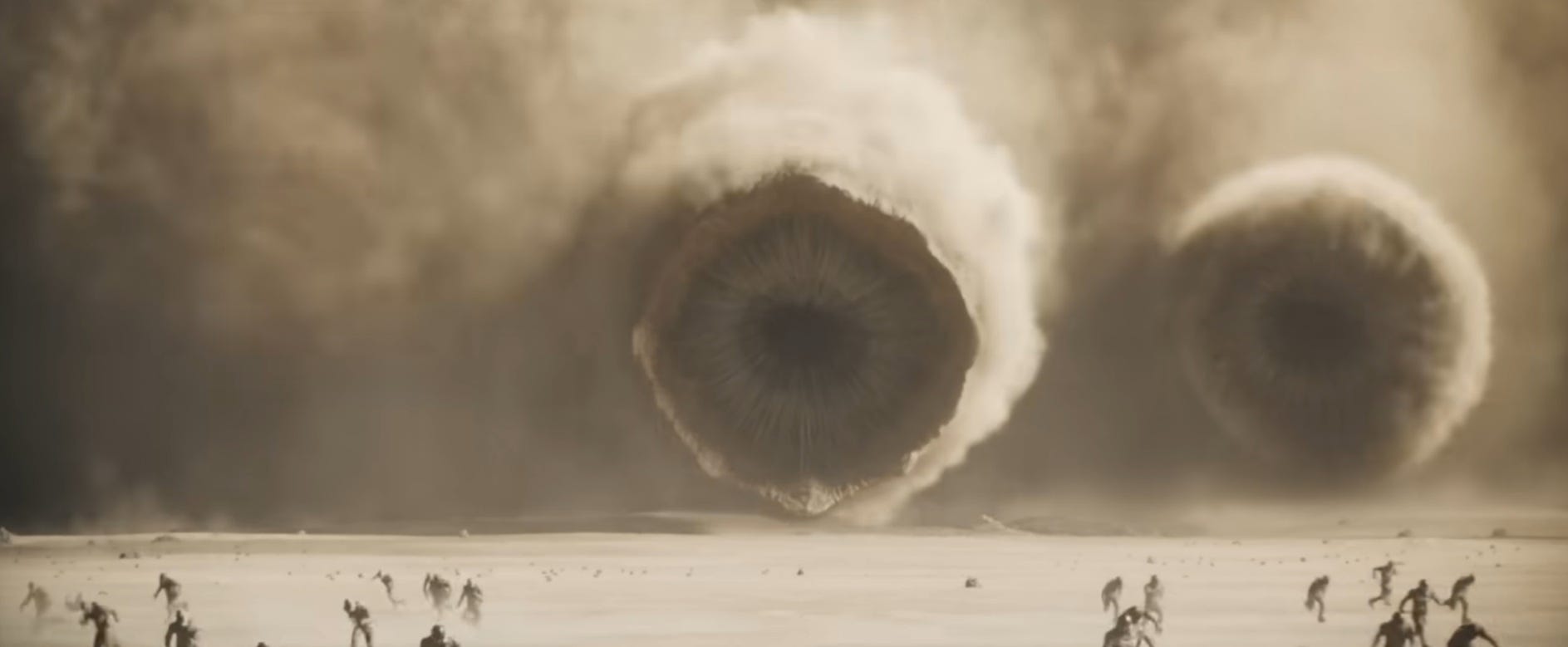
A small parley is set, and in that conversation Paul reveals his ability to destroy the spice. The Guildsmen immediately understand the peril that Paul’s knowledge poses to the current galactic society. Consider this exchange:
“Let us talk this over privately,” the taller Guildsman said. “I’m sure we can come to some compromise that is—”
“Send the message to your people over Arrakis,” Paul said. “I grow tired of this argument. […] The power to destroy a thing is the absolute control over it. You’ve agreed I have that power. We are not here to discuss or to negotiate or to compromise. You will obey my orders or suffer the immediate consequences!”
Thanks to Paul, the original deterrence returns in full-force. This time not as scarcity, but as complete disappearance. Paul’s control over the spice is the ultimate form of mutually assured destruction—and it leaves the Guild and the Imperial House without negotiating power. After all, Paul-Muad’Dib not only controls the spice, but also the fanatical legions of Fremen fighting for its protection.
The very same legions that just destroyed the Padishah Emperor’s Sardaukar forces.
This comes near the end of the book, but Herbert is explicit about how matters are resolved. The Emperor is forced to transfer all his CHOAM shares to Paul, formally consolidating his control over the spice. What had previously rested on the threat of destruction is now legalised since Paul becomes the single largest shareholder of the Company. The Emperor then permits him to marry Princess-Royal Irulan, allowing him to claim the Padishah Emperor’s throne through marriage, while simultaneously keeping the fief over Arrakis—where Paul remains the Lisan al-Gaib, wielding absolute authority over the Fremen.
This, in turn, activates the final mechanism of the engineered prophecy: Paul has indeed freed the Fremen from their oppressors, and the Lisan al-Gaib will now lead them. With control of the spice, the knowledge required to destroy it, and a fanatical army at his command, Paul ascends the galactic throne.
It is a full-stack theory of power—and, crucially, none of this requires hatred.
What Paul did is not racism: it is instrumental rationality applied to faith. It is important to stress that the Fremen are never portrayed as inferior.
Their technology is admired, their ecological knowledge of Arrakis is unmatched, their military effectiveness is feared even by the Sardaukar, and their “desert power” is explicitly envied by House Atreides. For example, Duncan Idaho, one of Duke Leto’s lieutenants said that the Fremen “were to be admired,” while Duke Leto wanted them as allies because “Fremen were a deep thorn in the Harkonnen side, that the extent of their ravages was a carefully guarded secret.”
What Paul and Jessica did, then, was not dehumanisation but instrumentalisation. They recognised the Fremen’s strength and agency, and consciously channelled it through a framework of legitimacy that served their own political survival. From his meeting with Stilgar and onwards, both Paul and Jessica dominated the Fremen because they understood their strengths, their social structures, the myths planted by the Missionaria Protectiva… and leveraged them.
That makes Paul’s rise feel less like colonial racism and more like cold realpolitik.
And that brings another chilling realisation: oppression in Dune does not require belief in inferiority—just narrative control, and a willingness to treat meaning itself as a resource.
The truth is that Paul was not a benevolent savior corrupted by power. He was a political actor who discovered that belief was the most efficient legitimisation mechanism available to acquire the so-called “desert power” he needed to retake Arrakis and overthrow the Emperor. In turn, the Fremen were not fooled because they were naïve or lesser—they were mobilised because their existing cosmology had already been engineered for it. Paul simply stepped into a system designed to turn belief into obedience.
Except that such systems have consequences no one can ultimately contain. But I will leave that open, until we can discuss the sequel books.
All in all, Dune is a thematically rich book—so here is a short list of other themes that enable further discussions:
Herbert himself revealed he modelled CHOAM as the Organisation of the Petroleum Exporting Countries and the water scarcity of Arrakis as a direct analog to oil scarcity. If you read all the economic conflicts using that perspective, you’ll likely find an environmentalist angle that critiques the resource economy of the ’60s and ’70s.
Likewise, and staying in the fictional world, you could analyse how an environment’s resources—as seen in Arrakis—affect society to the point of driving its culture, beliefs, technology, and actions. This could lead you to see Dune as cli-fi: namely, climate fiction.
Dune can also an examination of the pitfalls of absolute prediction, both regarding facts and evolution. To analyse this, you’d need to dive deeper into the Bene Gesserit’s plans.
The fact that Paul truly becomes the Lisan al-Gaib when he usurps the Reverend Mother’s power does enable a discussion on how patriarchal societies validate male figures by appropriating female power. It is a sharp and uncomfortable angle, but certainly rich for discussion.
There is also commentary on data science presented through the Mentats: the human computers of this universe. In modern times, there is one particular saying: “garbage in, garbage out.” It implies that biased data (“garbage in”) produces biased results (“garbage out”)… and Hawat’s character arc, the Atreides Mentat, can be read through this lens.
So many themes, so little time to discuss. Who knows, there may be another Dune episode in the works.
For now, if you enjoyed my breakdown of politics and authority, the world of my recently released book—The Omens of War—was also developed using some of the ideas I presented in this podcast. You can find it linked below.
Thanks for listening, and happy reading.
Copyright © 2026 Livia J. Elliot. All rights reserved. This publication is licensed for personal reading only. No article, or substantial part of an article, may be reproduced, republished, adapted, translated, compiled into another publication, incorporated into teaching materials or course packs, or used for AI training without prior written permission. Linking to the original articles is encouraged.
It is understood that CHOAM is actually a not-so-subtle reference to OPEC: the Organisation of the Petroleum Exporting Countries. This comparison actually comes from Dune Genesis, an article Frank Herbert wrote for Dune News (archived by The Wayback Machine). He wrote: “The scarce water of Dune is an exact analog of oil scarcity. CHOAM is OPEC.” This equation brings in a large number of interpretations but, unfortunately, I cannot fit them all into a single podcast episode.
Thucydides’s work, History of the Peloponnesian War is quite easy to find. There is a Penguin Classic for those preferring paperbacks, and the ebook is (of course!) part of Project Gutemberg; you can access it here.
The quote is from Donald Kagan’s magnus opus, On The Origins of War, and The Preservation of Peace. This is quite a dense read, so if you aren’t that familiar with the history of wars, I’d recommend you start with Margaret MacMillan’s War.
Both quotes come from The Origins of Polical Order by Francis Fukuyama (ISBN: 978-0374533229). I won’t lie: it is a dense non-fiction book, but it compares a many political systems making it a compelling read.


