



My job requires it, he thought, scraping bottom. Prestige. We couldn’t go on with the electric sheep any longer; it sapped my morale. Maybe I can tell her that, he decided.
A curious quote revealing one truth: prestige is seldom abstract. It arrives disguised as necessity, as morale, as professional obligation… and it surfaces, in private, as a justification. But this raises two interesting questions: what becomes prestigious, and why? And is wealth really all that backs prestige? It’s too early to answer that. For now, I’ll just say this: the two books we’re about to explore suggest that scarcity doesn’t merely limit resources—it reshapes meaning, status, and even morality.
Let’s get these books undone.
Hello everyone, and welcome to Books Undone. I’m your host, Livia J. Elliot and in today’s episode I want to analyse two unlikely books. Both are considered masterpieces, and have been adapted to movies—but one is arguably not science fiction, and the other is considered proto-cyberpunk. Their plots diverge wildly, but the core of their world-building circles around a triad: scarcity generates demand, and demand transforms possession into prestige.
I’m talking about Do Androids Dream of Electric Sheep? by Philip K. Dick (adapted as Blade Runner), and Dune by Frank Herbert.
Yet before we dive in, allow me to make two clarifications:
This discussion is spoiler lite. I’m focusing mostly on world-building elements more than in the plot itself. Therefore, you do not need to have read them to enjoy this episode.
What follows is an interpretation, not a verdict. You may disagree, and that strengthens the thematic richness of these books—which continue to invite discussions decades after publication.
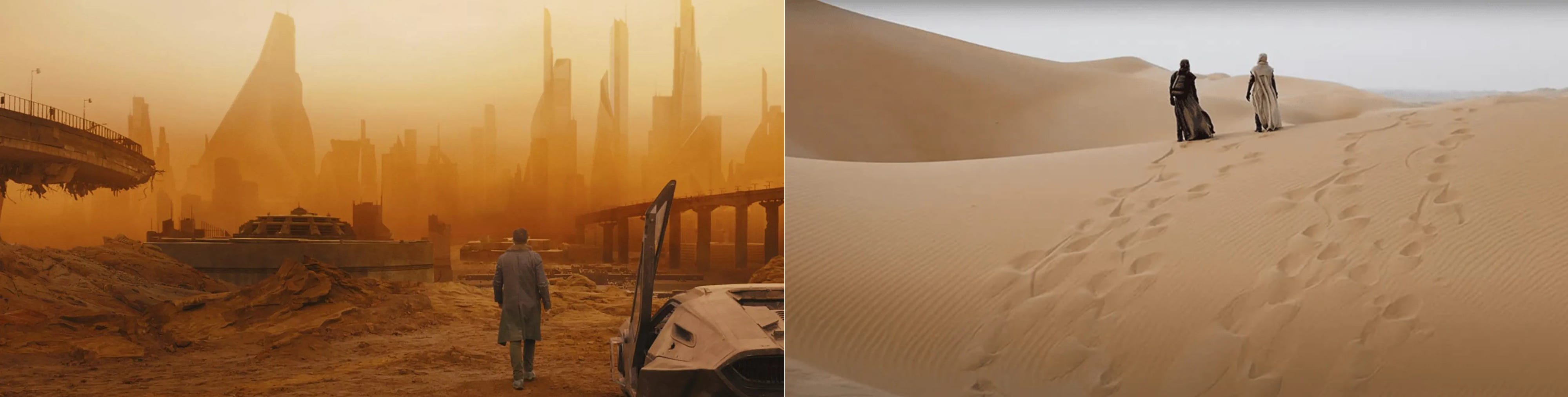
Let us begin by discussing the books’ settings.
This includes the reasons behind the scarcity, and which commodity is now precious.
Do Androids Dream of Electric Sheep? by Philip K. Dick…
—was published in 1968, and it’s a dystopian proto-cyberpunk novel set in a post-apocalyptic San Francisco. At some point before the book’s events, World War Terminus affected the entire ecosystem, extinguishing most animal life.
Consider this description, early in the book:
No one today remembered why the war had come about or who, if anyone, had won. The dust which had contaminated most of the planet’s surface had originated in no country and no one, even the wartime enemy, had planned on it. First, strangely, the owls had died. At the time it had seemed almost funny, the fat, fluffy white birds lying here and there, in yards and on streets; coming out no earlier than twilight as they had while alive. […] After the owls, of course, the other birds followed, but by then the mystery had been grasped and understood. A meager colonization program had been underway before the war but now that the sun had ceased to shine on Earth the colonization entered an entirely new phase.
As the excerpt highlights, the conditions for the scarcity are man-made: World War Terminus destroyed the atmosphere. Its ensuing radiation, ‘dust’ contamination, and lack of direct sunlight, led to an ecological collapse that made animals nearly extinct. Although some species, like owls or frogs, were more affected than others, all animals are now at the verge of extinction. This also includes vermin; for example, spiders are pretty rare in this world.
Which… certainly raises a somewhat obvious question: shouldn’t food be the scarce resource? In a world marked by ecological collapse and diminished sunlight, one might expect agriculture itself to be imperilled—yet food shortages are not foregrounded in the novel. The reader is left to assume that synthetic food is easily accessible.
Animals, however, are a different matter because their importance is not merely biological but symbolic. This distinction will become crucial as the episode unfolds. But before elaborating on it, we need to examine a second world structured by environmental extremity.
Dune by Frank Herbert…
—was published in 1965, and it’s considered one of the first cli-fi (climate fiction) books to become mainstream. Much of it centres around Arrakis: a desert world fundamental to the economics of the universe. The reason? It is the sole provider of spice, a multi-faceted product with extreme anti-aging properties, and one that also makes spacefaring possible.
But although spice is scarce and limited, it is not the resource we’ll discuss today.
Water is.
You see? Arrakis has no oceans, no humid patches, not even steppes. It is a sand-filled desert across its expanse, and it is populated by humans… and we humans, as you know, need water to stay alive. This raises the unavoidable problem of a fundamental need that can only be satisfied by a scarce resource.
When House Atreides is sent to rule over Arrakis, the Duke’s son—Paul Atreides—receives the following warning:
“You’ll learn a great concern for water,” Hawat said. “As the Duke’s son you’ll never want for it, but you’ll see the pressures of thirst all around you.” […]
Paul swallowed, suddenly aware of the moisture in his mouth, remembering a dream of thirst. That [Arrakis’] people could want water so much they had to recycle their body moisture struck him with a feeling of desolation. “Water’s precious there,” he said.
What Paul said, “Water is precious in Arrakis” is true. Notice how Hawat framed it: the Duke’s son will never need it, but everyone else will go thirsty—implying Paul would have it in abundance only due to his privileged position and economic standpoint, not because it would be easy to acquire it.
The extreme scarcity is also highlighted when Paul remembers that those living in Arrakis “recycle their body moisture” to have something to drink. This is fundamental because the planet has no natural bodies of water, and the population must reuse their own fluids, drain water from recently deceased bodies, or use so-called ‘windmills’ to collect the air’s scant moisture.
At this point we can raise another obvious question: if Arrakis’ environment is so hostile to humans, why remain there at all? The answer is the second resource: spice—and within Dune’s universe, spice must flow. Given its properties it is politically unavoidable to have troops and harversters there, and for the Fremen—the native population—their presence is less transactional and more existential; the novel offers fragments rather than a single explanation about their arrival, hinting at belief and long ecological ambition.
The politics of Dune are intricate and fascinating, but they are not the focus of this episode. If you want to hear about them, check my previous episode where I discussed the political theory behind it.
For now, we are concerned with scarcity itself.
Both settings share a structure, but not a cause.
In Do Androids… the scarcity is man-made: it’s the result of World War Terminus. In Dune, however, scarcity is natural: a result of the environment itself. The former is a technological catastrophe, the other just planetary extremity.
In both worlds, a single commodity rises above all others: living animals and water, respectively. Yet while the value of water is easy to guess, the relevance of living animals is not as clear.
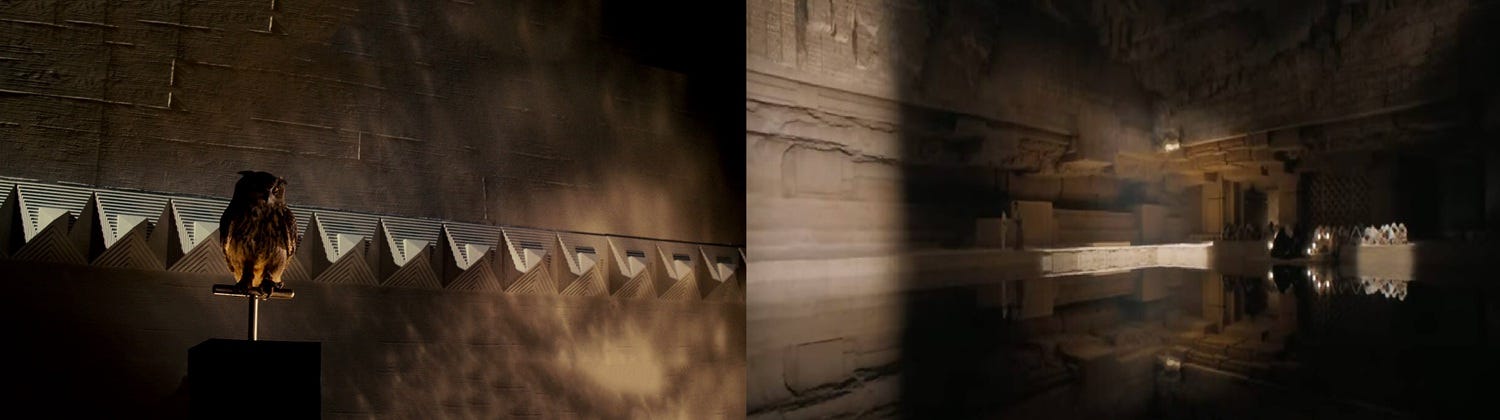
So let us deconstruct how value is assigned.
When I introduced Do Androids Dream of Electric Sheep?
…I mentioned that the importance of living animals was not merely biological but symbolic. In truth, scarcity changed how people thought about animals—and how people think about a commodity, affects its value. Consider this excerpt following protagonist Rick Deckard:
On his way to work Rick Deckard, as lord knew how many other people, stopped briefly to skulk about in front of one of San Francisco’s larger pet shops, along animal row. In the center of the block-long display window an ostrich, in a heated clear-plastic cage, returned his stare. The bird, according to the info plaque attached to the cage, had just arrived from a zoo in Cleveland. It was the only ostrich on the West Coast. After staring at it, Rick spent a few more minutes staring grimly at the price tag.
There are a few things to notice here:
Animals are now sold at specialised pet shops—and the street where these stores are located is colloquially referred to as ‘animal row.’
There is also a collective interest on animals, and a limitation to acquire them. In the quote, Deckard remarked he stopped there before work “as lord knew how many other people”—which implies he’s not the only one coveting them without actually purchasing.
Now remember the last line: “Rick spent a few more minutes staring grimly at the price tag.” It is clear that living animals are expensive—and some, rarer than others, even more expensive.
As we know from the real world, supply and demand affect a commodity’s price.
In this case, the collapse of the ecosystem had complicated the supply of living animals. However, the demand seems to be quite high, which drives the prices up. Because supply was so limited and there is a need to track prices and understand the market, the pet shops maintained a monthly publication called Sidney’s Animal & Fowl Catalogue. This magazine advertised the pet shop’s stock of living animals, their availability (if any) and their price tag. Here’s a scene of Deckard reading one:
Never in his life had [Deckard] personally seen a raccoon. […] In an automatic response he […] thumbed Sidney’s and looked up raccoon with all the sublistings. The list prices, naturally, appeared in italics; like Percheron horses, none existed on the market for sale at any figure. Sidney’s catalogue simply listed the price at which the last transaction involving a raccoon had taken place. It was astronomical.
As we can see, not every animal is available “in stock”, and the rarest ones command the highest price tags—exactly what happens when desire outpaces availability.
But high demand does more than inflate prices. It creates opportunity: a need that can be profited of.
In Do Androids… that opportunity takes a peculiar form: counterfeit animals. These are meticulously engineered, robotic replicas designed to pass as real. People purchase them not out of pride, but as a way to keep up appearances in a society where ownership signals status. To protect that illusion, the repair shops disguise themselves as ‘veterinaries,’ and help extend the pretense: owners buy synthetic food, perform maintenance routines, and sustain the fiction with surprising devotion.
With this, the book’s title begins to make sense. Rick Deckard, our unfortunate protagonist, owns an electric sheep. This is how he thinks of it:
For a long time he stood gazing at the owl, who dozed on its perch. A thousand thoughts came into his mind […]. He thought, too, about his need for a real animal; within him an actual hatred once more manifested itself toward his electric sheep, which he had to tend, had to care about, as if it lived.
This begins to look less like survival and more like theatre.
Remember the question we asked before: shouldn’t food be the scarce resource? Clearly, in this setting, living animals are not nutritionally useful and neither economically productive… so why does ownership matter so intensely? At the end of the day, animals are simply displayed.
There is a reason for this, and to understand it, we need to elaborate on one economic and social theory developed by Thorstein Veblen.
He was an American economist and sociologist who, during his lifetime, emerged as a well-known critic of capitalism. In 1899, he presented the theory of conspicuous consumption which “describes a form of consumer behavior that emerged in its modern form after the Industrial Revolution.”1 In particular, conspicuous consumption “is the practice of acquiring goods or other outward symbols of wealth in order to show others how much wealth one possesses.” Something to note is that the goods acquired in this way are not needed in any meaningful sense—as Todorova said in 20132, they are meant to “inform others of the purchaser’s superiority.”
Can you see where this is going? How it links back to the living animals?
Before we formally use Veblen to explain Do Androids…, let us consider this exchange between Deckard and his neighbour Barbour, who owns a pregnant Percheron mare:
“Ever thought of selling your horse?” Rick asked. He wished to god he had a horse, in fact any animal. Owning and maintaining a fraud had a way of gradually demoralizing one.
As you can see, Deckard covets a living animal because he has none, and only wants one to display it—exactly as his neighbour does. In turn, Barbour only sees the prestige of having the animals, but doesn’t seem to care about them as living beings.
This is what Veblen observed: that consumption becomes socially meaningful when it is conspicuous rather than necessary. In PKD’s world, even electric animals participate in this economy of display: the simulation suffices because prestige depends on visibility, not biological authenticity nor utility. If you recall, the opening line I used for this episode makes this link explicit:
My job requires, it he thought, scraping bottom. Prestige. We couldn’t go on with the electric sheep any longer.
But what is utility?
To answer that, we need to pause briefly on the idea itself. Classical economic theory often grounds value in utility: the capacity of a good to satisfy desire. As economist Joan Robinson states, utility is “the quality in commodities that makes individuals want to buy them, and the fact that individuals want to buy commodities shows that they have utility.”3
Yet as we have seen, the utility of living animals in Do Androids… is dubious. Uncertain, even. Their desirability exceeds their practical function because of the conspicuous consumption—but desire alone is not enough to explain value. There must be something else. Hold on to that idea; we’ll come back to it soon.
What matters now is that this ambiguity around the utility of a scarce resource does not exist on Arrakis. Water is necessary before it is anything else.
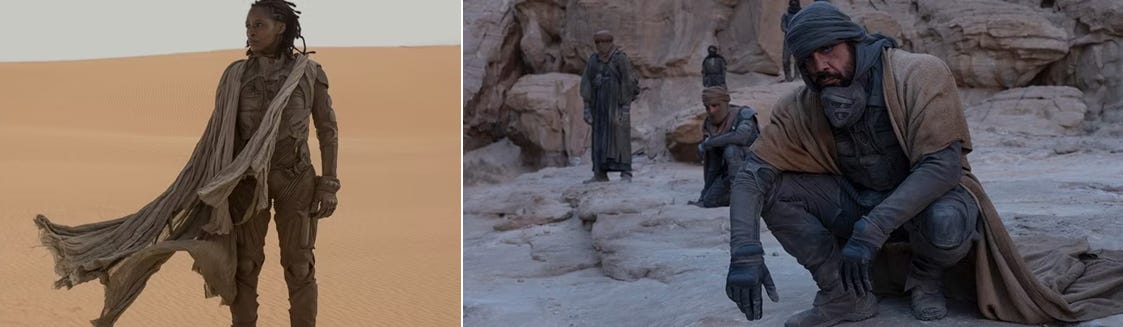
So let us return to Dune to assess how people think about water.
Shortly after arriving on Arrakis, Lady Jessica—the Duke’s concubine—speaks with the Fremen housekeeper, Mapes, about stillsuits. The exchange is brief, but revealing:
[Mapes] glanced down at her dress. “Why, you know, my Lady, I don’t even have to wear my stillsuit here?” She cackled. “And me not even dead!"
Mapes’ remark is half-joke and half-astonishment. On Arrakis, survival normally depends on wearing a stillsuit to reclaim the body’s moisture and repurpose it into drinkable water… yet inside the Duke’s residence, the air itself holds enough humidity that one can walk uncovered and live. For Mapes, that fact alone signals status.
This exchange indicates that wealth is more than the possession of water stored in cisterns—it lies in the ability to create living arragements that escape Arrakis’ constant survival pressures. In such an environment, access to water does not merely sustain life, but distinguishes those who can live from those who must survive.
Yet stored water itself is also socially charged, and its use carries specific meanings. To see how, let us consider another excerpt.
Later in the novel, Paul and Jessica are stranded in the desert with minimal supplies. They begin to travel south and soon encounter the Fremen—who promptly discover that the surviving Atreides carry surplus water in their packs. What follows is telling:
Stilgar glanced at Jessica. “Is this true? Is there water in your pack?"
To give you some context, literjons are impact-resistant containers used in Dune. They’re prepared to reduce water wastage and so do not crack or leak, and neither gather moisture when kept under the day’s heat. Each one carries about one litre of water, or a quarter gallon. Therefore, Jessica was carrying two litres.
To put this into perspective, we can remember a common health advice: we, humans, must consume roughly two litres of water (gathered from multiple sources) per day4… yet the Fremen consider that amount wealth because, in Arrakis, sparing a single droplet is a wastage. Any surplus of water above the bare minimum needed to survive is a luxury.
Yet what matters about this exchange is not how much water Jessica was carrying, but how people reacted during the exchange:
Did you notice how the Fremen whispered after Jessica recalled her homeworld’s rain and rivers? They gasped, fawned over the idea, and repeated it to each other as if it where unimaginable—because to them, natives to Arrakis, it was unimaginable. Remember: Arrakis has no oceans, no oases, no bodies of water. All water has to be reclaimed from the body’s moisture, extracted from a recently deceased person, or captured from the air with windmills.
In turn, Jessica’s upbringing in a water-rich world made her, by Fremen standards, ‘careless’ with water. She does not instinctively assign it the same relevance they do, and she says as much in the exchange. Her willingness to give it away could therefore be read as naïve generosity… but it is certainly not. By this point she already understands what water signifies on Arrakis, and her decision is calculated: she is buying trust in the only currency the Fremen acknowledge.
But do you remember how Stilgar responded? He didn’t say “Thank you.” Instead, he said: “Then we accept your blessing.”
That phrasing is culturally relevant, because water in Arrakis is so scarce, that both its possession and its distribution have become ritualised acts.
To the Fremen, water exchanges function symbolically: to offer drinkable water is to bestow a blessing, while shedding tears for the dead is an act of highest respect. Consider what happens when Paul cries over a dead Fremen:
A voice hissed: “He sheds tears!"
There are many more examples of ritualised water exchanges, but here are a few more for consideration:
Fremen tend to duel to death quite often. In these cases, the corpse’s water belongs to the killer, adding to their wealth. It is extracted soon after death, and the deceased’s family is given nothing.
The ceremony to raise a new Reverend Mother—the leading religious figure—requires her drinking and purifying the Water of Life before passing it into the crowd to drink.
To court a woman, a man must offer her ‘water rings’: metallic counters that represented the volume of water released by a body of a dead Fremen processed through a deathstill, and owned by the man.
As we can see, to the Fremen of Arrakis, water is more than just wealth… but why do they ritualise its use? Unlike other beliefs in this world, this was certainly not imposed into them by the Bene Gesserit.
There is a reason for this, and to understand it, we need to discuss the work of another thinker.
French sociologist Émile Durkheim—often mentioned alongside Karl Marx and Max Weber as one of the founders of modern social science—defined sociology as the study of institutions, using the term broadly to mean the “beliefs and modes of behaviour instituted by the collectivity.”5
Durkheim argued that the ‘sacred’ was anything that transcended the humdrum of everyday life. In his view, it is not only ‘gods’ or ‘divinities’ who are ‘divine’, but anything “that it is the subject of a prohibition that sets it radically apart from something else”6. In Durkheim’s view, the sacred and the profane are not absolute categories but relative to each society—which means that ‘sacredness’ is not an inherent quality of an object or commodity in itself, but rather a status imposed upon them through collective designation and social action.
In other words, an object’s ‘sacredness’ is developed by the society that uses it—which is exactly what happens to water in the Fremen society of Arrakis:
The scenes we analysed demonstrated clear rules governing its use.
And its scarcity and necessity elevated it beyond a mere resource.
Water, then, is not just a valuable resource—it is sacred. Possessing it signals both wealth and custodianship over something socially sanctified… and we’ll soon see that, as it happened with the living animals of Do Androids…, it’s not only its possession what implies wealth.
As you can see, in these books, scarcity is more than just a world-building detail.
These settings are socioeconomic thought experiments exploring what happens when the scarce good becomes the axis around which social distinction organises itself. This is why, at the beginning of the episode I asked: is wealth really all that backs prestige?
Water in Dune, and its recognition as sacred within Fremen society, suggests the answer is ’no.’ Yet what sustains its prestige is not belief or doctrine, but conduct: responsibility, restraint, and the moral handling of what is scarce. In a different way, Do Androids… points towards the same idea: prestige involves some degree of social responsibility.
Enter Jean-Jacques Rousseau:
A Genevan philosopher whose political philosophy influenced the progress of the Age of Enlightment throughout Europe.
In his famous Discourse on Inequality, he argued that humans are naturally compassionate and possess healthy self-love. Social problems arise not from human nature itself, but from inequality and social arrangements that generate comparison, competition, and artificial wants—exactly what scarcity did in these two books.
When resources become scarce and unevenly distributed, Rousseau would argue, people begin measuring their worth against others (what is known as amour-propre), creating status hierarchies that corrupt natural compassion.
Taking this into consideration, we can argue that wealth-derived prestige is not neutral because it carries an ethical weight: how someone uses their wealth reflects their moral alignment with the community. Therefore, genuine prestige may only exist when supported by both wealth and ethics.
Let’s apply this understanding to both books:
In Dune, controlling water grants political and social power—but the Fremen’s understanding of it as sacred, and the subsequent rituals, show that proper stewardship respects communal norms, embedding morality into resource control.
In Do Androids… a common theme of the book is empathy—and given that the ecological collapse was caused by humanity (through World War Terminus) we can see animal ownership as performative ethics: it signals, “I care, I empathise, I act morally by caring for the last few living animals”, thereby showing empathy in a society that is morally depleted.
Therefore, living animals and water are not merely commodities for these two fictional societies—they are mirrors of ethical priorities. While water in Dune signals communal survival and care for peers, the living animals of Do Androids… represent empathy, restitution, and moral attentiveness in a damaged world.
In this sense, scarce resources become morality made visible, and prestige functions as a signal of moral alignment with a community’s values. In Arrakis, status attaches to stewardship; in post-apocalyptic Earth, it attaches to compassion.
Wealth without ethical alignment may still confer power, but lacks the community’s moral endorsement that transforms mere possession into genuine prestige. Thus, when wealth accumulation divorces from community values, prestige erodes—and what remains is mere economic power, resented rather than respected.
Both Dune and Do Androids… suggest that sustainable social hierarchies require ethical justification, not just resource control. Strip away the moral dimension, and even the wealthiest risk becoming—like the absent animal owners or the water-hoarding oppressors—powerful but not prestigious, commanding resources but forfeiting respect.
Perhaps this is what both novels ultimately ask us to consider: that prestige is not merely the possession of what’s scarce, but also in stewarding it morally.
Before I leave you today,
…if you enjoyed my breakdown of scarcity and morality, you could check my episode on the politics of Dune, in which I discussed how religion was used to legitimise political authority. Likewise, consider subscribing to my Substack at liviajelliot.substack.com; I write weekly with in-depth literary and thematic discussions of speculative fiction. You can find it linked below.
Thanks for listening, and happy reading.
Copyright © 2026 Livia J. Elliot. All rights reserved. This publication is licensed for personal reading only. No article, or substantial part of an article, may be reproduced, republished, adapted, translated, compiled into another publication, incorporated into teaching materials or course packs, or used for AI training without prior written permission. Linking to the original articles is encouraged.
Veblen’s Conspicuous Consumption is available in Amazon. Otherwise, I was quoting “Veblen’s Theory of Conspicuous Consumption” published by EBSCO Knowledge Advantage here.
From Conspicuous consumption as routine expenditure and its place in the social provisioning process by Zdravka Todorova, published in 2013 by the Amarican Journal of Economics and Sociology. You can read it in JSTOR: https://www.jstor.org/stable/43818640
From Economic Philosophy by Joan Robinson, published in 1962 by Transaction Publishers.
For example, the Mayo Clinic states that “Some studies suggest that the average healthy adult will get enough water if they take in about 11.5 cups (2.7 liters) to 15.5 cups (3.7 liters) of total fluid. That includes fluid from all sources including drinking water.” and that sweating, salivating, urinating and more actually reduce a body’s water count. The article Water: How much should you drink every day? is available on their website.
The quote comes from Les Règles de la Méthode Sociologique, published by Émile Durkheim in 1919. The English translation is titled The Rules of Sociological Method.
If you’re interested in reading more about Durkheim, Durkheim on the Sacred bu John C. Durham (2001) is a short but thorough read, availble for free. “Emile Durkheim’s Perspective on Religion” by Karl Thompson (2018) also presents a brief summary—and it’s also free to read. Finally, Sacred and Profane by Law Alex, and published in Key concepts in Classical Social Theory is an excellent paper: https://doi.org/10.4135/9781446251485.n33


