


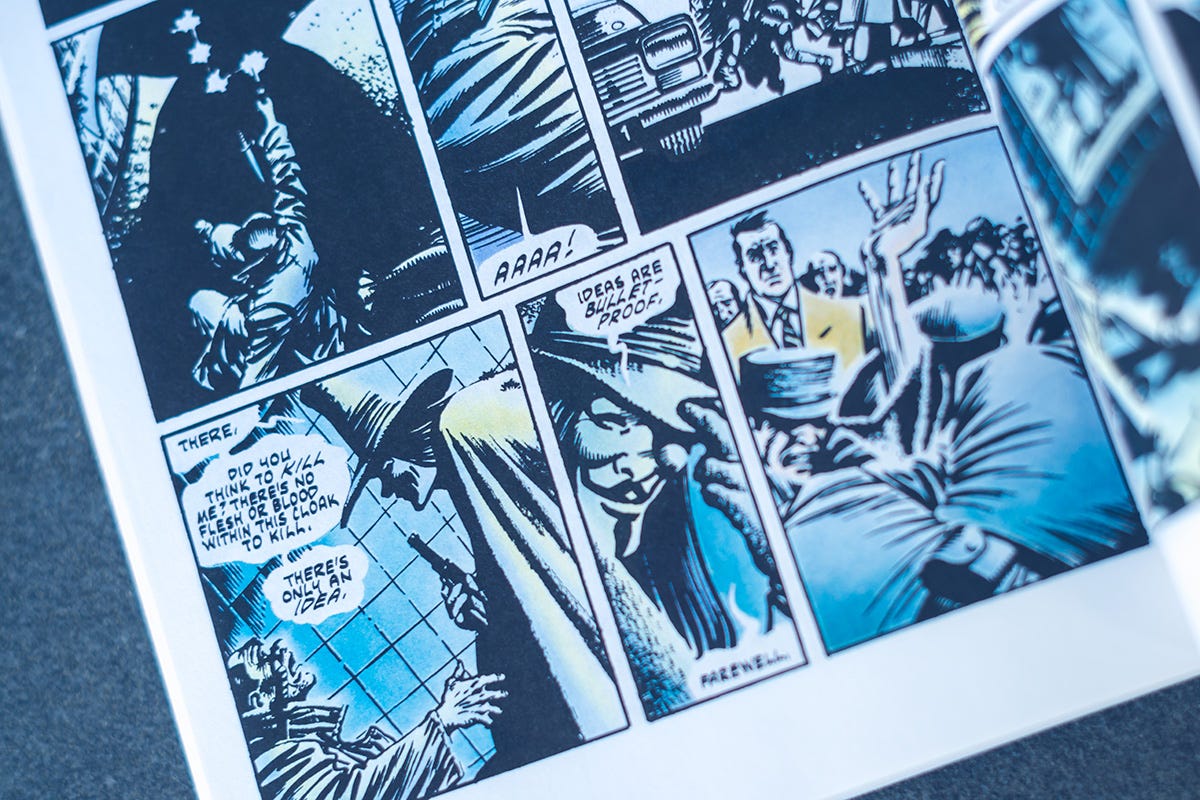
“There is no flesh or blood within this cloak to kill. Only an idea. And ideas are bulletproof.” Spoken by V, in V for Vendetta, this is one of the most iconic phrases regarding the immortality of ideas and one that has been discussed across many dystopian works. Today, we’re mixing three books to deconstruct this topic.
Let’s get these books undone.
Hello everyone, and welcome to Books Undone. I’m your host, Livia J. Elliot, and today I bring you quite a weird episode. Let me tell you how it came to be before we dive into today’s topic.
Not long ago, I hosted a group discussion on V for Vendetta by Alan Moore and David Lloyd. As we were chatting, we did quite a few crossovers with 1984 by George Orwell… and since it’s one of my favourite books I kept ruminating and mulling over some things we said. The more I thought, the more there was to discuss. Fast-forward a few days, and I found myself reading Ursula K. Le Guin’s The Dispossessed1 for a group discussion in the SciFi Masterworks Circuit Podcast—and that’s when the topic tied across the three books.
You see? These are three social sci-fi exponents that have remained timeless even though they were written quite a while ago. Likewise, they are all dystopias (or ambiguous utopia, in the case of The Dispossessed) with a heavy discussion on government, control, freedom, and ideas. We could say that, to some extent:
1984 presents the big problem of associating ideas with specific people; namely, people who become exponents or fierce defenders of those ideas.
V for Vendetta presents a way to counter-act INGSOC’s quote-on-quote ‘solution’ to this ‘problem’, and
The Dispossessed presents both a thorough example of INGSOC’s fear made (again, quoting) ‘reality’, and a way to invalidate V’s solution.
Quite a journey, right? Therefore, we will tackle the books in that exact order.
Before we can get into it, let me cover the usual disclaimers.
First, there are plenty of spoilers in this podcast for the three books: V for Vendetta (the graphic novel), Orwell’s 1984, and Le Guin’s The Dispossessed. There are also some brief non-spoiler mentions of Le Guin’s short story The Day Before the Revolution.
Second, what you will hear is my subjective opinion at the time of airing this episode; you may disagree, now or in the future, and future-me may change her mind as well!
1984 (George Orwell)
Much has been said about George Orwell’s 1984. The author—whose real name is Eric Arthur Blair—drew inspiration from his own experiences during World War II, and particularly from his time working for the BBC’s Eastern Service as a propagandist. There, he became aware of the power of propaganda, which also informed his understanding of how people can become associated with ideas and the problem they may present for a government such as the in-book INGSOC. Not surprisingly, 1984 is one of the most frequently banned books around the world.
As I mentioned, INGSOC (which stands for English Socialism) is the in-book totalitarian party that rules the fictional England of 1984. There are two key elements to understand:
The concept of thoughtcrime, a quote-on-quote ‘custom’ word introduced by the in-book fictional language of Newspeak2. Within the novel, thoughtcrime is the offence of thinking (not even acting) in ways not approved by INGSOC, even when the person in question may not be aware of their own thoughts.
To hunt these alleged ‘criminals’ the fictional government relies on the Thought Police—a special division that reports to the terrifying Ministry of Love. This Ministry tortures and murders thought-criminals, which are detected due to the extreme surveillance this fictional nation is subjected to. Remember the famous slogan: Big Brother is always watching.
Of course, as the story of 1984 unfolds, we find out that our protagonist, Winston Smith, is a thought-criminal. He is apprehended and taken to the Ministry of Love for a quote-on-quote ‘reeducation’ (namely, torture and mental conditioning) conducted by the Thought Policeman O’Brien. It is quite a harrowing and long scene, but as it goes, the reader finds out that: (a) some of these thought-criminals were actually renowned amongst the people, (b) INGSOC seldom kills them first, because (c) they rather reeducate them, although (d) they eventually vanish after being forgotten by the people.
At first glance, it sounds illogical. Why not just kill these dissidents rather than go through the expense of reeducation? Well, it turns out that the reason is the subject matter of this podcast episode, so let’s dive in.
O’Brien—the aforementioned Thought Policeman—is quite a talkative guy, and he explains his reasoning quite thoroughly while torturing Winston. He begins with a recount of history, stating that:
“In the Middle Ages there was the Inquisition. It was a failure. It set out to eradicate heresy and ended up perpetuating it. For every heretic it burned at the stake, thousands of others rose up. Why was that? Because the Inquisition killed its enemies in the open and killed them while they were still unrepentant: in fact, it killed them because they were unrepentant. Men were dying because they would not abandon their true beliefs.”
Let’s begin with a definition. According to the Merriam-Webster Dictionary, a martyr is “a person who voluntarily suffers death as the penalty of witnessing to and refusing to renounce their beliefs”3. Now, traditionally, there is a religious connotation to the meaning of the word ‘martyr’, and thus there is a bit of a discussion on whether it applies to people whose ideas are not religious in nature. In my opinion, it doesn’t matter for the purpose of this analysis of 1984, because O’Brien appears to use it in the wider sense of *any* idea worth dying for, and not necessarily one related to religion—especially because the INGSOC society was atheist.
All that said, the Dictionary definition of ‘martyr’ falls short of highlighting all the elements at play. Contrary to what it may seem, not anyone who dies for an idea is a martyr… to be one, they must have the following traits:
This person has to embody an idea to the point their name becomes a reference to the idea or concept.
To do so, they must fulfil the second point: be renowned; massively so, and enough for their name to ignite a myriad of emotions on others.
As a result we have point three: other people will have opinions for and against this person and, even if it is just broad strokes, a vast majority will know what they stand for.
Finally–and exactly as O’Brien said—this person has to be imprisoned, tortured, or killed while remaining unrepentant of their ideas.
The problem O’Brian points out, and the one fictional INGSOC was trying to quote-on-quote ‘prevent’, is that killing these types of people doesn’t actually kill the idea. Instead, such a display of violence had two (clearly unintended) consequences. First, it demonstrated how valuable and important that belief was—so much, that someone was willing to be horrendously tortured, or even give up their life (something we can never recover) just to make a point. Second, it created perennial symbols of that idea—namely, the martyr themselves!
From a bird’s-eye view, this just seems to reinforce V’s point, isn’t it? That ideas are bulletproof?
Well… not quite, and that is precisely why INGSOC’s Ministry of Love works as it works. To prevent a martyr, and thus successfully kill an idea, they first destroyed the person that embodied the idea by mentally conditioning to the point they reneged of it.
O’Brien, in his interesting verbiage, explained it very plainly:
[INGSOC does] not make mistakes of that kind. All the confessions that are uttered here are true. We make them true. And above all, we do not allow the dead to rise up against us. You must stop imagining that posterity will vindicate you, Winston. Posterity will never hear of you. You will be lifted clean out from the stream of history. We shall turn you into gas and pour you into the stratosphere. Nothing will remain of you, not a name in a register, not a memory in a living brain. You will be annihilated in the past as well as in the future. You will never have existed.
Okay, there is a lot to unpack from there, so let’s focus on that part where O’Brian explains that “all the confessions that are uttered here are true”. He is basically stating that the person-in-question (aka, the ‘potential martyr’) will contradict themselves in a way that seems honest. To avoid “the dead rising up against [INGSOC]” it is essential that they do not appear to be coerced, intimidated, or even tortured.
The Ministry of Love also “make them true” by leveraging INGSOC’s apparatus to change past documents and thus change history. This is why O’Brian threatens “Posterity will never hear from you. You will be lifted clean out from the stream of history.” In other words, he is allegorically saying that—once the torture has been completed, and once Winston has confessed—they’ll change all the records, exactly as we see at the start of the book, effectively erasing him our protagonist from history.
It is a twisted notion, and quite difficult to imagine, so let me give you an example.
Imagine someone who died by their ideas; someone who fought for them year after year, enduring hardship and misery and suffering. Ideally, you want to imagine someone you believe in. Now, picture this person coming back, seemingly lucid, unharmed, and unthreatened… and openly say they lied. Just like that, they tell you—and everyone who’ll listen—that they never believed in whatever idea they upheld before, that they were mistaken, misguided, or anything of that sort. Moreover, they may even behave contrary to the ideas they once represented. If you followed that person, if you believed in them… would such a change in mind break you? Wouldn’t you second-guess them? Second-guess the idea of beliefs they represented?
If the whole thought experiment made you incredibly uncomfortable, then you’re on the right track—that type of mixed emotions is exactly what INGSOC aimed to elicit in its own citizens! By discrediting the person (aka, the embodiment of the idea), they effectively discredited the idea!
There must be something that can be done, right? Weren’t ideas bulletproof?
V For Vendetta (Alan Moore)
To answer that question, let’ us jump to V for Vendetta, the graphic novel written by Alan Moore and David Lloyd. This work was heavily inspired by the political climate of Britain in the early 1980s, and Moore’s own political stance with regard to Margaret Thatcher’s Conservative Government, the use of nuclear weapons, and the rise of fascism. Just like 1984, this graphic novel was written as a cautionary tale, to lay ideas out in the open and leverage speculative fiction as a means to enable a discussion.
Within V for Vendetta, Norsefire is the fictional fascist government ruling England. Just like before, there is a high level of surveillance and control of the population, including curfews, disappearances, and a highly controlled news system, delivered through the TV Programme, The Voice of Fate. Norsefire is a fascist government and, several years before the plot begins, it imprisoned the people it hated, experimenting on them, and then established laws against them.
It is in this society where V, who seems to be nothing more than a vigilante, begins his plans to unleash a new idea among the population. Dangerous, isn’t it?
But let me ask you something: who is V?
The answer to this question is not straightforward, because (1) it is subtly implied that V didn’t expect to survive the events of the graphic novel, and (2) he wanted his ideas to transcend him, and so planned accordingly.
However, we can try to understand his identity through his iconic phrase: “There is no flesh and blood within this cloak to kill. Only an idea.” If we read it in a literal way, there is actual flesh and blood: V is the man wearing that outfit. However, he didn’t say it literally but allegorically; he actually implied he was not a human, but an idea in and of itself.
1984, Revisited
Let’s make a pause here, and briefly return to 1984. O’Brien’s (and thus INGSOC’s) way of destroying ideas only works if it’s attached to a person, right? They posit that if you (mentally) destroy the person embodying the idea, their followers would lose faith in them, and thus the idea will be forgotten.
V wanted to prevent this from happening and so detached himself from his beliefs of freedom—which is why he presents himself as an idea and not a person. Yet to achieve this, he created a symbol (namely, the mask and the cloak) that anyone could wear. That versatility would ensure that, no matter what happened to him—the human under the outfit—the idea would continue to exist because it wasn’t associated with someone but something.
After all, it is very difficult to destroy a symbolic object in the same way as INGSOC could destroy someone’s mind.
Yet… for ideas to take root in a population, and for symbols to be widely adopted, they both need to be massively appealing but also complex enough to endure the pass of time. It cannot be something easily refutable or forgettable, but something so intricate it’s almost alive.
V for Vendetta, Again
Therefore, let me ask again: who is V? We already agreed that our humble vaudevillian veteran is not a person but an idea… But what idea?
Let’s try to figure that out.
V as V (the Roman numeral) is the prisoner in room five; the victim captured and isolated because his personal traits were the target of Norsefire, the fascist government within this book. He was part of the group they hated, and so they brewed hate on him against those that saw him as less than human. Yet foundational as this person was—namely, the human who becomes V—we don’t know his real name, and never within the comic do we see his face. We barely see an outline of him and nothing else. Why? Because, in this case, V symbolises all the victims of Norsefire—those that were vanquished in utter silence because the rest of the society kept quiet.
V also embodies “vengeance; a vendetta, held as a votive, not in vain” in several ways.
First, his personal vendetta against the people who imprisoned him on Larkhill’s Concentration Cap, where they experimented on him with no regard neither for his life nor for his condition as a human being. This is personal, that vow that motivates V to escape the prison and begin his plan to topple Norsefire by killing the key figures of that party.
Second, V embodies a revenge against the people; the citizens that, through their actions (or lack thereof) allowed Norsefire to reach a position of power. This is somewhat hinted at during the pre-recorded speech that he broadcasts after taking over the TV Station. It is quite different to the movie; in the graphic novel he is quite overt, openly communicating his displeasure towards the people. He says:
“We’ve had our problems, too. […] Do you know what I think a lot of it stems from? […] It is your basic unwillingness to get on within the company. You don’t seem to want to face up to any real responsibility or to be your own boss. […] You see, you’ve been standing still for far too long, and it’s starting to show in your work and, I might add, in your general standard of behaviour."
That speech is highly allegorical yet plain at the same time. V is comparing, to some extent, a society’s need to get along and define a quote-on-quote ‘working culture’ that actually favours as many people as possible, to that of a society exercising its democratic right to vote… and thus electing a government like Norsefire, whose ideology literally killed thousands. In both cases, the final decision will affect everyone, including those that didn’t select it. But does that mean the ’losers’ must passively watch how others are harmed?
That answer is out of scope for this podcast, but let me exemplify the situation with a scene from the graphic novel.
To kill Bishop Lilliman, V sends a disguised Eevey to replace the little girl Lilliman had hired for the night. The scene cuts into a few panels with members of the Ear listening to the microphones in the Bishop’s private chambers. At that point, one asks, “Shall I try and get the Bishop?”; the other answers, “Oh yeah. It’s Sunday, isn’t it? ‘Children’s hour’!”… which clearly indicates they knew about the Bishop’s tendencies and did nothing to help those little girls.
V is rebelling against the passivity of those members of society whose inaction turns them into accessories of those in power as they abuse the powerless vast majority.
Third, and derived from the above, V seeks vengeance against a government that actively harmed half of its population just to manipulate many others through fear and thus remain in power.
V also symbolises a rebellion against injustice, summarised in that stylised mask of Guy Fawkes. Guy Fawkes was part of the Gunpowder Plot of 1605, a rebellion against the religious persecution he and many others were suffering during that time4. If you abstract yourself from the political nuances of England in 1605 and the in-book fictional one, what you have is two insignificant men rebelling against a political power that damaged and oppressed a lot of people while the majority just looked around without intervening.
That said, V’s ideas are also those of Valerie, the gay actress locked in the cell beside V. Valerie wrote that incredible letter on toilet paper, and slipped it into V’s cell when they couldn’t communicate with each other. She did that out of her need for her story, and thus her humanity, to be preserved in someone’s memory… and her words were foundational to V. Valerie wrote: “But it was my integrity that was important. Is that so selfish? […] It’s the very last inch of us, but within that inch we are free.”
The need to stand up for one’s values is integral to V (the person), while also being fundamental to V (the idea). V’s symbol is a call to action to stand up for one’s own values—something that we see in the graphic novel, with Eevey taking the mask-and-cloak, and in the movie with many people doing so.
V is a symbol of variability for two reasons:
First, it is an idea so variable it is contradictory—just like a person’s own thoughts are. V is both a villain and a victim, who voices a vision for what freedom and justice are by enacting a violent vengeance to vanish passivity and cast a modern verdict based on the vestiges of values long forgotten. He is nowhere yet everywhere, using people’s memory of the idea as its main vector.
Second, it is a nod to how diverse the people within a society are. Regardless of our differences, in circumstance and personality, we can all stand together if an idea strikes true for all of us. To some extent, this is presented in the comic when Eevey sees V’s corpse near the stairs and imagines herself removing the mask to unveil her father, her lover, and herself. This scene also demonstrates how V (the man) transcended his humanity to become an idea in and of itself; it is literally showing that it doesn’t matter who wears the mask-and-cloak outfit, the principles it symbolises will remain.
Overall, there are many more meanings associated with V as an idea, but the examples I presented here are enough to showcase how each of those quote-on-quote ‘components’ also evoke emotions that anyone can feel. For example, Norsefire’s victims (or relatives of the victims) will mourn what or who they lost. They may crave revenge, like the many others that were wronged by the party—just like Rose Almond was. Others may just be fed up about the injustice and thus seek to rebel, or simply have dreams and hopes like Valerie.
The problem with feelings like these (especially to O’Brien and INGSOC) is that once they become widespread and popular they are incredibly hard to dispel—those truly are bulletproof. Furthermore, a physical symbol like the mask-and-cloak is very difficult to defile, since their mere mistreatment may exacerbate the related emotions.
Therefore, it is this combination of the impersonal mask-and-cloak anyone can wear, plus the feelings anyone can feel what makes V’s idea truly bulletproof.
So, does that mean that ideas have to be then associated with physical symbols to be bulletproof? Not quite, and we can find the answer to that question in a book known as an ambiguous utopia.
The Dispossessed (Le Guin)
The Dispossessed by Ursula K. Le Guin, is a standalone novel part of her famous Hainish Cycle. It is often described as ‘an ambiguous utopia’, an ‘anarchist utopian science fiction novel’, or even ‘anthropological sci-fi’5. It is one of the few books that won all three Hugo, Locus, and Nebula Awards for Best Novel, including the John W. Campbell Memorial Award6.
The story of this novel unfolds across two fictional planets where immigration from one to another is non-existent and forbidden.
Urras is a somewhat 1970-ish inspired Earth, with a gorgeous environment rich in water, vegetation, and minerals; it is divided into nations, each with its frontiers and individual governments, each with contradictory interests.
Anarres is the other planet: a dry, dust-filled landscape with no big animals, and few types of vegetation. Vegetation imported from Urras is extremely resource-consuming, and considered luxurious. Most importantly, Anarres has no nations, frontiers, or religion, and everyone lives under the principles of Odonianism.
How this distribution of people across two planets came to be is actually the embodiment of O’Brien’s worst fears—namely, a fictional martyr whose ideas couldn’t be destroyed. Discussing this will lead us, in my personal opinion, to uncover a flaw in V’s quote-on-quote ‘solution’ to INGSOC’s method of killing ideas.
So, what is Odonianism?
Within The Dispossessed, Odonianism is the name of a martyr adapted to represent the idea believed by millions of people. The actual ideas of Odonianism can be summarised by quoting Le Guin’s own foreword to her short story The Day Before the Revolution, printed in the collection The Wind’s Twelve Quarters; Le Guin explained:
“Odonianism is anarchism. Not the bomb-in-the-pocket stuff, which is terrorism, whatever name it tries to dignify itself with; not the social-Darwinist economic “libertarianism” of the far right; but anarchism, as prefigured in early Taoist thought, and expounded by Shelley and Kropotkin, Goldman and Goodman. Anarchism’s principal target is the authoritarian State (capitalist or socialist); its principal moral-practical theme is cooperation (solidarity, mutual aid)."
In short, it is the type of idea that will terrify the governments from Urras, promptly sending them the INGSOC way. However, this podcast episode is far from being a political discussion, so what matters about Odonianism is not its ideas, but how it came to be. To understand that, let’s review the fictional history of Urras and Anarres.
It all begins with the fictional character of Laia Odo7—a political revolutionary who believed in that conglomerate of ideas Le Guin explained in the aforementioned quote: she opposed any authoritarian state (capitalist or socialist), and believed in a society based on mutual aid. Odo became worldwide famous across Urras because of her political ideas, which she divulged through her many in-book treatises, such as The Social Organism, Community, Analogy, and a few others.
When she was imprisoned, people risked their lives to get her writing out into the world where it could be published. Let me quote an excerpt from Le Guin’s short-story, The Day Before the Revolution:
“And there were those letters, which the tall guard with the watery grey’ eyes […] had smuggled out of The Fort for her for two years. The Prison Letters they called them now, there were a dozen different editions of them. All that stuff, the letters […] and the Analogy which was certainly the solidest intellectual work she had ever done, all of that had been written in the Fort in Drio, in the cell, after [her lover’s] death."
Odo actually lived 170 years before the timeline of The Dispossessed, yet as its story unfolds, we find out a few interesting bits. Odo was actually imprisoned eight times, and all because of the same reason—her ideas—and was kept in the prison mentioned in that excerpt I just read–The Fort. It became an iconic landmark after her passing and, in a desperate attempt to smother Odo’s image, the government of A-Io demolished the place.
Spoiler alert, it did not work.
Odo had become more than a person–she’d become a symbol exactly as O’Brian feared. She’d become a complex idea, just like V had; it wasn’t just her anarchism, but her interest in mutual aid, scientific development, lack of frontiers and self-sustainable societies, living alongside the environment, and many other points. The extent of Odo’s identity as an idea is not fully fledged in The Dispossessed, but it is clear that she had transcended her humanity.
Thus, when Odo died (something implied in The Day Before the Revolution), people adopted her name to create the in-book Odonian Society. It didn’t have just a handful of followers. In The Dispossessed it is implied that it rallied almost a million people, destabilising the government of Urras so much, that they literally sent them off to Anarres (namely, Urras’ Moon) to establish their anarchic community there.
It does sound like 1984 INGSOC’s worst nightmare, isn’t it? As O’Brien said, “the dead raising up against them.” In reality, although A-Io imprisoning Odo helped add to her image of a quote-on-quote ‘potential martyr’, what happened is another variant of what V did—the idea of Odonianism grew beyond Odo herself, detaching from her to become a concept so complex that it was alive on the people that believed on it.
Remember what I asked before: does that mean that ideas, have to be then associated with physical symbols to be bulletproof? Not necessarily! Odonianism was not attached to a physical symbol but to an attitude anyone could embody, and so it spread like wildfire across everyone it resonated with.
So, it truly seems that, putting INGSOC’s inhumane approach aside, ideas are bulletproof.
What if I tell you they are not? You can kill an idea in a way that is both less gory than INGSOC’s, and far more effective. This method is implied in The Dispossessed, and it is actually quite straightforward.
First, our protagonist Shevek—a physicist of sorts—thinks at some point that: “The idea is like grass. It craves light, likes crowds, thrives on crossbreeding, grows better for being stepped on.” That is actually quite correct, and we saw that method in action both in V for Vendetta (when V’s idea of rallying against the government takes place, differently in the movie than in the graphic novel), and in The Dispossessed itself with the blossoming of Odonianism.
Second, if in order to exist an idea has to scatter around people, then to kill it… you just have to ignore it. Shevek’s childhood friend, Bedap, explained that:
“You can’t crush ideas by suppressing them. You can only crush them by ignoring them. By refusing to think—refusing to change. […] Public opinion! That’s the […] unadmitted, inadmissible government that rules the Odonian society by stifling the individual mind."
What type of ideas can you kill this way? Any type!
Within The Dispossessed—and without going into too much detail—Shevek’s groundbreaking research on temporal physics was thoroughly ignored within Anarres because the current scientists refused to accept what he was proposing. They censored him, prevented him from publishing his research, and squashed him enough that he let go of it for years. They did the same with a theatre play written by another of Shevek’s friends, and with the non-traditional music composed by another one.
Now, let’s go back to the real world for a moment. Think of Piccasso and his art revolution, or music like Queen’s or Daft Punk’s. Imagine weird writing like China Mieville’s, Jorge Luis Borges’, or anyone along those lines. They all broke the common norm; they all went far away from what was being done at that moment—and now they are remembered because of it. Their unconventional art lives on because people never forget them. There was always someone (or a few, more accurately) who remembered them and spread the word about their art.
It is not only political ideas that can be killed by ignoring them. Creativity, scientific innovation, business proposals… Any type of idea can be killed, non-violently, by simply ignoring it for long enough.
Food for thought, most definitely.
Conclusion & Outro
So, that was an episode. It is the first one where I weave a few books to discuss the same topic, so let me know what you think and if you have any other ideas for episodes like this. That said, please, like it and subscribe to my podcast and channel—that is a lot of encouragement, and it helps me keep growing!
If you want to get bite-sized prose analyses, short thematic discussions, and other bookish musings delivered right into your inbox, please subscribe to my newsletter at liviajelliot.com You’ll also get a free ebook for my novella, The Genesis of Change. I’ll leave the link in the episode’s description.
Thanks for listening, and happy reading~
Copyright © 2024 Livia J. Elliot. All rights reserved. This publication is licensed for personal reading only. No article, or substantial part of an article, may be reproduced, republished, adapted, translated, compiled into another publication, incorporated into teaching materials or course packs, or used for AI training without prior written permission. Linking to the original articles is encouraged.
You can read my review of Le Guin’s The Dispossessed, my (summarised) take on the book’s ideas, and my ambivalence about her prose on my GoodReads review.
I actually did quite an extensive episode on 1984’s Newspeak–yup, an entire episode only on Newspeak and its purpose as a tool to bend a person’s perception of reality. If you are keen to listen to it, you may do so here:

The Merriam-Webster Dictionary definition of ‘martyr’: https://www.merriam-webster.com/dictionary/martyr
This podcast is by no means a lecture in English history, and so I will not cover Guy Fawkes’ history and ideas here. However, you can read a summary article in Historic Royal Palaces, and the Encyclopaedia Britannica.
Dr Alexander Howard, Senior Lecturer in English wrote an interesting article for The University of Sydney. You can read it here.
See Ursula K. Le Guin’s Award Summary in the Science Fiction Awards Database.
The fictional history of Laia Odo is visited more fully in Le Guin’s Nebula and Locus Award-Winning short story titled The Day Before The Revolution. However, I haven’t read it at the moment of writing this podcast, so to the effect of the brief summary here I’ll focus on what’s presented in The Dispossessed.


