


“If to remember is to be human, then remembering more means being more human.” This is one of the many mind-blowing truths on memory, interwoven in the plot of one of the latest cyberpunks written by the Dr of Cyberpunk himself—I’m talking about The Escher Man by award-winning author, T.R. Napper.
Let’s get this book undone.
Hello everyone, and welcome to Books Undone. I’m your host, Livia J. Elliot, and today we are discussing another cyberpunk novel—The Escher Man, by T.R. Napper. It was released in September of 2024, merely three months before this episode aired. However, Napper himself shared that he wrote The Escher Man over the course of a decade1; he explained that this is: “a first-person PoV from a man who has been subjected to memory wipes, memory edits, and wholly false memory implants. From a technical perspective this is particularly challenging and one of the reasons, I think, the novel took so long to write.”
As a result, today’s topic is the relationship between memory and identity as enabled by this cerebral book. We will first cover some relevant real-world references, begin with a small summary of the setting, and then dive into the theme.
But before we can get started, let me tackle the usual disclaimers.
First, this episode will be spoiler lite—this is mostly because, at the time of airing this episode, The Escher Man has been out only for three months. Therefore, although I will focus on some key ideas around memory and skirt around major plot events, I still recommend that you listen with caution.
Second, what you will hear is my subjective opinion. It may not be what the author intended, and you may also disagree with my interpretation; that’s okay, we all have different opinions.
Base Concepts
Let us begin with some meaningful real-world references related to the book. These will help us understand the context as we dive into the theme.
The title, The Escher Man references two things: a real-life artist, and the protagonist of the book.
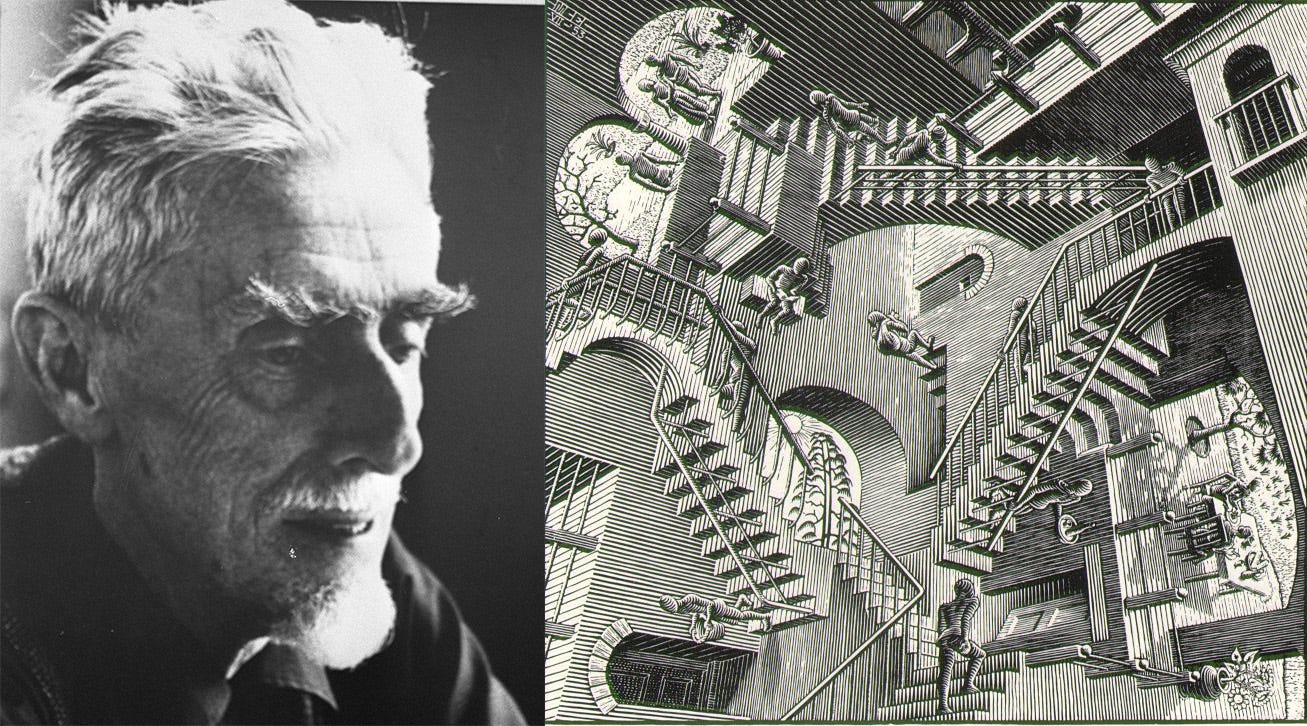
First, it references Maurits Cornelis Escher (1898-1972)2, known as M.C. Escher—a Dutch graphic artist who made woodcuts, lithographs, and mezzotints. Most of his work was inspired by mathematics, explorations of infinity, reflections, symmetry, perspective, and tessellations. It is said that regardless of the evident mathematical influence of his work, Escher was not the best at it.
In particular, this book is a reference to Escher’s famous lithograph Relativity, released in 1953; I’ll leave a picture of it on my website at liviajelliot.com; once there, you can also subscribe to my newsletter to get bookish discussions delivered fortnightly into your email.
Escher’s Relativity depicts a neighbourhood without gravity, with no distinction between floor, ceiling, and walls. It features a staircase connected in what seems to be an infinity loop, and the people within this lithograph seem to be always retracing their own steps. We will link to the book once we explore the connection between memory and identity.
Second, it references the book’s protagonist, an augmented thug called Endel ‘Endgame’ Ebbinghaus. We will dive more into his in-book story later on. For now, let us focus on his name because it references something else!
On the one hand, his nickname ’endgame’ may be a not-so-subtle reference to Endel’s thug life and the many people he’s killed. I believe there is more to it. According to the Cambridge Dictionary, ’endgame’ is defined as “the last stage of a process, especially one involving discussion”3.
As Napper himself said, Endel is “a man who has been subjected to memory wipes, memory edits, and wholly false memory implants […]” and you can imagine that someone so manipulated is: (a) an unreliable narrator, and (b) not healthy. Very early in the book, Endel is warned that the manipulation of his memories is reaching a critical state—he is at his own endgame. A memory doctor tells him: “Another year, maybe two, and you’ll be exactly who they want you to be. You’ll become as you are programmed, merely an instrument to the will of another.”
I promise we will come back to this, spoiler lite.
On the other hand, Endel’s surname Ebbinghaus is also very interesting. It is not stated in the book or the author’s notes, but I hazard a guess this references one or two people:
First, it could reference Hermann Ebbinghaus (1850-1909), a German psychologist who pioneered the experimental study of memory. Through his forgetting curve, he hypothesised that memory declines over time, losing information when there is no attempt to retain it. This is related to the strength of memory, which indicates that the stronger the memory, the longer the period that a person is able to recall it. Hermann Ebbinghaus is also known for his understanding of the spacing effect, which demonstrated that learning is more effective when study sessions are spaced out because active recall with increasing time intervals reduces the probability of forgetting information. I’ll leave a link to material about these in my blog4.
Second, Ebbinghaus could also mildly reference Julius Ebbinghaus (1885-1981), the son of Hermann Ebbinghaus and a German philosopher. He was closer to Kant in his philosophical work, often writing about the categorical imperative—a philosophical concept that evaluates the motivations for actions using reason rather than subjective feelings or customs. There are three formulations, but the formula for autonomy (oversimplifying) indicates that each individual creates their own moral parameters based on those of a society; this “self-legislation” is what makes our actions genuinely free and morally worthy5.
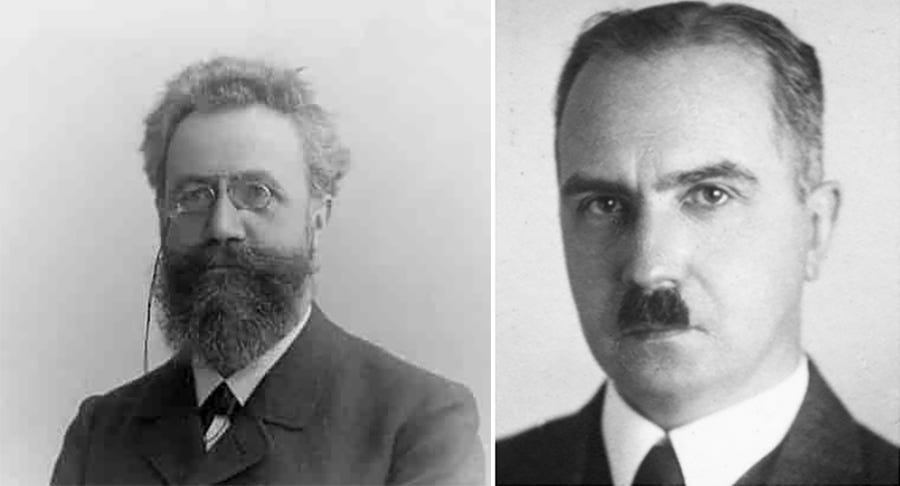
That said, I’m far more inclined to believe Endel’s surname refers to Hermann Ebbinghaus (the memory scientist); the three concepts we mentioned—the forgetting curve, the strength of memory, and the spacing effect play a fundamental role by enabling the plot of The Escher Man. However, there is, at some point, a moral debate regarding the erasure of memories and why people act… which I believe may be mildly related to the categorical imperative.
I promise we’ll get back to these concepts as we dive deeper.
Into The Escher Man
In terms of The Escher Man’s storyline, this is quite a character-driven cyberpunk thriller. Endel ‘Endgame’ Ebbinghaus is the head of security for Mister Long, headquartered in Macau, China, in 2101. In this cyberpunk setting, people have a cochlear implant behind their left ear which connects them to a wireless internet called freewave. It also sends information on-retina (like video calls, personal notes, and contextual information) to create some sort of augmented reality. Finally, it often includes a port for a memory pin. Imagine the SD cards that you can put into your phone to expand their memory, and what we have here is just a fancier version of that.
From a bird’s-eye view, that memory pin seems quite handy, right? Imagine having perfect audiovisual recall from a PoV camera for you to re-watch whenever you think of it. Anything you see or hear, you can recall through the pin; furthermore, the in-book characters can sometimes install software that cross-references those memories, offering contextual on-retina information about your own past events.
If you think that’s handy and supercool, or perhaps that you’ll never forget anything ever again… then you are likely mistaken. Can you guess the first consequence of this memory pin? The brain becomes lazy.
Just like many parts of our body, our brains are a muscle that has to be quote-on-quote ’exercised’. We all learn to recall when young, but to become more effective at doing so we must keep practising by actively recalling things. As the real-life scientist Ebbinghaus discovered, by regularly recalling information we have recently learned, we reinforce the neural connections needed to retain that bit of information in long-term memory (Brown, Roediger, & McDaniel, 2014). If we don’t try to remember something, we eventually forget it—that’s Ebbinghaus’ forgetting curve.
Now, the society in The Escher Man has become so thoroughly dependent on these memory pins that there is a massive recall issue. It is almost a quote-on-quote ‘inside joke’, because the most common response of any character to any event within the book is, “I can’t remember.” After all, any technology can be heavily misused or become addictive, regardless of whether it was created with a laudable end in sight. This is especially true for things that simplify everyday tasks. We humans are lazy, and we’ll try to outsource anything if that means we can get things done quicker, cheaper, or more easily.
As a result, there are in-book memory doctors called Omissioners. These physicians are dedicated to mending memory, both natural and implant-enabled, and before graduating, they swear some sort of Hippocratic Oath.
Early on in the book, our main character, Endel is sensibly concerned about his own memory wipes and seeks an Omissioner. Once in the clinic, Omissioner Aletheia is quite honest about the negative side effects of memory pins. She says to Endel:
This is the final nail in memory’s coffin. Memory pins ensure that the areas of the brain needed to form memories are no longer needed. Unused, they atrophy. The historical decline in memory, whatever the cause, was gradual. Decade after decade the slope of recall and attention fell ever so gently downwards. Then, the memory pins were introduced and it dropped precipitously.
In terms of real-world statistics, a bit of research told me that the average human’s attention span has declined from 12 seconds (in 2000) to 8.25 seconds (in 2023)… which turns out to be less than a goldfish’s attention span. The American Psychological Association has published a few papers that attribute this decline to the excessive use of computers and smartphones; again, I’ll leave links for this in my blog6. The problem with such a short attention span is that it gets very difficult to concentrate on fixing something in our memory; how can you try to recall something when your brain can’t concentrate?
With those current statistics in mind, fast-forward roughly seventy years (to reach the book’s future timeline), and you can see why Aletheia was complaining. The forgetting curve that real-live Ebbinghaus discovered has been exacerbated to such a degree that people cannot remember what they had for breakfast that morning unless they recall it through their memory pins. In turn, this excessive dependency has weakened the strength of memory as Ebbinghaus defined.
(Parenthesis: It is not touched in the book, but I don’t want to imagine the sheer mayhem that higher education must be in this cyberpunk dystopian setting!)
However, memory is needed for more than learning—we could say that memory is identity. Aletheia explains this to Endel, by saying:
"[Memory] is your soul. This is everything you are, your experience of the world, your fears and phobias, your friendships and failings, your mistakes and triumphs. Everyone you’ve ever loved, everything you’ve ever cared about, every fibre of your character is memory. This is the sum total of your being, everything, save the thin edge of the present."
Let me give you an example of what Aletheia means here. Try to remember someone in your life. If that person was highly supportive, a one-of-a-kind mentor, you probably learnt a lot from them—how to talk kindly to yourself, how to approach other people, how to progress your career… they probably marked you and changed your life. In turn, if that person you remembered was abusive, you likely and unwillingly learnt plenty of traumatic responses as you survived them.
In both cases, by forgetting the person (and all your interactions with them) you will lose attitudes, beliefs, emotions, and thoughts derived from having met them—and the sum of those interactions (and all their consequences) are a fundamental part of our individual identities. Likewise, we rely on those memories to keep growing—we are constantly remembering what we heard or said, how that made us feels, and thus experience new emotions just like deciding we don’t want to repeat an action or we actually want more of it.
However, we can’t quite replace our natural memory with a memory pin—and The Escher Man dives deep into this idea throughout the plot. The truth is that, compelling as that perfect audiovisual recall sounds, we humans are not made to live with static memories. Let me give you another example.
If you record a video of something, it will be just visuals and audio. It doesn’t record the emotions you felt at that moment, nor what you thought as everything happened, and it most certainly doesn’t record what you learnt. You could argue that by rewatching the video you see ‘joy’ or ‘happiness’ in someone’s face… but seeing it is very different to recalling (aka, experiencing again) that joy or happiness. Likewise, that video will not change regardless of how many times you play it.
Those two points are critical differences compared to human memory. Ommissioner Aletheia says to Endel: “Natural memory […] accretes with a new layer of meaning every time you remember something. […] every time you recall a memory, it is a new memory”.
It probably happened to you—you recalled something, let’s say a conversation with someone, and while remembering you noticed a new layer of meaning on the person’s face, or perhaps an intention in their words that you may have missed. Maybe, you had mixed feelings during that conversation, but by recalling the event you now understand that—back then—you actually felt happy but frustrated. Likewise, you may recall the scent of that person and if they were dear, you may now miss them… or remember another memory where their scent was important.
On the one hand, that’s the “new layer of meaning” Aletheia is referring to—the details we uncover when we remember something and the effects on our thoughts and emotions recalling has; basically, you remember what you felt when you smelled the person (in the original memory), but you also remember how recalling that feeling made you feel now.
On the other hand, now you have a new memory of you remembering the past memory.
This interweaving of memories literally changes how we see past events and how we experience the current world… and it’s not something that a computer’s memory can duplicate.
In the book, Endel often resorts to asking his cochlear implant to show him a video of something that happened because he can’t naturally remember—and that fake recall distresses him deeply. In the case of real memories, noticing that he doesn’t remember is a source of distress (namely, what happens to patients with Alzheimer’s); in the case of fake memories, he feels nothing because, as Aletheia says, “Artificial memories only have an aural and visual component. There is no emotion attached to them because they never happened. You feel empty, detached, alienated.”
Imagine feeling like that about everything you remember. Either you can’t recall when it happened, or you can’t be sure it happened at all. Furthermore, when you remember that conversation with a significant other, you cannot remember their scent, how their voice made you feel, or how dear their touch was to you. It would be awful, right? A one-way ticket to Despair Lane.
That is what our protagonist, Endel Ebbinghaus, is suffering throughout the plot of this book.
Which begs the question… how did Endel get there? There are plenty of answers, but I’ll go with the less spoilery one, and link it back to the relationship of memory and identity.
We already established that Endel is a thug. The opening line of the book says: “People would try to do one of three things when I was about to kill them: bribe me, beg me, or pretend they didn’t know me”. It’s a memorable opening, but it makes it very clear that Endel is about to be someone’s endgame.
Fast-forward a few pages, and we read about Endel watching the news… but not any news. He’s watching the coverage related to the assassination of his own victim—and he can’t remember it! Endel thinks:
“I felt this gnawing sense of déjà vu as I looked at the picture of the man. […] I shook my head. I got these bouts of déjà vu all the time. I’d meet someone whose face was strikingly familiar, but when I’d nod and say hi they’d introduce themselves with some name I’d never heard before."
In this futuristic world where people have a literal PoV camera recording their every action, it is sensible to assume such recordings could be used for legal purposes. For example, police officers or justices watching a person’s last moment or perhaps a suspect’s recordings to corroborate their alibis. Both are complicated situations for a thug like Endel who could have PoV recordings of every crime he’s committed.
Not fun if he is ever caught. Neither for him nor his boss, Mister Long, who happens to be the boss of an in-book cartel.
So, how did Endel get here? We can fashion a straightforward answer: he’s been wiped to cover all incriminating memories of his crimes.
If we circle back to memory being one’s soul, having emotions that expand and grow as we recall, and all that intertwining of memory we just discussed… it begs a few new questions: what happens to his guilt? How does this affect Endel’s ethics and identity because, after all, we each have an individual framework of morality upon which we act—and this is the categorical imperative that real-life Julius Ebbinghaus often wrote about; the Kantian idea of “self-legislation” I mentioned earlier on.
Our society is built upon laws, both explicit—like the justice system and the legislation that forbids killing someone—and implicit, like social norms, religion, or other moral systems that penalise taking someone’s life. The intertwining of these two systems creates a moral quote-on-quote ‘frame’ upon which we live. It is not subjective but based on reason; for example: clear penalties for disobeying the law, social penalties for not following social norms, and negative emotions for not acting according to our own principles.
One way or another, we feel strongly about these moral parameters, and we feel even more when we act against them… even when it is something very small like eavesdropping into someone’s private conversation. Now, let’s try to think of a grey area. Consider veterans who survived wars, or people who killed in self-defence, and try to gauge the trauma they live with. Nightmares, panic attacks, emotional triggers, automatic traumatic responses—it is a lot; those consequences are hefty. Such is the effect that our laws, both explicit and implicit, have on someone’s psyche.
In that case, does it mean that by erasing the problematic memory you erase the feelings as well? In the context of The Escher Man himself, Endel Ebbinghaus… what is the effect on his thoughts, emotions, and morals if he forgets his crimes? What is the effect on his identity?
The answer is not straightforward because memory and identity are not straightforward—and this book does an incredible job of considering all possible answers. Let me show you some excerpts from the book to enable this discussion.
Endel’s fellow thug, Chrome Linh Phu argues that: “[…] without memory there is no morality, no constraints, nothing but the perfection of the moment.” Later on, another thug asks Endel: “Why would you even want to remember what you did?” Another Omissioner says to Endel that: “Memory is pain. Memory is weakness. Memory is the chain that bind us.”
So, if we follow this line, the answer to my question is that—yes, they seem to live free of the guilt and trauma caused by what they did. These in-book thugs likely fathom that they committed awful crimes, but seem not to care. To some extent, we could argue that’s related to the self-legislation we mentioned before—they may have had a “the means justify the end” mindset to begin with, likely paired with a disregard for human life.
But not everyone is like that, and The Escher Man also presents the other side of the argument. When Endel realises the extent of his memory wipes, he thinks:
“Fear was spreading in my chest. Fear at the depths of my illusions, about what I’d done, who I had killed, who I really was. Maybe I’d murdered no one. Maybe a hundred innocents had died by my hand."
That doesn’t sound like quote-on-quote ’no morality’ to me. It actually sounds a lot like guilt exacerbated by the awareness that Endel just realised he cannot trust himself (aka, he is an incredibly unreliable narrator).
Another Omissioner explains to Endel that, “Memory is pain. […] Memory is the chain that bind us.” Memory is fundamental to our categorical imperatives—it stores our logic to act one way or another, while also storing the emotions. Although emotionally-driving decisions are not part of the rational categorical imperatives, they still drive a person’s behaviour. The combination of these two forms an individual’s reasons, effectively affecting how they see the world, how they judge their own (or others’) actions, why they make specific decisions, and so on. That is a huge part of someone’s identity.
So, let’s return to my question: does it mean that by erasing the problematic memory you erase the feelings as well?
On the one hand, The Escher Man may be trying to point out that while Endel’s memory wipe could have deleted the memories of him accepting a logic or feeling in some way… it couldn’t erase those strong feelings, and neither how he acquired themt. Part of his identity was so thoroughly rooted it couldn’t be deleted at all .
On the other hand, if Endel is at his own ‘memory endgame’… what would happen to his identity if his memory keeps being wiped out? If we forget something that used to be a reason to act for us (rational or not) we may start behaving in a different way, believing different things… and our identity will change.
Going back to the beginning of the discussion, this is what Aletheia meant when she said to Endel that; “[Memory] is the sum total of your being, everything, save the thin edge of the present.”
When Endel finally understands this link between memory, motivation, and identity, he says to a fellow thug that: “The line of your ambition that runs through this, it ain’t an accident. This motivation of yours can’t exist without a past, without some history driving it down this bloody road. A history that you damn well remember.”
Without memory we lose our reasons, our feelings and emotions dictating how and why we act. Without that, we lose part of our identity. We, literally, lose our selves. As the opening line of the podcast said, “If to remember is to be human, then remembering more means being more human.”
Allow me make one last point. Do you know why Endel is the literal Escher Man? Let me give you two reasons:
One, because Endel is literally walking the endlessly looping staircase pictured in the lithograph Relativity. He wakes up, acts, gets his memory erased, and the loop repeats. As Aletheia had explained, the more of his memories are replaced, the fewer feelings he recalls, and the emptier his life becomes. That’s the gist of our intertwining memories. They enable us to grow, to go forwards, to become more; staying static, doing the same over and over without understanding our reasons to act is that one-way ticket to Despair Lane I mentioned before. We are not meant for that, we are meant to analyse our past, to revisit it with all the pain it may imply and then move forwards.
Second, because we can see the looping staircases as his twisted, heavily-altered memory. Many paths lead to nowhere, the memories don’t connect or blend into each other, and time seems to stretch to infinity. He’s caught in a trap, while others watch him remain trapped.
Conclusion & Outro
All that said, I loved this episode as much as I loved the book. However, there are so many more themes within The Escher Man that I could not fit within this episode. For example:
There is also more to this idea of strong, deeply-rooted emotions that become core parts of our being, but I didn’t touch on them to avoid major spoilers.
There is a large discussion on how the memory pin technology could be manipulated to foster consumerism, alter geopolitics, and even control populations.
Because of the above, there is also a discussion on the relationship between collective memory and history and how what a society remembers changes reality.
Likewise, there is also a lot of commentary on our epidemic over-reliance on technology, and what the introduction of a memory pin could mean for human (de)evolution.
If you like the theme of memory, you may be interested in listening to some of my closely related prior episodes. For example:
Episode 9, was a discussion on collective memory as presented in Shadow of the Torturer and Claw of the Conciliator by multi-award-winning author, Gene Wolfe.
In Author Spotlight 6, I spoke to T.R. Napper about his novella Ghost of the Neon God—part of the same universe as The Escher Man, but set about 20 years before. This episode contains spoilers for the novella and some interesting comments about today’s book.
Episode 7 discusses an adjacent topic—human connections, as presented in the novelisations of Death Stranding. It’s a dystopian future, and you may find it interesting.
Finally, you may be keen on reading The Affirmation by Christopher Priest. Curiously, this book also discusses the intertwining of memories and has often been described as Escher’s lithograph, Drawing Hands.


Now it is finally time to wrap up, so if you liked this episode please subscribe to the podcast–and if you’re in BookTube, like the video! That actually helps me a lot, and encourages me to keep sharing book stuff with you. Likewise, you may be keen on subscribing to my newsletter at liviajelliot.com to get fortnightly bookish discussions and deep-dives delivered straight into your inbox… by doing so, you’ll also get the free ebook of my own novella, The Genesis of Change.
Thanks for listening, and happy reading~
Copyright © 2024 Livia J. Elliot. All rights reserved. This publication is licensed for personal reading only. No article, or substantial part of an article, may be reproduced, republished, adapted, translated, compiled into another publication, incorporated into teaching materials or course packs, or used for AI training without prior written permission. Linking to the original articles is encouraged.
You can read about the odyssey of writing The Escher Man on T.R. Napper’s own blog: http://nappertime.com/three-ways-to-write-a-novel-the-odyssey-the-fever-dream-and-the-fix-up/ There is also a mention to another book of his, Ghost of the Neon God, which I also featured in Books Undone.
You can read more about Escher on his own website, supported by the Escher Foundation: https://mcescher.com/about/biography/
The Cambridge Dictionary definition for ’endgame’: https://dictionary.cambridge.org/dictionary/english/endgame
For some quick reads on Hermann Ebbinghaus’ pioneering work on memory, you can check “How Memory Works”, published in the Derek Bok Center for Teaching and Learning. You can also check Vlack & Sandhofer (2012) paper, titled “Distributing Learning Over Time” to read about the spacing effect. Something quite interesting they said, is that “spaced learning promotes generalization by supporting the abstraction of relevant and irrelevant features” by providing “time in between learning presentations for learners to forget irrelevant information.”
A great read on Kant’s Categorical Imperative is Kant’s Moral Philosophy, published in Standford Encyclopedia of Philosophy.
“Speaking of Psychology”, by the American Psychological Association, published a very interesting episode titled “Why our attention spans are shrinking, with Gloria Mark, PhD. You may be interested in listening to it. It’s far more digestible than any paper.


