


“All my falsehoods were recoiling on me, and I, who remembered everything, could not be certain those memories were more than my own dreams.” Memory and truth are two powerful concepts implicitly discussed in two books that redefined the science-fantasy genre. I’m talking of Shadow of the Torturer and Claw of the Conciliator, by Gene Wolfe.
Let get these books undone.
Hello everyone, and welcome to Books Undone. I’m your host, Livia J. Elliot, and today we are discussing Shadow of the Torturer and Claw of the Conciliator. These are the first two books of the sci-fantasy quartet The Book of the New Sun, written by Gene Wolfe.
The Book of the New Sun
The Book of the New Sun was published between 1980-1983, at a pace of one book per year; this was actually a duology, but Gene Wolfe (the author) was requested to split it up into four volumes. Later on, TorBooks recompiled the series into two tomes, Shadow & Claw and Sword & Citadel as Wolfe had originally intended; this series is also part of Gollancz’s Sci-Fi Masterworks collections. In 1987, Wolfe published a fifth and last book, titled The Urth of the New Sun… but not many people recommend it. Additionally, there are also two follow-up series in the same universe, titled The Book of the Long Sun, and The Book of the Short Sun.
Across the four books, the series won several Best Novel of the Year in the following awards: British Science Fiction and British Fantasy, World Fantasy, Locus Fantasy (twice), Nebula Science Fiction, Campbell Memorial (Science Fiction), and Science Fiction Chronicle. It was also nominated and shortlisted twice for the Hugo Award, alongside many other recognitions.
For those who don’t know him, Gene Rodman Wolfe (1931-2019) was an American science fiction and writer, and early in his career, he exchanged correspondence with J.R.R. Tolkien; you can read the letter on Tolkien Gateway. In 1996, Wolfe was awarded the World Fantasy Award for Life Achievement, and inducted into the Science Fiction Hall of Fame in 2007. The SFWA named him Grand Master in December 2012, and in 2013 the Nebula Awards recognised him with the annual Damon Knight Memorial Grand Master Award.
That said, and before we move forward, let me make some disclaimers.
First, there are spoilers in this episode, but you can probably follow it without having read the book. The reason for this is that the themes of Shadow & Claw are somewhat more implicit and thus more imbued in the story. Therefore, in this episode you will hear more of my thoughts and less about quotes and extracts from the books.
Second, this discussion only pertains to Shadow & Claw, the first two books on the quartet. I have not yet read the last two books (namely, Sword & Citadel), which means that: (a) I will not touch or hint at the last two books, and (b) I may posit ideas that are later expanded in the second half of the series. I do hope to do a second episode on this series in the future… but there isn’t a date for it yet.
Setting Introduction
To help listeners understand the theme we will discuss, let me do a brief summary of the story during the first two books.
The first important bit, is the setting. Everything happens in the world of Urth, an earth-like planet with a dying sun… which, in actuality, is a far-future Earth. This world is ruled by the Autarch, there is a caste of strangely tall nobles called exultants, and a vast number of decaying structures that people of Urth don’t know how they were built.
Through the books we follow Severian, a young man who was raised in the Guild of the Torturers, located inside a Citadel with many other Guilds. All Torturers wear a darker-than-black fabric of the colour ‘fuligin’, and the mere sight of it inspires terror among the common folk. Severian grows to become a journeyman—a fully-fledged member of his guild—and because he saves a prisoner noblewoman, Thecla, he is sent to the city of Thrax. Before he departs, a Master Torturer gives Severian his executioner’s broadsword, named Terminus Est; the name is a latin phrase roughly translated as “it is the end”.
Interestingly, by the end of the second book, Claw of the Conciliator, Severian is still nowhere near Thrax. However, in his path across two books, he meets with a ragtag group of actors (The Doctor, Baldanders, and Jolenta), a woman who has lost her memory (Dorcas), a curious traveller named Jonas, and many others… including an exultant named Vodalus, who seems to be the cause of most of Severian’s problems.
The plot of the books is intricate and involves many digressions and side-quests, stories-within-stories, and even extracts from the playscripts Severian played alongside the actors—yet here comes the second important bit. These books are written like a memoir; they are an epistolary narrative written by Severian, where Wolfe (the author) self-positioned himself as a translator of the former’s text. While Severian’s narration is clear from the start, Wolfe positions is only clear if you read the appendixes.
Into The Themes
As I see it, a first key theme within Shadow & Claw is memory and how it is affected by the pass of time. There are two sub-topics:
First, the individual memory, which is what we see through Severian as he writes this memoir. In this case, his struggles with memory and the pass of time (we’ll get there, I promise) make him a memorable unreliable narrator. A matryoshka of secrets, as Ada Palmer suggested in her foreword.
Second, the memory of a society, which is implied and subtly treated in these first two books. There is no overt discussion on this in the books, so this part of the discussion will be mostly covered by my own interpretation.
Beyond these, there is also a second key theme—and that’s the nature of truth. Considering that these books are presented as a fictional memoir (a framed narrative, if you will) what is truth and what is perception is continuously subjected to debate.
Let me begin by discussing memory—collective, then individual—and then we’ll touch on the nature of truth.
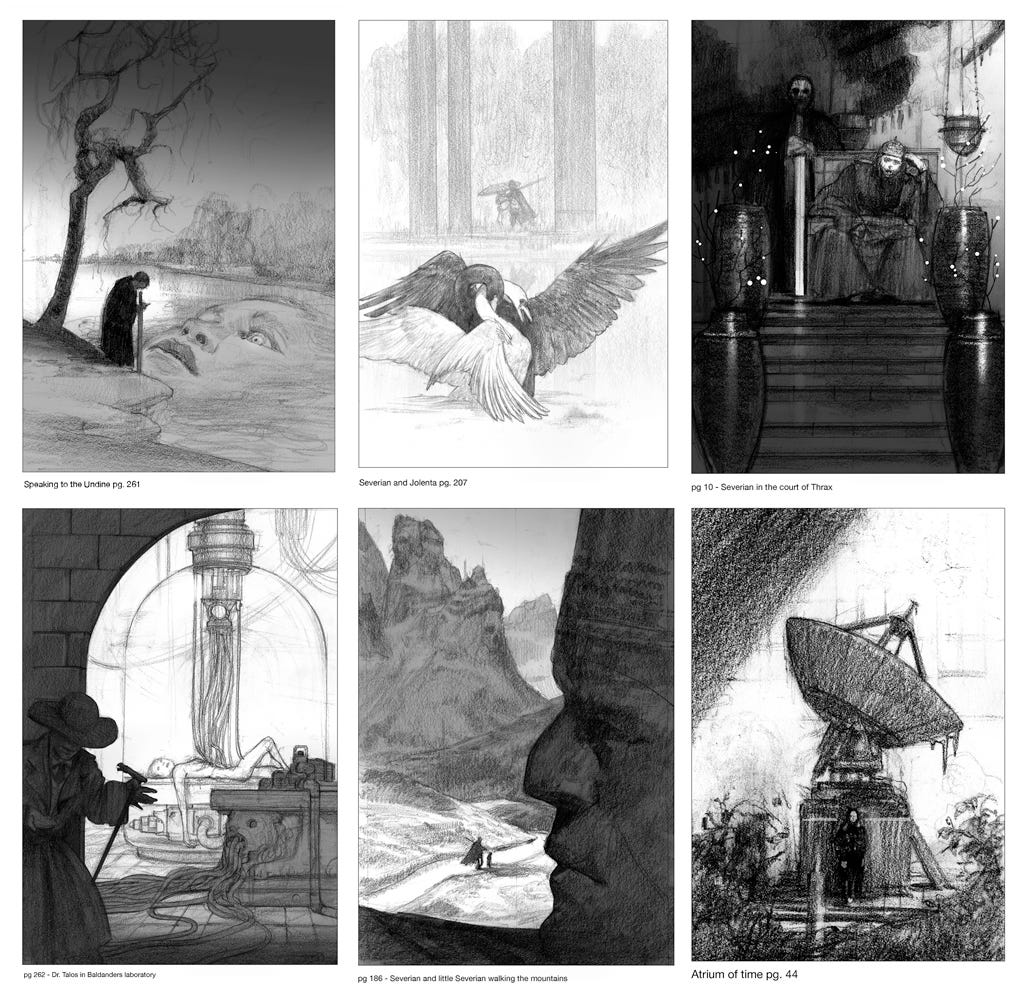
Within psychology, there is something referred to as collective memory—a topic of interest to several disciplines, including psychology, sociology, history, philosophy, and anthropology.
Psychologists Roediger and Abel (2015)1, defined collective memory as “a form of memory that is shared by a group, and of central importance to the social identity of the group’s members”. They also clarified that “[c]ollective memory seems to be shaped by schematic narrative templates, or knowledge structures that serve to narrate the story of a people, often emphasising heroic and even mythic elements while minimising negative or inconsistent ones”.
Overall, collective memory is extremely important for history, especially the farther behind we go in time—which is a relevant point regarding Shadow & Claw’s setting. In these books (as well as the entirety of the The Book of the New Sun), the planet Urth is Earth—even if the detail is obscured, unknown to the protagonist, and left for the reader to infer. Two key elements, explained very early at the start of the first book, allow such inference. Namely:
One, that the moon is too close to the planet, and historians remember a time when this was not the case.
Two, that the sun is dying, and it appears red and quite close to the planet.
Truth to be told, stars die very slowly, and we can use that subtle, almost imperceptible detail to guess that the story of Shadow & Claw happens in the far-future; aeons from now, most likely. In other words, our present (in 2024 or around) is the story’s distant past. However, there are so many clues masterfully sowed as part of the world-building that indicate the complexity of a world (and a society!) that have gone through so much.
So, why is Urth’s history and mysteries important when considering collective memory? The answer is simple, but two-fold. One the one hand, it’s relevant because history becomes part of a societies’ collective memory, and its collective unconscious knowledge. On the other hand, because the farther you go into the past, the more difficult it becomes to piece together what really happened back then. History becomes unclear, context is missing, and (as it has often happened), entire cultures may have been removed without leaving traces for the new ones to find them.
These problems thus clutter the interpretation of past times, forcing a society’s collective memory to rely on myths.
Think of our knowledge of ancient times; I’m not talking about Wolfe’s Urth, but of the real world. Think of Ancient Greece or Egypt, China before the Yellow Emperor, and other ancient civilisations… what we think we know about them is a compendium of educated guesses based on the many ruins of ancient civilisations, partial records of history, mummies, and other mementos that continue to be unearthed. Regardless of their scientific method, historians, archeologists, and anthropologists infer based on our current knowledge, on the results of prior research, and by crossing records—but there are many gaps and few-to-no certainties.
This uncertainty related to the interpretation of historical clues is one of the reasons of why we have published, peer-reviewed academic papers offering contradictory interpretations of past history. There have been cases of ancient things (ruins, records, and more) that were completely misunderstood until, decades after, a researcher revisited that knowledge and, based on new evidence, found the collective knowledge to be wrong.
Shadow & Claw are built upon that exact premise—that ancient history can be wildly misinterpreted due to the erasure of records, and thus misinterpretation, of a society’s own past… which then builds into myths that form the collective unconscious. Gene Wolfe superbly presents the reader with clues of current times that Severian (and other Urth dwellers) woefully misinterpret.
This leads to an intended quote-on-quote “contradiction” that the reader has to endure throughout the books. Namely, that both the reader, and the in-book people of Urth have opposing ideas about what our current time is, what knowledge we had, and why we do things; note that when I say “current times” I’m referring to 1980 (when the first book was written) or 2024 (the year this episode aired).
Let’s delve into the source material, and illustrate this idea with examples from the books.
In Chapter 5 of Shadow of the Torturer (the first book) Severian was a young apprentice sent around the Citadel as a messenger for the Guild of Torturers. In one of his errands, he arrives to a place filled with dusty, darkened paintings where he encounters a very curious one. Let me read the extract:
“The picture showed an armoured figure standing in a desolate landscape. It had no weapon, but held a staff bearing a strange, stiff banner. The visor of this figure’s helmet was entirely of gold, without eye slits or ventilation; in its polished surface the deathly desert could be seen in reflection, and nothing more. This warrior of a dead world affected me deeply, though I could not say why or even just what emotion it was I felt."
I must confess that the first time I read the book I just went by without noticing anything strange. The second time, though, three clues popped up—the painting portrays a desolate landscape, the man’s helmet has a gold visor, and he’s holding a stiff banner. To me, it resembles Neil Armstrong, standing on the moon’s surface in 1969; given that Shadow of the Torturer was written in 1980, that event was still a fresh memory for every potential reader, and it seems sensible for Wolfe to leverage such history-changing event to hint that Urth is actually a futuristic, dying Earth.
However, to Severian, an inhabitant of that far-future world, that painting is just a weird depiction from his world’s half-forgotten deep past. They know very little of what happened ages ago, instead relying on these unconnected mementos that survived the pass of time.
Let’s look at another wild example, another clue that Wolfe throws at his readers. This fragment happens nearly the end of Claw of the Conciliator (the second book) but it’s another flashback to when Severian was an apprentice.
The Guild of the Torturers is headquartered within the Citadel, a fortress-like city also housing other guilds. Among those are the Witches. Severian recalls, “When I was an apprentice […] I was given a letter to take to the Witches’ tower. […] I must have been very small indeed: I had to jump to reach the knocker.” We already know that people from Urth know nothing of our time (namely, their past), but from this preface, we are also warned that Severian was a toddler—and we can all agree that a toddler’s memories are highly inaccurate.
Once toddler-Severian is inside that odd place, his description also raises an eyebrow. He writes:
“Nothing seemed solid in the Witches’ tower. […] Much later, Master Palaemon explained to me that it […] had been built when the design of towers was still little more than the imitation in inanimate materials of human physiology, so that skeletons of steel were used to support a fabric of flimsier substances. With the passing of the centuries, that skeleton had largely corroded away."
Given that we already spotted a painting of Neil Armstrong (and a barrage of other clues throughout two books), it is easy to assume that the Witches’ Keep—that tower Severian just described—is likely a skyscraper, a high-riser building with a skeleton of steel, and lots of windows (aka, the “flimsier substance”).
While that’s my interpretation of the text’s clues as a reader in the year 2024, I also face the contradicting view of it that Urth’s people have. In particular, Master Palaemon revealed this strange explanation of structures that mimicked bodies by using skeletons of steel… and we all know that such belief is incredibly misguided; there are many reasons why high-risers are built in that way, and “mimicking a human body” is none of those. Yet this statement confirms two of the notions I presented before:
On the one hand, people from Urth believe themselves to be in a more advanced time, looking down upon past inhabitants—even when they continue to use the surviving structures and pieces of tech.
On the other hand, we have an incredible example of how myth blends into collective memory, to create an interpretation of the past that is sensible to those living in Urth, but… utter nonsense to those of us living in current times. And you know what? That type of assumption is exactly what historians and archeologists do. They interpret the clues of history based on: (a) everything found so far, (b) current theories of past facts, and (c) the present-time biases.
I am not dissing historians here; I love history… but it can be an inaccurate discipline. A society’s past is a puzzle to be solved, and one we neither have all the pieces needed to solve it, nor are close to procuring them.
That comparison is exactly what Ada Palmer writes about in the foreword to Shadow and Claw; this is printed in the edition of Tor Essentials. Palmer writes that:
“We trust. We ponder. We wade through the clutter of clashing technologies, tales of degeneration, of glory lost, but there’s no fall-of-space-Rome story to connect it up. […] So we spread our disconnected puzzle pieces out, […] looking not for direct connections but for fragments of arcs and colours, until our 100 puzzle pieces let us glimpse an image so vast it would take 100,000."
As I see it, in that foreword, Ada Palmer was referencing Wolfe’s implicit discussion on collective memory. Basically, we get these breadcrumbs of clues, like Armstrong’s painting or the skyscraper… yet at the same time, we are missing so much. How did those items survive the pass of time when so much was lost? When were they repurposed? What happened to past humanity? How was the knowledge lost? When did the scientific knowledge became myth?
Myth. That point we mentioned before, that little explanation Master Palaemon gave to a young Severian. Myth and collective memory are intrinsically related.
Let me cite another paper; this was published in 2018 by Irina Ponizovkina and Elena Agibalova2; I’ll leave links in the description. These two researchers explained that: “On the one hand, mythology helps society create its spiritual bonds and preserve valuable historical experience. On the other hand, the myth is actively involved in the management of values through the artificial construction of images of the past.”
Note what they said: “the artificial construction of images of the past”. When we rely on myth to explain the past, we may not be closer to reality—nor aim to be close either. In those cases, we are most likely just trying to make sense of what we see or experience, by pulling from the knowledge and language that we have at that time… which may be considerably limited. This is comparable to how a child may describe an event as quote-on-quote “magical”, when an adult has a perfectly sensible explanation for it.
Therefore, this creation of myths around forgotten knowledge is just how collective memory works—whatever we forget (or simply don’t know due to the lack of puzzle pieces), we complete with myths and theories that tie up the few clues that we currently have, while making up the rest… just like conspiracy theories do. The more time that passes, the more those myths spread, the more they become accepted as unchallengeable (yet proof-less) truths that are part of a society’s accepted knowledge.
Nevertheless, these puzzle pieces, scattered throughout Shadow and Claw also build up the reader’s view of Urth… and that’s were Master Palaemon’s perspective comes into question. On the one hand, he considered the skyscraper’s builders as “inferior”, something we can deduct by his choice of words; he said, “when the design of towers was still little more than”. Sassy, right? On the other hand, as modern-day readers, we may think Urth as medieval-like and quote-on-quote “less advanced” than we, simply because they forgot knowledge we currently take for granted.
In my opinion, this is a key point with regards to collective memory and bias (and its effects on truth)—and Wolfe guides us into it unashamedly. Let’s review another example to see how Wolfe set the stage for us, readers.
During Shadow of the Torturer, there is a scene in which Severian recalls the torture devices his Guild uses and, as you may expect, these are also remnants of another time; current times at that. In particular, Severian is walking alongside Master Torturer Gurloes and prisoner Thecla, when she looks at a device, asking, “What is that behind it? That tangle of wire, and the great glass globe over the table?” What a curious description, isn’t it? In any case, once Thecla is secured to the device, Severian explains that:
“There were cables to be wound from one part of the examination room to another, rheostats and magnetic amplifiers to be adjusted. Antique lights like blood-red eyes gleamed on the control panel, and a droning […] filled the entire chamber. For a few moments, the ancient engine of the tower lived again. One cable was loose, and sparks as blue as burning brandy played about its bronze fittings."
Let’s pause and recount the oddities. We have cables, a control panel with led-lights, and a charge building on the tower’s own electrical generators. The curious bit (the myth!) comes just after this. Master Gurloes kicks that loose cable and says: “Lightning. There’s another word for it, but I forget.”
In here, we can see how the knowledge of electricity was completely lost, and the myth of lightning channel through the cables took over3.
From here, the dreaded picture takes form—Thecla is likely strapped to something akin to an electric chair, yet what happens to her is not the point of this podcast episode. My point is the blatant inconsistency that Wolfe prepared for us, readers. As we stated before, we know that people from Urth believe that their past (namely, our current times) were not as advanced and likely medieval-like… while we (in 2024) read this book about a society that doesn’t know how to use electricity, and consider them to be medieval-like.
But… who’s correct? Us, living here and now? Or Urth’s inhabitants, who lost most of the puzzle pieces? Perhaps, we are both correct, since we’re guessing based on what we know. Bias has an important effect on memory and truth.
From there, we can hop to that second key theme that Wolfe enmeshed in the framework of collective memory. Namely, the nature of truth and the perception of history.
In my subjective opinion, the point Wolfe attempted to make is that even history is heavily distorted by time, error, and deceit—there is nothing as an unmarred, impersonal, unquestionable truth. It just doesn’t exist. Yet, at the same time, what was true never stops being true, although not all the pieces supporting such truth may be revealed or encountered… effectively leading societies to create myths to explain what we cannot explain. Jonas talks about this with Severian in Claw of the Conciliator, by saying: “They don’t know what some of the words mean any longer, but they cling to the stories because those are all they have.”
After all, the loss of knowledge due to war, political decay, and technological decay have been a constant through our real-world history. How many times has humanity lost knowledge? Think of the burning of Alexandria’s Library, of the records written in languages we can no longer translate, of the wars in which the victors burned all traces of the defeated ones.
Overall, human history is an incomplete puzzle for which we will never find all the pieces—and thus, our collective memory will remain faulty, biased, and distorted. However, these myths that build into the collective memory eventually become an implicit part of our identity. Old-Severian reflects on this early on, writing:
“We believe that we invent symbols. The truth is that they invent us; […] I did not know it back then, but it is a profound mistake to believe that we must know of such things to be influenced by them."
As I see it, what old-Severian was reflecting back then is the fact that collective memory becomes innately ingrained into someone’s world-view, to the point it may be very difficult to distinguish them without external help. Yet at the same time… those myths, those collective beliefs shape us. They are part of us, and thus they tint the world as we see it and experience it just like a coloured glass would do if placed before our eyes.
Another woman Severian meets in Shadow of the Torturer (there are many women crossing his path), reflects on this difficulty. She says to Severian, “Weak people believe what is forced on them. Strong people what they wish to believe, forcing that to be real.”
What I take from this is that challenging collective memory requires both an individual effort, but also the effort of a society… and in modern times, we could very well relate this idea to the fake-news and fact-checkers that populate the internet. Yet at the end, as Severian answered to this woman, “we all seek to discover what is real” even when doing so may be outright impossible.
What I mentioned here are just some of the clues that Wolfe prepared for us, but there are many others. For example, Severian’s sword, Terminus Est, seems to have a channel in its core filled with liquid hydrargyrum… which is another name for mercury; there is a great article about physics in The Book of the New Sun4 that’s definitely worth reading. Likewise, there is a character (Jonas) who seems to be either an android or an augmented human, and references to genetically-manipulated humans, mostly presented in Claw of the Conciliator.
Yet once we looked at society as a whole, thus establishing the base for that shared knowledge all members of such society have, we can finally take a look at the individual.
Very early at the start of Shadow of the Torturer (the first book), Severian confesses: “It is my nature, my joy and my curse, to forget nothing”, yet quite soon he proceeds to forget, omit, and tone down content in his memoir.
Sarcasm aside, a compelling nuance in The Book of the New Sun is that Severian not only remembers what has happened, but also how he used to remember what had happened, and so contrasts how he used to remember things and how he remembers them now. What a mouthful. In short, what I mean is that Severian’s memoir has a reflective quality to it—he is constantly comparing a past version of himself with the current, old-Severian who has lived so much.
For example, this is old-Severian reflecting on the attitudes of apprentice-Severian: “I had been a man (if I was truly a man) such a short time; I could not endure to think that I had become a man so different from the boy I had been.”
Very early on the story, we are introduced to the effect of time on Severian’s memory; he is capable of distinguishing his past impressions from his current reflections. For example, the next fragment is actually the end of Chapter 1 of Shadow of the Torturer; old-Severian ponders the following:
“Thus I knew nothing […] of the dogmas of the movement Vodalus led, but I soon learned them all, for they were in the air. With him I hated the Autarchy, although I had no notion of what might replace it. With him I despised the exultants who failed to rise against the Autarch. […] With him I detested the people for their lack of discipline and a common purpose. […] It was in this fashion that I began the long journey by which I have backed into the throne."
There are several key points to take from that chapter:
First, old-Severian is not afraid of dropping spoiler-bombs, because by the end of the first chapter of the first book… we know that he (somehow!) ends up becoming the Autarch.
Second, notice how he hints at the collective knowledge, when saying “I soon learned them all, for they were in the air”. To me, this is a metaphor to the gossips and sayings that exist in each society, thus forming the myths of past and present times. Likewise, this is also hinting that apprentice-Severian only knew the myths and not the true dogmas of the Vodalarii. Old-Severian is hinting that, as a youngster, he could’ve been severely misguided.
Third, note that old-Severian shares both what he knew and didn’t know while implicitly implying that this is no longer what he believes. How can we know this? In my opinion, because of the verbal tenses he’s using. Remember, this is a framed narrative, and we’re allegedly reading Severian’s memoir… if he continued to hate the Autarchy, first he’d indicate that, and second, he wouldn’t be the Autarch.
In this fashion, we readers are thrust deep into Severian’s mind, forming two ideas of him—the young man travelling towards Thrax, and the Autarch writing this memoir… and they are both different. Granted, it is easy to spot some foundational similarities, even if (at this halfway point of the quartet) we know nothing of how old-Severian actually is; we only have his reflections and are, therefore, led to infer the rest.
Yet there is something very interesting at play here—the second key theme of the books, the nature of truth. For all of us, memory is the reconfiguring of what is lost; the more we reflect on it, the more we recall and continue to analyse past events, the more nuances we find. Why? Because: (a) our older selves have more information to weave into that self-reflective analysis (including having experienced the consequences of the past), and (b) the pass of time has helped us detach from the emotions of the moment.
But even when time has gone by and we have quote-on-quote “cooled off” and re-analysed our past, it remains to be part of us. As Severian himself said, “it seems to me that all experiences become part of my being”—thus leading us into that very same state Severian is in, were we both remember how we used to think about stuff, while recalling how we think of it now. In other words, the actual past event is an experience, and remembering and reflecting on it is another experience.
(Parenthesis, I am aware that we can take Severian’s sentence both philosophically, as I am doing here, but also literally. There is so much more we can discuss if we consider the alzabo, and other elements of in-book memory… especially given what I know of the remaining two books. However, I don’t have enough space in this podcast episode to discuss that.)
That said, let us return to Wolfe’s take on memory and truth. To do so, I’ll quote another research paper, by Lena Nadarevic and Edgar Erdfelder (2012)5; they stated that, “Two theoretical frameworks have been proposed to account for the representation of truth and falsity in human memory”, and that “both models presume that during information processing a mental representation of the information is stored along with a tag indicating its truth value”.
In other words, we are capable of actually remembering whether we believed something to be truthful or not… even when that assessment is subjective and personal. Note that whether memory is actually an accurate representation (or ’truth’) seems to also be a hot discussion topic among researchers; modern-day philosopher Svern Bernecker actually discussed this in his 2017 paper titled “Memory and Truth”6.
I’m quite sure that something like this happened to you—upholding a belief, certain that it was true, and later on being faced with an actual truth… which doesn’t replace what we believed back then, instead only changing what we believe now and how we think when recalling that memory.
Let me give you a silly and fun example. When I was about 5 years old, the table holding my grandad’s TV reached the ceiling—and that was my truth. I recall, very clearly, having to look up, bending my neck and being certain (oh so certain), that the TV was grazing the ceiling. When I was twenty-something, I saw my grandad’s TV, remembered the tall table, and enquired about the new one… but grandad laughed, and pointed to the table saying it was the same. To my dismay, it barely reached my chest! It was then when the actual truth dawned on me.
I have been recalling a past truth (namely, the table reached the ceiling) that belonged to my 5-years-old, petite and impressionable self. However, the actual truth was different (namely, the table only reached my chest). It was, quite literally in this case, a matter of perspective.
But let me ask you something. Does the actual truth replace what was true for my toddler-self? No, it doesn’t. It doesn’t alter my memory but the way I recall that memory now. I recall to have believed the table to be incredibly tall, even when now I know it wasn’t; I recall my past awe fondly, aware it was a toddler’s memory (unreliable, right?).
What I am implying here is basically what Severian says at the start of Claw of the Conciliator: “if my memories of the past remain intact, perhaps it is only because the past exists only in memory”… and we are capable of reflecting on them, and adding layers of truth to those memories while holding another contradiction in our minds—namely, what we knew before and what we know now of what we knew.
They are, to some extent, both truthful. They can, to the same extent, continue to impact us. For example, Severian says, “[…] the old, recalled emotions were too strong” and it is very easy to think of a traumatic trigger (as in PTSD, or post-traumatic stress disorder), when something similar to a past event brings back memories and emotions so strong that they are truthful at the moment. Both the original traumatic event, and the triggered flashback are independent experiences.
This leads us to the meaning of experiences, which is somehow related to the nature of truth. We could say that the truth is layered, multi-partite, and can be (contradictory as it sounds) truthful in parts. Severian and Thecla, during their many philosophical discussions, had concluded something similar; towards the end of Shadow of the Torturer, he explains this to Dorcas, by saying:
“Everything, whatever happens, has three meanings. The first is the practical meaning. […] The second is the reflection of the world about it, every object is in contact with all others, and thus the wise can learn by observing the first. […] The third is the transubstantial meaning […] all [events] must express [the Pancreator’s] will, which is the higher reality."
In my subjective opinion, this refers to different levels of understanding of reality, and its effects in memory. Let’s try to break it down:
The first meaning is the literal one. As Severian clarifies “the thing that the plowman sees”, which may be devoid of context, and thus interpreted through the eyes of the beholder. Namely, something happens, we believe it to be truthful given we are experiencing it, and we infer its context according to what we know (or what we don’t know). This truth is factual but isolated.
The second meaning is relational, requiring us to place the event in the context of the world. What does it tell us about the world around it? Suppose we see a parent yelling at his son in the middle of a store but nobody intercedes… what does that tell us about the immediate society? This second meaning, “is the reflection of the world”, and thus (perhaps) an implied truth.
The third meaning, and regardless of its religious implications, aims to look at the entire picture. The world exists as it does for a reason, and it falls to us to deduce why everything fits together the way it does. This is, in actuality, filled by the collective memory, the myths that compose a given society, and even the faith and world-views of the observer.
A reader could very well interpret this as a warning from Wolfe to the reader, almost breaking the fourth wall… but that’s outside the scope of this episode. What matters here is that idea of a layered truth, which then impacts how we remember things, and how we feel and think about what we remembered. Yet at the same time, it is not a matter of factual truth, but perception as well.
Halfway through Claw of the Conciliator, Severian realises that the nature of truth is far more complex that those three levels I just discussed, and that he was missing a fourth level of truth—a person’s biases and their subjective interpretation of the fact. That emotional link that is also seared in memory and altering our truth about the past. Severian writes: “I have just paused to reread what I have written of it, and I see that I have failed utterly to convey the essence of the thing.”
Overall, that fourth layer of the truth—emotions and an individual’s perception—ties back directly to how memory alters someone’s perception. What we have been through, what we have experienced through the course of our life, is another stained-glass tinting the way we perceive the world.
If someone has been constantly let down by others, they’ll readily second-guess any other person. Someone may perceive a joke as hurtful simply because it was too similar to the mocking and bullying they received long ago. Yet those perceptions are not less truthful than the fact; they are, ultimately, just another facet of the truth. That fourth level Severian just realised he was missing.
The interpretation I just went through in this episode is truthful for me now; namely, to Livia of 2024, who has read these books only twice and has not yet reached Sword & Citadel, who is still missing so many life experiences. Ultimately, that’s the beauty of memory and truth. This episode may not be truthful (for me!) in the future and, likewise, it may not be truthful to you either (now or in the future), simply because the truth is layered, personal, and linked both to the individual and collective memory.
Conclusion & Outro
Oh well! This was an incredibly fun episode to share, and I hope you enjoy it. Overall, I don’t think I did justice to Wolfe’s complex series here, and discussing it in-depth will require more time (and episodes) than I have available. Other themes I have detected are:
Redemption, and how one’s own life experiences can change our perspective of the world, thus leading us to become a new person, a new iteration of one self.
Messianic figures, spiritual transcendence, and miracles, especially with regards to how they influence a society, and how they’re embedded in it.
Religion, since several times, Wolfe himself said that he wanted to explore some elements of his religion and faith through his book.
A person’s evolution through time, and how age and experience change how we are, what we believe, and thus how we act.
That said, I’m looking forward to discussing the second half of The Book of the New Sun once I read it… and I may (or may not) do another meta-episode about world-building as Wolfe did it. Therefore, if you liked this episode, please, subscribe or follow on whatever platform you are listening to, and leave a comment—we can continue the discussion there.
Finally, if you want bite-sized deep-dives, prose analyses, and updates on my own writing, please subscribe to my newsletter. As a bonus for subscribing, you’ll get a free ebook for my novella titled The Genesis of Change; it is grim, dark, and its magic system is based on philosophy. I may not be at Wolfe’s master level, but he definitely influenced me. I’ll leave a link to subscribe my newsletter the description.
Thanks for listening, and happy reading~
Copyright Notice: © 2024 Livia J. Elliot. All rights reserved. This publication is intended for individual readers. No part of these articles may be reproduced, distributed, incorporated into teaching materials, course packs, or AI training datasets without prior written permission. Linking to articles is encouraged.
“Collective memory: a new arena of cognitive study”, by Henry L. Roediger III and Magdalena Abel, 2015. Published in Trends in Cognitive Sciences. See: https://doi.org/10.1016/j.tics.2015.04.003.
“Collective Memory and Cultural-mythological Space”, by Irina Ponizovkina and Elena Agibalova , 2018. Published in the Proceedings of the 5th International Conference on Education, Language, Art and Inter-cultural Communication. See: http://dx.doi.org/10.2991/icelaic-18.2018.159 PDF available through ResearchGate.
There are also other clues related to Urth’s use of electricity, or more accurately, their lack thereof; as I recall, they are always bringing torches, moving wood, or using other devices to rely on light. Granted, at some point (towards the end of Claw of the Conciliator) there is a reference to solar panels, but none of the characters how they work—they barely know how to plug them in.
“Physics in The Book of The New Sun” by Brendon Fuhs, available at: https://ffden-2.phys.uaf.edu/211_fall2010.web.dir/Brendon_Fuhs/Terminus.html
“Spinoza’s error: Memory for truth and falsity” by Lena Nadarevic and Edgar Erdfelder, 2012. Published in Memory & Cognition, a Springer journal. See: https://link.springer.com/article/10.3758/s13421-012-0251-z
“Memory and Truth” by Sven Bernecker, 2017. Published as a chapter, in The Routledge Handbook of Philosophy of Memory, first edition. Read: https://www.taylorfrancis.com/chapters/edit/10.4324/9781315687315-5/memory-truth-sven-bernecker As a note, Sven Bernecker is one of the most respected philosophers of our times, both in the fields of contemporary epistemology and classical German philosophy. His particular interests include the philosophy of mind, an area in which he is considered a pioneer of the renaissance of the philosophical debate on memory. He works at the University of California, Irvine.


