



“His brain warns him that there are words that cover up the world. Words that are convenient, hygienic. Legal.” This is the hidden premise behind a layered dystopian novel that examines language as a tool for the normalisation of unethical actions. I’m talking about Tender is The Flesh by Agustina Bazterrica.
Let’s get this book undone.
Hello everyone, and welcome to Books Undone. I’m your host, Livia J. Elliot, and today we are discussing a standalone body horror novel that has swiped the world: Tender Is The Flesh by Agustina Bazterrica. If you’ve listened to the podcast before, you may have noticed that I don’t tend to cover horror novels, but the truth is this book drew my attention after reading some interesting (and polarising) commentary about it.
The prose is distinctive, and though the body horror is present—and at times graphic—it never exceeds what is necessary to explore the novel’s themes and central critique. That critique, in my view, is not simply the vegan allegory some readers assume it to be. Rather, the horror serves a more unsettling purpose: it exposes how a precise and bureaucratic use of language can normalise—and render tolerable—even the most intolerable acts. In this sense, the novel’s brutality is not gratuitous but instrumental, revealing how terminology, euphemism, and institutional framing reshape moral perception itself.
But I am getting ahead of myself, because before diving into linguistic theories once again, I want to offer some reassurances:
Tender Is the Flesh is a dystopian body horror novel centred on a society where some humans are treated as livestock by others. Yes, you heard that correctly. Because of that premise, the book can be pretty disturbing and comes with a very, very long list of content warnings. However, I will not be discussing those graphic elements here. The focus of this episode is strictly on language and linguistics within the world of the novel.
Because of that, this episode will have relatively partial spoilers. We will look mainly at the setting, the language used in the society, and its cultural impact; although I will touch on some plot points, I will try to share as little as possible. That said, if you think you can handle it, I do recommend reading the novel.
Now, let us cover some trivia about the author and the book.
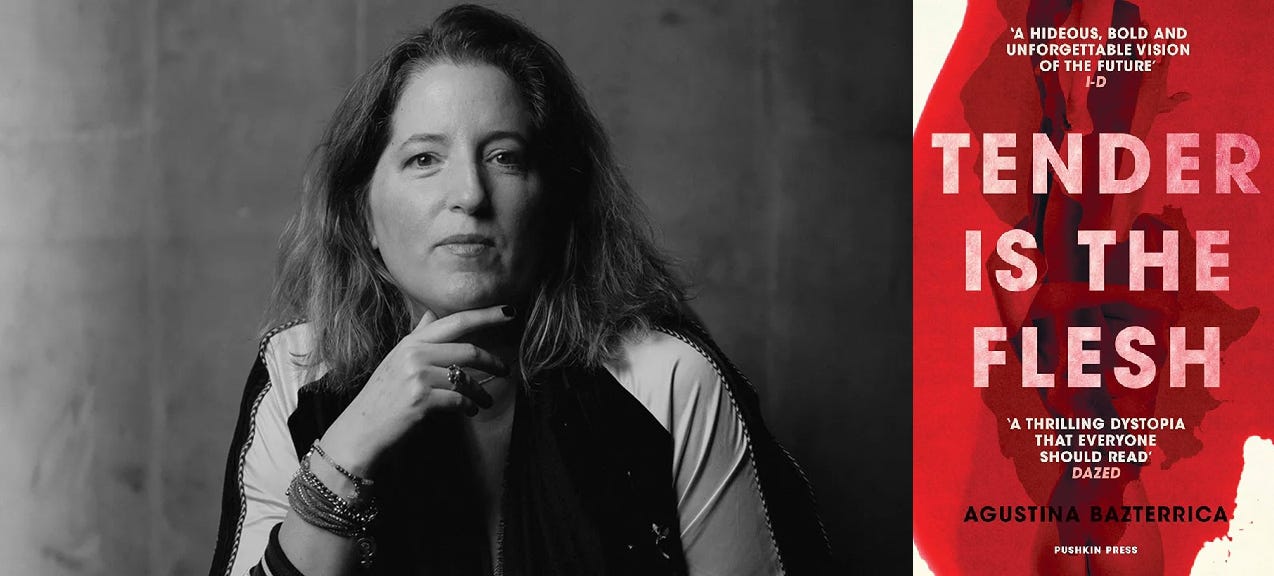
Tender Is The Flesh was originally published in Spanish under the title of Cadáver Exquisito (namely, Exquisite Corpse) in 2017, by Argentine author Agustina Bazterrica. In the same year, it won the Premio Clarín to Best Novel—a significant and prestigious recognition in its country of origin. It was later translated to English by award-nominated translator Sarah Moses, and received considerably praise by international critics, such as Daniel Kraus from The New York Times Book Reviews and Justine Jordan of The Guardian1.
Since its publication, it has been translated into more than thirty languages, and is estimated to have sold over 600,000 copies in the United States alone.
However, Tender Is The Flesh is not the author’s first novel either, since before that, Agustina Bazterrica published a number of short-stories in different magazines and anthologies. In 2020 she was also awarded the Ladies of Horror Fiction Award for Best Novel—an interesting development, given her book was (according to my findings) the only translated work to have won this award.
With that said, let’s dive into the setting.
Tender Is The Flesh opens by revealing that, at some point in the near future, a virus infected all animals in the world—from birds to cats and dogs, rabbits, cattle, everything except humans. The virus is known as GGB, and although the acronym is never explained, it is made clear that being bitten or scratched by an infected animal is fatal to humans, just as it is consuming them.
The protagonist, Marcos Tejo, recalls the following:
He remembers when they announced the existence of GGB. The mass hysteria, the suicides, the fear. After GGB, animals could no longer be eaten because they’d been infected by a virus that was fatal to humans. That was the official line. The words carry the weight necessary to mold us, to suppress all questioning, he thinks.
Barefoot, he walks through the house. After GGB, the world changed definitively. They tried vaccines, antidotes, but the virus resisted and mutated. He remembers articles that spoke of the revenge of the vegans, others about acts of violence against animals, doctors on television explaining what to do about the lack of protein, journalists confirming that there wasn’t yet a cure for the animal virus.
It may be difficult to grasp the magnitude of the problem, so let me show you some statistics to put things into perspective. Various studies (in the real world, of course) estimated that—by 2023—between 78-90% of the global population regularly consumed meat, with some countries, such as United States, consuming about 122.80 kilograms of meat per capita per year2. Since Tender is The Flesh is set in the real world, these statistics reveal something important: given the GGB virus, there was a lot of food to substitute.
And because this is a dystopia, the solution that emerged was… not precisely ethical.
The first thing that happened was that animals were slaughtered: birds, cattle, wild animals, pets—everything was put down to ensure humans were not infected. Next came suspicion and unrest. Naturally, most people were sceptical of the GGB virus, with some dismissing it as a conspiracy theory, while others were far more concerned with the prospect of losing access to meat… and so they sought it by other means. Marcos Tejo recalls this:
Groups of people had started killing others and eating them in secret. The press documented a case of two unemployed Bolivians who had been attacked, dismembered, and barbecued by a group of neighbors. When he read the news, he shuddered.[…]
In some countries, immigrants began to disappear in large numbers. Immigrants, the marginalized, the poor. They were persecuted and eventually slaughtered. Legalization occurred when the governments gave in to pressure from a big-money industry that had come to a halt. They adapted the processing plants and regulations. Not long after, they began to breed people as animals to supply the massive demand for meat.
Given that this novel is set in the near-future, and considering the social hierarchies we already have in place, it is perhaps unsurprising which social groups were the first to be targeted.
However, I want to pause here to redirect your attention to the tone of the excerpt—it was taken verbatim from Sarah Moses’ translation, but… don’t you think it reads factual? Clinical or even detached? The narrator is limited: we see events through Marcos Tejo’s view who, at the time the GGB was announced, was a first-year student in university—which means he lived through all of the “Transition” (as the book refers to it). Yet… he expresses no dismay. He recalls how humans began to be “bred for consumption” (as the novel puts it), yet his account is as unemotional as a Wikipedia summary. Hold on to that idea; I’ll refer back to it very soon.
In the meantime, we must discuss how the governments came to “adapt processing plants and regulations” to, you know, “process” (as per the book’s language) the newly acquired livestock of… humans.
While Marcos recalls the “massive protests, hunger strikes, [and] complaints filed by human rights organization” he also notes that “the population and poverty had been reduced, and there was meat” although “malnutrition was on the rise”—a not-so-minor inconvenience that forced the government to adopt drastic measures to ensure the new “product” (as the novel calls it) was accepted by the population.
Do you know what they did? We could summarise it as a marketing stunt, but the implications are far more complex… and far less funny. Here’s how Marcos introduces it:
The government, his government, decided to rebrand the product. They gave human meat the name ‘special meat.’ Instead of just ‘meat,’ now there’s ‘special tenderloin,’ ‘special cutlets,’ ‘special kidneys.’
He doesn’t call it special meat. He uses technical words to refer to what is a human but will never be a person, to what is always a product. To the number of heads to be processed, to the lot waiting in the unloading yard, to the slaughter line that must run in a constant and orderly manner, to the excrement that needs to be sold for manure, to the offal sector. No one can call them humans because that would mean giving them an identity. They call them product, or meat, or food. Except for him; he would prefer not to have to call them by any name.
That is, actually, the end of the first chapter… and I must pause here again because there is much to unpack:
What the government did was to—quite literally—rename the new “product”. The text is quite explicit; Marcos used the word “rebrand.”
This rebranding was carefully done. If you pay attention to the selected words, you can see it is vocabulary that most people were already familiar with—words that had been, for too long, associated with cattle. Namely: tenderloin, cutlets, and so on… “Tenderloins.” That’s a product you can pick up neatly packaged in the supermarket, right? You don’t need to know where it comes from, how it’s processed… you just have a rough idea of what it is: meat. This is where the linguistic horror begins to slip in because we, as readers, know very well that this ’tenderloin’ did not come from cattle. Or at least not the cattle we know.
Yet the rebranding extended beyond consumer-facing words. It also changed the vocabulary related to the process and regulations—everything that the workers, inspectors, and legislators would be using.
Therefore, as Marcos explained, these workers (butchers) would be processing… “heads” (remember what Marcos said: you cannot call them “humans”!), and senators would be discussing the “process” not mass-murder. The in-book government also relied on familiar vocabulary because, at the end of the day, the process itself didn’t really change; there were “lots,” a “slaughter line,” and “excrement” or “manure.” Again, words we associate to cattle.
Which brings us to the point where the dark humour fades, giving way to the central theme of Tender Is The Flesh: that the way we think about events and the words we use to describe specific actions, can quote-on-quote ‘shield’ a person from the moral implications of their behaviour. Furthermore, as I hinted at the start, the use of bureaucratic language has an additional effect.
We could also argue this is why Marcos—even though he seems to disagree with the language resulting from this rebranding—sounds like a factual Wikipedia summary. Without being consciously aware of it, and even at the outset of the novel, he’s already suffering the consequences of this rebranding.
Which consequences? Moral detachment. But I’m getting ahead of myself.
First, we must understand that language influences thoughts and emotions.
Its power goes beyond providing the vocabulary for precise communication. It also shapes ethics, morality, and the distance we place between ourselves and uncomfortable realities—especially when we take part on that uncomfortable reality.
Remember the line I used to open the episode:
There are words that are convenient, hygienic. Legal.
We will return to this again since it’s rich in meaning. However, what matters now is the implication that some words are “convenient” and “hygienic.” As I hinted before, words (and the meaning they carry) impact someone’s mind—and Marcos, like the rest of society, is being reshaped by this linguistic rebranding, even when he can understand the horror of it.
Let us consider a few excerpts.
Marcos works at a Processing Plant organising sales and purchases, which requires him to visit places where this vocabulary has become exceedingly common. Early in the book, he arrives to a tannery, hears how the owner (Mr Urami) speaks of the “leather” to process, and thinks the following:
Urami’s words construct a small, controlled world that’s full of cracks. A world that could fracture with one inappropriate word.
Notice this: “a controlled world.” Controlled, in part, by the language produced through the government’s rebranding because what is happening—humans bred as livestock—remains ‘acceptable’ and ’tolerable’ only so long as this vocabulary is maintained. This is why Marcos notes that the system could “fracture with one inappropriate word”: the moment people consciously recognise that “heads” are actually humans, and that “special meat” once belonged to someone like them would be a moment of moral and ethical reckoning brought by something we may refer to as the collapse of linguistic distance.
What that collapse truly means, and its implications, is what I’ll eventually discuss.
For now, let me show you another excerpt. This is what Marcos thinks when talking to the owner of a breeding centre:
They’re light words, they weigh nothing. They’re words he feels mix with others that are incomprehensible, the mechanical words spoken by an artificial voice, a voice that doesn’t know that all these words can conceal him, even suffocate him.
Another detail to notice: “all these words can conceal him.” It’s a strange turn of phrase, and one intended to be read metaphorically. People’s minds are shrouded by words, even protected by them—which is why the words ‘conceal’ the people from the ’truth’ (namely, what the words truly mean). However, for someone who cannot simply lose that awareness, the new vocabulary can be “suffocating” because—to them—language cannot hide the underlying moral dilemma.
There is a name for the manner of speech Marcos implies. Something defined by researchers but originally derived from another dystopian novel. It is called:
Doublespeak, and it was derived from George Orwell’s Newspeak, as used in the novel 1984.
You may not know this, but Orwell actually worked as a propagandist, so he was quite aware of the quote-on-quote ’techniques’ used in that line of work. This is why Newspeak is such an important part of 1984, to the point he dedicated an entire Appendix to it in the original novel.
Regardless, George Orwell did not create the concept of doublespeak—one linguist did, by taking into account two other terms that appear in the novel:
Doublethink, which refers to the ability of simultaneously holding two contradictory beliefs in one’s mind, and accepting both of them. And,
Newspeak, which is the name of the language defined by Ingsoc with the sole goal of “narrowing the range of thought.”
Therefore, if we take the “double” concept of doublethink and the “speak” part of newspeak… we arrive to doublespeak3.
This is what linguist William Lutz did in 1987, on his seminal essay on doublespeak. Two years later, in 1989, he published the “Notes Toward a Definition of Doublespeak”, where he argued that doublespeak: “is language which pretends to communicate but really does not. It is language which makes the bad seem good, something negative appear positive, something unpleasant appear attractive, or at least tolerable. It is language which avoids or shifts responsibility; language which is at variance with its real and its purported meaning; language which conceals or presents thought. Doublespeak is language which does not extend thought but limits it.”4
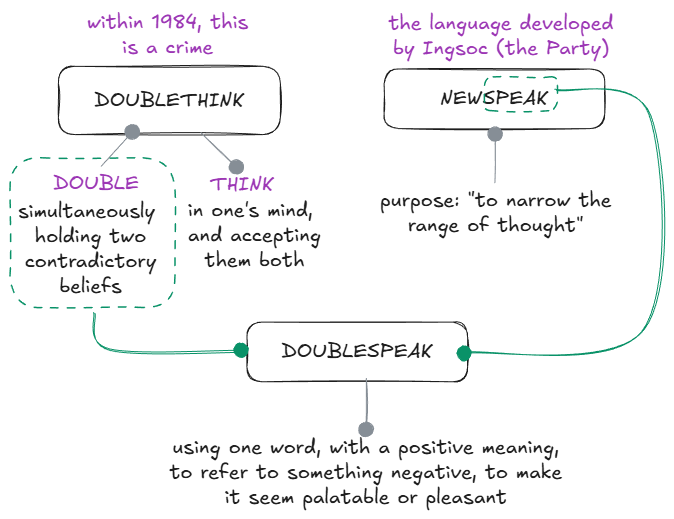
Notice what Lutz wrote: “language which is at variance with its real and its purported meaning”. This implies that words with a positive meaning are used to refer to a concept that has a negative connotation. Using an example taken from 1984, the word love has two different meanings:
The real one is itself—the intense feeling of deep affection—but,
The purported meaning of the word love is actually torture and brainwashing. This is something you can see through the famous Ministry of Love, responsible for terror, torture and brainwashing of political dissidents.
With that clear, we can return to the seminal definition by William Lutz. Towards the end, he used quite a conspicuous word, saying that doublespeak is “language which conceals […] thought”. If you recall, in Tender Is The Flesh, Bazterrica wrote “all these words can conceal him.”
Is it a straight reference to doublespeak? Or perhaps a literary nod to 1984? I can neither confirm nor deny it but it does look suspiciously like one. Even more if you consider Marcos’ quote—the one I told you we’ll return to:
There are words that are convenient, hygienic. Legal.
Words that are “legal”.
Similar as to what happened in 1984, with Ingsoc developing Newspeak and enforcing it on the Party Members, the in-book government of Tender Is The Flesh performed a rebranding, legalised it (through, you know, the Senate and other democratic means), and enforced it by establishing legal penalties. Both are cases of language enforced by political authorities trying to normalise actions of dubious ethics. Both enforced doublespeak… and neither book was precisely fictional in its use of this manner of speech.
Awful as it sounds, doublespeak is often deliberate, institutionalised, and used in contexts where linguistic distance must be created in order to enable moral detachment.
And, unfortunately, this is not a ‘modern’ concept either. In fact, researchers were already studying this phenomenon long before the turn of the century. For example:
In 1977, Luis Grand published an essay titled “Public Doublespeak: Badge Language, Realityspeak, and the Great Watergate Euphemism Hunt”.
In 1982, R. Y. Okamura published “Concentration Camps: A Cover-Up Through Euphemistic Terminology”.
And in 1987, Paul Chilton published “Metaphor, Euphemism, and the Militarisation of Language”5.
What these papers demonstrate is the type of institutions that tend to rely on doublespeak. Unsurprisingly: military organisations, politicians, and legislators.
You can open almost any newspaper and find examples of it. During wartime, for instance, politicians rarely speak of ‘civilian deaths’, but instead refer to ‘collateral damage’; likewise, a ‘kill’ becomes ’neutralisation’, and ’torture’ may be ’enhanced interrogation’. Sometimes, the language becomes even more evasive through passive constructions: they won’t say “someone was killed” but instead report that “a target was neutralised”.
Much like the real versus purported meaning of the word “love” in 1984, terms such as ’neutralising’, ‘collateral’, and ‘interrogation’ sound neutral. Technical. Exactly as Marcos describes in Tender Is the Flesh: convenient and hygienic.
But why was doublespeak needed?
It’s not a single reason, but a chain of them.
First, as Marcos mentioned, “malnutrition was on the rise” so the governments faced some degree of social pressure to provide food. Second, and you can probably guess: economic pressure and the need for profit. Marcos made it very clear:
Legalization occurred when the governments gave in to pressure from a big-money industry that had come to a halt.
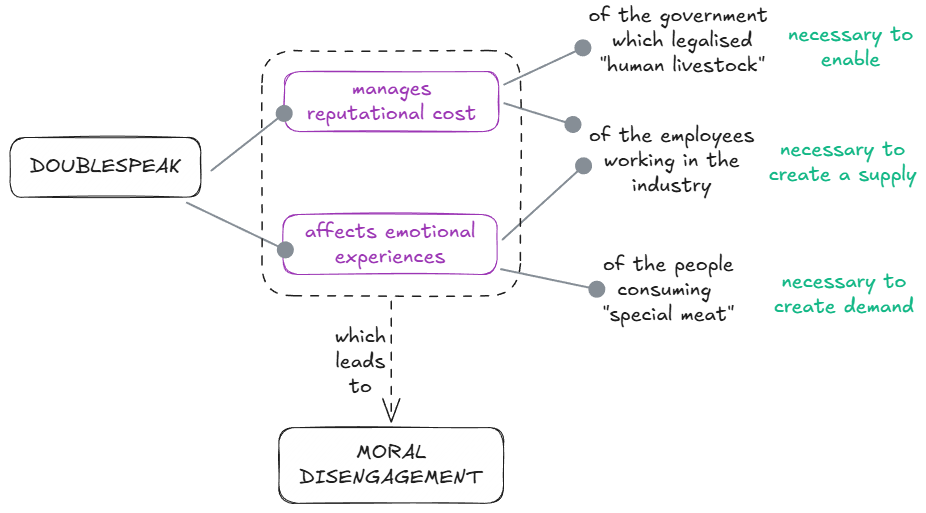
But this “big-money industry” now required something intrinsically amoral: the enslavement and mass-murdering of “heads”. Doublespeak was the only thing that would allow them to make this horror acceptable enough by managing the reputational cost of legalising and working in such industry, and affecting the emotional experiences of workers and consumers alike.
Let’s break this down.
In 2021, linguist Alexander C. Walker demonstrated that: “a strategic speaker can, through the careful use of language, sway the opinions of others in a preferred direction while avoiding many of the reputational costs associated with less subtle forms of linguistic manipulation”6.
This is, to some extent, what the government in Tender Is The Flesh was doing: by changing the language around… “special meat” and their livestock of… “heads” (not “humans”, remember!) they were minimising the reputational implications of what they had just legalised. This would protect not only the government’s image, but also make the work more appealing—otherwise, nobody would want to legislate this, work as a butcher, stunner, or breeder, or even clean a processing plant. Without workers there would be no industry and way to produce any supply.
In addition to that, doublespeak—or language more generally—affects the emotional impact of an event or action. In 2017, Jeffrey A. Brooks demonstrated “that labeling one’s emotional experiences and perceptions alters those states”, also noting that “in the absence of accessible emotion concepts, the meaning of affective experiences and perceptions are ambiguous”7.
What this highlights is the relationship between the words we use and the emotions we experience, including how intensely we experience them. Doublespeak relies on this link. By replacing morally-charged words with neutral or positive ones, it reframes unethical or disturbing acts in language that feels procedural, technical, and emotionally distant. In other words, the more bureaucratic the vocabulary becomes, the more bureaucratic the act itself appears.
This is precisely what the government’s rebranding in Tender Is the Flesh sought to achieve. The consumption of “special meat” is presented as something routine—administrative, even—much like the meat industry that existed before, only with new terminology for the cuts. The reason is simple: this “big-money industry” (as Marcos put it) required consumers who would demand its product. If ordinary meat-eaters could be persuaded to accept “special meat”, then the state’s nutritional crisis would be solved, the industry would have a demand to satisfy, and the system would sustain itself.
Marcos was quite explicit about the emotional impact of words. He said:
No one can call them humans because that would mean giving them an identity. They call them product, or meat, or food.
And later the people themselves understood how language was being used and began to propose terms to make everything more palatable. Here’s what Marcos recalls:
Before long, people began to ask for front or hind trotters, using the cuts of pork to refer to upper and lower extremities. The industry took this as permission and started to label products with these euphemisms that nullified all horror.
This nullification of horror through language—and the linguistic distance it creates—is how moral disengagement happens.
In 1999, Albert Bandura published a paper titled “Moral Disengagement in the Perpetration of Inhumanities”8. This paper discussed the psychological process allowing individuals to engage in harmful behaviors without feeling guilt or remorse—something achieved after separating moral reactions from inhumane conduct and disabling the mechanism of self-condemnation.
As you can imagine, language and—in particular—doublespeak are essential mechanisms to achieve moral disengagement.
Back in 1975, a group of researchers demonstrated that, through intricate rephrasing, detrimental behaviour can be made to appear more innocuous and acceptable—to the point that those involved may feel less personal guilt about their actions9. This returns us to the kind of bureaucratic language we saw in the military examples: ’neutralisation’, ’targets’, ‘assets’, ‘interrogation’. These terms exist for a reason. They frame actions in technical or procedural terms, allowing institutions to describe difficult or morally-charged actions in a way that emphasises their operational role rather than their emotional consequences.
And this is exactly what Tender Is The Flesh does: it exaggerates the linguistic distance to demonstrate how a society can become desensitised, while the readers experience how language itself becomes the infrastructure for violence.
What makes this a dystopia is the moral disengagement at a societal level.
Tender Is The Flesh is not about a group of outlaw cannibals hunting respectable citizens. It is about a world that has legalised the practice under a handful of morally palatable justifications—fighting malnutrition, creating jobs, sustaining the economy—while extensively manipulating language to make it acceptable… and ultimately succeeding in doing so.
The logic was disturbingly simple:
Step One, change the language.
Step Two, embed the new vocabulary in laws, industry terminology, advertising, and everyday conversation. Once everyone uses the same words, the reframing becomes social reality.
Step Three, change the category, and therefore the moral rules. Once something is linguistically classified as food, the ethical prohibition against killing people disappears within that framework.
Which leads us to a chilling conclusion: sometimes, changing the words is all it takes to change the rules. At the end of the day, language does not merely describe reality; within systems, it can make violence acceptable.
Before closing off…
I want to acknowledge that there are so many more themes in this book, but I couldn’t include them all—either because of space, or because it required delving into something more explicit. To name a few:
Throughout the plot, the book presents a latent contradiction in society. Namely, people do things that require them to acknowledge that “heads” are actually “humans”, while simultaneously using the curated language of the rebranding. This can be a reference to doublethink (simultaneously holding two contradictory beliefs in mind). I decided not to cover this given how explicit some examples are.
Likewise, regardless of how aware Marcos may be about the language, his internal narrative does not truly follow that focus. For example, his actions demonstrates that he cares more about his late dogs or some puppies he found in an abandoned zoo, rather than a female “head” that was gifted to him. This can be another example of doublethink, but it also speaks about how his morals are corrupted even though he thinks they’re not.
The treatment of female “heads” in this book is appalling, and incredibly grotesque. There is room to discuss the use of female bodies as objects, and how women are reduced to “producers of children”.
It is possible to read the existence of “heads” as a reference to slavery. In particular, one chapter takes places in a game reserve, and the way the hunters take photos with their… ehm, “acquisitions” resembles quite closely some photos taken before the abolition of slavery.
There is more still, but I was not attempting to be exhaustive. What matters is that Tender Is The Flesh is a nuanced and layered book that goes far beyond the body horror that tends to take the forefront in most reviews.
That said, if language as a topic interests you, then allow me to tell you a secret: language is one of my most discussed topics in Books Undone, so there are three episodes I want to share with you:
Through Babel-17 by Samuel Delaney, I discussed how language shapes thought, using both Sapir-Whorf hypotheses (known as linguistic determinism and relativity). This was actually the third episode of the podcast, back in 2023.
Of course, I did a thorough discussion on Newspeak from 1984 by George Orwell. This episode complements some of the themes in the one I mentioned previously. It also includes some interesting trivia on Orwell himself.
Among the most recent ones is my discussion on metaphors, lies, and mental abstraction as presented in Embassytown by China Miéville. This is quite a long episode, but one of my favourites.
You can find the transcript for all the episodes—plus thorough literary analyses of speculative fiction—in my Substack at liviajelliot.substack.com. I post weekly, and the podcast is included in the publication. I will leave the link in the description.
Thanks for listening, and happy reading.
Copyright © 2026 Livia J. Elliot. All rights reserved. This publication is licensed for personal reading only. No article, or substantial part of an article, may be reproduced, republished, adapted, translated, compiled into another publication, incorporated into teaching materials or course packs, or used for AI training without prior written permission. Linking to the original articles is encouraged.
“What if the Meat We Ate Was Human?” by Daniel Kraus (2020) published in NYT Review and “Tender Is the Flesh by Agustina Bazterrica review – a prizewinning Argentinian dystopia” by Justine Jordan for The Guardian.
“What Percentage of the Population Is Vegetarian?” in Cook Unity links to many relevant articles. For something local, in a media release, the Australian Bureau of Statistics reported that there was a 1.8% increase in meat consumption per year. Finally, World Population Review has detailed statistics on Meat Consumption by Country by 2026 which you can see here.
You can read some interesting articles about newspeak in Orwell Today: https://orwelltoday.com/dblspkthennow.shtml
“Notes Toward a Definition of Doublespeak” is the first chapter of Beyond Nineteen Eighty-Four, a book published in 1989 by William Lutz. The PDF is publicly available through the author’s institution: https://files.eric.ed.gov/fulltext/ED311451.pdf Besides his work, there are a large number of academic papers about Doublespeak, some even published in 2025. Make of that what you will.
The papers I mentioned are: (a) Chilton, Paul. “Metaphor, euphemism and the militarization of language.” Current research on peace and violence 10, no. 1 (1987): 7-19. // (b) Grant, Louis T. “Public doublespeak: Badge language, realityspeak, and the great watergate euphemism hunt.” College English 39, no. 2 (1977): 246-253. // (c) Okamura, Raymond Y. “The American concentration camps: A cover-up through euphemistic terminology.” The Journal of Ethnic Studies 10, no. 3 (1982): 95.
The paper I was quoting is “Controlling the narrative: Euphemistic language affects judgments of actions while avoiding perceptions of dishonesty” by Alexander C. Walker, Martin Harry Turpin, Ethan A. Meyers, Jennifer A. Stolz, Jonathan A. Fugelsang, and Derek J. Koehler. It was published in Cognition an Elsevier journal, in 2021. https://doi.org/10.1016/j.cognition.2021.104633 Interestingly, they also touch on doublespeak.
This paper is very interesting. “The role of language in the experience and perception of emotion: a neuroimaging meta-analysis” by Jeffrey A. Brooks, Holly Shablack, Maria Gendron, Ajay B. Satpute, Michael H. Parrish, and Kristen A. Lindquist, published in 2017 in Social Cognitive and Affective Neuroscience: https://doi.org/10.1093/scan/nsw121
“Moral Disengagement in the Perpetration of Inhumanities” by Albert Bandura, published in 1999 in Personality and Social Psychology Review: https://doi.org/10.1207/s15327957pspr0303_3 It is a very interesting read.
“Effects of altered responsibility, cognitive set, and modeling on physical aggression and deindividuation.” by E. Diener, J. Dineen, K. Endresen, AL Beaman, and SC Fraser. Published in 1975 in the Journal of Personality and Social Psychology: https://doi.org/10.1037/h0076279


