


Within a year there were fires on the ridges and deranged chanting. […] He thought that in the history of the world it might even be that there was more punishment than crime but he took small comfort from it.
This stark quote gestures towards an uncomfortable truth: in a world stripped of society, where each person stands alone and violence is abundant, can morality even exist? It is not an easy question to answer, yet however we do it we cannot escape the weight of our own judgement—for even in the absence of law and order, we remain our own harshest tribunal. As another book indicated:
I was embarrassed by the man and his fear, shamed by him, as though I myself were the coward, not him.
This raises an interesting question: is morality something we do, or something we tell ourselves we’ve done? It’s too early to answer that, so for now, I’ll just say this: the two books we’re about to explore work over the same philosophical framework to study morality from different points of view.
Let’s get these books undone.
Hello everyone, and welcome to Books Undone. I’m your host, Livia J. Elliot, and in today’s episode I want to analyse two unlikely books. Both are considered masterpieces: one won the Pulitzer Prize for Fiction, and the other is part of an ouvre often referred to as having “redefined the meaning and scope of literature”1.
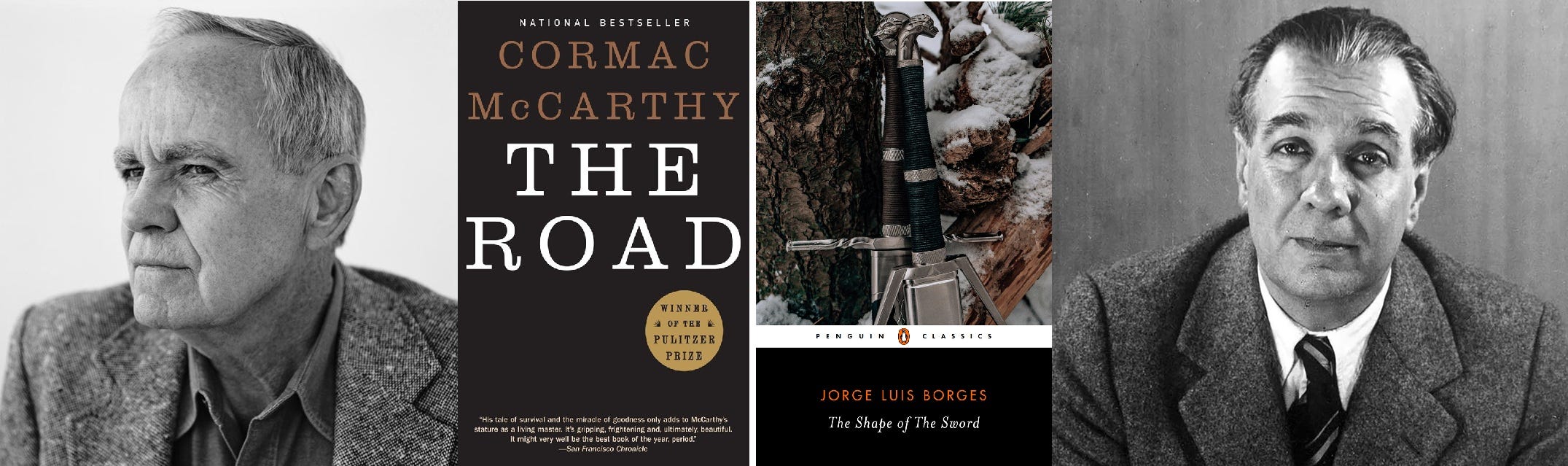
I’m talking about The Road by Cormac McCarthy (published in 2006), and The Shape of The Sword by Jorge Luis Borges (published in 1942).
Yet before we dive in, allow me to make some clarifications:
Today’s discussion will be more meaningful if you have read both stories. However, this episode will walk you through the setting, the characters, and part of the plot needed to follow my philosophising… making it spoiler heavy. That said, if you haven’t read The Shape of The Sword I strongly encourage you to pause here and read it—this is a short story, barely 8-pages long, and it will blow your mind.
What follows is an interpretation, not a verdict. You may disagree, and that strengthens the thematic richness of these stories—which continue to invite discussions decades after publication.
Finally, remember that you’ll be able to find all the links to the citations I’m using in my Substack, at booksundone.com.
In these books, the settings are not mere backdrops.
They are fundamental enablers of the thematic angle we want to explore.
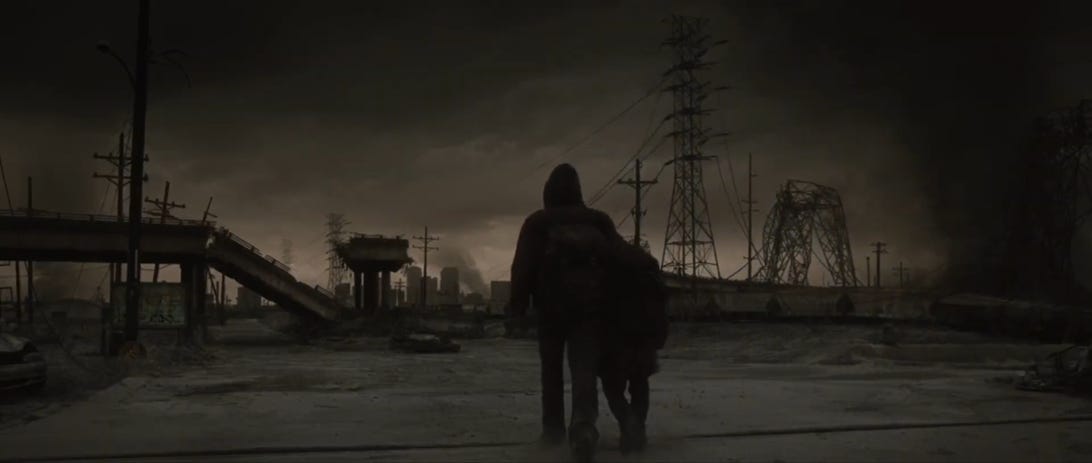
The Road, by Cormac McCarthy is set in the future…
—in some unspecified year, somewhere in what once was the United States, in what is often defined as a post-apocalyptic landscape. Unclear? Deliberately so. Throughout the story, we are given only oblique clues as to what actually occurred. These appear as brief flashback scenes, scattered through the opening quarter—such as this:
The clocks stopped at 1:17. A long shear of light and then a series of low concussions. He got up and went to the window. What it is? she said. He didnt answer. He went into the bathroom and threw the lightswitch but the power was already gone. A dull rose glow in the windowglass. […] What is it? she said. What is happening?
I dont know.
We can assume the ‘glow’ the narrator described was a bomb—nuclear, perhaps—or an electromagnetic pulse—an EMP—given its apparent effect on electrical systems. A follow-up fragment tells us a bit more, implying something:
They sat at the window and ate in their robes by candlelight a midnight supper and watched distant cities burn. […] Beyond the window just the gathering cold, the fires on the horizon.
But who is attacking? Why is this bombarding happening? The book does not provide an answer. After all, the narrator seems to be an ordinary citizen, and it is quite plausible he would not have enough information to explain what happened… or, perhaps, this lack of details could be hinting at something bleaker: the government was utterly destroyed along with the societal identity it imposed. In such a case, the reasons for the war and the nations involved do not matter, only the consequences.
Those consequences are key to this discussion. Consider the following excerpt; it seems to be a conversation between the man (the narrator) and his wife, likely months after the event at 1:17am:
We’re survivors he told her across the flame of the lamp.
Survivors? she said.
Yes.
What in God’s name are you taking about? We’re not survivors. We’re the walking dead in a horror film. […] She watched him across the small flame. We used to talk about death, she said. We dont any more. Why is that?
I dont know.
It’s because it’s here. There’s nothing left to talk about.
The wife’s perspective here goes beyond mere pessimism. The key line is: “We’re not survivors. We’re the walking dead in a horror film.” The reference is telling.
Post-apocalyptic fiction—whether in film, literature, or games—tends to follow a familiar logic: a catastrophic event disables technology, fractures government (local, global, or both), and in so doing dissolves the structures that sustain social order. What remains is not simply hardship, but a reversion to survival governed by force rather than norms.
Her comparison to a “horror film” is subjective, but may also signal how she interprets the world around her: not as a damaged society, but as one in which the very conditions for society no longer hold.
This reading aligns with a well-established body of research: law enforcement and civic norms play a measurable role in reducing violence. As Isaac Ehrlich argued, “law enforcement—the apprehension and punishment of law breakers—serves partly as a means of deterring future crimes”. More recent research has extended this idea, identifying that social norms are “an important factor in curtailing antisocial behavior.” In other words, how individuals think and behave about violence matters as much as formal enforcement2. Remember this; we will come back to it as the podcast episode develops.
That said, here’s where the comparison to a “horror film” takes another dimension: in the wife’s eyes, the post-war world has become a landscape of unimaginable, ever-present violence. So much that ‘death’—or, more precisely, the threat of being denied death and forced to endure violence—is now a possibility they constantly live alongside.
Within this setting, it is easy to assume that morality cannot exist… but The Road will challenge that assumption. Before that happens, let us review:
The setting of The Shape of The Sword, by Jorge Luis Borges.
This is a fictional story, but Borges often relied on real elements—such as historical events, places, or even people—to frame his fictional plots. Thus, and unlike The Road, this short-story is set in the past and grounded in real history. It has two temporal lines:
The present storyline is set in the northern departments of Uruguay, around the late-30s or early-40s. This was contemporaneous to the time it was written.
The past storyline is set overseas, during one very real independence war. The character narrating this storyline introduces it as follows:
In 1922, in one of the cities of Connaught3, I was one of the many young men who were conspiring to win Ireland’s independence. […] We were Republicans and Catholics; we were, I suspect, romantics. For us, Ireland was not just the utopian future and the unbearable present; it was bitter yet loving mythology […].
Allow me to briefly review history with you.
In the lead to 1922 Ireland split into two camps over the Anglo-Irish Treaty:
supporters (who agreed with the new Irish Free State), and
deterrents who rejected it as a betrayal of the Republic declared in 1916.
This disagreement led to the Civil War the narrators obliquely referenced. At the beginning, this conflict first involved conventional warfare, where the pro-Treaty National Army gradually captured key urban centers, including Dublin… but a number of defeats made anti-Treaty fighters shift to guerrilla warfare4.
It is roughly in this point, during the early guerrilla phase, that the story is set. It is also worth noting that, while The Road presents us a world without society, The Shape of The Sword is set in a society under extreme duress. Though the Irish Civil War had lower civilian deaths than other equivalents, the fighting disrupted daily life, damaged property and local trade. Both sides used reprisals—namely, attacking homes and property of the opposite side—while the government executed prisoners, intensifying the cycle of violence. One narrator in this short story explicitly references this:
Of my companions there, […] one, the best of us all, was shot at dawn in the courtyard of a prison, executed by men filled with dreams. Others (and not the least fortunate, either) met their fate in the anonymous, virtually secret battles of the civil war.
Within this setting, this short story prepares itself to evaluate something more personal: how beliefs—and their changes—can affect someone’s moral stance. It is an interesting proposition, complementary to where The Road will lead us.
Thus, it is time we discuss…
The effects of the settings on the leading characters.
They are a consequence of the book’s world-building, and thus fundamental to the moral dilemmas we’ll see emerge.
The Road follows two characters:
The man and the boy, father and son, moving south through the abandoned roads. Their goal is simple: to find shelter in warmer lands.
Their ages are unclear; I personally assumed the father to be in his early forties and the boy somewhere between five and seven, though the text gives nothing to confirm it. Likewise, at no point are their names revealed, and even when the narrator appears to be limited to the father’s perspective, he thinks of his son simply as “the boy”, and of his late wife as “she.”
This is more than an authorial quirk, and it’s related to the lack of geographical and societal names in the book.
We know that names are more than just an identification—they’re tied to our identity. A person’s name is widely seen as a marker of selfhood, shaping self-acceptance and even acting as the ‘ultimate control element’ over memory5. Furthermore, geographical names—like those of cities, regions, and nations—are fundamental to preserve cultural heritage, contributing to identity by strengthening someone’s bond with that place and everything it represents6. Therefore, to strip someone of their name, and to strip a society of its names, is to erode something fundamental about who they are: their identity, their goals, their purposes.
This is how the book deals with an uncomfortable idea: what purpose does a name tied to the past serve? What point is there in remembering a life that will not return?
It is a nihilistic worry, but it haunts the man:
Rich dreams now which he was loathe to wake from. Things no longer known in the world. […] He thought each memory recalled must do some violence to its origins. […] What you alter in the remembering has yet a reality, known or not.
That collapse of identity—personal, civic, civilisational—is the same collapse that dissolved the norms and institutions that once kept violence in check, and ensured that the basic conditions for life were met: shelter, food, medicine, clothing. The fact that you can walk into a supermarket today and purchase food is possible only because countless institutions enable it: government bodies regulating trade, companies farming, processing, distributing, supplying. Remove all of that, and both other survivors and the environment itself become a threat.
However, regardless of the collapse, some self-imposed duties, attitudes, and beliefs that were part of the father’s identity before the world became post-apocalyptic, continue to be part of him. This translates into two behaviours we see repeatedly in the book; both are also tied to the lack of government and the new conditions of life:
protect his child from that latent threat of violence caused by other people—what we discussed before in the setting’s introduction—and
find the resources they need to keep moving. As you know, without food the body grows vulnerable, without proper clothing you risk sickness, and without medicine almost any ailment becomes a death sentence, especially in this post-apocalyptic setting.
Thus, the father faces a constant, impossible balance: staying safe (where meals are poorer and clothing insufficient) or venturing out to find supplies in places that may put the boy in danger. Either choice has consequences. Consider this scene:
What if there’s someone here, Papa? […]
We’ve got to find something to eat. We have no choice. […]
They stood in the doorway. Piled in a windrow in one corner of the room was a great heap of clothing. […] He would have ample time later to think about that. The boy hung to his hand. He was terrified. […] In the yard, there was an old iron harrow propped up on piers of stacked brick and someone had wedged between the rails of it a forty gallon castiron cauldron […] All these things he saw and did not see.
That search in that house did not end well. They end up finding mutilated people in the basement, enslaved by a handful of cannibals… of course, these leads to a chase in which the man has to consider the impossible: killing the boy before he’s captured. There are other encounters like this: armed men that attack them in the open using the boy as a shield, having to hide from slavers, and escaping survivors who want to kill them for their supplies. The father and son make it alive, but the cost of these encounters is more than physical. Listen to how the father speaks of his own role:
This is my child, he said. I wash a dead man’s brains out of his hair. That is my job. Then he wrapped him in the blanket and carried him to the fire.
What you’re seeing here is the outset of something called moral injury.
As Griffin et al. explained, “individuals who are exposed to traumatic events that violate their moral values may experience severe distress and functional impairments known as moral injuries.” Meanwhile, Shay et al. also established that “moral injury is present when there has been (a) a betrayal of ‘what’s right’; (b) either by a person in legitimate authority, or by one’s self […]; (c) in a high-stakes situation.”7
We can see all of this in the father:
(a) to him, ‘what is right’ is to protect his son and provide for him, but
(b) he endangered the boy (even if to increase their chances of survival), which led the father to consider mercy-killing his son to spare him from suffering—something that contradicts these beliefs—because
(c) they live in a high-stakes situation that demands these actions.
What we must understand is that a moral injury represents the damage done to someone’s identity and principles, caused by acting against your own values, or witnessing others doing so without being able to reconcile it.
Here’s where something emerges, and to understand it I’ll give you a practical example. You’re cooking, the stove is on, and you touch it with your bare fingers—it’ll hurt you, yes, but the next time you’ll try to protect yourself by using a kitchen towel. This type of protective reaction is not exclusive to physical health, for we often do things to protect our state of mind. Therefore—and perhaps only instinctively aware of what was happening to him—the father slowly begins to develop a new ethical behaviour to somewhat ‘prevent’ his moral injury from worsening.
This prevention comes in the shape of two so-called ‘catchphrases’ that will repeat themselves throughout the book. After their first dangerous encounter, where the boy was almost taken, the father tells him this:
You wanted to know what the bad guys looked like. Now you know. It may happen again. My job is to take care of you. I was appointed to do that by God. I will kill anyone who touches you. Do you understand?
Yes.
He sat there cowled in the blanket. After a while he looked up. Are we still the good guys? he said.
Yes. We’re still the good guys.
Then this:
We wouldnt ever eat anybody, would we?
No. Of course not.
[…] Because we’re the good guys.
Yes.
And we’re carrying the fire.
And we’re carrying the fire. Yes.
Notice the two phrases: “We’re the good guys”, and “We’re carrying the fire.” At a first glance, the first one reads as reassurance of their ethics, and the second like a religious or faithful comment… but they are so much more. They represent a pattern that psychology can help us decode.
In 1986, researchers Jeff Greenberg, Sheldon Solomon, and Tom Pyszczynski developed something called terror management theory. TMT posits that someone manages their terror of death by developing and maintaining cultural worldviews: humanly constructed beliefs about reality, shared among individuals, that minimise existential dread by conferring meaning8. Existential dread encompasses the overwhelming anxiety and despair someone experiences when confronting life’s fundamental questions about purpose, mortality, and the human condition—and we have seen that this setting has entirely eroded those three elements:
There is no identity left—something we see reflected in the lack of names. As the father thought before: “Rich dreams now which he was loathe to wake from. Things no longer known in the world.” Therefore, every purpose and meaning he may have developed in the world from before are now irrelevant.
Mortality, as we discussed when I introduced the setting, is too close for comfort. As the wife said: they are “the walking dead.”
Finally, the human condition has deteriorated, and they live with the threat that, one day, they may not be able to escape the violence.
Therefore, father and son must then create meaning on their own.
If you recall, they’re travelling south to survive the winter… but that’s not really a purpose as much as a milestone in their journey. It is not a reason to live, and neither a motive to act. They need something truly meaningful because, as Viktor Frankl said in Man’s Search For Meaning: “He who has a why to live for can bear almost any how.”
In this post-apocalyptic world, this is not an easy task… and given the boy’s age, the duty falls entirely on the father’s shoulders. At the start, it is easy to think his meaning is what he told the boy here:
My job is to take care of you. I was appointed to do that by God.
…but the problem is the father is affected by a moral injury—something that specifically disrupts the meaning-making process TMT relies on. Protecting his son and being a good father were his humanly constructed beliefs about reality… but he had to act against that. Repeatedly. The father did not take care of his son when he endangered him by getting inside the cannibals’ house, even less when he considered mercy-killing him. That’s the problem, remember? Moral injury corrodes the mechanism he would normally use to cope.
Which leads us back to the point in the story where these catch-phrases appear—after the moral injury has deepened enough that the father must create new beliefs. Those beliefs crystallise into two commitments:
Being “the good guys” means that they do not enslave, do not prey on others, and do not kill unless survival demands it.
“Carrying the fire”, thus, elevates that stance into something closer to a vocation: not merely surviving, but living in service of their values.
This, in turn, serves three purposes:
It reframes what it means to be a good father. This is no longer just a “protect him at all costs, without exception”—which is precisely what caused the moral injury—but something more complex. Something that allows the father to take reasonable risks (which may endanger the boy) if the risk itself is motivated by the boy’s survival. Why? Because the father’s core belief now is no longer being a protector, but being “a good guy”—namely, that no matter what he does there are limits to his behaviour.
At the same time, “carrying the fire” gives meaning to their journey. After all, who else will do it if not them?
Finally, and more poignantly, it gives the boy something to hold onto once the father is gone. A reason to keep walking when there is no one left to walk beside him.
Yet these two catch-phrases can be read in a deeper way.
We could present “being the good guys” as a behaviour, and “the fire” as the name they give to what that behaviour protects: ethics and morality in a world that has abandoned both. Which brings me to one key question: how can you not fail morally in a world like this?
We can’t answer that yet, because we must first evaluate…
The characters in The Shape of The Sword.
You’ll notice that the same psychological ideas from The Road are approached here from different angles.
That said, the story has two main characters:
The first one narrates the present timeline, and is a fictional version of Borges himself. In pure Borgesian fashion, the short story pretends to be a recount of the events during one of his trips to Uruguay. There he meets the second character:
The Englishman at La Colorada9: a figure of mystery coming from Rio Grande do Sul, to where he’d arrived as a smuggler. From there, he acquired a farmhouse in north Uruguay where he lived surrounded by myths. The short story opens with his description:
His face was traversed by a vengeful scar, an ashen and almost perfect arc that sliced from the temple on one side of his head, to his cheek on the other. His true name does not matter; everyone in Tacuarembó called him “the Englishman at La Colorada.” […] The Englishman worked shoulder to shoulder with his peons. People say he was harsh to the point of cruelty, but scrupulously fair.
That scar is core to The Shape of the Sword. Fictional-Borges manages to visit the Englishman’s farmhouse and, while dining with him, asks for the story behind the scar. Bold. Yet after some consideration, the Englishman answers this:
“I will tell you the story of my scar under one condition—that no contempt or condemnation be withheld, no mitigation for any iniquity be pleaded.”
That’s… an unusual preface, don’t you think? One may expect such a scar to mark a battle survived, or someone defended. Instead, the Englishman is pre-emptively demanding to be judged—even refusing, in advance, any attempt to soften or excuse what he is about to confess. Could this be somehow related to the concept of moral injury we just discussed? Hold on to that idea; we’ll come back to it soon.
What matters now is that the narration—originally in first person from fictional-Borges point of view—changes. It becomes a first-person narrative from the Englishman’s perspective, as he recounts the events during 1922 in Connaught. After some context about the Irish Civil War, he introduces a third character:
One evening I shall never forget, there came to us a man, one of our own, from Munster—a man called John Vincent Moon.
He couldn’t have been more than twenty. […] He had studied, ardently and with some vanity, virtually every page of one of those Communist manuals; […] There are infinite reasons a man may have for hating or loving another man; Moon reduced the history of the world to one sordid economic conflict. […]
Not the most flattering introduction, but it highlights something important: Vincent Moon was a man of firm, almost rigid convictions. Convictions that, in his own mind, explained everything—how to understand the world and the people, reasons to act, certainties to stand on.
The Englishman elaborates:
The verdicts Moon handed down impressed me considerably less than the sense of unappealable and absolute truth with which he issued them. The new comrade did not argue, he did not debate—he pronounced judgement, contemptuously and, to a degree, wrathfully.
This matters because the Irish Civil War was, at its core, a conflict of beliefs—specifically, whether the Anglo-Irish Treaty was a necessary compromise or a betrayal of the republican cause. What made it so devastating was not merely the violence, but the fact that people who had fought together for independence (in the years before) now found themselves on opposite sides of that question… and did not stop believing they were right. If anything, the stakes of being right had never felt higher.
Vincent Moon embodies that certainty in its most extreme form. And it is precisely that certainty—the absolute conviction that his cause justified his actions—that will matter when we reveal what he actually did.
As the Englishman recounts it, during the guerrilla phase he saved Vincent Moon from capture and sheltered him in General Berkeley’s country house. For nine days, the Englishman left each morning to fight alongside his comrades whilst Moon remained upstairs, surrounded by books on military strategy, and pronouncing judgements he had no intention of acting on. On the tenth day, the Englishman returned to find Moon on the telephone… betraying their location to their enemies.
What follows is a chase through the house. In the Englishman’s words:
Once or twice I lost him, but I managed to corner him before the soldiers arrested me. From one of the general’s suits of armor, I seized a scimitar, and with that steel crescent left a flourish on his face forever—a half-moon of blood. To you alone, Borges—you, who are a stranger—I have made this confession. Your contempt is perhaps not so painful.
Pay attention to this: the Englishman left a scar on Vincent Moon’s face. The Englishman, who has a scar in his face—crossing from the temple in one side to the cheek on the other. It is one of the greatest twists in short stories, and it is also part of a very specific psychological presentation related to morality and beliefs. But I’m getting ahead of myself.
Let me first tell you how it all ends.
Fictional-Borges does not immediately understand what this confession means, and asks what became of Vincent Moon. The answer is the most celebrated line in the story:
“Do you not believe me?” he stammered. “Do you not see set upon my face the mark of my iniquity? I have told you the story this way so that you would hear it out. It was I who betrayed the man who saved me and gave me shelter—it is I who am Vincent Moon. Now, despise me.”
The Englishman and Vincent Moon are the same person—meaning that someone else scarred him. Actually, I mentioned that person before, in the same oblique way that Moon acknowledged him at the very beginning of his narration:
Of my companions there, […] one, the best of us all, was shot at dawn in the courtyard of a prison, executed by men filled with dreams.
The reason for his death? Moon’s betrayal.
His name? Unknown.
At this point you’re probably wondering something: why would he tell the story in this way? Here is where psychology comes to our aid once again.
In 1987, E. Tory Higgins presented the theory of self-discrepancy—differences between how people see themselves now and the self-guides they compare themselves against. In this theory, we have: the actual self (who we are), the ideal self (who we wish we were), and the ought self (who we should be)10. If we apply this to Vincent Moon, we could argue that:
His ideal/ought self is that of a brave revolutionary—someone like the man who saved him and who he ended up betraying: “the best of us.” Not a casual description. Moon was naming his own ideal self without recognising it.
Meanwhile, his actual self is that of a betrayer.
This incompatibility is the source of a moral injury. If you recall, moral injury represents the damage done to someone’s identity and principles, caused by acting against your own values7. Vincent Moon had built his entire sense of self around rigid beliefs—the Communist manuals, the theories of revolution, the certainty that he knew what the cause demanded. And yet, when the moment came, he betrayed the very man who embodied everything he claimed to stand for—the nameless one who was Moon’s ideal self though, at the time, he failed to recognise it.
Vincent Moon tells the story in this way—pretending to be the one he betrayed—because he cannot yet cope with his actions, and so narratively splits the ideal and actual selves to be able to recount the story. The scar has now become a permanent inscription of guilt: a part of the actual self that constantly reminds him of the moral injury… and that he will never become his ideal self. After all, notice the precise words Moon used to describe the scar: “a half-moon of blood.” Moon is his surname and, as we saw before in The Road, names are tied to one’s identity.
The scar—aptly, the shape of the sword—and the moral injury it represents, is now Vincent Moon’s identity.
Yet there is something else to consider in relation to the one command Vincent Moon issues to Borges: “Now, despise me.” That is the closing line of the story, and it links quite well to that awkward preface Vincent Moon offered before recounting his story:
”[…] that no contempt or condemnation be withheld, no mitigation for any iniquity be pleaded.”
This implies that Vincent Moon loathes himself—a known consequence of moral injuries—but that contempt is not enough, and so he demands it from others. The authoritative tone he used with fictional-Borges also reflects a need: Moon needs others to validate how he feels now because, perhaps, he no longer trusts his own moral judgement. He already acted on his beliefs before, and that—ironically—led him to betray those beliefs.
So here comes a crucial point: Vincent Moon was not telling this story as a confession of what was done to him, but of what he did—or better said, who he is, and is seeking the contempt of others to validate the guilt caused by his moral injury. Where the father in The Road instinctively tried to create new beliefs (namely, “we’re the good guys” and “we’re carrying the fire”) to stop the moral injury from worsening, Vincent Moon in The Shape of The Sword cannot resolve the conflict on his own and neither create a new meaning… and so simply searches for confirmation of what he feels.
In this way, this story leads us to another question around morality: How do you live with the knowledge that you have failed morally?
What we have seen so far is two stories evaluating morality from different standpoints:
In The Road, the man and the boy want to act ethically and morally but are constantly at risk of failing. This book presents morality as something one must actively maintain.
In The Shape of The Sword, however, Vincent Moon has already failed… and so the story is about a moral failure becoming an identity (the actual self: “I am the traitor”).
Yet there is something more to analyse here.
What if I told you that these are not just characters, but ‘characterised themes’?
How would that contribute to our discussion on morality?
Before we dive in, I want to explain one nifty literary trick—something called literalised metaphors.
In a literalised metaphor, a figure of speech is interpreted or depicted as being literally true within a book or short story. As I see it, we can apply this approach to the books we’ve been discussing—namely, taking an abstraction and giving it narrative form—by reading the characters as embodied themes. In this sense:
the boy from The Road becomes morality itself, while
Vincent Moon from The Shape of The Sword becomes interpretive morality.
Let’s undo that idea, one story at a time.
To understand the boy in The Road as morality embodied…
—we need to also evaluate a handful of scenes. For example, here is what happens when father and son encounter a man who was struck by lightning:
The boy kept looking back. Papa? he whispered. What is wrong with the man?
He’s been struck by lightning.
Cant we help him? Papa?
No. We cant help him.
The boy kept pulling at his coat. Papa? he said.
[…]No. We cant help him. There’s nothing to be done for him.
A lightning strike is quite deadly, and we could argue the boy is too young to understand the waste of supplies that helping this man would be. We can also see the father is not technically wrong either… but weren’t they “the good guys”? Weren’t they “carrying the fire”? Or does morality and ethicality only apply when it is free of consequences?
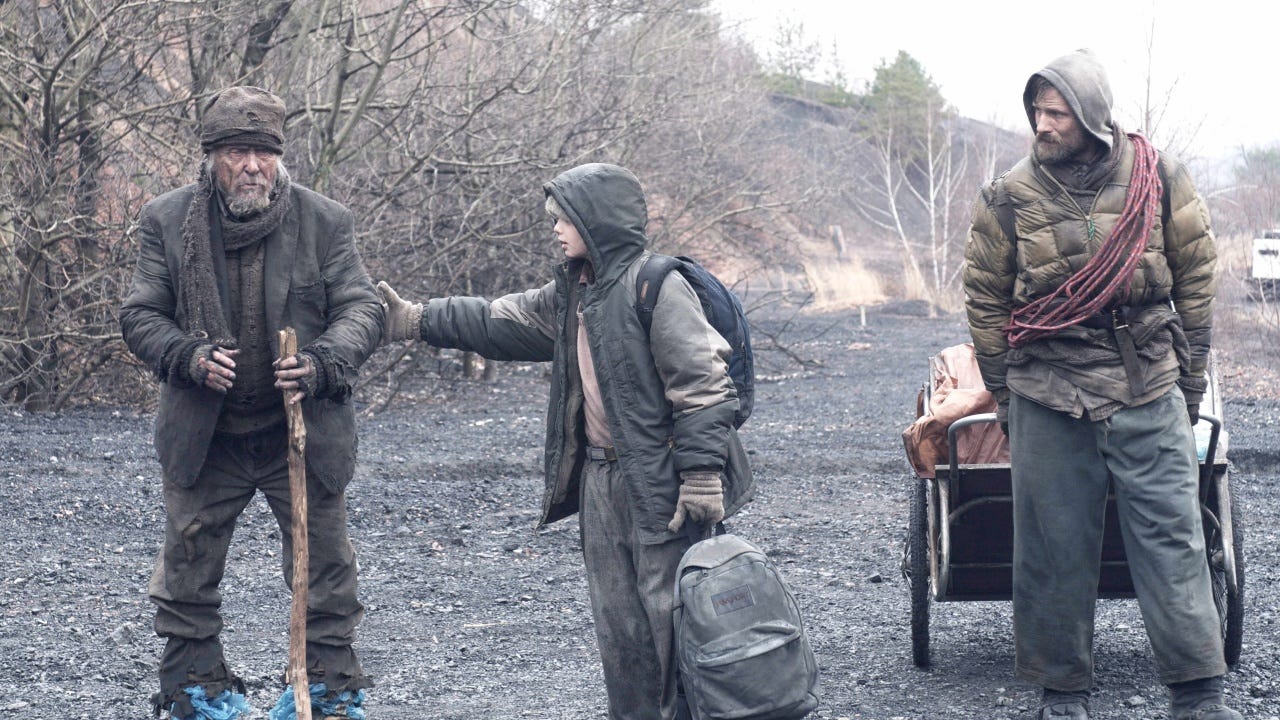
This type of conversation repeats quite often—after the boy spots another youngster on the street, after a thiefling steals their supplies and they catch up with him, with every old man they cross, with animals, anything. But here’s the interesting detail: the more the father’s moral injury progresses—the more he endangers the boy in his pursuit of supplies, or sometimes simply due to being tired and committing mistakes—the more the boy insists on helping others.
For example, after they risked their lives to get supplies—and finally stocked themselves full—they encounter someone and the following happens:
In the morning they stood in the road and he and the boy argued about what to give the old man. In the end he didnt get much. Some cans of vegetables and of fruit. Finally the boy just went over to the edge of the road and sat in the ashes. The old man fitted the tins into his knapsack and fastened the straps. You should thank him you know, the man said. I wouldnt have given you anything.[…]
Will it hurt his feelings?
No. That’s not why he did it.
Why did he do it?
He looked over at the boy and he looked at the old man. You wouldnt understand, he said. I’m not sure I do.
Maybe he believes in God.
I dont know what he believes in.
Such behaviour may appear irrational if the boy is read purely as a character… we would have expected some quote-on-quote ‘development’, some ‘growth’ based on the father’s training. Perhaps we’d expect the boy finally grasping the conditions of the world they live on, or—more logically—being corrupted by it.
But that’s not what happens.
If we assess the boy as a characterised theme, his behaviour fits what he embodies: an irreducible moral instinct, never corrupted by the world because what is moral will always be moral. The boy’s requests to help others are not the whims of an obtuse toddler unable to grasp the situation they’re in—these requests are the demands of morality itself. He insists on helping others and not abandoning strangers even when he understands the costs of doing so and, in addition to that, continuously questions the father on whether they are still “the good guys.”
Again, were we to read the boy only as a character, the father consenting to help others could be seen as him merely trying to appease a toddler… but that would be quite against the father’s character—the savvy, pragmatic, ruthless-when-necessary man the book showed us he was. The morally-injured survivor who crafted a new set of beliefs in what we could argue was self-defence.
Again, if consider the boy as a characterised theme, the father’s actions take on another dimension and meaning. This is no longer paternal love and dedication, but something more radical—the answer to the very first question I posited in the introduction: morality is not something we tell ourselves we’ve done, morality is something we do and choose to do constantly, regardless of the cost, and without guarantee of a reward.
Why? Because as the famous existentialist philosopher, Jean-Paul Sartre, said: “Man makes himself; he is not found ready-made; he makes himself by the choice of his morality, and he cannot but choose a morality”11.
Which brings me back to yet another question—the one I told you The Road was exploring: how can you not fail morally in a world like this?
You will have to forgive me, because I was being deliberate with my choice of words. I should have asked it in a more straightforward way: can morality survive in a world like this? Or, knowing what we know now: can the boy—morality embodied—survive?
The answer is bleak: he cannot.
The boy requires constant care an attention—the father must feed him, warm him, wash his clothes, give him medicine. The boy is a child and caring for him is the father’s duty, yes… but just like the boy, morality cannot exist on its own. As we saw when I introduced the setting—and as the book’s nihilistic plot takes painstaking effort to demonstrate—moral and ethical behaviour decays promptly if there are no laws and social norms to enforce and demand it. In such a situation, morality can only exist if it is actively chosen—precisely in the same way the father chooses the son: to care for him, to protect him, to listen to his requests to be a “good guy.”
Eventually, the most contested part of the book comes: the father becomes sick and eventually dies in a cave. The boy—although he’s lived his entire life on the road and learned to survive from his father—doesn’t know what to do. He eats everything in one or two days, wastes their supplies, then goes to stand alone in the middle of the road.
Utterly irrational, were he only a character.
Yet what happens at the very end supports the idea I presented here: reading the boy as the embodiment of morality. A man approaches the boy, perhaps the age of the (now late) father, arguing he talked to his wife and decided to come and rescue him. After a few questions, the following conversation ensues:
How do I know you’re one of the good guys?
You dont. You’ll have to take a shot.
Are you carrying the fire?
Am I what?
Carrying the fire.
You’re kind of weirded out, arent you?
No. […] So are you?
What, carrying the fire?
Yes.
Yeah. We are.
Do you have any kids?
We do. […] We have a little boy and we have a little girl.
[…] And you didnt eat them.
No.
You dont eat people.
No. We dont eat people.
And I can go with you?
Yes. You can.
Did you notice how easily this stranger understood what “the fire” meant? That’s because we can read this encounter as yet another man, who has nothing to gain and everything to lose, actively choosing morality—not once but thrice: with the two little ones he already had, and now with the boy.
Given how bleak the book is, it ends on a positive note: literally for the boy, and metaphorically for morality itself.
The ending confirms that moral principles depend on people choosing them even when doing so is costly. If the father abandoned that responsibility—the fire, and thus, the boy—morality dies… not because it was false, but because it is vulnerable. The Road never considers morality as a construct or illusion depending on society; it presents it as something real but contingent—almost like a living thing that requires care to exist.
Yet we are humans and, as Sartre argued, “before you come alive, life is nothing; it’s up to you to give it a meaning, and value is nothing else but the meaning that you choose”12. Therefore, if we make morality part of our identity, then it becomes part of our subjective interpretation.
Which brings us back to Vincent Moon in The Shape of The Sword.
I presented him as interpretive morality.
To understand this, we need to mentally split the character into two:
Vincent Moon, the idealist boy during 1922 in Connaught. The one who betrayed “the best of us.”
The Englishman, as the older, scarred version that now lives in north Uruguay. The one carrying the moral injury. The one who, as we established before, does not trust his own moral judgement and needs external loathing to anchor himself.
Back then, Vincent Moon had a set of beliefs that led him to understand that betraying his saviour was the moral thing to do… but the story never reveals what those beliefs actually were. We only get the comments on “the Communist manuals”, or the “dialectical materialism” and the “strategy books”. This summarisation is, perhaps in pure Borgesian fashion, too easy to blame on the limitations of the format (this is, after all, an 8-pages long short story)—but we can also read it as a deliberate choice on the Englishman’s part. He chose to never tell us what Vincent Moon (his former self) actually believed, nor the reasoning for the betrayal. What matters to him is the act, not the reasons that led to it.
Could it be that those beliefs would make the betrayal… be moral?
There is a somewhat contentious topic in philosophy (and also politics and history) that we can use to understand this: moral relativism. Depending on the discipline it tends to refer to different things, but metaethical moral relativism (MMR) considers that: “the truth or falsity of moral judgements, or their justification, is not absolute or universal, but relative to the traditions, convictions, or practices of a group of persons”13.
Convictions. Precisely what led Vincent Moon to act as he did, later shaping how the Englishman tells the story. He frames his former self as obtuse, too young, too judgemental, a coward who trusted books over action. He biases us, deliberately, towards the worst possible reading of Vincent Moon. But MMR would ask: is that the only valid lens? It was a Civil War. Moon was young. He believed in something deeply enough to act on it. I’m not excusing what he did—I’m merely pointing out that the Englishman isn’t giving us the full picture.
Ultimately, that’s what MMR would argue: depending on the lens you use, what is moral… changes. The Englishman is just one lens to the morality of what Vincent Moon did, and he’s presenting himself as the only one.
So here comes what this story is guiding us towards: morality is subjective, and it can be easily filtered through unreliable storytelling. Discourse can easily shape what we consider ‘right’ or ‘wrong.’ That final line—“Now, despise me.”—is perfectly moral relativism, because the Englishman is telling us how to interpret Vincent Moon.
Ultimately, both books are correct.
As The Road proposes, morality is fragile because it cannot exist on its own—it is, as the boy showed us—something we are responsible for keeping alive, regardless of the laws and social norms that may or may not exist at a given moment in time. However, as the Shape of the Sword argued, morality is also something we are constantly reshaping through subjective discourse.
Somewhere in between both books, morality starts to look like a fiction we all agree to believe, because it depends on perspective and framing… which are, by design, perennially suspect.
This leads me to a closing question: if morality is fragile and narratively unstable, what actually anchors it, if anything?
If you enjoyed my comparison of two very unlikely books, I have something else to offer you:
You may want to check my episode titled Broken Heroes, Broken Ethics. This was a conversation with guests on Watchmen, winner of the Hugo Award, and often lauded as the greatest graphic novel ever written. In that conversation, moral ambiguity was a recurrent topic.
Also, if the topic of literalised metaphors interests you, I have an essay titled Take It Literal: Literalised Metaphors in Speculative Fiction. I cover four wildly different examples, and even offer guidelines on how to leverage this device.
You can find both—including the transcript of this episode and all citations—at booksundone.com. Once there, you can also subscribe and support me. I write weekly with in-depth literary and thematic discussions of speculative fiction. All links will be in the episode’s description.
Thanks for listening, and happy reading.
Copyright © 2026 Livia J. Elliot. All rights reserved. This publication is licensed for personal reading only. No article, or substantial part of an article, may be reproduced, republished, adapted, translated, compiled into another publication, incorporated into teaching materials or course packs, or used for AI training without prior written permission. Linking to the original articles is encouraged.
From Harvard Professor Mariano Siskind, on his course “SPANISH 194 - The Borges Machine”. Here. Geraldine Rogers, in “jorge Luis Borges in Argentina” called him “the most influential Argentine writer of the 20th century within the South American cultural and historical framework”. Roger’s article published in Oxford Academic in 2018: https://doi.org/10.1093/acrefore/9780190201098.013.274
I was citing two different works:
“The Deterrent Effect of Criminal Law Enforcement” (1972) by Isaac Ehrlich (https://doi.org/10.1086/467485).
“Social norms and dishonesty across societies” (2022) by Diego Aycinena, Lucas Rentschler, Benjamin Beranek, and Jonathan F. Schulz (https://doi.org/10.1073/pnas.2120138119).
The modern spelling is “Connacht”; however, Borges used the older “Connaught” in the original Spanish, and this is retained in the Andrew Hurley translation (Penguin Classics) used for this essay. As I could find no definitive date for the spelling change, nor any clarification in Hurley’s translator’s notes, I have simply followed Borges’s usage.
I was referencing a few documents to summarise the events of the Irish Civil War. In particular:
“The Irish Civil War” by John Dorney (2012) (https://www.theirishstory.com/2012/07/02/the-irish-civil-war-a-brief-overview/)
Irish Civil War by Jim Greene, MFA (2023) (https://www.ebsco.com/research-starters/history/irish-civil-war)
“The Legacy and Memory of the Irish Civil War” in UCC (2022) (https://www.ucc.ie/en/theirishrevolution/feature-articles/the-legacy-and-memory-of-the-irish-civil-war.html)
“Names, Identity, and Self” by Kenneth L. Dion (published in 1983), also includes an interesting recap of research around the link between names and identity up until then. It was published on “Names: A Journal of Onomastics” by Taylor & Francis: https://doi.org/10.1179/nam.1983.31.4.245
There are some interesting papers about this. “Place Names as Ingredients of Space-Related Identity” by Peter Jorfan (2012) was published in Names and Identities, in Oslo Studies in Language 4(2). There is also an interesting information bulleting from the UNGEGN published in 2024.
Here are two very interesting papers: “Moral Injury: An Integrative Review” by Brandon J. Griffin, Natalie Purcell, et al. (2019) published in the Journal of Traumatic Stress (https://doi.org/10.1002/jts.22362). Also, “Moral Injury” by Jonathan Shay (2014) published in Psychoanalitic Psychology (https://doi.org/10.1037/a0036090)
The original paper is “The Causes and Consequences of a Need for Self-Esteem: A Terror Management Theory” by Jeff Greenberg, Tom Pyszczynski, and Sheldon Solomon (1986) published in the Springer Series in Social Psychology. This work seems based on original ideas by Ernest Becker; you can read more about that in the Ernest Becker Foundation (https://www.ernestbecker.org/terror-management-theory).
If you know the story, you will also know he is not precisely English—he is Irish. However, this is not revealed at the outset, and the mislabelling feels deliberate: the Englishman is a figure of mystery, and his name is part of that construction. As with the characters in The Road, I have chosen to work with the name the text gives him.
Actually, E. Tory Higgins is pretty much alive (at the time this podcast was aired), and is the Stanley Schachter Professor of Psychology and Business, and Director of the Motivation Science Center at Columbia University. The paper I was referencing is “Self-discrepancy: a theory relating self and affect.” by E. Tory Higgins (1987) published in Psychology Review (https://doi.org/10.1037/0033-295X.94.3.319).
From “Existentialism is a Humanism” by Jean-Paul Sartre (1946).
From “Existentialism and Human Emotions” by Jean-Paul Sartre (1957).
The Stanford Encyclopedia of Philosophy has a very interesting (and freely available) article titled Moral Relativism. It was first published in 2004 and substantively revised in 2021. I was quoting it verbatim. You can read it here: https://plato.stanford.edu/entries/moral-relativism/


