


But the emptiness has the value and the appearance of plenty. One way of getting is not looking, one way of having is not asking and only believing that the silence I believe to be inside me is the answer to my—to my mystery.
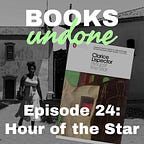
Mystery. Mysery. That emptiness with the appearance of plenty. This excerpt comes from a book asking one terrifying question: what happens if meaning only arrives at the same moment it becomes impossible? I’m talking about Hour of The Star, the last book of the acclaimed Clarice Lispector.
Let’s get this book undone.
Hello everyone, and welcome to Books Undone. I’m your host, Livia J. Elliot, and today I want to analyse the work of an author I’ve not discussed so far: Clarice Lispector, and in particular, her famous Hour of The Star. Lispector became renowned for her unconventional prose and distinctive narrative style, as well as for the profound meaning that permeates her work. In particular, Hour of the Star is often presented as a novel about poverty… and yet I believe it poses a deeper question.
If material poverty is inescapable, and if it creates—and perpetuates—an inner poverty, is it possible to create meaning under such conditions? And from there, what if the discovery of meaning in one’s life is itself a privilege?
Before we seek an answer to those questions, allow me to make some clarifications:
There are spoilers in this episode. Hour of the Star is a novella—less than 80 pages long—and so I will need to reveal much of the plot in order to present my analysis. That said, I strongly encourage you to read this book; Lispector didn’t tell a story, she submerged the reader into an experience.
What follows is an interpretation, not a verdict. You may disagree, and that strengthens the thematic richness of this book.
With that said, allow me to introduce you to:
Clarice Lispector, author of The Hour of the Star.
She was born as Chaya Pinkhasivna Lispector to a Jewish family in 1920 in Western Ukraine. However, during those years, her family suffered significantly due to the pogroms—violent riots incited with the aim of massacring or expelling a religious group—that followed the collapse of the Russian Empire. As a result, in the early months of 1922 and around the time Ukraine became one of the constituent republics of the Soviet Union, her family fled to Romania, from where they emigrated to Brazil. Upon arrival, all of the Lispectors—except the middle daughter—changed their names; this is how Chaya became Clarice Lispector.
They lived in the northeast, in Alagoas—the city that’s the home of the protagonist of Hour of the Star—and eventually moved to Recife… where the other protagonist of this book comes from. They struggled economically, but in 1932 and due to her performance, Clarice secured admission to the most prestigious secondary school in the state. Years later, they relocated to the then-capital of Brazil, Rio de Janeiro, where Clarice eventually studied in the Law School of the University of Brazil.
In 1940, she published her first short story, Triunfo (meaning, Triumph) when she was nineteen years old. Some time later, in 1943 she published her debut Near to the Wild Heart which the poet Lêdo Ivo called “the greatest novel a woman has ever written in the Portuguese language.” She won the prestigious Graça Aranha Prize and so began shaping latinamerican postmodernist literature.
Benjamin Moser, the author of Lispector’s biography and translator of her books, referred to her as “the most important Jewish writer since Kafka”1, while Los Angeles Times stated that “Lispector should be on the shelf with Kafka and Joyce.”
Something to note is that, historically, Clarice Lispector’s work has not been easy to translate; there are letters and exchanges between her and her editors discussing how she leveraged language… and the headaches that gave her translators. The Harvard Review Online mentioned that: “Many of her most beautiful sentences, at first glance apparently senseless or non sequiturs, glimmer like hidden truths upon closer inspection. […] As a result of her pushing language to its limits, Lispector’s prose often feels foreign” and that a translator, when working on her Collected Stories had managed to “translate the untranslatable”2.
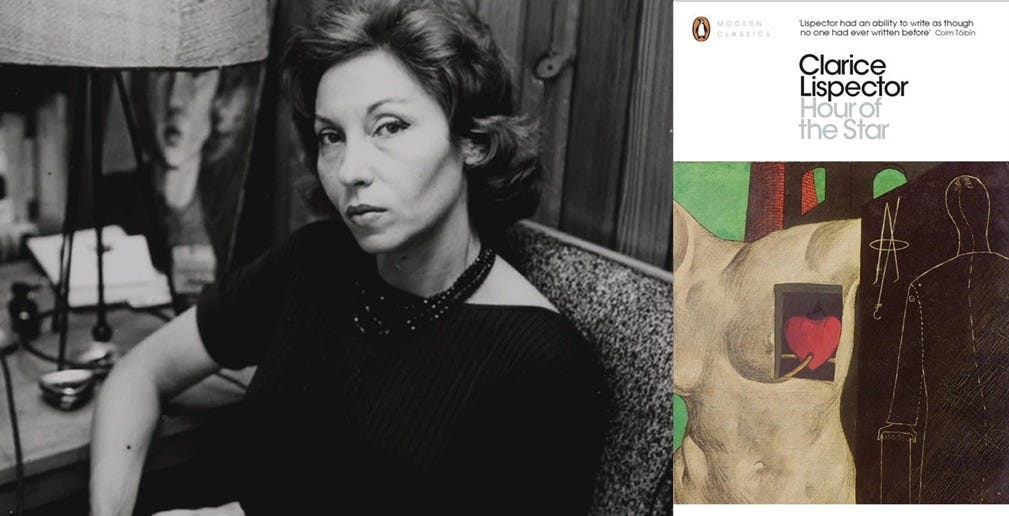
Therefore, if you haven’t read Hour of the Star, I do urge you to read it. That said, it is time to move on and introduce…
The protagonists of Hour of the Star.
You see? There is something quaint about this book: it is about a fictional writer struggling to tell—or rather, discover—a story.
This fictional writer is called Rodrigo.
He’s the one writing the in-book book—but this is not a framed narrative, where he reflects about what happened to him in the past. Instead, this ‘story within a story’ is a fictional tale… and it seems to trouble him. Most of the beginning of Hour of the Star is about Rodrigo penning his writerly struggles:
As I’ll now explain, this story will be the result of a gradual vision—for the last two and a half years I’ve been slowly discovering the whys. It’s the vision of the imminence of. Of what? Maybe I’ll figure it out later. Just as I’m writing at the very same time I’m being read.
We never know much about him. How he looks, how old he is , where he’s writing… However, we do know the theme of the story he’s about to write does not seem simple; early on, he warns us about the language he’ll use. Consider this:
I do not intend for what I’m about to write to be complex, though I’ll have to use the words that sustain you. […] An exterior and explicit story, yes, but which contains secrets. […]
It seems Rodrigo’s opinion of his writing style, but I believe there is something deeper here: a clue to something he doesn’t know—or perhaps, doesn’t want to make explicit. But I’m getting ahead of myself. Before I can tell you what that is, we have to finally (finally!) consider the moment he tell us about the protagonist of his story:
How do I know everything that’s about to come and that I myself still don’t know, since I never lived it? Because on a street in Rio de Janeiro I glimpsed in the air the feeling of perdition on the face of a northeastern girl. Not to mention that I as a boy grew up in the northeast.
The phrasing is striking. The girl is simultaneously unimportant and fundamental.
Rodrigo does not see her in the sense that her appearance, age, or any other bodily characteristic is completely transparent to him. What only matters is “the feeling of perdition” on the girl’s face; that emotion he cannot name. Rodrigo glimpses it (a fleeting visual action) “in the air” (like a smell), as though her despair had extended beyond her individual experience to saturate the senses of those around her. That saturation, that perceived perdition, is the “exterior and explicit story” Rodrigo mentioned before… but the reasons for it, are the “secrets”.
How can Rodrigo know them? He’s not overt about it, but we can read between the lines—especially in the moment he confesses to have grown up in the northeast, just as the girl.
You see? The Brazilian northeast is quite a peculiar region, always leaving a mark on those born there. Half of it is semiarid and prone to drought, yet it sustains roughly a quarter of the country’s population—about 53 million people. Since the 19th century, the Brazilian northeast has been home to the largest concentration of rural poverty in Latin America, with the World Bank estimating (in 2010) that about 39% of families there survived on just $1.48 (USD) a day3.
It is against this backdrop that Rodrigo’s next confession takes on a different weight:
I also know about things because I’m alive. Everyone alive knows, even if they don’t know they know.
If you combine this—“I’m alive”—with the “exterior and explicit story […] which contains secrets”, we can make an inference: Rodrigo is confessing that he understood the girl’s perdition because of experiential knowledge:
because he also experienced hardship and vulnerability in the indigent Brazilian northeast, and
he had the intuitive, pre-rational realisation that whatever he saw in that girl’s face captures what he’s been feeling—that “mystery” Rodrigo indicated in the quote I opened with.
In this sense, to be “alive” is to carry within oneself an awareness of an invisible suffering caused by having lived in poverty—even when one does not consciously recognise it as such. But what is that “sense of perdition”? Why does it haunt Rodrigo?
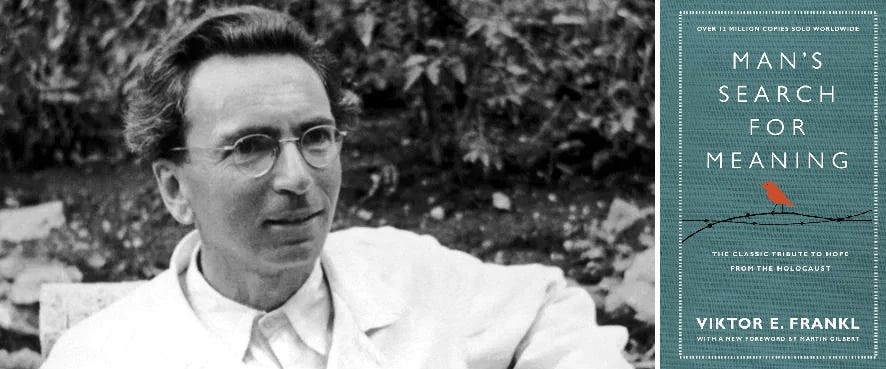
This is where the work of Viktor Frankl could help us answer that. In Man’s Search for Meaning, Frankl’s memoir of survival in Nazi concentration camps, he observed that “in some ways suffering ceases to be suffering at the moment it finds a meaning, such as the meaning of a sacrifice.”4 This became one of the principal tenets of logotherapy—an existential form of psychotherapy grounded in the premise that the primary motivational force in humans is the search for meaning.
As we know, poverty causes suffering. Physical suffering (from lack of food or medicine), and mental suffering from the anxieties of the day-to-day—for example, “what am I going to eat?” or “what happens if my child falls ill and I can’t help him?” But that inner suffering has a peculiar cruelty: it lingers. Even when a person escapes poverty, even when they manage to improve their circumstances, something remains. It is in that aftermath where we meet Rodrigo; while he’s lingering in that “mystery,” unable to make sense of his “perdition”.
Consider what he said here:
Forgive me, but I’m going to keep talking about me who am unknown to myself, and as I write I’m a bit surprised because I discover I have a destiny.
“As I discover I have a destiny” is perhaps not so far away from “as I discover I have a purpose” or “a meaning”, or even that “the material poverty I survived had a meaning”. Following this interpretation, derived from Frankl’s ideas, when Rodrigo perceived that perdition in the face of that northeastern girl, he sought to understand her life as a way of understanding himself—to find the meaning of his suffering through hers. Hold on to this hypothesis; it’ll matter later.
For now, we must turn to the girl herself.
Macabéa, the typist.
One of the first things that Rodrigo tells us about her is this:
I want to declare that this girl doesn’t know herself except from living aimlessly. If she was dumb enough to ask herself ‘who am I?’ she would fall flat on her face. Because ‘who am I?’ creates a need. And how can you satisfy that need? Those who wonder are incomplete.
Not her physical description, and neither any other outward characteristic.
Her mindset; her perception of life and existence itself—that’s what matters the most to Rodrigo about her, because he’s still hung into that “feeling of perdition” he saw in the street.
Notice this: “‘Who am I?’ creates a need”—something that Frankl would argue to be ’the need for purpose’; living while knowing we have no purpose leads to depression, anxiety, to being “incomplete” as Rodrigo aptly pointed out. But “wondering” is necessary, and the only way to define who are we as per the narrative of our lives, how we choose to interpret the events that happen to us in order to give them meaning… and from that meaning construct the self.
Here’s where the work of another existentialist philosopher comes to mind: Jean-Paul Sartre, who argued that “we are our choices” and that we are “condemned to be free; because once thrown into the world, [one] is responsible for everything [one] does. It is up to [us] to give [life] a meaning”5. To “wonder,” as this girl does not seem to do.
Yet that raises a question: can we always make meaning?
This question is just the beginning what I believe Lispector was challenging with Macabéa’s story—and, therefore, what Rodrigo thus struggles with. Early in his prelude he begins sowing the idea that Macabéa may not have that “need” to “give life a meaning” at all.
Consider what she thinks whenever she’s feeling Sunday blues:
She never complained about anything, she knew that’s just how things are and—who organised the land of men? Surely someday she’d deserve the heaven of the crooked where you only get in if you’re warped.
“That’s just how things are.”
We can certainly read that as acceptance, as the detachment that comes after understanding one has little control of the context. Yet that stance in life requires strength of mind—awareness of one’s own feelings and reactions, emotional intelligence to label them and reason them, and an understanding of the society we live in. Such acceptance would lead to what Viktor Frankl argued in Man’s Search for Meaning: “What is demanded of man is not […] to endure the meaninglessness of life, but rather to bear his incapacity to grasp its unconditional meaningfulness in rational terms”4.
But can Macabéa even do that? Does she have the means to rationalise her life?
Excellent question—but before we can answer it, we must recognise that acceptance is not the only interpretation of what she’s expressing by saying “that’s how things are”. There is another emotion that could work as well: resignation, where the awareness of what we cannot control comes with a different attitude, not from the strength of mind but from powerlessness and, yes, perdition.
But there is a third way of reading that phrase Macabéa always returns to, and it could help answer my recent questions. Consider what Rodrigo writes about her childhood:
I limit myself to telling of the lame adventures of a girl in a city that’s entirely against her. She who should have stayed in the backlands of Alagoas in a cotton dress and without any typewriter, since she wrote so badly, she only had three years of school. Because she was so ignorant she had to type slowly letter by letter—her aunt was who gave her a crash course in typing.
Three years of school make someone barely literate, and what he tells us about Macabéa’s typing process may very well imply she did so by simply pattern-matching the letters she saw handwritten by her boss. It does make sense, if we remember that the Brazilian northeast is extremely poor and undereducated, and that her aunt taught her typing as a means of protection. In Rodrigo’s words:
[The aunt] also considered it her duty to see the girl didn’t end up like all those girls in Maceió standing on street corners with lit cigarettes waiting for men. Though [Macabéa] had shown no signs of turning into a hooker.
With this context, we can return to the questions I posited before: what if Macabéa didn’t have the means—the literacy—to reason the events of her life and find meaning in them? Were that the case, “that’s how things are” is neither acceptance nor resignation… but merely a reference to the unchallengeable unknown. A belief that would jail someone within a meaningless existence, being alive without the tools to even ask why, let alone answer.
Consider what happens when Macabéa hears one song for the first time:
When she heard it she started to cry. It was the first time she’d ever cried, she didn’t know she had so much water in her eyes. She cried, blew her nose no longer knowing what she was crying about. She wasn’t crying because of the life she led: because, never having led any other, she’d accepted that with her that was just the way things were.
Surely this happened to you: minding your own business when suddenly a song catches your attention. You stop what you’re doing and listen—then the world is no longer important and all that matters is the song. The more you listen, the more it reflects whatever you’re going through, as if it explained everything better than we ever could, or as if the composer had truly known what was happening to us.
That is precisely what Macabéa experienced in that paragraph: finding herself reflected on those lyrics. Yet because she had no means to logically reason what she was feeling, her only response was instinctive: crying. Crying and saying “that was just the way things were”, because such is the only ’explanation’ she has available and the one keeping her at arms length of any dreaded ‘why.’
And this leads me to one poignant point: the core issue stemming from poverty. It doesn’t merely take away one’s access to white-collar jobs and higher salaries. Ultimately, poverty—and the illiteracy it reinforces—limits the understanding of information needed for self-care6. It lowers self-esteem, reduces autonomy, and narrows critical thinking… everything we need to develop the emotional intelligence that enables self-awareness and, with it, the ability to search for meaning.
It is of no surprise, then, that in 2020 researcher Qiyang Zhang demonstrated that higher levels of illiteracy increase anxiety levels by almost 12% compared those of the literate population7. The connection between anxiety and meaning-making is, although more philosophical, something that Viktor Frankl approached in Man’s Search for Meaning, arguing that existential anxiety is derived from the ultimate fear that life has no meaning.
Which brings us back to Lispector’s challenge: can we always make meaning?
From an existentialist perspective, that is terrifying.
Rodrigo, the fictional writer narrating Macabéa’s story, seems to intuitively arrive to this question… but he doesn’t propose an answer, so I’ll leave it open—for now. There is another situation we have to consider first: what happens the moment Macabéa finds the book that her boss, Mr Raimundo, was reading:
One day [Macabéa] saw something that for a brief moment she coveted: a book that Mr. Raimundo, who had a literary bent, had left on his desk. The title was “Humiliated and Offended”8. She grew thoughtful. Maybe for the first time she defined herself in a social class. She thought, thought and thought! She concluded that nobody had ever actually offended her, everything that happened was because that’s how things are and there was no struggle possible, struggle for what?
It seems impossible to think that someone who grew up in the poorest regions of an entire continent, who was therefore denied any possibility of progress… would not feel offended by the lack of available opportunities, by how little others think of her. And yet the excerpts we’ve considered show a different picture.
Was Lispector romanticising poverty? Hardly.
As I see it, this is another angle of what I mentioned before: the effects of illiteracy on critical thinking. It is a complex skill, and the Standford Encyclopedia of Philosophy presents it as “careful thinking directed to a goal”9. In this sense, it is central to meaning-making because it allows someone to reflect on their beliefs, evaluate reasons, and organise their lives around justified values… which are also fundamental to perceive an injustice as such.
Think of Viktor Frankl, who spent three years of his life incarcerated in multiple concentration camps during World War II and was able to survive simply because he found meaning in his suffering—which was, by far, greater than Macabéa’s. By the time Frankl was sent to the first concentration camp he was already a psychologist—graduated from the University of Vienna—and had worked in a renowned Austrian hospital; he’d also founded his own clinic and even published academic papers10. In fact, in Man’s Search for Meaning he shares that through Auschwitz he found meaning in the idea that he could complete his research after exiting the camps, and with it help others.
That is a completely different standpoint to Macabéa’s. She’s malnourished, didn’t even finish school and can barely write without typos. The novel shows us moments in which she actively cannot grasp basic concepts—including those that describe her own condition. For example, at one point she asks, plainly:
— Because there are so many things I don’t understand. What does “per capita income” mean?
She does not know the term used to describe the threshold of poverty, the one she’s clearly below. She’s not Frankl, armed with the knowledge and critical thinking necessary to withstand the Holocaust. Because of her lack, “struggle” is not something she refuses—it is something she was never given the language to conceive.
From the perspective of someone literate, this is impossible… yet as Rodrigo writes, it has a very different effect for her:
As for the girl, she lives in an impersonal limbo, without reaching the worst or the best. She just lives, inhaling and exhaling, inhaling and exhaling. Actually—why would she do anything more? Her existence is sparse. Yes.
Here surfaces one of the most unsettling details about Hour of the Star: Macabéa is denied nearly every conventional source of meaning. She has little education, little social power, little self-knowledge, and almost no ability to shape the narrative of her own life. Even her desires are borrowed from advertisements, radio programs, and clichés:
Clock Radio […] used those drops of minutes to run ads—she loved ads. […] On chilly nights, shivering beneath her thin cotton sheet, she liked to read by candlelight the ads she cut out of old newspapers lying around the office. Because she collected ads. She pasted them into an album.
Yet as we have seen, Lispector’s treatment of Macabéa’s life meaning and her perception of it is… complicated.
Macabéa doesn’t experience her life as a tragedy in the way an educated, self-aware person might; on the contrary, she is often strangely content, or at least unreflective. Here is where one absurdity emerges—not from her consciousness, but from the gap between her existence and the stories society tells about what a meaningful life should be.
That absurd is an existential idea.
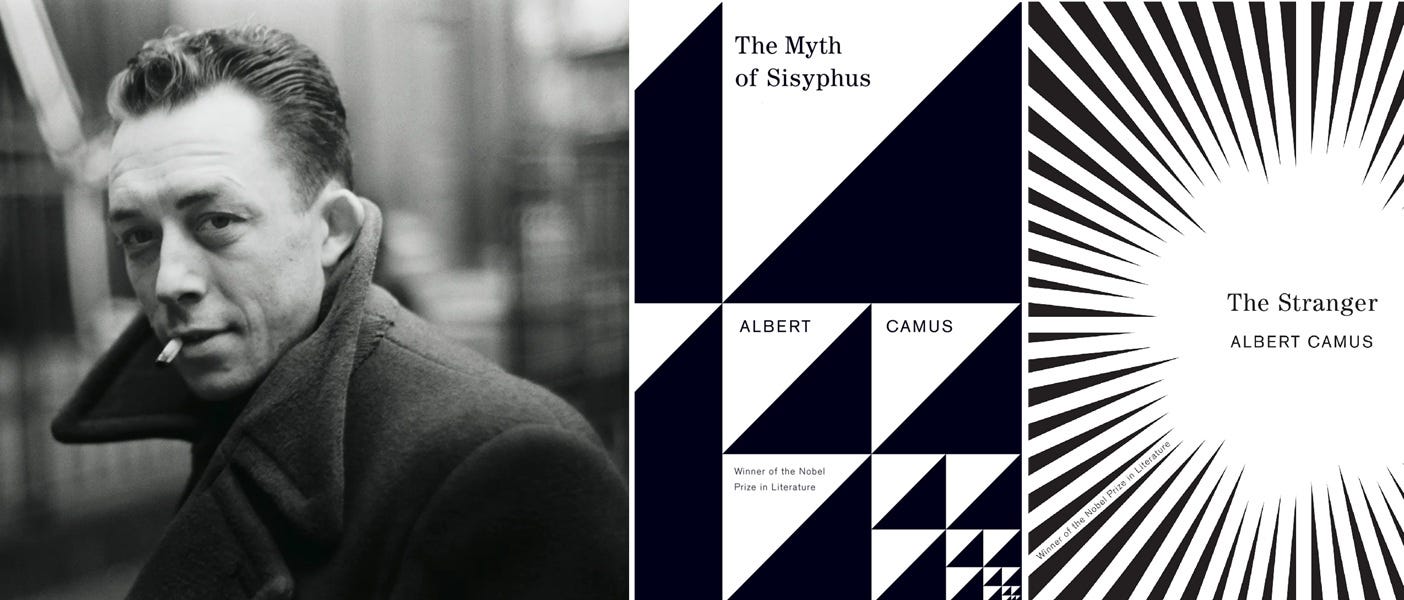
And precisely what philosopher Albert Camus argued: “the absurd is born of this confrontation between the human need and the unreasonable silence of the world”11—because the world, or existence itself, will not provide us with meaning. This is something we craft, even when doing so is unlikely to change anything beyond ourselves. Camus also suggested that “judging whether life is or is not worth living amounts to answering the fundamental question of philosophy.”
Is existence worth it? That’s the question at the core of Camus’ philosophy.
…and yet in Rodrigo’s words, Macabéa “just lives, inhaling and exhaling, inhaling and exhaling.” She doesn’t know she can ask whether her existence is worth it. As she said in one of the previous excerpts:
She wasn’t crying because of the life she led: because, never having led any other, she’d accepted that with her that was just the way things were.
“This is how life is,” Macabéa keeps saying, unbothered by the silence of the world, by the people who do not see her. Remember, “nobody had ever actually offended her”, not even when her boyfriend called her an “idiot”, or when he dumped her to instead date someone else; even less when she was fired due to the many typos in her copies. “That’s just how things are” she keeps saying throughout the book, having no means to reflect about why this is the case.
It seems absurd—in Camus’ terms—but that absurdity is only visible to us and to Rodrigo, the fictional writer who desperately tries to make sense of her life and keeps failing. He grows frustrated with his own fictional character, with this woman who despite everything she lacks, seems to live without regrets… and so he writes a twist: Macabéa’s coworker suggests she visits a fortune-teller, and lends her money to pay the service fees.
The fortune-teller, of course, does what her kind does:
—But, little Macabéa dear, what a horrible life! May my friend Jesus take pity on you, my child! How awful!
Macabéa blanched: it had never occurred to her that her life was that bad.
Madame got everything right about Macabéa’s past, even saying that she’d hardly known her father and mother and was raised by a relative like a wicked stepmother. Macabéa was shocked by the revelation: up till now she’d always thought that what her aunt had done was educate her to make her a nicer girl. Madame added: [...]
—Macabéa! I’ve got great news! Listen carefully, my flower, because what I’m about to tell you is very important [...]: your life is going to change completely! And even more: it will change the minute you step out of this house! You’ll feel completely different.
Of course, the fortune-teller, Madame Carlotta, proceeds to shower Macabéa with omens of good fortune: telling her she’ll get a better job, fall in love, marry a rich man… even that her sparse hair would grow up again. What matters here is not whether the fortune-teller is lying, but her motives—and to unravel those, we first need to see how her words affect Macabéa. As Rodrigo writes:
Macabéa [...] didn’t know what she was thinking, it felt like someone had given her a good knock on her head with its sparse hairs, she felt as disoriented as if an unhappiness had befallen her. [...]
Madame Carlota had gotten everything right, Macabéa was stunned. Only then did she see that her life was miserable. She felt like crying when she saw her other side, she who, as I said, had always thought she was happy.
“She who had always thought she was happy.” But was she happy?
Remember that Rodrigo had told us Macabéa “live[d] in an impersonal limbo, without reaching the worst or the best.” That would mean she was neither happy nor unhappy, just… neutral. While there is a chance she truly felt this way, we must consider a grimmer possibility: that in her ignorance, Macabéa had interpreted her detachment and apathy… as happiness.
How could she have known what happiness truly felt like if she had never learnt how it should feel? If she had no way of comparing an ‘unhappy’ moment to a ‘happy’ one? After all, we learn to name our emotions when we are young, because someone—a parent, a caretaker—puts words to what we are feeling. Macabéa never had that.
But her unawareness of ‘happiness’ is not her only lack. If you recall, Rodrigo wrote that: “Only then [after visiting the fortune-teller] did she see that her life was miserable.” This circles back to something we established earlier: ‘struggle’ was something Macabéa was never given the language to conceive—and so, even if she struggled, she had no means to know she was struggling.
Which leads, yet again, to Lispector’s challenge: can we always make meaning?
The answer, in a sense, is disarmingly simple: that person needs someone to help them. Yet that help, contrary to what we may think, does not come from someone else giving the afflicted a meaning—that is not how meaning works; it must be discovered from within. The only way to help someone like Macabéa is to do exactly what the fortune-teller did: give her the language she was missing, so that new words might open what was previously unthinkable: the meaning of her life.
But the world is absurd, remember?
And so, after Macabéa departed the fortune-teller’s house, just after she’d been taught the most important lesson of her life… Rodrigo writes her end:
Then as she stepped off the pavement to cross the street, Destiny whispered swift and greedy: now, quick, it’s my turn!
And enormous as an ocean liner the Mercedes hit her---and at that very moment in some single corner of the world a horse as if in reply reared in a peal of neighing. Macabéa as she fell still had time to see, before the car fled, that Madame Carlota’s prophecies were already coming true, since it was a very luxurious car. [...]
She lay helpless on the side of the street, perhaps taking a break from all these emotions, and saw among the stones lining the gutter the wisps of grass green as the most tender human hope. Today, she thought, today is the first day of my life: I was born.[...]
Then Macabéa said a phrase that none of the passersby understood. She said clearly and distinctly:
—As for the future.
[...] And then—then the sudden rattling of a seagull, all at once the voracious eagle lifting to the high airs the tender lamb, the sleek cat mangling some dirty rat, life eats life.
Macabéa’s death is cruelly absurd: the fortune-teller taught her the basics of emotional intelligence and gave her the tools needed to find meaning… but the story just erased her because Rodrigo tired of her. In his own words:
Is this a melodrama? What I know is that melodrama was the summit of her life, all lives are an art and hers inclined toward the great uncontrollable weeping like rain and lightning.
It is not a melodrama; it is the absurd.
And it links back to Albert Camus, and how he died in real life. Allow me to tell you the story.
In January 1960, Albert Camus had spent a holiday in Provence, France, along with Michel Gallimard, his friend and publisher’s nephew. Camus’ wife and both his children had travelled to Paris by train, and so he also had a return ticket in his pocket—but Gallimard persuaded him to ditch the train and make the journey by car instead. Camus agreed and took the passenger seat. Somewhere along the ride, Gallimard lost control of the car—and it was later proven he was not drunk and neither speeding; the road was straight, the pavement was not icy (not even wet). And yet the car veered into a tree, killing Camus almost instantly and fatally wounding Gallimard12.
Was Lispector directly referencing Camus’ death? I guess we will never know, though the resonance is striking.
Many readers have seen a grim irony in Albert Camus’ death: a philosopher of absurd contingency meeting an absurdly contingent end. Beyond the car crash, Macabéa’s death operates along the same lines: the possibility of discovering meaning arrived at the exact moment meaning itself became impossible.
Everything here unveils the tragedy of a life without the means of discovering meaning… but underneath it lies a harsher truth.
Meaning itself is a privilege.
As we have discussed in this episode, the freedom to ‘craft a life’ requires education, economic security, language, self-awareness, and social recognition—things poverty deprives a person of. Therefore, in its depiction of the consequences of material poverty, Hour of the Star poses a terrifying question: is existential freedom truly universal, o are some people excluded from it merely because of material conditions?
In that sense, Macabéa’s story pushes past the limits of existential philosophy.
Albert Camus asked: how do we live in a meaningless universe? And Viktor Frankl gave us an answer: “Ultimately, man should not ask what the meaning of his life is, but rather must recognise that it is he who is asked.” But through this novel, Clarice Lispector challenged them both with a single counter-question: what if someone is never even granted the tools to ask that question?
That’s part of what makes Macabéa such a devastating character. She was not merely confronting the absurd; she was almost invisible within it.
Before we wrap up, allow me to say that existentialism and meaning-making is quite a recurrent topic in Books Undone—and I’ve discussed it before in other episodes, through other books. For example:
Through Annihilation, by Jeff VanderMeer, I discussed the impossibility of making meaning in an environment—in this case, Area X—that makes all meaning irrelevant.
When approaching Walking on Glass by Iain Banks, I discussed the consequences of making someone else the meaning of our lives… and what happens when that person leaves us.
And using The Escher Man by T.R. Napper, I discussed existentialism at the intersection of memory and identity.
That said, I do hope you have enjoyed this episode, and remember that you can find the entire transcript—as well as all citations and links—in BooksUndone.com. Once there, you can subscribe to weekly writing craft deep-dives, thematic discussions, and book reviews.
Thanks for listening, and happy reading.
Copyright © 2026 Livia J. Elliot. All rights reserved. This publication is licensed for personal reading only. No article, or substantial part of an article, may be reproduced, republished, adapted, translated, compiled into another publication, incorporated into teaching materials or course packs, or used for AI training. Linking to the original articles is encouraged.
“The most important Jewish writer since Kafka” by Ian Thomson, for Spectator Australia: https://www.spectator.com.au/2014/01/why-this-world-by-benjamin-moser-review/
Gabriel García Ochoa’s review of The Complete Stories by Clarice Lispector and translated by Katrina Dodson. Available in Harvard Review Online: https://www.harvardreview.org/book-review/the-complete-stories/
“Moving out of Poverty in Northeast Brazil” from the IBRD Results published in March 2010. Read here. Do take in mind that Lispector published this book in 1977; this document does cover some statistics regarding the World Bank’s aid during the ’70s, including a mention to the Recife office they opened in 1974—another city mentioned in this novella.
“Man’s Search for Meaning” is Viktor Frankl’s memoir, published in English in 1959. It is divided into two parts, with the first one recounting his experience in a concentration camps during World War II, and the second one covering logotherapy—a meaning-centred psychotherapy developed by Frankl himself.
I have repeatedly quoted Jean-Paul Sartre in this podcast, and I’ve also leveraged his idea of “existence precedes essence” in my own books. The quote I was using here comes from his book “Existentialism and Human Emotions.”
In 2010, the UNESCO completed a pilot study on the social impact of illiteracy: “The Social and economic impact of illiteracy: analytical model and pilot study” conducted by Rodrigo Martínez and Andrés Fernández. Available here: https://unesdoc.unesco.org/ark:/48223/pf0000190571
The data comes from “The cost of illiteracy: A causal inference study on how illiteracy affects physical and mental health” by Qiyang Zhang, published in Health Education Journal (volume 80, issue 1) in 2020. Here: https://doi.org/10.1177/001789692094989
The translation by Moser uses “Humiliated and Offended”, which seems a transliteration of “Humilhados e Ofendidos”—the Portuguese title of “Humiliated and Insulted,” the 1861 novel by Fyodor Dostoevsky. I do hazard a guess that, because Macabéa had lingered in the word ‘offended’, which does not have the exact same meaning of ‘insulted’, Moser decided to change Dostoevsky’s title in order to preserve Lispector’s word-play. In other words: translating is not mere ‘swap of words.’
From “Critical Thinking” by the Stanford Encyclopedia of Philosophy, revised in 2022. Stanford Encyclopedia of Philosophy
In Man’s Search for Meaning, Frankl talks extensively about the time he worked on the Steinhof Psychiatric Hospital before the Nazi annexation of Austria, as well as his research on Freud’s psychoanalysis. His first scientific paper was published in 1928, when he was only 18 years old. You can read more about him here: https://viktorfranklamerica.com/viktor-frankl-bio/
From “The Myth of Sisyphus” by Albert Camus.
There is even something more tragically absurd about Albert Camus’ death: upon returning to Paris, he’d planned to meet again with the love of his life, actress Maria Casares. The pair had been exchanging love letters for years, even though Camus was married. The book later published by Penguin—Letters by Albert Camus and Maria Casares—contains the translations of those exchanges… and ends with the last one he sent, hours before accepting Gallimard’s ride.


