

How to "Show Don't Tell" in Fiction
An indexed guide to the craft decisions that produce showing rather than telling. Specific techniques and real examples organised by how they interact.

There is no piece of writing advice more frequently repeated than "show, don't tell."
If you've ever searched for an explanation of it, you have probably encountered endless articles mentioning the advice itself, yet with surprisingly little discussion of how it actually works.
The phrase is often presented as “a narrative technique”1—the singular doing rather a lot of work there—when in reality… it is not a technique at all. “Show, don’t tell” is an outcome: the cumulative effect of dozens of different choices made by the writer throughout a story.
Those choices operate across several interacting elements:
the world on the page—be it a real-world setting or a secondary one.
the characters’ identity.
the choice of language, and
the narrative style.
How do those four elements interact? Well:
World-building—the history, culture, social and political structures of a setting—bear down on characters because people do not exist in isolation from the contexts that formed them. World-building—its culture, beliefs, and languages—affects your choice of language. However, all three elements affect the narrative style because (a) characters affect narration in limited or first-person approaches, while (b) omniscient narrators take that influence directly from the world itself.
It's a messier chain-of-effects than most writing guides admit. Hence the diagram:
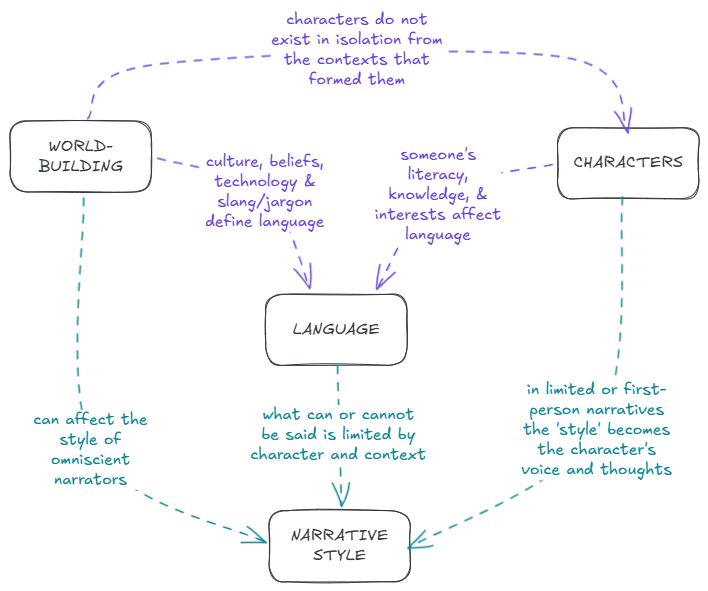
It’s because of the complex relationship between those four elements that explaining “show, don’t tell” is not an easy task.
An Index of “Show, Don’t Tell” Techniques per Interacting Elements
Therefore, below you’ll find an index of articles organised around the interactions of these four elements. Each article works through extremely detailed examples: line-by-line analyses of prose excerpts drawn from a wide range of published fiction, across decades and subgenres. Before presenting each, I will share a brief summary so that you know exactly what you’ll find.
Do keep in mind that this is a living document, and articles will be added as new pieces are published.
World-building & Language
Natural languages are organic: they are developed by a society and evolve alongside it in order to enable communication. The changes in the former, thus, drive the latter to create new words or alter the meaning of existing ones. For example, the word ‘telephone’ did not exist until it wasn’t needed; the Oxford Dictionary claims its first recorded use is of 18322… yet its subsequent shortening to ‘phone’ indicates commonality and familiarity.
A writer can appeal to neology—namely, made-up worlds—to “show, not tell”, though doing so can be a double-edged blade that adds complexity to the text. The following essay covers this topic and dissects some interesting examples (including how they are ‘taught’ to the reader):

In a similar vein, character’s names carry social hierarchies, tradition, genealogy, and more—and, as you can guess, their shape, sound, and length can be used to show (or rather, hint at) the setting’s history. The following essay includes a detailed process as applied by a writer:

World-building, Character, & Language
Anachronisms appear when a character uses a word that: (a) is too modern for the society they live in, (b) carries a strong connotation at odds with the character’s world and knowledge, or (c) is derived from a someone’s name—a ‘someone’ who may not have existed in the setting of the book.
Therefore, using the right words at every moment becomes paramount to show the influence of society in language, and of those in the character.
The below essay shows the above problematic by analysing a very specific excerpt: a character watching a ‘painting’ of a scene they do not have the right words to describe… though—by applying common sense—the reader should be able to infer what the character is seeing:

Character & Language
We are biased; all of us. Our age gives us a bias, literacy level, the career path we chose, the beliefs we hold and those that we left behind. Those biases can affect how a character communicates—which, in turn, can be used to show the character’s identity without explicitly describing it.
For example, a younger narrator—imagine: a toddler—will use simpler words, may even lack emotional language to truly understand what’s happening… but they’ll perceive events nonetheless, and it is in the dissonance between what the toddler-narrator says and what the adult-reader can infer that we can “show, not tell.” The below essay analyses a scene and provides guidelines:

Someone’s career path influences how they see the world. For example, while an architect may focus on the details of a room before paying attention to its occupants, a seamstress may only see the clothing but not the people wearing it. Granted, these are extreme examples, but the concept stands.
Thus, the essay below demonstrates—in limited narrators—how the description of a specific hallway can change depending on who’s crossing it: a military official, or a political strategist. They focus on different details, and interpret them according to their profession, thus showing their personality and interests.

Character & World-building
We all have opinions about the world we live in—and in limited or first-person narrators, that ‘inner monologue’ can be used to show details about the world. These details are, however, biased: limited to what the character thinks (which may not be entirely truthful) or knows (which may be incomplete or even wrong)… and so also—and indirectly—show the character’s beliefs.
First example: an analysis of a veteran’s inner monologue about the effects of war. You’ll notice that he makes highly biased statements that—regardless of how the reader may feel about them—communicate the state of the world:

What world-building details can be communicated through a character’s thoughts depend on the character’s understanding of the world. The veteran of the essay above has a very different view than a strategist.
That’s the case of the below example: where the inner monologue of a political strategist is used to show the geopolitical relationships of different nations across an entire fictional world.

Characters, Language & Narrative Style
Regarding more constant effects…
In first-person narratives—including framed narratives—the prose itself becomes a reflection of the character. Therefore, by altering the cadence, sentence structure, and choice of words, a writer can show the character's literacy and personality.
For example, we all avoid grammar and spelling mistakes… but an almost illiterate character who can barely hold a pen will should not be able to produce a neat and orderly prose. This is an extreme case, but the essay below analyses how this technique was used—to “show, don’t tell” a character’s intellectual development—in Flowers for Algernon:

Similar to the above, though most novels do not appeal to text formatting—except for italics for emphasis—it can indeed show a fundamental detail of the narrating character.
The below essay analyses a book in which strike-through text (like this) was used to show the thoughts that an emotionally abused person did not allowed herself to have. In particular, this narrating character did not have the means to understand her own refusal, and so the narrative (in first-person present-tense) could not explain it (tell it) to the reader:

Regarding temporal mental states…
In limited third-person and first-person narrators—often not in framed narratives—a temporal mental state will alter the shape of the prose. Think of anxiety, extreme fear (and the fight-flight response it induces), intoxication (alcohol, drugs), sexual drive (well, yes), depression, a traumatic flashback, exhaustion and sleep-deprivation, thirst and starvation…
Think of your own experience with, for example, deep exhaustion; you probably weren’t able to articulate your thoughts clearly, likely stammering over your words or making somewhat incoherent sentences. In such a case, your narrating character will not be able to narrate properly… and thus, you can show this temporal impediment through the shape of the prose.
For example, if they are overwhelmed or in a fight-flight response, punctuation—and the lack of thereof—can become an incredibly powerful tool to control reading speed and, therefore, transfer the character’s perception to the reader. This is the topic of the below essay:

Now think of the opposite case: extreme analytical focus in a high-stakes, life-or-death situation. The character should not be able to reason and instead merely experience what’s happening. This can translate into clipped prose stripped of articles, connectors, and contextually ‘unnecessary’ words:

Want to practice this? The below essay demonstrates uses a graphic novel’s panel as the base, and provides three examples of prose: purely telling, mixed, and purely showing:

Contrary to what most advice says, long sentences are not necessarily “bad”—especially if they are used to show a narrator’s mental state. The below essay covers three examples (distorted perception of time and ‘thinking out loud’ for limited narrators, and tonal influence for omniscient):
[ LINK ]
World-building & Narrative Style
Using an omniscient narrator does not necessarily imply a plain, factual voice. A deliberate choice of adjectives can keep the narrative far away from any character, while making a commentary on the world itself.
Thus, the below essay analyses Jorge Luis Borges used adjectives commonly applied to living things to inanimate objects to: (a) show how strange the setting was, and (b) generate a range of emotions on the reader, including dread:

If you are interested in some trivia, the Oxford English Dictionary provides some interesting sources: https://www.oed.com/dictionary/telephone_n?tl=true